
Outer Plane • The Twin Paradises
The Twin Paradises of Bytopia — Plane of Honest Work and Shared Reward
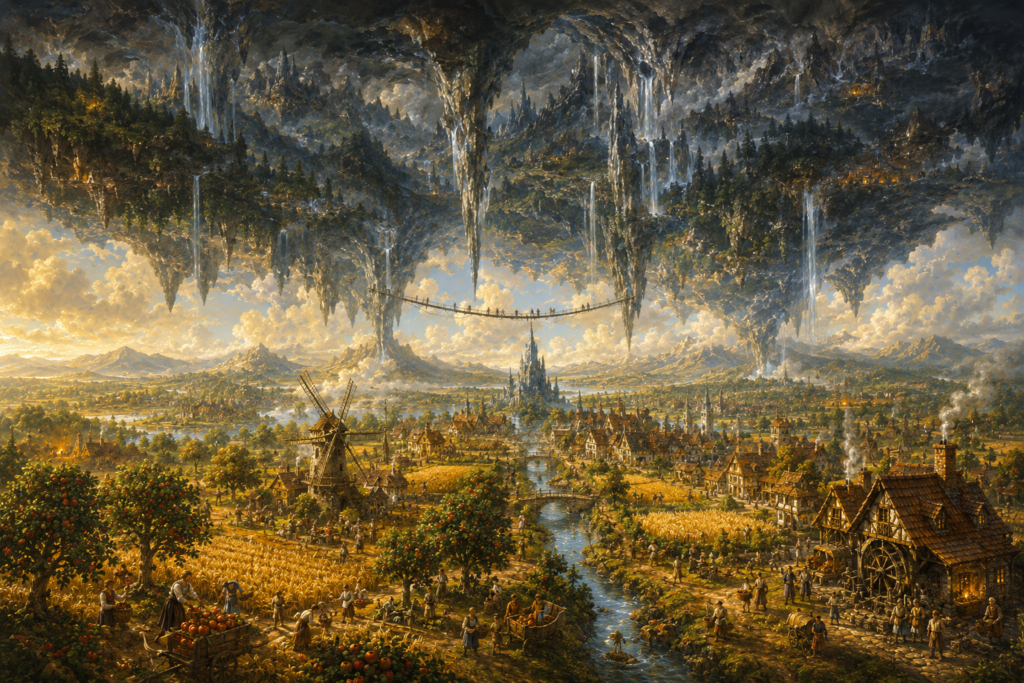
Two immense worlds face one another across a shining sky. On one, fields, workshops, sacred groves and villages flourish through cooperation; on the other, mountains, storms, high roads and wilderness turn effort into courage. Bytopia teaches that paradise is neither possessed nor consumed. It is maintained together.
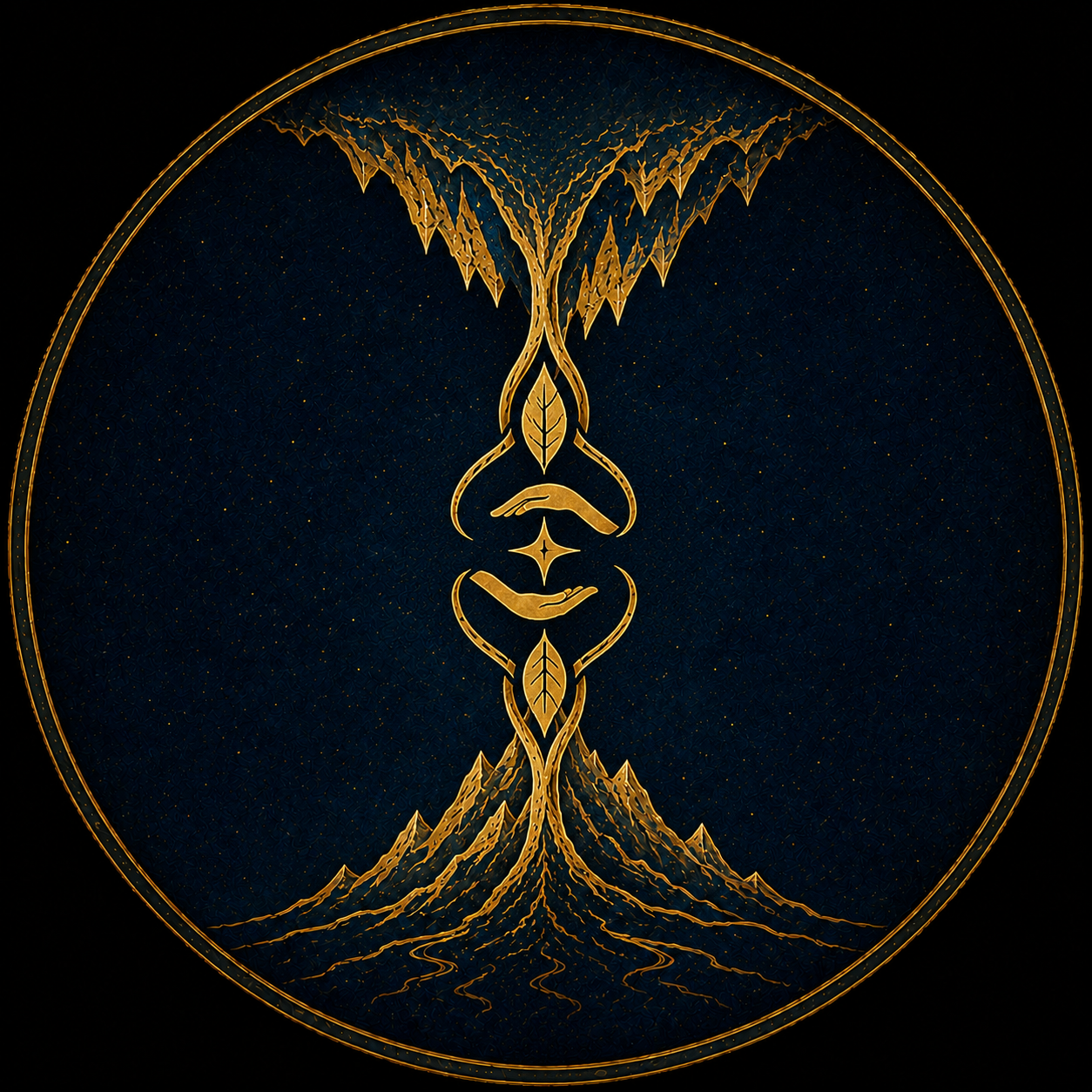
Opposed mountain forms represent the facing worlds, while the open hands, leaves and central light signify reciprocity, useful labour and shared reward.
Overview
Bytopia is the paradise of work well done.
It is not a palace of idle reward, nor a shining court where goodness merely admires itself. It is a living country of farms, mills, mines, workshops, orchards, hearths, bridges, mountain roads, shared meals, repaired roofs, fair markets and difficult journeys undertaken for worthwhile reasons.
The plane consists of two infinite layers facing each other across open sky. From the fields of Dothion, a traveller can look upward and see Shurrock: forests, high waterfalls, glaciers, ravines and storm-lit mountains hanging overhead. From Shurrock, the traveller can look upward and see Dothion’s orchards, canals, fields, forge smoke, villages and hearth-lights.
Bytopia rewards effort, but not greed. It honours self-reliance, but not isolation. It praises skill, but not pride. Someone who works only for themselves finds the plane beautiful, comfortable and strangely closed. Someone who helps mend a bridge, tend a sick neighbour, protect a caravan, repair a mill, rescue a climber or gather a harvest before a storm finds doors opening everywhere.
The central question of Bytopia: What are you willing to do for another person when nobody can force you?
Cosmological Role
Bytopia occupies a philosophical middle ground between the merciful peace of Elysium and the disciplined justice of the Celestial Realms.
Elysium says that goodness can heal. The Celestial Realms ask whether responsibility can become just order. Bytopia asks who will carry the timber, teach the apprentice, repair the mill, cook the meal and finish the road.
The plane draws souls associated with honest craft, loyal companionship, fair exchange, practical generosity, neighbourly duty and useful courage. Many never made grand declarations of virtue while alive. They simply turned up when something needed doing.
Bytopia is therefore a cosmological rejection of exploitation. Evil takes without giving. Bytopia gives freely, but expects the recipient to become part of the network through which help continues to flow.
The Two Facing Layers
Dothion — The Held Garden
Dothion is Bytopia cultivated. Green valleys, orchards, lakes, watermills, market towns, canals, workshops, gardens, mines and small farms cover its immeasurable landscape.
Its communities are prosperous without needing to become imperial metropolises. Towns cluster around workshops, market squares, common barns, kitchens, public hearths, gardens, libraries and halls.
Authority is expected to be useful. Leaders organise harvests, maintain roads, settle disputes, protect apprentices and answer for their mistakes. Rank earns little respect unless accompanied by competence and service.
Leisure is plentiful but seldom passive. Music, brewing, storytelling, carving, weaving, gardening, dancing, games and teaching are valued because creation and companionship are themselves part of Dothion’s idea of rest.
Its danger is complacency. Dothion is safe because its inhabitants keep it safe. Every wall was repaired by someone. Every feast required hands to harvest, carry, cook and clean.
Shurrock — The Wild Workshop
Shurrock is paradise before comfort: an infinite wilderness of mountains, cold rivers, old forests, exposed plateaux, glaciers, caves, high lakes, violent storms and difficult roads.
It is not corrupt or fallen. Shurrock exists to make effort matter. Here settlements find ore, timber, difficult knowledge and rare resources, while travellers encounter challenges that cannot be overcome merely through wealth or social standing.
Its danger is pride. Suffering does not become virtuous merely because it hurts. A climber who risks death only to boast learns little. One making the same ascent to deliver medicine to an isolated community understands Shurrock.
The Between-Sky
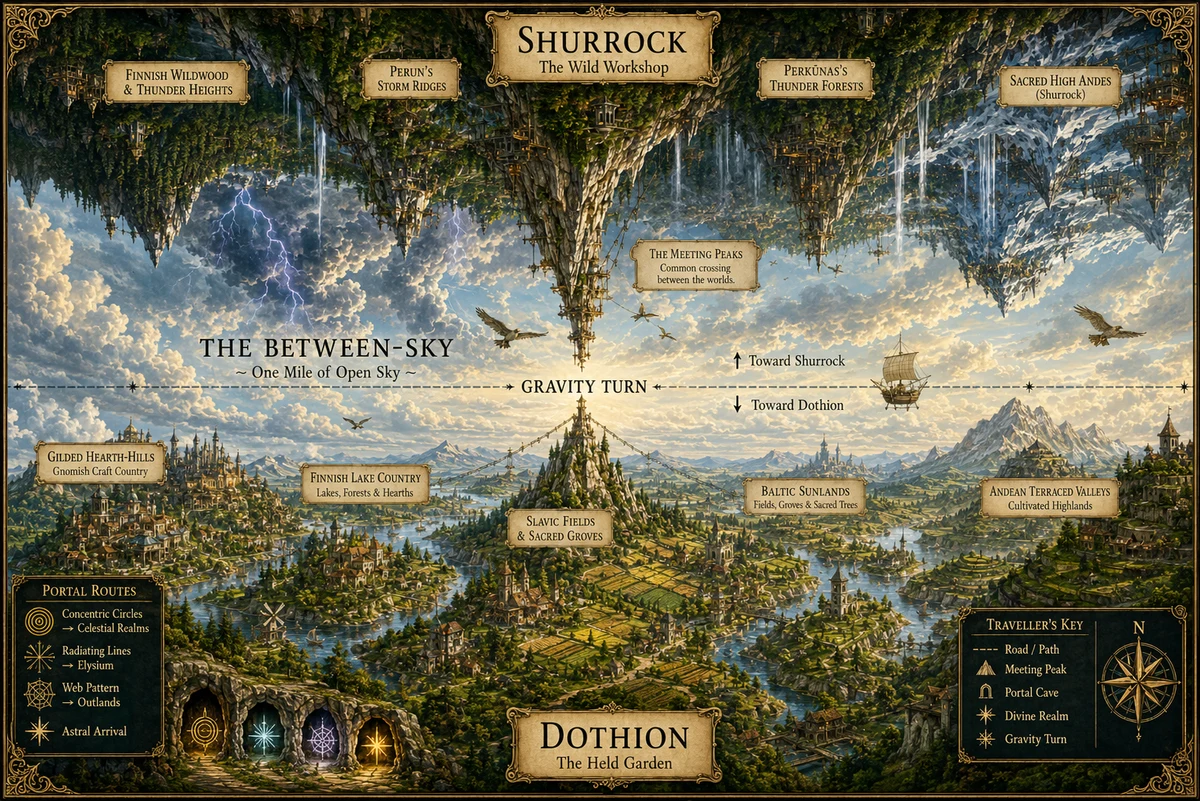
Dothion and Shurrock ordinarily face each other across roughly one mile of open sky. Local geography, divine realms and mountain ranges can reduce, complicate or distort that separation.
Each layer possesses its own down. Somewhere between them gravity changes allegiance. A traveller leaving Dothion eventually begins falling toward Shurrock, and one leaving Shurrock eventually falls toward Dothion.
Native travellers cross by ropeway, bridge, flying creature, wind-barge, levitation, climbing rig or mountain route. Children learn the gravity-turn early. Workers secure loads on both sides of it. Experienced guides recognise the transition almost without thinking.
The Meeting Peaks
At the Meeting Peaks, mountains from both layers rise so high that their summits touch, interlock or nearly meet. These are Bytopia’s best-known overland crossings.
Ropes, chains, ladders, old stairways, shrines and repair platforms mark many routes. Some communities use the crossing as a rite of passage, but the traveller is usually given a useful task rather than being challenged to suffer for its own sake.
Climbers approach the gravity-line by bracing themselves, changing grips and turning their bodies so the mountain above becomes the mountain beneath their feet. Experienced companions secure one another before the transition. A careless traveller can fall away from one paradise and toward the other.
The Gilded Hearth-Hills
Across portions of Dothion rise the Gilded Hearth-Hills, an old centre of Bytopia’s gnomish craft, mining, invention and hearth traditions.
Burrow-homes, forge villages, jewel workshops, orchards, breweries, waterwheels, small mines, communal halls, copper roofs and painted doors cluster among warm green hills.
The Hearth-Hills are not a divine theme park or one enormous palace. They are lived country: inventive, argumentative, generous, practical and deeply proud of good work. Gnomish powers and their servants maintain sacred estates here, but they are one tradition among several that call Bytopia home.
Gods and Sacred Realms
Bytopia is one of the great shared divine landscapes of SpiralWorlds. Its resident traditions do not merge into one universal pantheon. Each preserves its own gods, myths, sacred geography, relationships and divine jurisdictions while sharing the wider plane.
Divine realms can meet along roads, watersheds, mountain chains, forests, markets and pilgrimage routes without losing their separate identities. A god may transform a sovereign estate, but no resident pantheon owns Bytopia itself.
Finnish and Finnic Sacred Country
Substantial Finnish and Finnic territories spread through both layers. Dothion contains cultivated lake districts, fishing settlements, fields, forest-edge farms and sacred household country. Shurrock contains deeper forest, hunting country, storm heights and wilderness associated with sky and woodland powers.
The principal resident powers include:
Ahti Akka Äkräs Mielikki Nyyrikki Peko Tapio Ukko Ved-ava Vellamo
Explore the Finnish Pantheon →
Fields, Waters and Hearths
Akka and Äkräs fit naturally among fertile country, orchards and working farms. Peko’s associations with grain, beer and cultivation appear in brewing districts, harvest settlements and communal feast traditions.
Forest and Storm
Ukko’s thunder heights overlook broad reaches of Shurrock, while Tapio, Mielikki and Nyyrikki are associated with immense forests, hunting country and the difficult boundary between settlement and wild land.
Lake and Water Country
Ahti, Ved-ava and Vellamo are encountered around great lakes, water roads, fishing communities and waters so broad that their far shores lie beyond sight. Their territories may touch Dothion’s settlements and Shurrock’s wilder waters alike.
The darker Finnish powers of death, suffering and Tuonela are not treated as ordinary residents of this prosperous Bytopian country. Finnish underworld traditions remain distinct from the lake, forest, field and storm realms described here.
Slavic Sacred Country
Slavic divine territory crosses the division between settlement and wilderness rather than occupying one simple block of Dothion.
Dothion — Field, Hearth and Forge
Mokosh, Svarog and Jarilo are strongly represented in cultivated valleys, village country, fertile fields, weaving households, forges and seasonal agricultural landscapes.
Shurrock — Thunder and Wild Heights
Perun is associated with storm ridges, great oaks, thunder valleys and high places where the weather itself becomes a trial.
Deep Roads and Boundaries
Veles has strong associations with cattle, wealth, magic, water, roots and the world beneath. His Bytopian territories occupy deep valleys, cavern roads, springs and old boundary country rather than requiring a separate plane.
Slavic spirits are common around households, farms, waters and forest margins. A Domovoi may protect a Dothion household for generations, while the broader Slavic Bestiary supplies creatures for sacred and dangerous borderlands.
Baltic Sacred Country
Baltic divine geography likewise extends through cultivation, forest, storm and chthonic depth.
Dothion — Sun, Earth and Fate
Dievas, Laima, Saulė and Žemyna are associated with sunlit fields, households, fertile earth, harvest, fate and communities whose prosperity depends upon a maintained relationship between people and land.
Shurrock — Thunder and Forest
Perkūnas is strongly associated with thunder country, high forests, sacred trees and storm roads. Baltic wilderness estates are therefore an important part of Shurrock rather than an afterthought.
The Chthonic Country
Velnias or Velns belongs to a deeper and more ambiguous sacred geography of caves, roots, underground roads and the dead. These regions lie within Bytopia’s larger structure rather than forming an additional Outer Plane.
Andean and Inca Sacred Country
The Andean and Inca divine world is one of the major reasons neither Dothion nor Shurrock should be treated as culturally uniform. Its cosmological relationships become an especially strong expression of Bytopia’s vertical geography.
Dothion — Cultivated Sacred Valleys
Inti, Mama Killa, Manco Cápac and the cultivated aspects of Pachamama are associated with terraced valleys, irrigation works, roads, estates, agricultural communities and sunlit highland settlements.
Shurrock — The Sacred High Andes
Shurrock contains immense snow peaks, high lakes, glaciers, suspension bridges, sacred caves, mountain roads and territories associated with Viracocha, Pachamama’s wilder manifestations and the sacred powers of the high mountains.
Ukhu Pacha — The World Within
The deeper caves and under-earth regions contain the most chthonic Andean territories, including domains associated with Supay. Their presence gives Bytopia moral and political complexity without making Ukhu Pacha a separate plane.
Hanan Pacha, Kay Pacha and Ukhu Pacha are represented within SpiralWorlds as sacred regions, relationships and levels of the Andean divine world inside Bytopia. They do not become three additional planes.
Divine Sovereignty
A resident god can shape a sovereign divine estate, receive petitioners, maintain servants and establish its own customs. That authority does not automatically extend across Dothion or Shurrock.
Two divine territories can appear to occupy neighbouring valleys while remaining metaphysically distinct. Their borders may be expressed through bridges, shrines, watersheds, customary roads, treaties, shared festivals, old feuds or gates that open only to invited travellers.
The result is not one blended mythology but a plane of neighbouring sacred worlds whose peoples continually negotiate roads, water, hospitality, pilgrimage, trade and responsibility.
Laws of the Plane
Work Must Mean Something
Bytopia does not worship toil. Labour has value when it creates, protects, teaches, repairs, heals, feeds or fulfils an honest responsibility.
Cleaning an infected house, carrying water, repairing a cartwheel, teaching a child, guarding a caravan or fighting a fiend can all matter. Pointless labour imposed merely to exhaust or humiliate another creature has no virtue.
Rest Is Part of Good Work
Bytopia does not celebrate exhaustion for its own sake. Good work includes knowing when to eat, sleep, celebrate and allow somebody else to take a turn. The feast following the harvest belongs to the same moral cycle as the harvest itself.
Wealth can purchase food, accommodation, transport and tools, but it cannot purchase the plane’s deeper welcome. Someone who continually consumes other people’s effort without contributing may be served politely without ever becoming part of the community.
Self-Reliance and Mutual Aid Are One Virtue
Bytopia rejects dependency deliberately created by exploitation, but it also rejects pride that refuses legitimate assistance. Competence matters because it allows somebody to carry their own weight and sometimes somebody else’s.
Wilderness Is Not Evil
Shurrock’s cold, storms, predators, cliffs and distances are not evidence of corruption. The moral question is why somebody faces those dangers, what they take from the wilderness and what responsibilities follow.
Exploitation Leaves an Echo
Unpaid labour, stolen tools, false weights, unsafe workplaces, predatory debt, broken apprenticeships and theft of another person’s work disturb the plane.
The first response is usually an opportunity for restitution rather than supernatural vengeance. Fires smoke. Animals grow wary. Doors become inconvenient. Trust cools. Good guides become unavailable. Bytopia wants the debt repaired.
The Opposite Sky Is a Reminder
In clear weather another inhabited world hangs overhead. Bytopian cultures often treat this as a reminder that no village, guild, family, divine realm or traveller exists entirely alone.
Inhabitants
Bytopia is inhabited by petitioners, divine servants, celestial beings, intelligent animals, household spirits, forest guardians, craftspeople, farmers, miners, healers, guides, wardens and communities connected with its resident divine traditions.
The World Bestiary supplies encounter statistics for established creatures. Regional starting points include the Finnish Bestiary and the Slavic Bestiary.
Dothion
- Farmers, shepherds and orchard keepers
- Smiths, builders, millers and craftspeople
- Teachers, healers and apprentice communities
- Household spirits and ancestral guardians
- Forest-edge beings and intelligent animals
- Divine servants of Finnish, Slavic, Baltic and Andean/Inca powers
Shurrock
- Mountain guides and bridge keepers
- Highland farmers and road communities
- Hunters, scouts and wilderness wardens
- Storm and mountain spirits
- Forest guardians and great beasts
- Servants of thunder, woodland and high-mountain powers
Hearth-Hills & Settlements
- Gnomish petitioners and craft communities
- Domovoi and other household guardians where culturally appropriate
- Miners, brewers and jewel workers
- Inventors, makers and illusion-working artisans
- Craft spirits and guardians of useful secrets
Forest Wardens
Great intelligent trees and woodland guardians may hold recognised territory in forest regions. An Elder Treant can act as an ancient boundary keeper, witness to a divine treaty or protector of a woodland road rather than merely as a combat encounter.
Bytopia should not become a generic celestial menagerie. Most intelligent inhabitants have work, relationships, kinship ties, territory, apprentices, debts or chosen responsibilities. Even a supernatural guardian should normally be guarding something for a reason.
Personhood and Law
Petitioners, intelligent beasts, celestial beings, settled communities and divine servants are recognised as persons. Long-rooted trees, household spirits and other enduring intelligences may possess equivalent customary rights.
Surrender matters. Once an enemy has ceased to present an immediate danger, restitution, restraint and judgement become more important than revenge. Fiends and violent marauders can certainly be fought, but killing a helpless prisoner is not excused merely because that prisoner started the conflict.
Property exists, but responsibility accompanies ownership. Emergency use of an unattended tool may be accepted when life or community is in danger, provided the object is returned, repaired or replaced. Theft for enrichment and deliberate destruction remain offences.
A master who steals an apprentice’s work or an owner who knowingly sends workers into an unsafe mine may be judged more harshly than a hungry thief who steals food and later makes honest restitution.
Travel and Arrival
The Astral Plane provides the most universal approach to Bytopia. Portals can also appear as cellar doors, wells, caves, orchard gates, mountain shrines, market arches and roads that continue farther than mortal geography should permit.
Most safe arrivals open onto Dothion. Gates into Shurrock more often emerge in high valleys, caves, remote passes and wilderness sanctuaries, sometimes several difficult days from the nearest settlement.
Old Portal Signs
Experienced planar travellers recognise several traditional patterns carved around old cave gates:
- Concentric circles are associated with routes toward the Celestial Realms.
- Radiating lines are associated with routes toward Elysium.
- Web-like patterns are traditionally associated with routes toward the Outlands.
These signs are customs rather than universal laws. Any particular portal may still require a key, season, action, offering or condition.
Crossing Dothion
Dothion is physically comfortable but socially connected. Travellers may be asked to carry letters, share news, help move a cart, guard a bridge, assist with a harvest or contribute to work caused by their own arrival.
Crossing Shurrock
Shurrock travel should feel like an expedition. Weather, navigation, climbing, animals, damaged roads, river crossings and supply decisions matter. The important question is often not whether the party can reach its destination, but whether everyone arrives together and what obligations were created along the way.
Planar Effects
The Warmth of Useful Hands
Sincere service makes Bytopia increasingly welcoming. Food seems richer, tools better balanced, sleep easier and local people more willing to trust.
The Weight of Taking
Deliberate exploitation creates the opposite effect. Local help becomes harder to obtain, animals become wary and comfortable shortcuts develop inconvenient complications.
Gravity’s Turn
Near the middle of the Between-Sky the direction of gravity changes. Prepared travellers rotate, brace or fly across. The unprepared may suddenly discover that the world above has become the ground below.
Hospitality’s Second Half
Bytopia welcomes guests. Its deeper custom is that receiving help makes a traveller part of the network through which help can later be passed onward.
Game Statistics
The baseline traits below preserve Bytopia’s established planar identity. The additional Bytopian Resonance rules express the SpiralWorlds campaign treatment of honest labour, restitution and purposeful travel.
Bytopia — D&D 5.5e
Baseline Planar Traits
Bytopian Resonance
Bytopia responds subtly to cooperation, restitution, fair exchange and freely chosen service. The following rules are additional SpiralWorlds planar effects.
Crossing the Gravity-Line
A creature crossing the gravity transition while climbing, walking a narrow structure or otherwise relying on a surface must make a DC 15 Dexterity saving throw if it is unaware of the transition or unable to prepare.
On a failure, the creature loses its orientation and begins falling toward the opposite layer unless secured.
A creature that knows the transition’s location and has time to brace does not make the save. A creature already freely flying or levitating likewise makes no save merely for crossing it.
Honest Labour
After completing a meaningful act of craft, repair, protection, healing, rescue, teaching, guidance, fair judgement or other useful service that genuinely costs time, effort, risk or resources, a creature can gain Heroic Inspiration.
A creature can gain Heroic Inspiration from this effect only once per Long Rest. Token gestures, coerced labour and acts performed chiefly to exploit the rule grant no benefit.
Bytopian Rest
After a Long Rest following meaningful service, restitution or a successful Shurrock expedition, choose one:
- Remove one level of Exhaustion.
- Gain Temporary Hit Points equal to your Proficiency Bonus + your Wisdom modifier, minimum 1.
- Gain Advantage on one ability check made before your next Long Rest using an appropriate skill or tool proficiency to fulfil a fair obligation or aid another creature.
Debt-Marked
A creature that knowingly exploits hospitality, steals another person’s work, abuses workers, falsifies a fair bargain or refuses reasonable restitution must make a DC 15 Charisma saving throw.
On a failure, the creature becomes Debt-Marked until it makes meaningful restitution.
While Debt-Marked, the creature has Disadvantage on Charisma checks against Bytopian inhabitants, cannot gain Bytopian Rest, and has Disadvantage on checks made to secure voluntary local aid, trustworthy guides or exceptional hospitality.
Shurrock Expedition
For a significant wilderness journey that does not require encounter-by-encounter movement, the party must gain 5 successes before 3 failures.
| Journey | Typical DC |
|---|---|
| Guided or exceptionally well prepared | 13 |
| Typical meaningful route | 15 |
| Storm, winter pass, damaged bridge or severe terrain | 18 |
Useful checks include Strength (Athletics), Wisdom (Survival), Intelligence (Nature), Wisdom (Perception), Wisdom (Animal Handling), Wisdom (Medicine), Wisdom (Insight), or an ability check using an appropriate tool proficiency.
Success should create an advantage such as a safe camp, useful ally, shortcut, warning, repaired equipment, medicinal plant or good omen. Failure advances the journey but introduces a meaningful complication.
Fair Bargain
When an important agreement is freely made in Bytopia, both parties may state their obligations clearly. A creature that keeps its part can gain Advantage on one relevant ability check directly connected to fulfilling that work. Knowingly breaking the agreement can trigger Debt-Marked.
Bytopia — Pathfinder 1e
Baseline Planar Traits
- Time: Normal.
- Size: Infinite.
- Gravity: Objective directional gravity; Dothion and Shurrock pull in opposite directions.
- Morphic: Divinely morphic.
- Alignment: Mildly good-aligned.
- Magic: Normal.
Mildly Good-Aligned
Evil-aligned creatures take a –2 circumstance penalty on Charisma-based checks while in Bytopia.
Gravity-Line Crossing
A creature encountering the gravity transition unexpectedly while climbing or relying on a surface must succeed at a DC 20 Reflex save or lose its orientation and fall toward the opposite layer.
A creature that knows exactly where the change occurs and can brace does not need to save. Flying and levitating creatures do not save merely because they cross the transition.
Additional SpiralWorlds Rule — Honest Labour Boon
Once per day, after at least 1 hour of sincere useful service, a creature can gain a +2 morale bonus on one saving throw, skill check, attack roll or caster level check made within the next 24 hours while fulfilling a fair obligation.
Additional SpiralWorlds Rule — Bytopian Rest
After 8 hours of rest following meaningful service, restitution or a successful Shurrock expedition, choose one:
- Remove the fatigued condition.
- If exhausted, improve the condition to fatigued.
- Gain a +2 morale bonus on one appropriate Craft, Diplomacy, Handle Animal, Heal, Knowledge, Profession, Sense Motive or Survival check made within the next 24 hours while fulfilling a fair obligation.
Additional SpiralWorlds Rule — Debt-Marked
A creature committing deliberate exploitation must succeed at a DC 15 Will save or become Debt-Marked until meaningful restitution is made.
While marked, it takes a –2 circumstance penalty on Diplomacy, Handle Animal, Sense Motive, Survival and Profession checks made to obtain voluntary cooperation in Bytopia and cannot receive the Honest Labour Boon or Bytopian Rest.
Shurrock Expedition
Earn 5 successes before 3 failures. Appropriate Pathfinder skills include:
Climb, Craft, Handle Animal, Heal, Knowledge (nature), Knowledge (planes), Perception, Profession and Survival.
- Guided route: DC 12
- Typical route: DC 15
- Severe terrain or weather: DC 20
Fair Bargain
A creature that clearly states and fulfils its part of a significant agreement gains a +2 circumstance bonus on one directly relevant check. Knowingly violating the agreement can trigger Debt-Marked.
Bytopia — D&D 3.5e
Baseline Planar Traits
- Time: Normal.
- Size: Infinite.
- Gravity: Objective directional gravity; each layer pulls toward its own ground.
- Morphic: Divinely morphic.
- Alignment: Mildly good-aligned.
- Magic: Normal.
Mildly Good-Aligned
Evil creatures take a –2 penalty on Charisma-based checks while in Bytopia.
Gravity-Line Crossing
A creature encountering the transition unexpectedly while climbing must make a DC 20 Reflex save or lose its hold and fall toward the opposite layer.
A creature that knows precisely where the gravity change occurs and can prepare does not need to make the save. Flying and levitating creatures are normally unaffected by the crossing itself.
Additional SpiralWorlds Rule — Honest Labour Boon
Once per day, after at least 1 hour of sincere useful service, a creature can gain a +2 morale bonus on one saving throw, skill check, attack roll or caster level check made within the next 24 hours while fulfilling a fair obligation.
Additional SpiralWorlds Rule — Bytopian Rest
After resting for 8 hours following meaningful service, restitution or a successful Shurrock expedition, choose one:
- Remove fatigue.
- Reduce exhaustion to fatigue.
- Gain a +2 morale bonus on one appropriate Craft, Diplomacy, Handle Animal, Heal, Knowledge, Profession, Sense Motive, Spot or Survival check made within the next 24 hours to fulfil a fair obligation.
Additional SpiralWorlds Rule — Debt-Marked
A creature committing deliberate exploitation must succeed at a DC 15 Will save or become Debt-Marked until it makes meaningful restitution.
While marked, it takes a –2 circumstance penalty on appropriate Charisma-based and cooperation-oriented checks against Bytopian inhabitants and cannot receive the Honest Labour Boon or Bytopian Rest.
Shurrock Expedition
Earn 5 successes before 3 failures. Appropriate D&D 3.5e skills include:
Climb, Craft, Handle Animal, Heal, Knowledge (nature), Knowledge (the planes), Listen, Profession, Spot, Survival and Use Rope.
- Guided route: DC 12
- Typical route: DC 15
- Severe terrain or weather: DC 20
Fair Bargain
A creature that fulfils its clearly stated part of an important bargain gains a +2 circumstance bonus on one relevant check connected with that work. Deliberate breach can trigger Debt-Marked.
Running Bytopia
Bytopia works best when its goodness is practical rather than sanctimonious. Its inhabitants can be stubborn, competitive, argumentative, eccentric, proud of local customs and wrong about particular disputes. What distinguishes them is the expectation that eventually somebody must do something useful.
Do not run Dothion as an unlimited free inn. Do not run Shurrock as a punishment wilderness. Both layers reward participation.
Good Bytopia Scenes
- A feast where every guest contributes something meaningful.
- A bridge repair during worsening weather.
- A dispute over stolen craft or unpaid work.
- A guide refusing to carry a client’s unnecessary luxuries.
- A village helping the party and later requesting help for an unpopular neighbour.
- A mountain road maintained jointly by rival divine communities.
- An apprentice whose master has claimed an invention as their own.
- A sacred boundary whose upkeep matters to two different pantheons.
Questions for Adventurers
- Will the fighter stand watch when nobody can compel them?
- Will the rogue expose false weights when there is nothing to steal?
- Will the spellcaster teach dangerous knowledge responsibly?
- Will the healer aid somebody who cannot pay?
- Will the noble carry timber beside everybody else?
- Will the ranger guide strangers through a storm?
- Will the bard preserve the name of the person who actually did the work?
What to Avoid
- Do not make Bytopia smug or preachy.
- Do not make every inhabitant morally flawless.
- Do not turn Shurrock into a monster-filled punishment zone.
- Do not reduce the plane to the Gilded Hearth-Hills.
- Do not make labour joyless or industrial by default.
- Do not reward meaningless hardship merely because it is difficult.
- Do not merge Finnish, Slavic, Baltic and Andean/Inca traditions into one invented mythology simply because their divine realms share a plane.
Adventure Hooks
The Bridge That Refuses the Guilty
An ancient bridge at a Meeting Peak has begun twisting away from anyone who tries to cross it. Merchants blame storms, engineers blame damaged anchors, and several divine communities accuse one another of sabotage.
The bridge is reacting to an unpaid communal debt concealed by one of the towns that depends upon it. The party must discover what happened, prevent the dispute becoming violent and determine what genuine restitution requires.
The Thunder Orchard of the High Roads
Above an Andean sacred road in Shurrock grows an orchard that bears fruit only during violent mountain storms. Its crop can save a Dothion settlement from a wasting illness, but the previous expedition disappeared beyond a broken suspension bridge.
The route’s mountain guardians believe generations of lowland visitors have taken from the heights without maintaining the road. The party can reach the fruit only by repairing the neglected crossing and demonstrating that need brought them there rather than entitlement.
The Golden Tool
A legendary implement has vanished from the Gilded Hearth-Hills. In willing hands it can complete extraordinary communal work with impossible speed. Used coercively, it drains skill from craftspeople and turns workers into obedient extensions of the wielder’s will.
The thief does not seek wealth. They intend to build a perfect city in which nobody is ever permitted to refuse useful labour. Recovering the tool is only the beginning; the party must decide whether a device whose greatest virtue depends upon consent can safely remain in existence.
The Road of Four Gods
An old road crosses Finnish forest, Slavic farmland, Baltic thunder country and an Andean high valley without ever leaving Bytopia. For centuries its maintenance has been divided by treaty.
Now each section is intact except the boundary stones between them, and travellers are vanishing precisely where jurisdiction changes. The culprit is exploiting the assumption that somebody else is responsible. The party must solve the disappearances while preventing a practical maintenance dispute from becoming a divine diplomatic crisis.
Historic and Mythic Context
Bytopia turns several old images of desirable life into planar geography: the fruitful garden, well-kept household, prosperous field, honest workshop, difficult sacred journey and mountain whose dangers give an undertaking meaning.
The English word paradise ultimately belongs to an Old Iranian word-family associated with enclosed or protected gardens. That historical image is particularly useful for Dothion, where abundance is cultivated and maintained rather than simply appearing without care.
The Finnish/Finnic, Slavic, Baltic and Andean/Inca divine territories are part of the SpiralWorlds cosmological synthesis. Their historical and mythic traditions remain separate. Placing their divine realms within one Outer Plane describes where those powers reside in the campaign cosmology; it does not claim that the cultures that honoured them believed themselves to share a single pantheon.
Hanan Pacha, Kay Pacha, Ukhu Pacha and comparable named mythic regions remain culturally meaningful parts of their own traditions while functioning as regions inside an established SpiralWorlds plane rather than adding new planes for every historical cosmology.
In play, Bytopia is therefore not a passive reward awaiting the virtuous. It is a functioning paradise. Roads still require maintenance. Apprentices still need teaching. Storms still need crossing. Tools need repairing. Disputes need settling. Crops need gathering. Neighbours sometimes need help at extremely inconvenient moments.
Video Lore: Exploring Bytopia
These guides provide complementary introductions to the traditional plane and its unusual twin-world structure. They provide RPG background rather than overriding SpiralWorlds canon.
Exploring Bytopia
What They Don’t Tell You About the Twin Paradises of Bytopia
Keep this reference growing
If this page helped with your reading or game, you can support its upkeep or explore the curated books.
Explore the Bookshop — epics, classics and stories behind imagined worlds.