
At a Glance
| Tradition | Indigenous and Romano-Celtic/Germanic cults of the Low Countries and Lower Rhine |
|---|---|
| Heartlands | Zeeland, the Rhine–Meuse–Scheldt delta, Brabant, the Frisian coast, Tongeren and the Lower Rhine; the Ardennes form a connected southern borderland |
| Most visible powers | Nehalennia and Magusanus |
| Other attested names | Baduhenna, Hludana, Sandraudiga, Vagdavercustis, Viradecdis, Haeva, Arcanua, the Matronae and Arduinna |
| Sacred places | Harbour shrines, riverbanks, temple precincts, woodland sanctuaries and family hearths |
| Neighbouring traditions | Roman, Continental Celtic and Germanic gods |
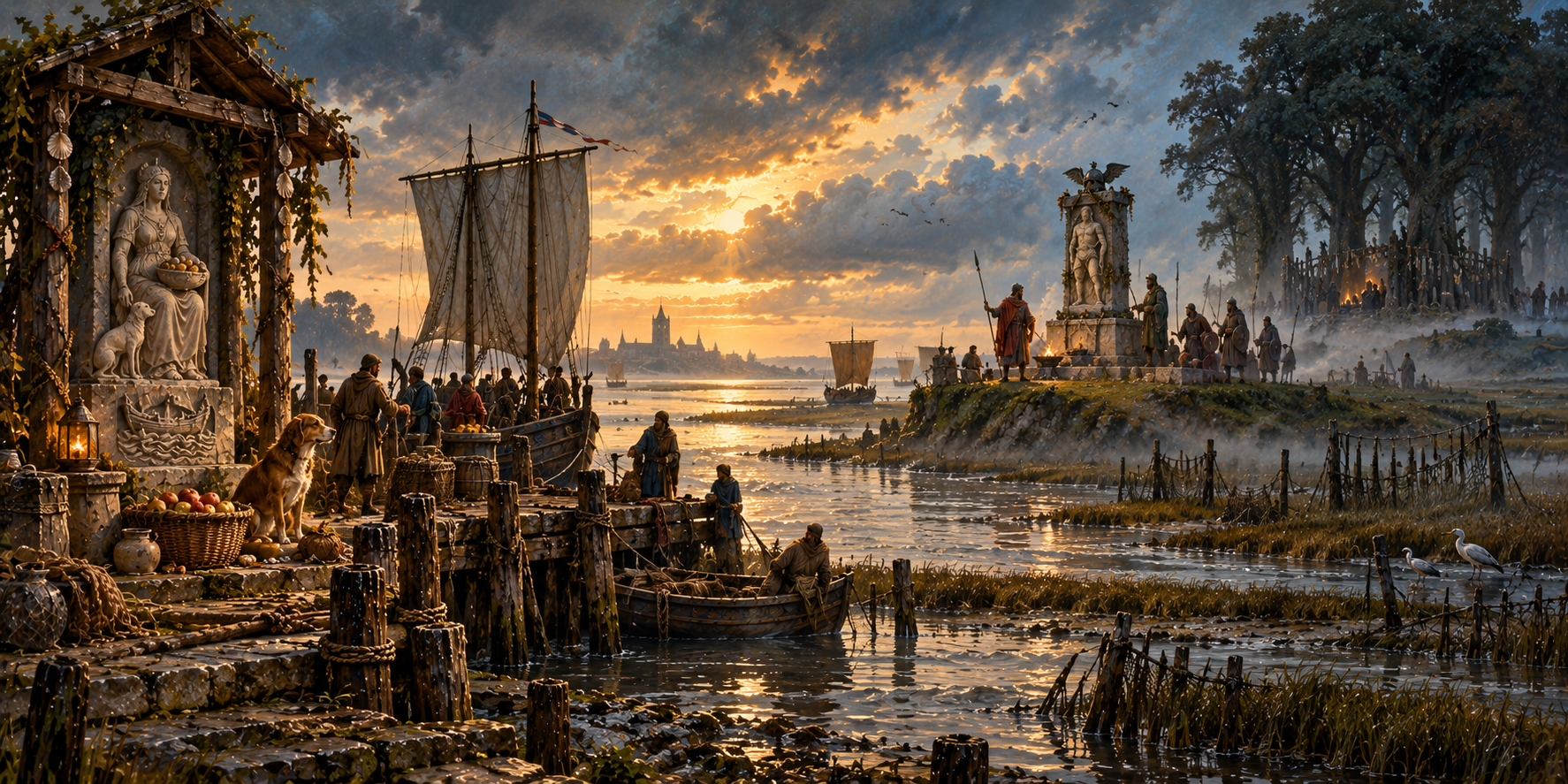
The gods of the Low Countries belong to the tides, islands, river crossings, battlefields and deep woods. Sailors call upon Nehalennia before facing the North Sea. Warriors remember Magusanus. Farther inland, the names of Baduhenna, Vagdavercustis and other old powers survive beside streams, altars and sacred groves. Their shrines belong to distinct peoples and sacred places, joined by trading routes rather than a single divine court.
Neighbouring Continental Germanic traditions: The Matronae share sacred landscapes with neighbouring Germanic peoples, but local groups retain their separate names. Nehalennia, Baduhenna, Hludana and Magusanus keep their own entries in this pantheon. The Frisian Fosite cult is historically compared with Forseti, although the identification remains disputed.
Where the Old Gods Are Found
Along the Zeeland coast, a sailor promises fruit, bread and a silver coin to Nehalennia, then watches the wind change at the mouth of the Scheldt. In Brabant, a mercenary leaves an old spearhead beside a weathered stone for Magusanus. Inland, children are warned away from a grove where a woman’s name has outlived the people who built her shrine.
Worship is local. A household need not recognise every god named here, and two villages on the same river may keep different customs. Roman soldiers, merchants and travellers brought additional gods and joined local names to foreign ones. Some powers are known through numerous altars; others survive through a single inscription. A damaged stone may preserve a divine name long after its prayers have vanished; each harbour and inland village remembers different rites.
The Powers of the Delta and Lower Rhine
Nehalennia — Guardian of the Crossing
Heartland: Zeeland, particularly the old sea routes around Domburg and the Oosterschelde. Known concerns: safe seafaring, commerce, home and abundance. Signs: a dog, fruit and the equipment of a ship.
She is the most clearly visible goddess of the coastal cults. A ship can carry armed men and rich cargo, yet a single storm can sink both; sailors who return safely know whose protection they sought. Images show her with a dog and baskets of produce, while altars commemorate successful voyages and saved goods. Her worshippers are not simply priests: they are merchants, crews, households and people waiting for a ship to come home.
Magusanus — Champion of the Batavians
Heartland: Batavian territory around the river delta and the Lower Rhine. Known concerns: strength, military courage and warrior devotion. Roman identification: Hercules.
Magusanus receives the offerings of warriors and returning soldiers. Temple sites at Empel and Elst attest to the strength of his local cult. His altars are natural places to confront a veteran, swear a challenge or discover what a warrior surrendered after a battle. At his shrines a Batavian warrior and a Roman legionary can honour the same god, though neither approaches him in quite the same way.
Baduhenna — The Goddess of the Frisian Wood
Heartland: the northern coastal region associated with the Frisians. Known evidence: Tacitus names a grove of Baduhenna in his account of fighting between Frisians and Romans.
Her name belongs to a woodland remembered for bloodshed. The character of the goddess beyond that association is unknown. Those who enter the grove hear stories of old bloodshed. Beneath its trees, the sound of marching feet sometimes rises even when no soldier is in sight.
Hludana — The Name Beside the Water
Heartland: the northern Netherlands and Lower Rhine. Known evidence: inscribed dedications, including worshippers associated with fishing rights or fisheries.
Her precise powers are not preserved. Fishing crews and river travellers still recognise her name on stones by the water, even when they disagree about the gifts she receives.
Sandraudiga — The Goddess of Brabant
Heartland: the Breda–Rijsbergen region of Brabant. Known evidence: a local inscribed altar naming the goddess and her worshippers.
Sandraudiga is a distinctly local power whose name survives without a reliable complete myth. Her stone stands in the country lanes of Brabant, where villagers bring offerings even though few can explain why their grandparents chose that place.
Vagdavercustis — The Lower Rhine Goddess
Heartland: the Lower Rhine, including the sanctuary area at Kalkar. Known evidence: votive dedications and a sanctuary associated with regional and military worship.
Her cult was substantial enough to attract offerings, yet her name does not provide an unquestionable list of divine powers. Travellers encounter her in a frontier country shared by towns, forts and old sacred sites, where different communities have their own explanations of what she protects.
Other Named Powers and Local Cults
Viradecdis (Viradecthis)
A goddess associated with the Tungrian people around Tongeren. She is known through dedications, including those made by people far from home. Her surviving record is excellent material for a soldier or traveller keeping faith with the gods of their birthplace.
Haeva
An indigenous goddess named with Magusanus in a dedication. The two names share a dedication, and travellers make offerings to both at the old crossroads.
Arcanua
A goddess of the southern Netherlands attested through inscriptions, one on a bronze cockerel. The bird is an intriguing possible attribute, but its meaning is not certain. A cast bronze cockerel stands among her votive gifts, its bright eyes turned toward the sunrise.
The Matronae — Mothers of Communities and Kin
The Mother Goddesses are a family of related local cults rather than one named individual. Offerings to groups such as the Aufaniae testify to the importance of household, community and ancestral protection. Their identities and epithets vary from place to place; they should not all be collapsed into one universal mother.
Arduinna — The Ardennes Borderlands
A regional goddess whose name is associated with the wooded Ardennes and who belongs at the southern edge of this collection, with a cross-reference to the Celtic tradition. Her exact imagery is less secure than many retellings imply: the famous boar-riding figurine is not inscribed with her name.
Adventures Among the Old Shrines
The Third Voyage from Zeeland
A salt merchant in Zeeland has lost two ships on the same crossing. The survivor of the second wreck insists that a stone image of Nehalennia was taken from a ruined shore shrine before either vessel sailed. A third ship is due to leave with food for a hungry town. The party can search the tidal ruin, investigate whether a human saboteur is using the goddess as cover, or persuade the merchant to delay until the missing shrine stone is found. The food reaches its destination only if the characters choose a workable course before the tide turns.
The Weapons Beneath Empel
After floods uncover an old weapon deposit, a troop of paid soldiers begins taking spears and shield fittings from a place sacred to Magusanus. That night the soldiers’ commander loses the use of his sword arm, while a local smith recognises the insignia of a long-dead war band. The characters must decide what to return, what to examine and whether a rival company should be allowed to purchase the recovered arms. The answer determines whether the shrine becomes a place of reconciliation or another battlefield.
The Wood That Remembers
A carpenter near the Frisian coast returns from an ancient grove speaking Latin he has never learned. Inside the wood lies the broken equipment of soldiers dead for centuries; outside it, a frightened village wants the trees felled. The party can protect the grove, uncover the reason the dead are disturbed, or find a way to make the wood safe without destroying it. Baduhenna need not appear in person for her sacred place to change everyone who enters.
Gods Who Cross These Borders
Epona appears through wider Celtic and Roman-world horse cults; Mercury, Neptune, Jupiter and Hercules arrive with Roman religious practice and trade. Wodan and Donar belong to broader Germanic traditions. These gods have their own identities and should be cross-referenced, not duplicated as unrelated local inventions. The Witte Wieven are feared in their misty fields and burial mounds, but villagers speak of them differently from the named gods of the stone altars.
Explore the Gods & Pantheons directory, the Roman Pantheon, Zeeland, and the County of Holland.
Historical Sources
The carved names and sanctuaries above survive in ancient inscriptions, excavated objects and classical accounts. The adventures, living shrines and encounters describe these gods in the campaign world, beyond the details preserved on Roman-period stone.
Keep this reference growing
If this page helped with your reading or game, you can support its upkeep or explore the curated books.
Explore the Bookshop — epics, classics and stories behind imagined worlds.