
Van Diemen’s Land — Tasmania, Peoples and Wild Country
On the west coast, wind batters the dunes above long-used coastal gathering places. Inland, dark rainforest grows in the shelter of steep mountains. To the east, the sea turns turquoise around granite headlands and shellfish grounds. The island south of Terra Australis is neither an empty wilderness nor a mainland province: it is home to peoples who know the seasons, coastlines and high country.
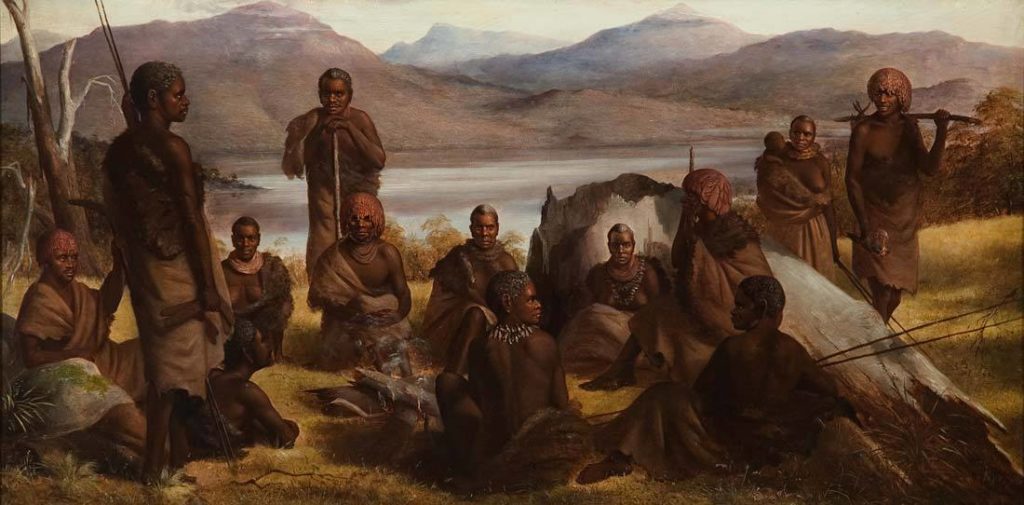
The old site called this place Van Diemen’s Land, a name given in the later European colonial period. In the earlier campaign starting world it is the island now known as Tasmania, with Tasmanian Aboriginal or palawa communities maintaining distinct countries, relationships and knowledge. Its later colonial chapter remains part of the setting’s broader timeline, but nineteenth-century governors and penal towns do not rule over an earlier island.
At a Glance
| Land | Large island south of the Australian mainland, separated by Bass Strait, with offshore islands, mountain plateaus, rainforests, grasslands and coasts |
|---|---|
| Inhabitants | Multiple Tasmanian Aboriginal communities with distinct lands and histories; later colonial settlers appear only in later-era campaigns |
| Travel | Established coastal and inland routes, river crossings and sea passages; wind and changing conditions govern access |
| Supplies | Food, water, waterproof shelter, coastal boats and expert knowledge of season, country and crossings |
| Wildlife | Thylacines, wallabies, wombats, seabirds, marine life and other animals suited to different island habitats |
| Campaign pressure | Dangerous coastal weather, river floods, fragile routes, predators and visitors who mistake cultivated cultural landscapes for empty country |
What Is Happening Right Now?
The coast after the storm
Huge surf has broken through the dunes and stranded a small boat at the edge of a fishing place. A visiting party can carry the vessel inland, find sound timber for a repair, or help the fishers move supplies before the next tide. One route across the beach passes a well-used shell midden whose history matters to local people. The choice is how to do the work without damaging the place, not whether to pillage a supposed ancient ruin.
The stripes beyond the grass
Travellers camp at the edge of woodland where a thylacine has been seen near a nesting ground. It is a living animal in the earlier campaign period, not a supernatural ghost or a modern extinction mystery. A frightened visitor wants to kill it; a more experienced hunter knows that a quiet change of route is safer for the camp and animal alike. If the party chooses to approach, their actions can either stop or start a needless fight.
The mountain pass closes
Cold rain turns a steep western foot track into a torrent. A traveller with an injured leg cannot descend before night, and carrying them through the water risks losing everyone. Local knowledge of a sheltered route and a suitable temporary camp matters more than brute force. The party can seek help, construct a crossing or wait out the flood, knowing the delay may affect people expecting the traveller on the coast.
A Different Island in Every Direction
The western and southwestern rainforest
Deep valleys, wet forest, tannin-dark rivers, mountains and gorges create long and demanding journeys. Country that looks impenetrable to an outsider has long histories of Aboriginal presence, with archaeological evidence from caves and shelters and landscapes shaped by targeted burning. The wilderness is not evidence that no people lived there. The western waterways are magnificent, but storms and swollen creeks can defeat a heavy travelling party.
Northwest dunes and shorelines
Coastal camps and productive shellfish places connect families to the sea. The present-day Arthur-Pieman landscape preserves evidence of shell middens, hut depressions and other cultural places associated with the North West nation and distinct clans. These are not anonymous fantasy burial mounds. A journey here is about sea conditions, seasonal food, connections between people and careful travel along wind-blown shores.
Eastern granite coasts
Where rock meets the surf, hidden coves can provide temporary refuge, but an offshore wind makes a boat journey dangerous. Families use coastal resources with skill accumulated over generations. A party trying to move along this coast should learn where the next freshwater stream, shelter and safe landing lie, not simply look for a conveniently placed town.
Central highlands and inland rivers
Cold plateaus, rocky ranges, lakes and rivers differ from the milder coast. Ground can turn treacherous in mist or cold weather. On a longer journey, heat and exposure can both be problems in different seasons. The safest route follows experience: a sheltered crossing, a known ridge or a person who understands where water collects.
People, Skills and Practical Help
Communities on the island do not form one court with one king, capital or official language. A traveller should ask whose country they are approaching and what relationships make a visit possible. Along the coast, help might mean a safe landing, cooked food, materials for shelter and knowledge of weather; inland it might mean a route around a flooded gorge or help carrying an injured companion.
For a fictional playable anchor, Windbreak Shore Camp is an occasional gathering point near a narrow inlet on the northwestern coast. An experienced local boat-mender is protecting the community’s stored fibre and tools after a storm. The party can offer practical labour and arrange a passage if there is enough safe weather. This name and situation are invented for the campaign, not claimed as a real Aboriginal settlement or ritual.
Wildlife, Stories and Sacred Country
The thylacine is a particularly distinctive real inhabitant of this island in the earlier period. Its survival should affect how animals and travellers move around open woodland and wetlands, without making every encounter a monster hunt. Other living traditions are local, bound to places and people, and cannot be collapsed into a single island pantheon. Some important rock marking and cultural sites deserve respectful mention without manufacturing named supernatural guardians or borrowing sensitive stories.
In a fantasy campaign, the unknown and magical may exist, but that is no licence to attribute invented ceremonies or monsters to living Tasmanian Aboriginal people. For supernatural encounters, first use attested locally public narratives with clear attribution, or state plainly that a creature is an original campaign invention rather than historic folklore.
Later History: Van Diemen’s Land and the Penal Colony
The European colonial name Van Diemen’s Land belongs to a later period than the campaign’s initial medieval benchmark. The island was colonised by Britain from 1803. In the nineteenth century Hobart Town and penal settlements became important colonial places; Port Arthur began as a penal settlement in 1830. Lieutenant-Governor Sir George Arthur was a colonial ruler in the 1820s and 1830s, not the island’s ruler in 1454.
Colonisation caused devastating violence, dispossession and forced removals of Tasmanian Aboriginal people. It is historically false to describe Aboriginal presence only in the past or to reduce the conflict to an interchangeable guerrilla-versus-settler adventure. Palawa people and communities remain living peoples today. Later-era campaigns can explore the period, including its human horrors, without rewriting it as a bloodless fantasy frontier.
Travel Beyond the Island
Bass Strait separates this island from the mainland. Sea conditions can make the crossing difficult; it is not a short land road in the campaign’s starting period. Return to Terra Australis for mainland journeys or Oceania for broader voyages. If playing later centuries, follow the existing Port Arthur entry with its own period-specific historical setting.
Sources and Setting Notes
- UNESCO — Tasmanian Wilderness: deep occupation history, rock shelters and changing managed landscapes.
- Tasmania Parks — Arthur-Pieman: named northwest clans and living coastal cultural landscapes.
- Tasmania Parks — Tasmanian Tiger: thylacine distribution, life and later extinction.
- Tasmania Parks — Port Arthur historical development: opening of the penal station in 1830.
The three adventures and Windbreak Shore Camp are fictional additions. Later British colonial names and events are identified rather than projected back into the earlier world.
Keep this reference growing
If this page helped with your reading or game, you can support its upkeep or explore the curated books.
Explore the Bookshop — epics, classics and stories behind imagined worlds.