
Nova Zeelandia — Waka Routes, Taniwha and Pounamu
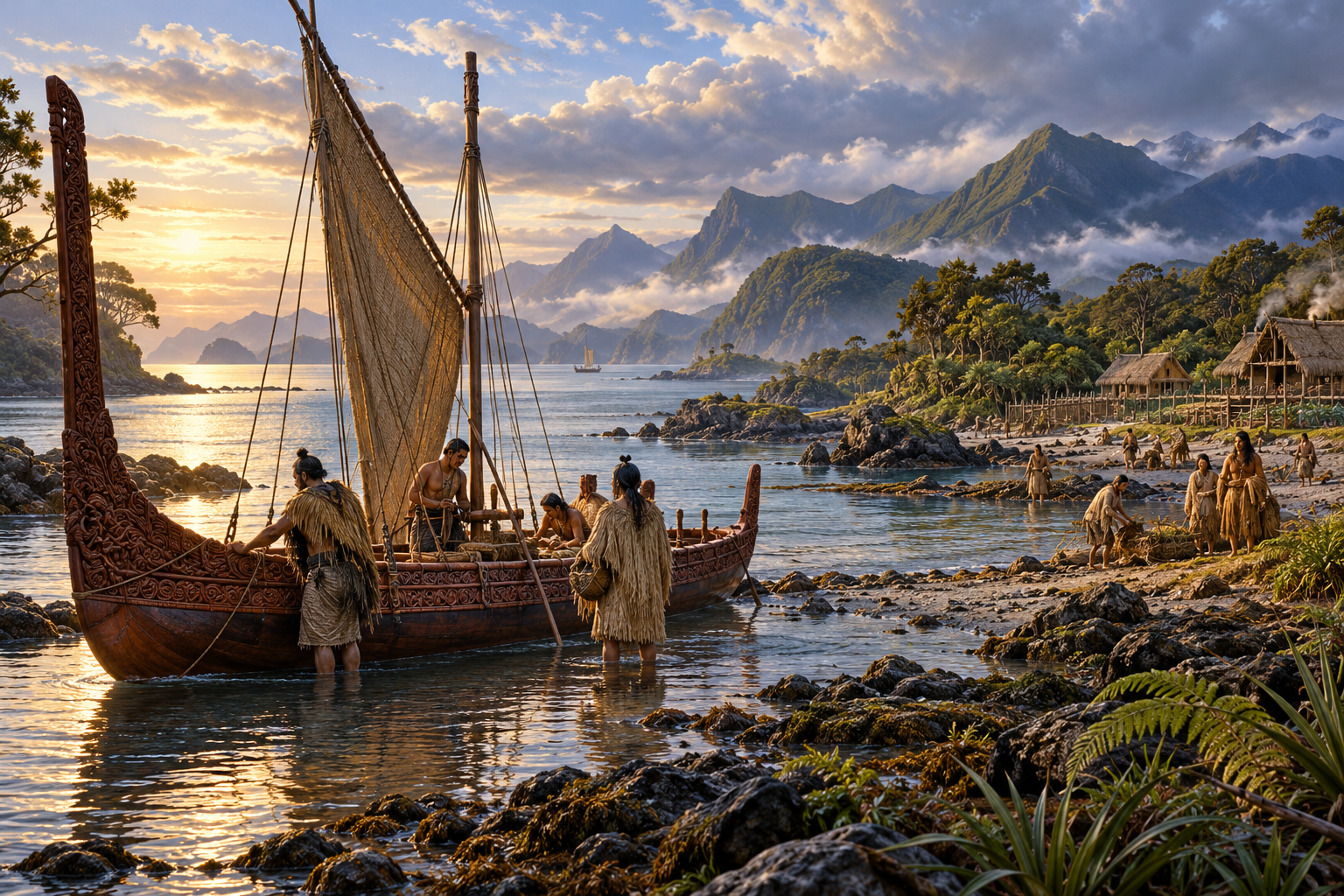
South-west Pacific · Te Ika-a-Māui and Te Waipounamu · Communities joined by canoe routes, coastal paths and seasonal journeys
The harbour’s narrow mouth is white with breaking surf. A navigator holds a laden waka back from the passage, while fishers ashore hurry to pull their craft above the tide. Across the strait, a river has risen against a party carrying prized pounamu; the nearest safe crossing lies beyond the next valley. Here the weather, the water and the people who know the country matter more than any distant king.
Nova Zeelandia is a later European cartographic name for the islands now generally called Aotearoa New Zealand. No king commands these islands from a single capital. Along the harbours, rivers and hill country, communities of hapū and iwi have distinct settlements, genealogies, allies and traditions. Their relationships change over generations. A navigator from a northern estuary may know nothing of a western mountain route, yet both places are part of the same network of voyages, exchange and shared history.
At a Glance
| Lands | Te Ika-a-Māui (North Island), Te Waipounamu (South Island), straits, outlying islands and alpine ranges |
|---|---|
| Communities | Coastal and river settlements, gardens, fisheries, defensible places and inland gathering routes; no single ruler or capital |
| Languages | Related Māori dialects spoken in diverse communities |
| Journeys | Waka along coasts and known crossings; forest paths, river fords and mountain routes with experienced guides |
| Food and crafts | Fish, shellfish, birds, kūmara where the climate permits, weaving, canoe building, stone working and local exchange |
| Local wonders | Named taniwha, ancestral mountains and waters; volcanic landscapes, dangerous straits and living sacred traditions |
| Immediate trouble | A damaged harbour canoe, an overdue fishing party and a dangerous southern river crossing |
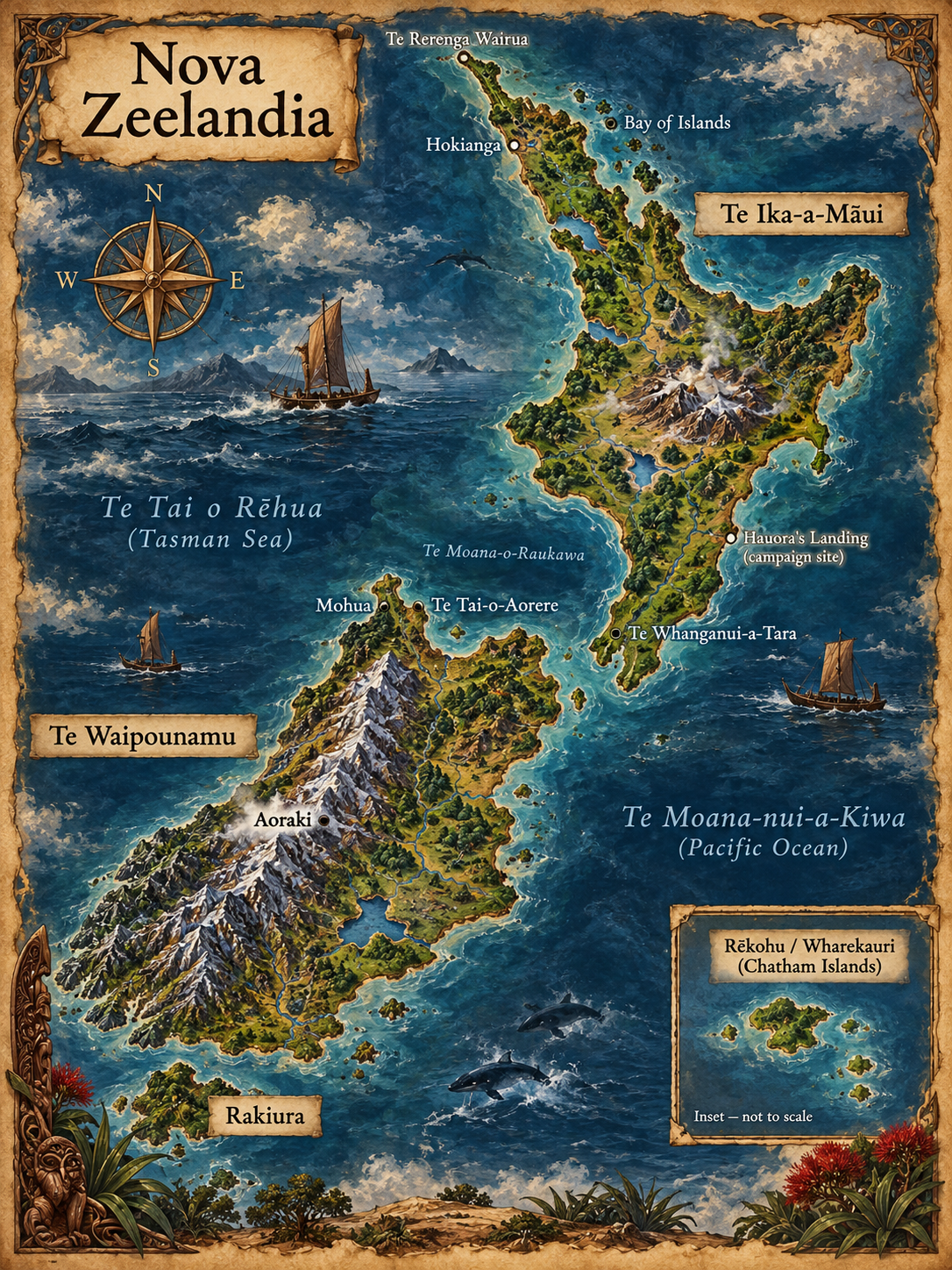
Map of Nova Zeelandia
What Is Happening Right Now?
The Harbour Passage — Te Whanganui-a-Tara
A returning waka has struck rock at the harbour entrance. Its injured crew have reached a narrow beach but the craft will not survive the next tide. Fishers who know the passage are willing to help, provided someone first carries a message and tools to a sheltered landing. The people here recount the story of Ngake and Whātaitai, the beings who shaped the harbour. The stranded crew needs medicine, fresh lashings and people willing to carry repairs over the headland before the next swell. Hinewai, a Ngāi Tara harbour warden encountered among the Oceania characters, will help organise the rescue but will not allow an armed stranger to command the landing. The reef remains dangerous whether or not a taniwha is seen.
Overdue on the Hokianga
A trading canoe has failed to arrive at a northern harbour before a gathering. Rough surf has closed the entrance. A local pilot believes the crew has taken shelter farther along the coast; the cargo includes food that will not keep indefinitely. A search needs a boat, a trusted guide and an agreed signal. The pilot speaks of Āraiteuru, guardian of the Hokianga entrance, and points out the breakers that keep even skilled crews from forcing the passage. A party that understands where the currents break may find the missing crew without a fight.
The Pounamu Crossing
South of the strait, travellers carrying precious stone reach a river swollen by rain. They need a safe route before supplies run out and cold weather traps them. People from a nearby settlement can provide a guide and tools, but their own damaged canoe needs repairing first. The nearest boatwright has timber but no dry rope. A detour through the next valley is possible, provided someone goes ahead to warn the waiting households.
Places Worth Visiting
Northern Harbours and Cultivated Shores
Northland’s bays, tidal rivers and sheltered beaches support communities tied to fishing, food gardens and canoe journeys. Knowledge of the entrance to Hokianga is worth more than a polished chart brought from elsewhere. Inland ridges conceal paths and places of settlement that a traveller at sea cannot see. Time your landing well; the harbour’s open mouth can turn a safe journey into a difficult one.
Te Whanganui-a-Tara and Te Moana-o-Raukawa
At the southern end of the northern island, the great harbour opens onto a strait notorious for strong winds and rough water. In one Wellington tradition, Ngake broke through from an inland lake to the sea, while Whātaitai became stranded and helped shape the shore. A navigator pointing to the harbour’s ridges can trace the course of the two beings in the land itself. Families tell the story in different ways, each tied to this particular water.
Te Waipounamu: Greenstone, Rivers and Mountains
Across the strait lie eastern bays, broad rivers, western rainforests and the high Southern Alps. Pounamu sourced in the west is valuable for tools, adornment and exchange, but travellers cannot simply march across the ranges in a straight line. Aoraki stands within a southern creation tradition maintained by Ngāi Tahu, whose own movements and custodianship belong to a changing history; do not project later tribal boundaries unchanged into every earlier century or ignore other southern communities.
Central Lakes and Volcanic Trails
In the heart of Te Ika-a-Māui, lakes, wooded ridges, volcanic ground and swift rivers offer another kind of country. Steam may reveal a thermal area, while forest cover hides steep approaches and difficult crossings. People who know the terrain can direct visitors to reliable shelter and safe water. A stranger who sees empty wilderness may be looking at a landscape others know in close detail.
People, Food and Shelter
Visitors need a host willing to receive them, a navigator who knows the next stretch of coast and someone able to judge their boats and supplies. A fishing settlement may have canoe makers, stone workers, weavers and skilled gatherers; it may still lack food to spare after a storm. Hospitality and trade depend on people, relationships and local circumstances. In a small harbour, helping carry a waka clear of the tide may matter more than offering unfamiliar coins.
At Hauora’s Landing, a sheltered bay reached by a winding track, the boatwright Tiri works beneath a lean-to above the tide. Tiri can repair paddles, cordage and a damaged canoe but will not send the last seaworthy vessel away while neighbours remain stranded. Visitors in need of passage can offer to help with carpentry, gather food for the stranded households or promise to return with new cordage. An experienced local guide is never merely a purchasable map.
Pack dry wrappings, food that survives a crossing, spare cordage, good paddles and practical tools. Those travelling inland should establish where drinking water, safe shelter and a person who knows the next river crossing can be found. Not every settlement has an armourer or an interchangeable magic shop.
Living Folklore and Sacred Landscapes
Māui drawing up Te Ika-a-Māui is among the traditions that give the islands their character. Accounts of Tangaroa, Tāne and other atua belong to living sacred worlds, not a single identical belief system shared by every settlement. Named waters and mountains have relationships, histories and responsibilities whose meanings vary by place.
Taniwha may protect a waterway, warn of danger or threaten travellers. Ngake and Whātaitai belong to Te Whanganui-a-Tara; Āraiteuru belongs to Hokianga. A fisherman who believes a named guardian watches the water will read its sudden silence and dangerous currents differently from a passing stranger.
The islands also had giant moa in their early human history. Archaeological evidence suggests their extinction by roughly the middle of the fifteenth century. A few isolated birds may still survive in the remoter valleys of this changed world, enough to excite hunters and worry those guarding their young. The Giant Moa has playable statistics; whether a living flock exists on a particular island is a question for the people who know that valley.
Journeys Beyond the Islands
Travelling between islands requires a seaworthy waka, experienced guidance and suitable weather. Northern tidal passages, southern mountain crossings and the exposed strait demand different knowledge. Waiting for the right tide may cost a day, but pressing a damaged vessel into the strait can cost a crew. A sound craft and a trusted navigator are worth the delay.
From here explore Oceania, cross the Tasman Sea to Terra Australis, or consult the Polynesian traditions directory. The western archives call the islands Nova Zeelandia; the people whose villages and waters lie here use their own names.
References and setting notes
Sources: Te Ara, Māori arrival and settlement; Te Ara, waterways and trade; Te Ara, named sea taniwha; Wiremu Grace’s Ngake and Whātaitai narrative; Ngāi Tahu’s account of Aoraki; Auckland Museum, moa extinction. Recorded traditions have different local tellings. Hauora’s Landing and Tiri are fictional places and people created for this world.
Watch and Learn
The original curated video is retained as a modern introduction to Māori people and culture; it is not period footage or a source for the imagined campaign episode.
Keep this reference growing
If this page helped with your reading or game, you can support its upkeep or explore the curated books.
Explore the Bookshop — epics, classics and stories behind imagined worlds.