
Jupiter
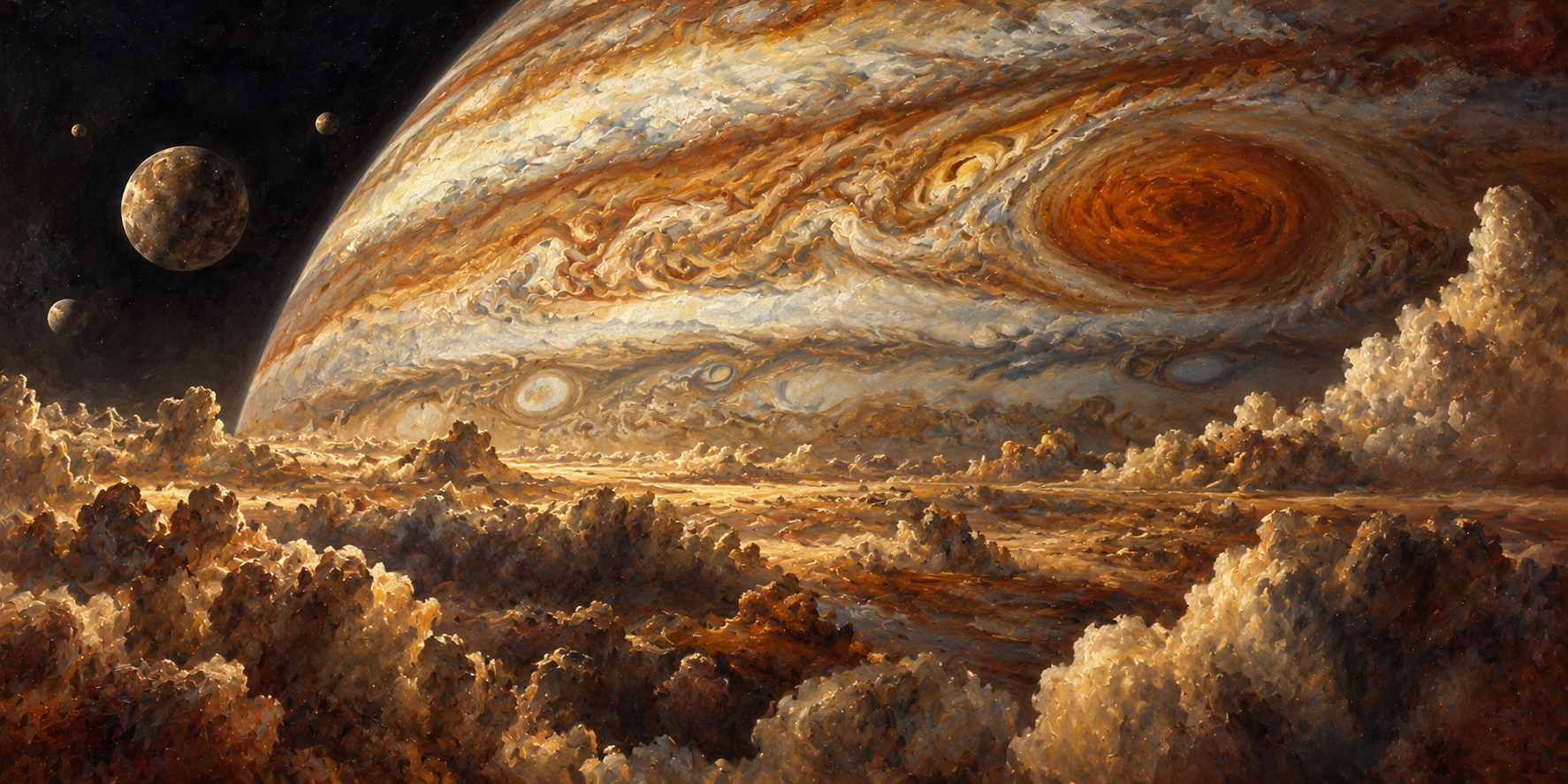
Fifth planet from the Sun · The largest world in the Solar System.
Jupiter fills a navigator’s forward view long before a ship reaches its moons. Broad belts of pale and rust-coloured cloud circle the immense gas giant. There are no dry shores below them. Winds, crushing atmospheric depths and violent storms make the planet itself a poor destination for a landing, but its moons hold very different worlds.

The storm and the unseen danger
The Great Red Spot is an enormous storm carried in Jupiter’s atmosphere, while smaller storms gather and disperse around it. The apparently smooth cloud bands hide fierce motion. Deeper descent brings increasing pressure and heat; any vessel intending to return must remain well above those depths.
Jupiter’s powerful magnetic environment traps hazardous radiation, especially near some inner moons. This cannot be judged by sight. A ship can be safely clear of the planet’s clouds and still be in trouble if its protection fails during a close approach.
Four very different moons
- Io: a volcanic world, bright with sulphur-rich deposits and scarred by repeated eruptions. A landing party must watch the ground as carefully as the sky.
- Europa: a smooth-looking crust of ice above a deep ocean. The surface is no easy place to survive, and the water below is not an open sea or known settlement.
- Ganymede: larger than Mercury, with an icy surface and its own magnetic field. Its size offers a world of terrain rather than a mere rock to circle.
- Callisto: an old, heavily cratered moon farther from the fiercest inner radiation. Its battered ground preserves traces of ancient impacts.
Routes through the Jovian system
A vessel approaching Io for a mineral survey discovers that the intended landing ground lies beside a newly active volcanic vent. Returning empty would leave its sponsor without the samples it paid for; diverting toward a safer moon would exhaust much of the crew’s reserve. The decision is complicated by the radiation exposure of a longer orbit around Jupiter.
An ice survey on Europa presents a different problem. The most promising fracture for examining material from below has opened along unstable ground. An expedition can make shallow observations from a safer distance, or attempt a descent that might strand its crew beneath shifting ice.
The giant in the earthly sky
Jupiter has long been among the wandering lights studied by earthly astronomers, and its name recalls the Roman god. That association does not make the planet an Outer Plane or the god’s residence. The worlds circling Jupiter belong to the Solar System, reachable by the hazards and distances of physical travel or a separately established magical route.
Explore Saturn, the Space atlas or Outer Space Terrain.
Physical astronomy: NASA — Jupiter facts; NASA — Io.
Keep this reference growing
If this page helped with your reading or game, you can support its upkeep or explore the curated books.
Explore the Bookshop — epics, classics and stories behind imagined worlds.