
Ethiopian Empire — Zara Yaqob’s Highland Realm
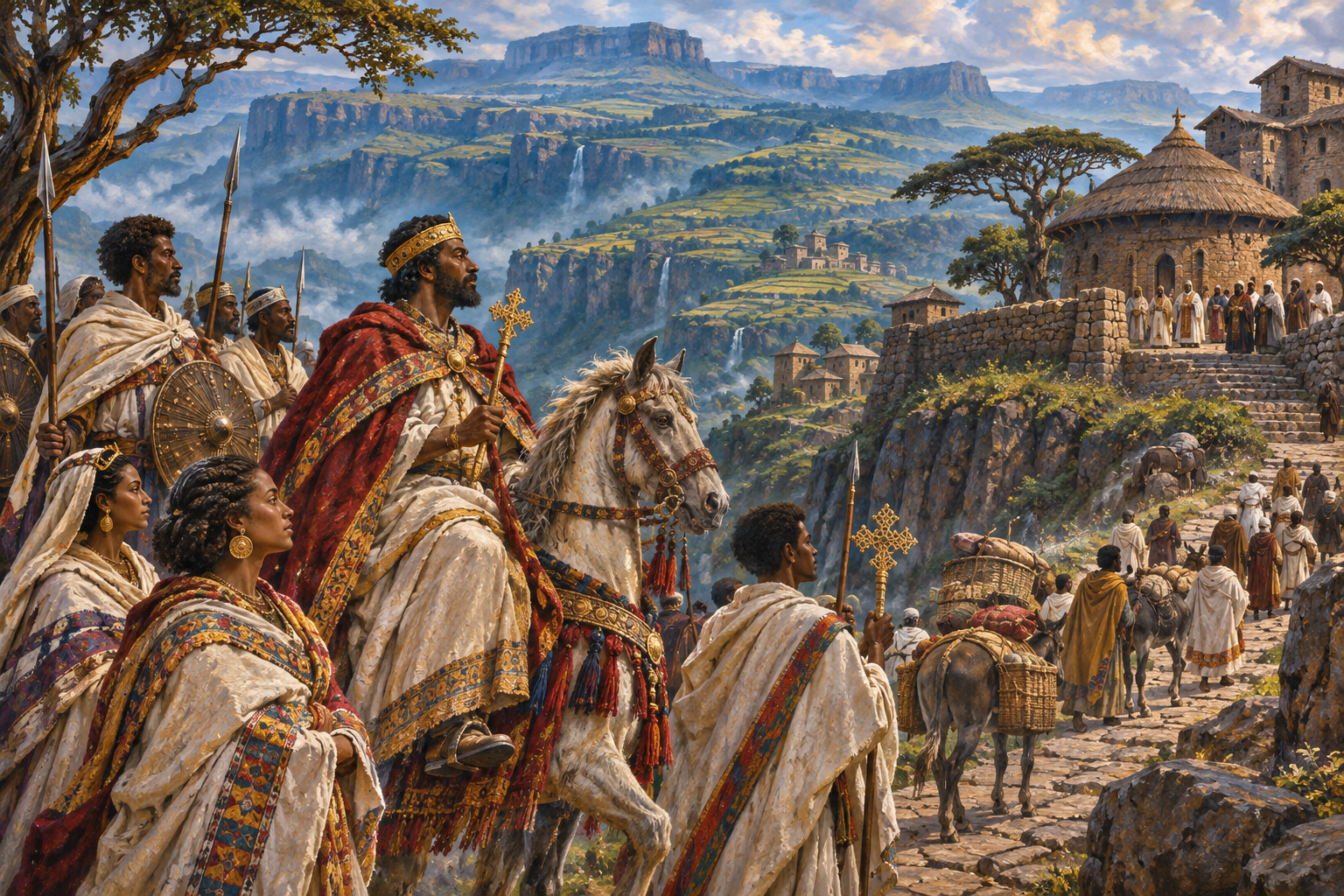
North-East Africa · Solomonic Empire · Highland Roads · Adal Frontier · 1454 CE
At a Glance
| Realm | Solomonic Ethiopian Empire; a far-reaching but unevenly controlled highland realm |
|---|---|
| Ruler | Emperor Zara Yaqob (reigned 1434–1468), the negusa nagast — King of Kings |
| Seat of power | A travelling imperial court; royal camps and residences rather than a modern fixed capital |
| Heartlands | Amhara, Shewa, Tigray, Lasta and adjoining highland districts |
| People and languages | Amhara, Tigray, Agaw and other communities; Geʽez in writing and scholarship |
| Landscape | High plateaus, terraced farms, river gorges, escarpments, mountain passes and valleys |
| Livelihoods | Grain, cattle, craft trades, salt, pack transport and Red Sea commerce |
| Neighbours | Adal to the east, Hadiya and southern polities, Nile lands and Kemet to the north |
| Current pressure | The 1445 war’s aftermath; royal centralisation, provincial rivalries and unsafe roads |
| Campaign present | 1454 CE |
On the Shewa road, bells sound before the emperor’s camp comes into view. Armed retainers watch caravan traffic while scribes receive petitions and pack animals crowd the hillside. A merchant newly arrived from Adal reports riders moving towards the frontier. The governor whose territory they crossed insists the report is a lie. Both men demand Zara Yaqob’s judgement. The soldiers behind them have already begun choosing sides.
Geographical Campaign Map
What Is Happening Right Now?
Zara Yaqob strengthens the throne. Imperial captains travel with new orders for provincial officials. Some replace corrupt men and protect villages; others demand supplies with little regard for the households forced to provide them. In one Shewa district, two couriers have arrived from the same governor with contradictory instructions. Both carry the right seal.
Adal remains dangerous, not defeated forever. The emperor’s victory over Sultan Badlay in 1445 altered the eastern balance of power, but the highland court and Adal still depend on merchants who use overlapping roads. A salt caravan has vanished between markets. A rash reprisal could begin another war, and an ambitious official already wants permission to march.
Farther north, gnoll clans are moving. Displacement following older conflicts around the southern approaches to Kemet has scattered raiders, herding groups and rival captains into unstable country. No single gnoll ruler speaks for them all. Imperial scouts also report cattle killed in a mist-bound forest pass, their remains too badly crushed for an ordinary wolf pack.
Places to Explore
The Moving Imperial Court
Zara Yaqob rules through a large travelling household of guards, servants, scribes, petitioners, merchants and soldiers. Its position changes with royal journeys and political necessity. The court is a working town while it remains in one place; when it departs, whole markets follow its wagons. Gaining an audience may demand more persistence than surviving the road.
Aksum and the Stelae
In Tigray, stone monoliths and ancient foundations mark the heart of the old Aksumite kingdom. Zara Yaqob was crowned here in 1436, renewing its ceremonial importance. Aksum is not the everyday capital of his moving court. Its custodians can identify old inscriptions, royal tombs and threats that an impatient visitor would overlook.
Lalibela and the Lasta Mountains
Centuries-old rock-hewn buildings sit below ground level in carved trenches and connected passages. Local keepers know the drainage, narrow entrances and hidden spaces better than the emperor’s travelling officials. After heavy rain, a damaged channel can strand a group in the deep excavations. The surrounding Lasta highlands are cut by difficult climbs.
Lake Tana and the Abay
West of the highland heartlands, settlements and island communities surround Lake Tana. The lake feeds the Abay, or Blue Nile, whose gorge makes overland travel slow and dangerous. Boats help on the lake, but there is no easy navigable river highway through the downstream chasms. Grain, cattle and local boatmen are vital to journeys here.
The Shewa and Amhara Grain Roads
Farms, mills, grazing grounds and market settlements support the imperial household and provincial garrisons. A messenger carrying a seal is visible from far off; villagers know whether the last soldiers to pass paid for what they took. Grain transport, not palace ceremony, is often the difference between a successful campaign and an uprising.
The Eastern Escarpment
Routes descend from cool highlands towards warmer lowlands, Red Sea markets and Adal’s sphere of influence. Soldiers can guard a pass; they cannot hold every well. Guides and merchant relationships are often more useful than proclamations. A local chief who offers shelter to both sides may be protecting trade rather than betraying a sovereign.
People and Powers
Emperor Zara Yaqob: A learned and forceful ruler determined to oversee governors, armies and written records himself. He prizes duty and obedience, and his punishments can be severe. An honest petitioner may receive justice; an innocent person accused by a powerful rival may receive little time to defend themselves.
Provincial governors: Imperial officers, military captains and local rulers maintain their own households and loyalties. Some keep roads safe and famine at bay. Others turn their posts into opportunities for private wealth. Their conduct matters more than the title stamped on a letter.
The Baher Nagash: A senior authority over the northern and coastal approaches whose messengers, local partners and soldiers watch the Red Sea roads. News from a port may pass through several hands before it reaches the emperor.
Caravan leaders and regional households: Farmers, guides, salt traders, smiths, scholars and local elders keep the realm functioning. Written Geʽez records coexist with local languages and customs. No single description can stand for every highland or frontier community.
The court prizes hierarchy, appointments, rewards for service and punishment for disobedience. In practice this lawful order can be used justly or cruelly. Loyalty to the emperor is not a substitute for judging how his representatives treat the people who must live under them.
Markets, Shelter and Practical Help
Highland settlements trade grain, bread, pulses, cattle products, leather, cloth, ironwork and pack animals. Travellers cannot assume a familiar coaching inn waits at every crossroads. Shelter is often arranged through a merchant, patron, caravan camp or local guesthouse. Food, fodder and a guide who knows the next crossing matter more than a heavy purse.
The Grain Yard
At a Shewa crossroads a storehouse rents covered space and pack animals. Its keeper knows which convoy is late and which garrison is buying far more food than it needs. She will sell provisions, but refuses to handle a wagon bearing the stamp of a district robbed during the last levy.
The Caravan Armourer
A market smith repairs harness, spearheads and shield fittings. The guard captain has placed an urgent order that will delay every civilian repair. A bent iron arrowhead found inside a merchant’s shield carries a maker’s mark unfamiliar to the local soldiers.
The Court Scribe
A scholar or clerk can read Geʽez documents, identify seals and compose a petition. Interpreters familiar with eastern merchants can help secure passage through disputed districts. A forged order may fool a distant guard but not the steward who knows its supposed author.
Magic, Relics and Sacred Places
Monastic communities, learned scribes, healers and local sacred custodians preserve their own traditions. Travellers may seek treatment, guidance, protective rites or the interpretation of an ancient text, but help depends on relationships and trust. The mountains contain older places whose guardians are not answerable to every royal official.
The Stone’s Second Shadow
At Aksum an old stela seems to cast a second shadow at dawn. The line points towards a sealed underground passage. The custodian has found a related passage in a damaged manuscript, yet fears excavators will destroy the place before learning its purpose. The party must safeguard the evidence and decide whom to trust.
The Beast on the Cloud Road
Cattle are disappearing beside a wooded mountain pass. A wounded herder has seen the huge iron-hard hide and jaws of an Ethiopian Forest Bull. A caravan is trapped beyond the beast’s hunting ground, and hunters need allies before the weather closes in. Use the linked creature’s established rules instead of duplicating its statistics.
Dangers and Adventure Hooks
- The Emperor’s Double Seal: Two officials carry authentic-looking orders demanding opposite treatment of a village’s harvest. Both insist delay is treason. Discover the source before a starving settlement faces armed requisition.
- After Gomit: An Adal trader brings evidence of a captain planning a revenge raid. His escort has vanished. A faction at court wants the proof destroyed, another wants war, and the traders on the road will pay the price unless someone finds the missing witnesses.
- Rain over Lalibela: A storm tears open an ancient underground channel and floods a storeroom below the rock-cut buildings. Workers, manuscripts and an unknown chamber are at risk. Rival treasure-seekers arrive before the rain has stopped.
- The Northern Cattle Trail: gnoll scouts follow an exhausted herd, but the clan chief claims his people merely need water. A separate raiding band has been attacking farms in the clan’s name. Find the attackers before soldiers strike the wrong camp.
Encounters on the Roads
| Route | Threat | Way forward |
|---|---|---|
| Shewa grain road | Rival escorts seize the same supplies | Establish the true order and protect the farmers |
| Eastern pass | Caravan gone missing | Read the trail before rumours provoke war |
| Lasta mountains | Flooded rock-cut chambers | Rescue workers and preserve the site |
| Northern grazing land | Gnolls shadow the herd | Identify the genuine raiders and seek safe passage |
Travel, Authority and Wider Geography
Medieval Ethiopian highland caravan routes follow usable passes, water, farming districts and established markets. The same distance can demand a modest journey across open plateau or days of hard climbing along an escarpment. Rain, lost pack animals and a flooded bridge can halt an army as decisively as an ambush.
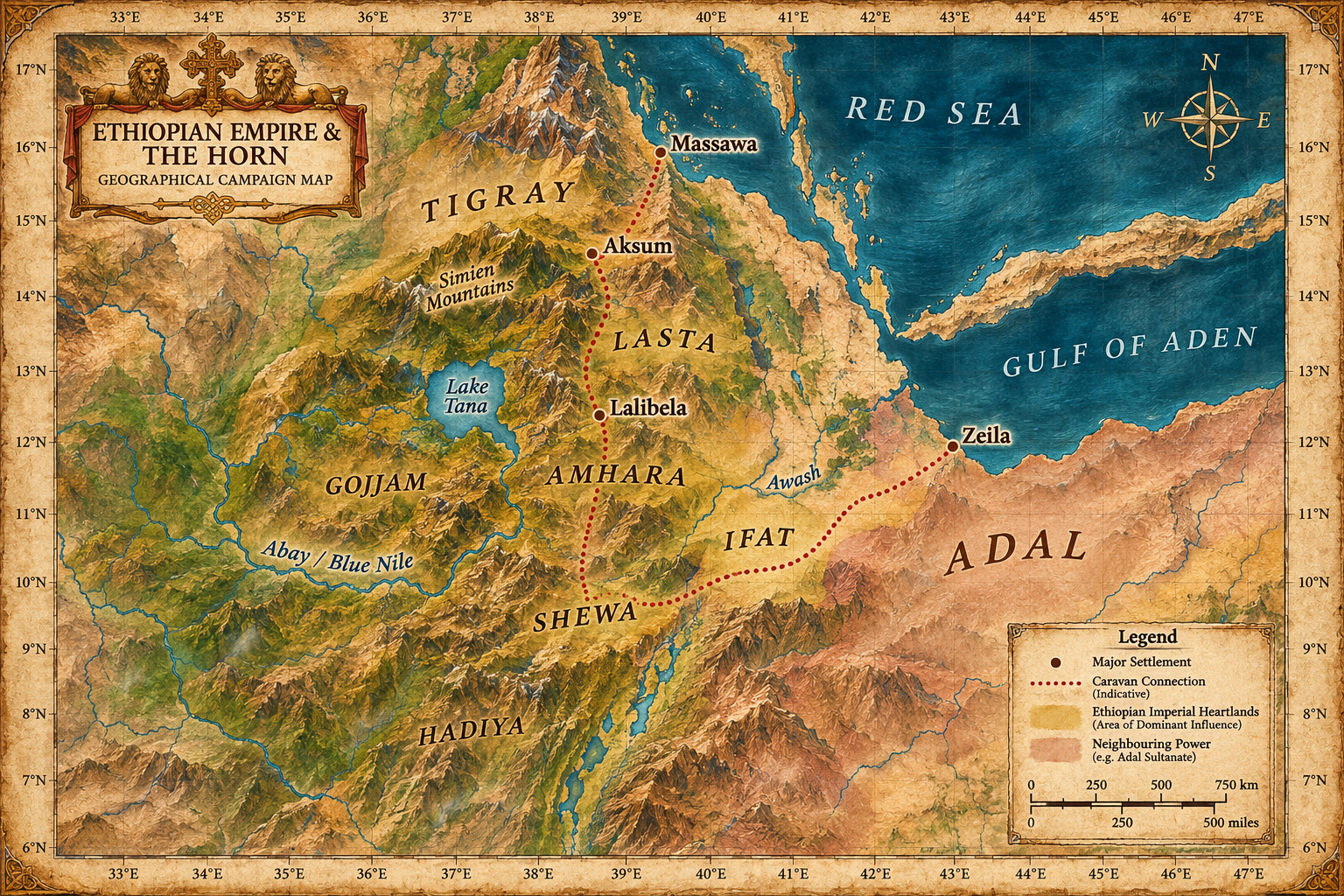
North: Tigray, Aksum and roads towards Massawa. West: Gojjam, Lake Tana and the Abay basin. South: Shewa and territories with their own rulers and obligations. East: Ifat, Adal and the routes towards Zeila. Coastal markets and the highlands are connected by traders, not by a single effortless imperial highway.
For the broader regional setting, use North-East Africa and the Africa gazetteer. The Indian Ocean guide covers the seaward approaches. Where frontier politics fails, raids by gnoll bands and encounters with creatures such as the Yale or Ethiopian Forest Bull can threaten isolated travellers.
Local officials, escorts, village leaders and caravan captains each control parts of a journey. Royal letters can help, but most travellers still need introductions, safe resting places, agreements over grazing and a guide familiar with the next district.
Deeper History
The Solomonic dynasty has ruled since the late thirteenth century, drawing legitimacy from an older world of Aksumite kingship and religious memory. Aksum’s stelae are ancient; Lalibela’s stone-cut monuments belong to the earlier Zagwe centuries. Both remain important, but neither is a modern administrative capital in 1454.
Zara Yaqob took the throne in 1434 and was crowned at Aksum in 1436. He pursued greater central control of the provinces and defeated Sultan Badlay of Adal in 1445. His long reign is also notable for Geʽez literature and determined, at times severe, religious and social reforms. Border states retain their own courts and commercial interests even after military defeat.
A later royal residence at Debre Berhan is associated with Zara Yaqob, but its exact founding date is disputed and it should not be treated as a securely established fixed capital throughout 1454. Gondar’s later castles, a national parliament, a modern census and the nineteenth-century Ethiopian flag do not belong on this page. Exact medieval population and border figures remain uncertain.
The specific missing messengers, contested grain shipments, magical discoveries and supporting characters above are campaign incidents. The named historical ruler, major places, geography and important political events have independent historical foundations.
Sources and Onward Journeys
Dictionary of African Christian Biography — Zara Yaqob · UNESCO — Aksum · UNESCO — Lalibela · Study of medieval Ethiopian trade.
Further entries: North-East Africa · Africa · gnoll · Ethiopian Forest Bull · Yale.
Keep this reference growing
If this page helped with your reading or game, you can support its upkeep or explore the curated books.
Explore the Bookshop — epics, classics and stories behind imagined worlds.