
Yale (Eale) — The Horn-Turning Beast of Aithiopia
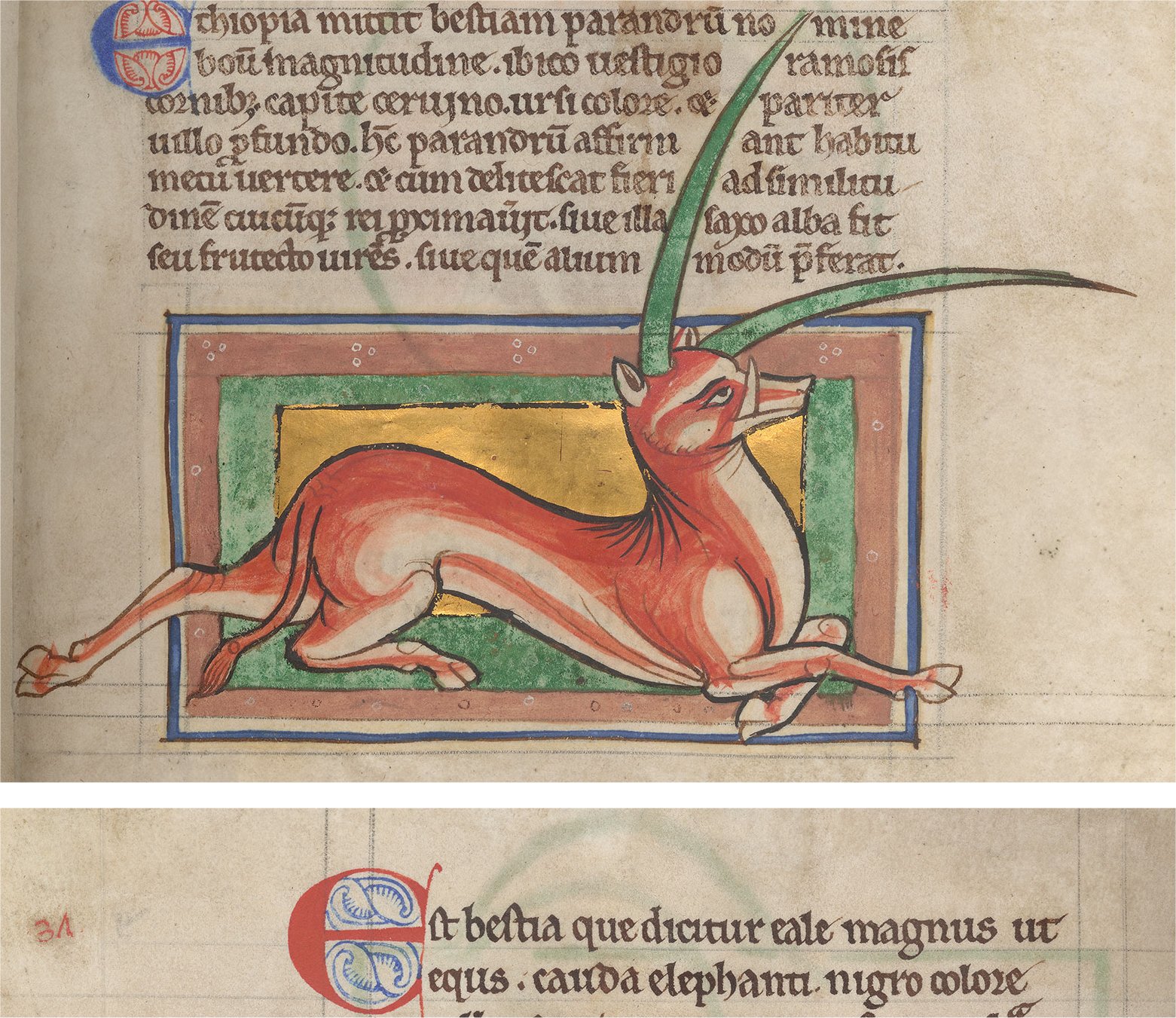
A hippopotamus-sized black or tawny beast with boar-like jaws and two long horns that turn independently in battle.
The yale, or eale, is one of the strangest animals placed in Aithiopia by classical writers. Pliny describes it as the size of a hippopotamus, black or tawny in colour, with an elephant-like tail, boar-like jaws and horns more than a cubit long. Those horns are not fixed: the yale can bring one forward to fight while folding the other back, then exchange them if the first is damaged or badly placed.
Explore: World Bestiary · African Bestiary · North East Africa · Ethiopian Bull · Catoblepas
At a Glance
Rules by Edition
Yale
Large Beast, Unaligned
AC 14; Initiative +1 (11)
HP 52 (7d10 + 14)
Speed 50 ft.
18 (+4)
13 (+1)
15 (+2)
2 (−4)
13 (+1)
6 (−2)
Skills Perception +3
Senses Passive Perception 13
Languages —
CR 2 (450 XP); PB +2
Traits
Trampling Charge. If the yale moves at least 20 feet straight toward a creature and then hits it with Horn on the same turn, the target takes an extra 9 (2d8) Piercing damage. A Large or smaller target must succeed on a DC 14 Strength saving throw or have the Prone condition.
Turning Horns. The yale can attack with either horn without changing its facing or position. Difficult approaches, creatures on opposite sides of it and narrow spaces do not prevent it from using Multiattack normally.
Actions
Multiattack. The yale makes two Horn attacks. It can target one creature twice or two different creatures within reach.
Horn. Melee Attack Roll: +6, reach 5 ft. Hit: 9 (1d10 + 4) Piercing damage.
Hooves. Melee Attack Roll: +6, reach 5 ft., one Prone creature. Hit: 11 (2d6 + 4) Bludgeoning damage.
Yale
Large beast, unaligned
Armor Class 14 (natural armor)
Hit Points 52 (7d10 + 14)
Speed 50 ft.
18 (+4)
13 (+1)
15 (+2)
2 (−4)
13 (+1)
6 (−2)
Skills Perception +3
Senses passive Perception 13
Languages —
Challenge 2 (450 XP)
Traits
Charge. If the yale moves at least 20 feet straight toward a creature and then hits it with a horn attack on the same turn, the target takes an extra 9 (2d8) piercing damage. A Large or smaller target must succeed on a DC 14 Strength saving throw or be knocked prone.
Turning Horns. The yale can bring either horn to bear in any direction. It can use Multiattack against creatures on opposite sides of it.
Actions
Multiattack. The yale makes two horn attacks, against one target or two targets within reach.
Horn. Melee Weapon Attack: +6 to hit, reach 5 ft., one target. Hit: 9 (1d10 + 4) piercing damage.
Hooves. Melee Weapon Attack: +6 to hit, reach 5 ft., one prone creature. Hit: 11 (2d6 + 4) bludgeoning damage.
Yale CR 2
XP 600
N Large animal
Init +1; Senses low-light vision, scent; Perception +6
Defense
AC 14, touch 10, flat-footed 13 (−1 size, +1 Dex, +4 natural)
hp 26 (4d8+8)
Fort +6, Ref +5, Will +2
Offense
Speed 50 ft.
Melee 2 gores +6 (1d8+4) or 2 hooves +6 (1d4+2)
Space 10 ft.; Reach 5 ft.
Special Attacks pivoting gore
Statistics
Str 19, Dex 13, Con 15, Int 2, Wis 13, Cha 6
Base Atk +3; CMB +8; CMD 19 (23 vs. trip)
Feats Alertness, Endurance
Skills Acrobatics +9 when jumping, Perception +6
Special Ability
Pivoting Gore (Ex). When making a full attack, the yale can gore one opponent with both horns or attack two creatures adjacent to it, one with each horn. It does not need to turn or reposition between those attacks.
Ecology
Environment warm plains, scrub and open forest
Organization solitary or herd (2–8)
Treasure none
Yale
Large Animal
Hit Dice 3d8+3 (16 hp)
Initiative +0
Speed 60 ft. (12 squares)
Armor Class 13 (−1 size, +4 natural), touch 9, flat-footed 13
Base Attack/Grapple +2/+9
Attack gore +4 melee (1d8+3)
Full Attack gore +4 melee (1d8+3) or 2 hooves +4 melee (1d4+1)
Space/Reach 10 ft./5 ft.
Special Attacks pivoting gore
Special Qualities low-light vision, scent
Saves Fort +4, Ref +3, Will +2
Abilities Str 17, Dex 12, Con 12, Int 2, Wis 13, Cha 4
Skills Hide +1, Jump +15, Listen +4, Spot +4
Feats Alertness, Endurance
Environment warm plains or forests
Organization solitary or herd (2–8)
Challenge Rating 2
Treasure none
Alignment always neutral
Pivoting Gore (Ex)
As a full attack action, the yale can strike one opponent with both horns or two adjacent opponents with one horn each. Make one attack roll for each horn. The yale can swivel its horns independently and does not need to change position to bring them to bear.
Behaviour
Yales are grazers, not man-eaters, but they are far from placid cattle. Their long horns make close pursuit dangerous from almost any angle, and a threatened animal can turn one horn toward a predator while keeping the second folded back. Herds prefer to break away at speed; cornered individuals lower the head and attack until an escape route opens.
Their unusual horns also make dominance contests look different from ordinary cattle. Rivals can test one another with a single horn while keeping the other withdrawn, reducing the chance that both weapons become entangled or damaged.
Signs Before Initiative
- Deep paired hoofprints lead to browse lines stripped well above ordinary cattle height.
- Trees and standing stones carry narrow horn-gouges at several different angles.
- A predator carcass has two different puncture tracks on opposite sides of the chest.
- Local herders leave unusually wide gaps in thorn barriers so a yale does not feel trapped.
- Old art shows the horns pointing in directions no fixed-horned animal could achieve.
If Violence Starts
A yale charges once it has a clear lane, then tries to keep multiple enemies within horn reach rather than turning its whole body toward one threat. It does not fight to the death unless protecting young or unable to escape. Broken ground and tight alleys reduce its speed but do not neutralise the horns.
Range and Related Beasts
Classical writers place the yale in Aithiopia. In the campaign, it belongs naturally in North East Africa and the country around the Ethiopian Empire. It shares old natural-history traditions with the Ethiopian Bull and Catoblepas.
Using a Yale in an Encounter
The horn road. A caravan route crosses the only dry grazing corridor used by a migrating herd.
The wounded trophy. A noble hunter breaks one horn and assumes the yale is helpless. The second horn swings forward.
The live capture. A collector wants a yale brought back unharmed, making pits, ropes and barriers more important than damage.
The ruined paddock. A captured yale has learned how every gate opens and uses its horns to manipulate latches from angles its keepers did not anticipate.
Classical and Medieval Sources
Pliny — Natural History
Pliny describes the yale as hippopotamus-sized, black or tawny, with a boar-like jaw, elephant-like tail and movable horns used alternately in combat. See the Eale source collection at Theoi.
Worksop Bestiary
The hero is a public-domain medieval yale from Morgan Library MS M.81, available through Wikimedia Commons.
Rules Sources and Licensing
The 5.5e/2024, 5e/2014 and Pathfinder 1e presentations are original compatibility adaptations of the older yale statistics and the classical horn behaviour. The D&D 3.5e block preserves the legacy conversion already associated with this page rather than claiming an official SRD yale.
Keep this reference growing
If this page helped with your reading or game, you can support its upkeep or explore the curated books.
Explore the Bookshop — epics, classics and stories behind imagined worlds.