
Bog Slain — The Drowned Sentinel of the Marsh
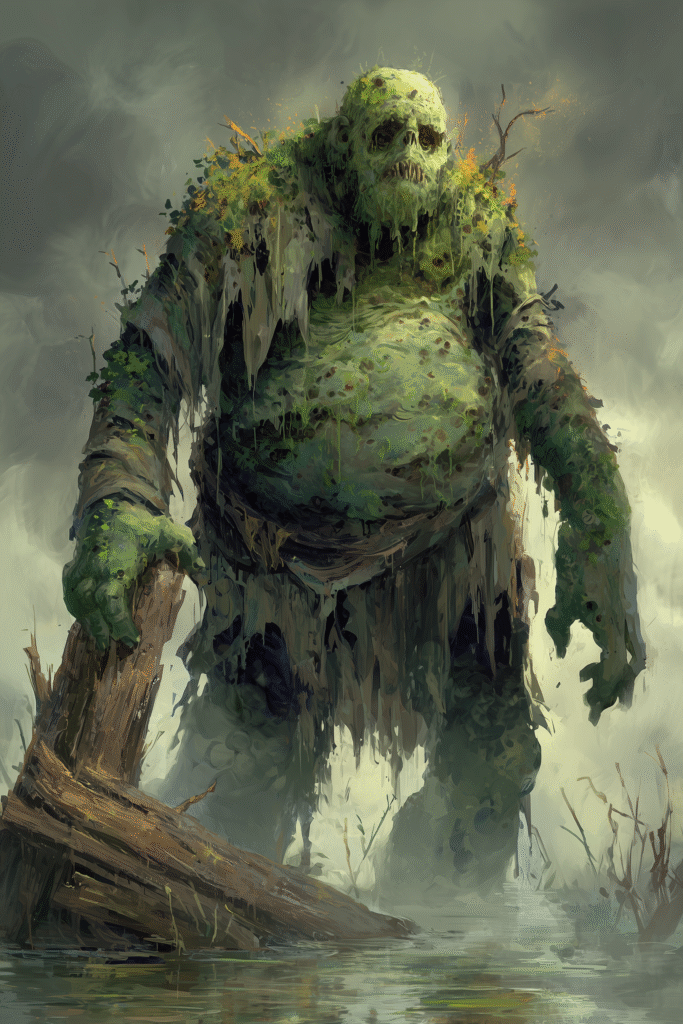
The pool is so still that the reeds cast perfect reflections across it. A boot appears below the surface, then a pale face with its eyes open. Something heavy hauls itself out of the peat, swollen with black water and hung with leeches. It opens its mouth before the ferryman can turn the boat, and a foul stream strikes the bank.
At a Glance
- Creature
- Bog Slain — a water-swollen corpse made into a marsh sentinel
- Nature
- Medium Chaotic Evil Undead, mindless and bound to its creator’s commands
- Appearance
- Bloated pale-green skin, silted eyes, clinging moss, leeches and a jaw leaking foul orange water
- Haunts
- Peat bogs, flooded battlefields, black reed beds, drowned roads and ruined ferries
- Origin
- Corpses dredged from bogs and animated by a water mage’s necromantic rite
- Threats
- A sudden line of diseased marsh water, a heavy slam and infection that may rob victims of sight
- Weaknesses
- Limited breath reserves, dependence on water, and the simplicity of its mind
- Command
- Guard a ford, a sunk chest, a hidden passage or the dwelling of the necromancer who raised it
A Bog Slain is more than an ordinary Zombie. Peat water is held within its corpse by magic, and what it spits may carry a disease worse than the injuries inflicted by its fists. It understands no bargain and devises no plan. Whatever cunning appears in its ambush belongs to the person who set it beneath the water.
The method was first devised by a water mage who wanted servants from the bodies she could recover without entering public graveyards. Her notebooks passed through many hands after her death. In 1454 the same rite can be found far beyond the marsh where it began, used by anyone willing to make a guardian from a drowned body.
Bog Slain Statistics
Bog Slain — D&D 2024
Medium Undead, Chaotic Evil · CR 2 (450 XP; PB +2) · Original conversion
AC 15 (swollen, resin-hardened corpse); Initiative −1 (9); HP 45 (6d8+18); Speed 30 ft., Swim 20 ft.
| STR | DEX | CON | INT | WIS | CHA |
|---|---|---|---|---|---|
| 14 (+2) | 8 (−1) | 16 (+3) | 3 (−4) | 10 (+0) | 5 (−3) |
Saving Throws Wis +2; Damage Resistances Fire, Bludgeoning, Piercing and Slashing damage from attacks that aren’t magical; Damage Immunity Poison; Condition Immunities Charmed, Exhaustion, Frightened, Paralyzed, Poisoned; Senses Darkvision 60 ft., Passive Perception 10; Languages understands the spoken orders of its maker but cannot speak.
Traits
Water-Soaked Husk. The Bog Slain does not breathe. If it goes a full day without submerging for at least one hour, it takes 3 (1d4) Necrotic damage and loses Fire Resistance until it next submerges.
Undead Fortitude. When reduced to 0 HP, it makes a Constitution Saving Throw with DC 5 plus the damage taken, unless the damage was Radiant or from a Critical Hit. On success it drops to 1 HP instead.
Actions
Slam. Melee Attack Roll +4, reach 5 ft., one creature. Hit: 7 (1d10+2) Bludgeoning damage.
Fetid Breath (Recharge 5–6; Three Uses Before Refill). The Bog Slain spits foul water in a 30-ft.-long, 5-ft.-wide line. Creatures in the line make a DC 12 Dexterity Saving Throw, taking 13 (3d8) Necrotic damage on failure or half on success. On a failure, a living victim also makes a DC 12 Constitution Saving Throw or contracts Blinding Sickness. The Bog Slain may use this action at most three times before its water reserve is exhausted; it refills by spending two complete rounds submerged per expended use.
Disease: Blinding Sickness
After 1d3 days, an infected creature becomes Feverish and makes a DC 12 Constitution Saving Throw each dawn. On failure it takes 7 (2d6) Necrotic damage, and its Speed decreases by 10 ft. until the next dawn. If it fails two consecutive daily saves, it is Blinded until the disease is cured. Two consecutive successful daily saves, Lesser Restoration or another disease-cleansing spell end the disease and restore sight lost through it. Disease damage cannot by itself reduce the creature below 1 HP.
Original D&D 2024 CR 2 conversion of the Dread Codex Bog Slain. The disease uses this edition’s conditions and rules; it does not assume ability-score damage or automatic blindness on a critical failure.
Bog Slain — D&D 2014
Medium Undead, Chaotic Evil · CR 2 (450 XP) · Original conversion
AC 15 (swollen, resin-hardened corpse); HP 45 (6d8+18); Speed 30 ft., Swim 20 ft.
| STR | DEX | CON | INT | WIS | CHA |
|---|---|---|---|---|---|
| 14 (+2) | 8 (−1) | 16 (+3) | 3 (−4) | 10 (+0) | 5 (−3) |
Saving Throws Wis +2; Damage Resistances Fire, Bludgeoning, Piercing and Slashing damage from nonmagical attacks; Damage Immunity Poison; Condition Immunities Charmed, Exhaustion, Frightened, Paralyzed, Poisoned; Senses Darkvision 60 ft., Passive Perception 10; Languages understands the spoken orders of its maker but cannot speak.
Traits
Water-Soaked Husk. The Bog Slain does not breathe. If it goes a full day without submerging for at least one hour, it takes 3 (1d4) Necrotic damage and loses Fire Resistance until it next submerges.
Undead Fortitude. When reduced to 0 HP, it makes a Constitution saving throw with DC 5 plus the damage taken, unless the damage was Radiant or from a Critical Hit. On success it drops to 1 HP instead.
Actions
Slam. Melee Weapon Attack +4, reach 5 ft., one creature. Hit: 7 (1d10+2) Bludgeoning damage.
Fetid Breath (Recharge 5–6; Three Uses Before Refill). The Bog Slain spits foul water in a 30-ft.-long, 5-ft.-wide line. Creatures in the line make a DC 12 Dexterity saving throw, taking 13 (3d8) Necrotic damage on failure or half on success. On a failure, a living victim also makes a DC 12 Constitution saving throw or contracts Blinding Sickness. The Bog Slain may use this action at most three times before its water reserve is exhausted; it refills by spending two complete rounds submerged per expended use.
Disease: Blinding Sickness
After 1d3 days, an infected creature becomes Feverish and makes a DC 12 Constitution saving throw each dawn. On failure it takes 7 (2d6) Necrotic damage, and its Speed decreases by 10 ft. until the next dawn. If it fails two consecutive daily saves, it is Blinded until the disease is cured. Two consecutive successful daily saves, Lesser Restoration or another disease-cleansing spell end the disease and restore sight lost through it. Disease damage cannot by itself reduce the creature below 1 HP.
Original D&D 2014 CR 2 conversion of the Dread Codex Bog Slain. The disease uses this edition’s conditions and rules; it does not assume ability-score damage or automatic blindness on a critical failure.
Bog Slain — Pathfinder 1e
CE Medium Undead · CR 1 (400 XP) · Original Pathfinder conversion
Initiative +0; Senses Darkvision 60 ft., Perception +1; AC 16, touch 10, flat-footed 16 (+6 Natural); HP 6 (1d8+2); Fort +0, Ref +0, Will +3; DR 3/—; Resist Fire 10; Immunity Undead traits.
Speed 30 ft., Swim 20 ft.; Melee Slam +1 (1d6+1); Special Attack Fetid Breath (60-ft. line, DC 12 Reflex, then DC 11 Fort against Blinding Sickness); Space/Reach 5 ft./5 ft.
| STR | DEX | CON | INT | WIS | CHA |
|---|---|---|---|---|---|
| 13 (+1) | 10 (+0) | — | — | 12 (+1) | 3 (−4) |
BAB +0; CMB +1; CMD 11; Bonus Feat Ability Focus (Fetid Breath); Environment marshes; Organisation solitary, gang (2–5), squad (6–10) or mob (11–20); Treasure standard.
Special Abilities
Fetid Breath (Su). Standard Action every 1d4 rounds. The Bog Slain sprays foul water in a 60-ft. line, 5 ft. wide and high. Each creature in the line makes DC 12 Reflex save. On failure, the water checks its movement for one round and the victim makes DC 11 Fortitude save against Blinding Sickness. The Bog Slain can breathe three times before it needs to submerge. Recharging each use takes two full rounds beneath the water’s surface.
Blinding Sickness (Ex). Infection Fort DC 11; onset 1d3 days; frequency daily; effect 1d4 Strength damage. Whenever a victim loses 2 or more Strength from one day’s illness, it makes another Fortitude DC 11 save or becomes permanently Blinded. Cure requires two consecutive successful daily disease saves or disease-cleansing magic; Restoration or appropriate healing restores ability damage and blindness.
Water Dependency (Ex). If it does not submerge for at least an hour each day, its Fire Resistance decreases by 2 and it takes 1 HP damage per day. After submerging fully for an hour, its lost Fire Resistance returns.
Original Pathfinder 1e adaptation of the 2004 Dread Codex creature, not a published Paizo Bestiary entry. The source’s CR 1 and distinctive disease-breath are preserved.
Bog Slain — D&D 3.5e
Always Chaotic Evil · Medium Undead · CR 1 · Published Dread Codex creature
HD 1d12 (6 HP); Initiative +0; Speed 30 ft., Swim 20 ft.; AC 16 (+6 Natural), touch 10, flat-footed 16; BAB/Grapple +0/+1; Attack Slam +1 Melee (1d6+1); Full Attack Slam +1; Space/Reach 5 ft./5 ft.; Fort +0, Ref +0, Will +3; DR 3/—; Fire Resistance 10; Undead traits, Darkvision 60 ft.
| STR | DEX | CON | INT | WIS | CHA |
|---|---|---|---|---|---|
| 13 (+1) | 10 (+0) | — | — | 12 (+1) | 3 (−4) |
Feats Ability Focus (Breath Weapon) (Bonus); Environment any marsh; Organisation solitary, gang (2–5), squad (6–10), mob (11–20); Treasure standard; Advancement 2–3 HD (Medium).
Special Attack
Breath Weapon (Su). Once every 1d4 rounds, Standard Action, expel a gout of diseased marsh water in a line 60 ft. long, 5 ft. wide and 5 ft. high. DC 12 Reflex negates being Checked for one round; a creature caught in the spray then makes DC 11 Fortitude save or contracts Blinding Sickness. Three uses are available before the creature must submerge for two full rounds per use to refill.
Blinding Sickness (Ex). Incubation 1d3 days. Each day inflicts 1d4 temporary Strength damage unless the victim makes DC 11 Fortitude save. Whenever the disease causes at least 2 Strength damage on one day, the victim makes another DC 11 Fortitude save or becomes permanently Blinded. Ordinary disease-curing magic and appropriate restoration can remove disease and blindness.
Marsh Dependence (Optional Rule). Each day without an hour of submersion costs the Bog Slain 1 HP and reduces Fire Resistance by 2. One hour submerged restores its resistance.
From Dread Codex — Bog Slain (2004), written by Bret Boyd and published by Adamant Entertainment under OGL. This is a third-party D&D 3.5e monster, not an official Wizards of the Coast Monster Manual creature.
What Is Happening Right Now?
The causeway across the marsh has collapsed, and the ferryman refuses to take passengers after dusk. He has found tracks in the mud leading from an old drowned village, but none lead back. The local reeve suspects robbers use the abandoned ford. The water mage who once guarded that crossing is long dead, yet her servants still follow the last command they were given: no stranger is to pass.
The Mage’s Drowned Servant
The first Bog Slain were not born from the marsh alone. A forgotten water mage discovered how to make servants from the bodies she could recover beneath the peat. She used their lungs and bellies to hold polluted water, then bound them to guard her hut and the paths leading to it. After her death a rival found the formula and sold copies to other necromancers. What began as a single experiment can now appear in bogs far from its origin.
These corpses have no desires, love of vengeance or wish to return to life. Their orders are the only will they possess. They may guard a sunken chest, a witch’s cairn, a timber bridge or a path towards a hidden gathering place. When no living master remains, the command survives in the husk long after the settlement it defended has vanished.
Rotten Water and Blind Eyes
A Bog Slain’s breath is the hazard most travellers remember. The corpse draws on stagnant pools to fill itself with polluted water. When it opens its mouth, a long stream can knock an opponent aside or cover them in disease. The immediate fight may be short. The infection that follows can be worse, spreading fever and eventually stealing sight days after the creature has been broken apart.
Unlike the Drekavac, whose sickness belongs to a supernatural grievance, this creature is made deliberately by necromancy. Its swollen body needs moisture to endure. A company that can keep it away from the water for long enough may weaken its defences before fighting it.
Signs in the Marsh
- A body lies face-up in the peat with its mouth full of stagnant water
- Orange vapour hangs above a pool when the air is otherwise clear
- Reeds move against the current and reveal a corpse standing just below the surface
- A recovered skeleton still wears a sling and rusted coins from its former life
- New tracks reach the drowned road, but none leave it
Running the Encounter
Begin on the causeway or aboard a narrow ferry. When the Bog Slain rises, the party may have little room to avoid its line of fouled water. A low bank offers shelter from the spray, while a sharp turn along the reed bed may force the mindless creature to approach on foot. After it has emptied its reserves, it must return to the water before it can breathe again. Characters who understand that limit can hold the causeway and protect those already infected.
Do not give it intelligent tactics. Its creator may have ordered it to attack anyone carrying a particular token or to remain in a pool until the road is crossed, but it cannot change its plan. When encountered in a group, the danger comes from several corpses attacking in succession, not from elaborate coordination.
Three Encounters
The Ferryman’s Toll. A trader has vanished on the old causeway, leaving a cart of wool behind. The ferryman insists the water took him, but the wagon’s wheels show someone forced it towards the mud. An animated corpse guards the road to a buried chest.
The Water Mage’s Notebook. A necromancer offers a reward for a notebook lost when a marsh cottage sank. The last page contains the command that still controls the Bog Slain. Recovering it may end their vigil—or let the necromancer create a new one.
The Blind Village. Several villagers fall ill after rescuing a stranger from a swamp. The healer suspects a disease borne by the water. The stranger’s clothes are full of peat moss, and the old ferry crossing is no longer safe.
The Dead Beneath the Peat
Every corpse once belonged to someone. Its few possessions—a sling, coins, a locket or a piece of a map—may identify the road or home from which it vanished. A party that destroys the undead but leaves the bodies unclaimed has stopped one danger. Returning the dead to their families and undoing the maker’s command brings a more lasting peace to the crossing.
Related Creatures and Sources
Ordinary Zombies cannot expel the same fouled water. The Drekavac and Mummy spread other forms of cursed illness, and the Bog Slain should not be confused with a creature that possesses an intelligent grievance.
Rules source: Dread Codex, Bog Slain, by Bret Boyd (2004), Adamant Entertainment. The D&D 3.5e version is the third-party CR 1 creature; Pathfinder 1e and both fifth-edition versions are original conversions. The flooded ford and the events of 1454 CE are campaign material, not history supplied by the original rules text.
Return to the Undead Bestiary.
Full Open Game License 1.0a and Section 15 notices
OPEN GAME LICENSE Version 1.0a
The following text is the property of Wizards of the Coast, Inc. and is Copyright 2000 Wizards of the Coast, Inc (“Wizards”). All Rights Reserved.
1. Definitions: (a)”Contributors” means the copyright and/or trademark owners who have contributed Open Game Content; (b)”Derivative Material” means copyrighted material including derivative works and translations (including into other computer languages), potation, modification, correction, addition, extension, upgrade, improvement, compilation, abridgment or other form in which an existing work may be recast, transformed or adapted; (c) “Distribute” means to reproduce, license, rent, lease, sell, broadcast, publicly display, transmit or otherwise distribute; (d)”Open Game Content” means the game mechanic and includes the methods, procedures, processes and routines to the extent such content does not embody the Product Identity and is an enhancement over the prior art and any additional content clearly identified as Open Game Content by the Contributor, and means any work covered by this License, including translations and derivative works under copyright law, but specifically excludes Product Identity. (e) “Product Identity” means product and product line names, logos and identifying marks including trade dress; artifacts; creatures characters; stories, storylines, plots, thematic elements, dialogue, incidents, language, artwork, symbols, designs, depictions, likenesses, formats, poses, concepts, themes and graphic, photographic and other visual or audio representations; names and descriptions of characters, spells, enchantments, personalities, teams, personas, likenesses and special abilities; places, locations, environments, creatures, equipment, magical or supernatural abilities or effects, logos, symbols, or graphic designs; and any other trademark or registered trademark clearly identified as Product identity by the owner of the Product Identity, and which specifically excludes the Open Game Content; (f) “Trademark” means the logos, names, mark, sign, motto, designs that are used by a Contributor to identify itself or its products or the associated products contributed to the Open Game License by the Contributor (g) “Use”, “Used” or “Using” means to use, Distribute, copy, edit, format, modify, translate and otherwise create Derivative Material of Open Game Content. (h) “You” or “Your” means the licensee in terms of this agreement.
2. The License: This License applies to any Open Game Content that contains a notice indicating that the Open Game Content may only be Used under and in terms of this License. You must affix such a notice to any Open Game Content that you Use. No terms may be added to or subtracted from this License except as described by the License itself. No other terms or conditions may be applied to any Open Game Content distributed using this License.
3. Offer and Acceptance: By Using the Open Game Content You indicate Your acceptance of the terms of this License.
4. Grant and Consideration: In consideration for agreeing to use this License, the Contributors grant You a perpetual, worldwide, royalty-free, non-exclusive license with the exact terms of this License to Use, the Open Game Content.
5. Representation of Authority to Contribute: If You are contributing original material as Open Game Content, You represent that Your Contributions are Your original creation and/or You have sufficient rights to grant the rights conveyed by this License.
6. Notice of License Copyright: You must update the COPYRIGHT NOTICE portion of this License to include the exact text of the COPYRIGHT NOTICE of any Open Game Content You are copying, modifying or distributing, and You must add the title, the copyright date, and the copyright holder’s name to the COPYRIGHT NOTICE of any original Open Game Content you Distribute.
7. Use of Product Identity: You agree not to Use any Product Identity, including as an indication as to compatibility, except as expressly licensed in another, independent Agreement with the owner of each element of that Product Identity. You agree not to indicate compatibility or co-adaptability with any Trademark or Registered Trademark in conjunction with a work containing Open Game Content except as expressly licensed in another, independent Agreement with the owner of such Trademark or Registered Trademark. The use of any Product Identity in Open Game Content does not constitute a challenge to the ownership of that Product Identity. The owner of any Product Identity used in Open Game Content shall retain all rights, title and interest in and to that Product Identity.
8. Identification: If you distribute Open Game Content You must clearly indicate which portions of the work that you are distributing are Open Game Content.
9. Updating the License: Wizards or its designated Agents may publish updated versions of this License. You may use any authorized version of this License to copy, modify and distribute any Open Game Content originally distributed under any version of this License.
10. Copy of this License: You MUST include a copy of this License with every copy of the Open Game Content You Distribute.
11. Use of Contributor Credits: You may not market or advertise the Open Game Content using the name of any Contributor unless You have written permission from the Contributor to do so.
12. Inability to Comply: If it is impossible for You to comply with any of the terms of this License with respect to some or all of the Open Game Content due to statute, judicial order, or governmental regulation then You may not Use any Open Game Material so affected.
13. Termination: This License will terminate automatically if You fail to comply with all terms herein and fail to cure such breach within 30 days of becoming aware of the breach. All sublicenses shall survive the termination of this License.
14. Reformation: If any provision of this License is held to be unenforceable, such provision shall be reformed only to the extent necessary to make it enforceable.
15. COPYRIGHT NOTICE
Open Game License v 1.0a Copyright 2000, Wizards of the Coast, Inc.
System Reference Document Copyright 2000–2003, Wizards of the Coast, Inc.; Authors Jonathan Tweet, Monte Cook, Skip Williams, Rich Baker, Andy Collins, David Noonan, Rich Redman, Bruce R. Cordell, John D. Rateliff, Thomas Reid and James Wyatt, based on original material by E. Gary Gygax and Dave Arneson.
Dread Codex Copyright 2004, Adamant Entertainment; Author Bret Boyd.
Pathfinder Roleplaying Game Core Rulebook Copyright 2009, Paizo Publishing, LLC; Author Jason Bulmahn.
Keep this reference growing
If this page helped with your reading or game, you can support its upkeep or explore the curated books.
Explore the Bookshop — epics, classics and stories behind imagined worlds.