
Drekavac — Screaming Plague Undead of South Slavic Folklore
A failed burial learns to scream, and the sickness follows the sound.
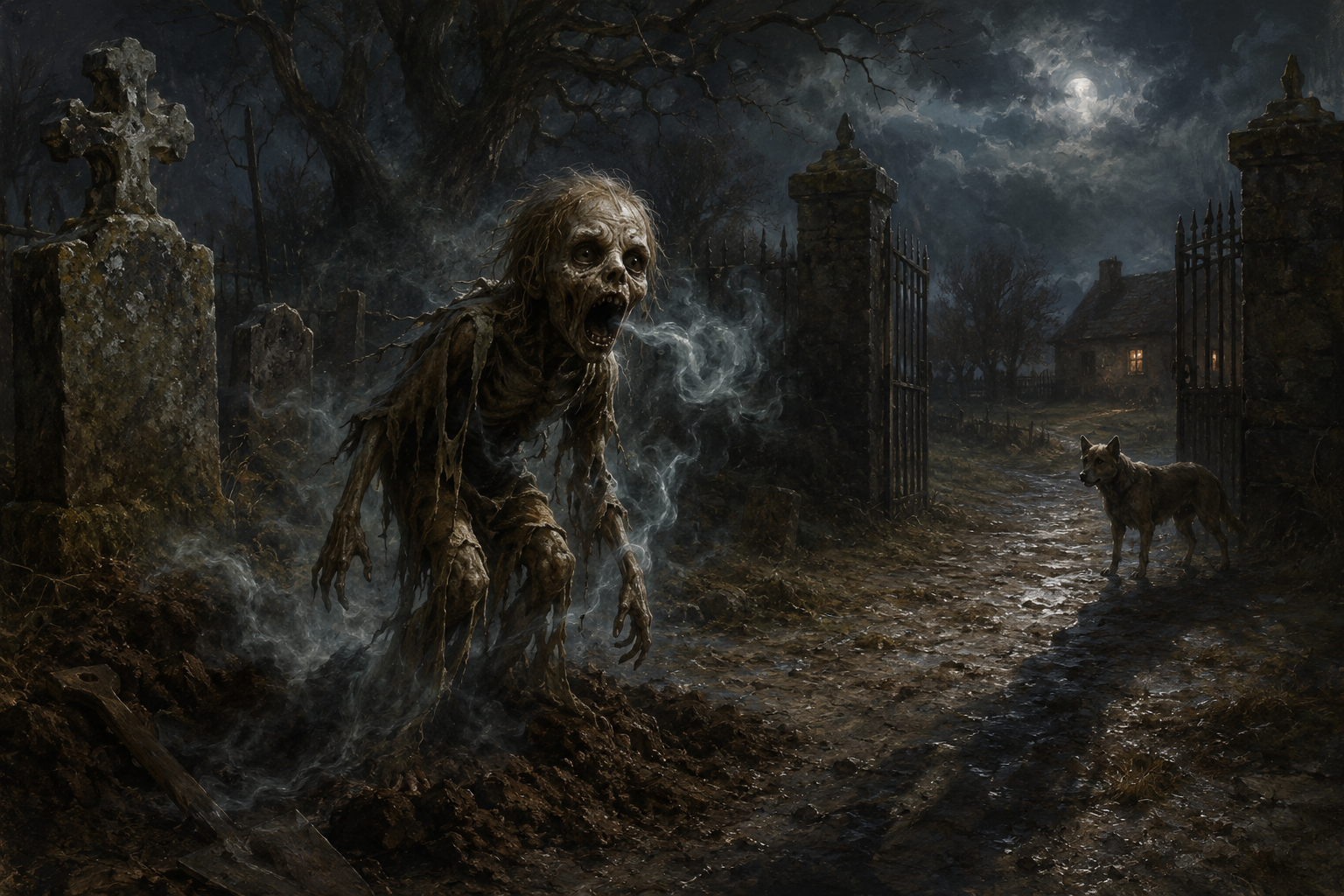
A drekavac is born when a child’s death is hurried, hidden, or denied. Plague takes the body. Fear takes the village. Neglect takes the name. What rises afterward is not a grieving spirit looking for comfort, but an undead cry wrapped in grave-rags and fever mist.
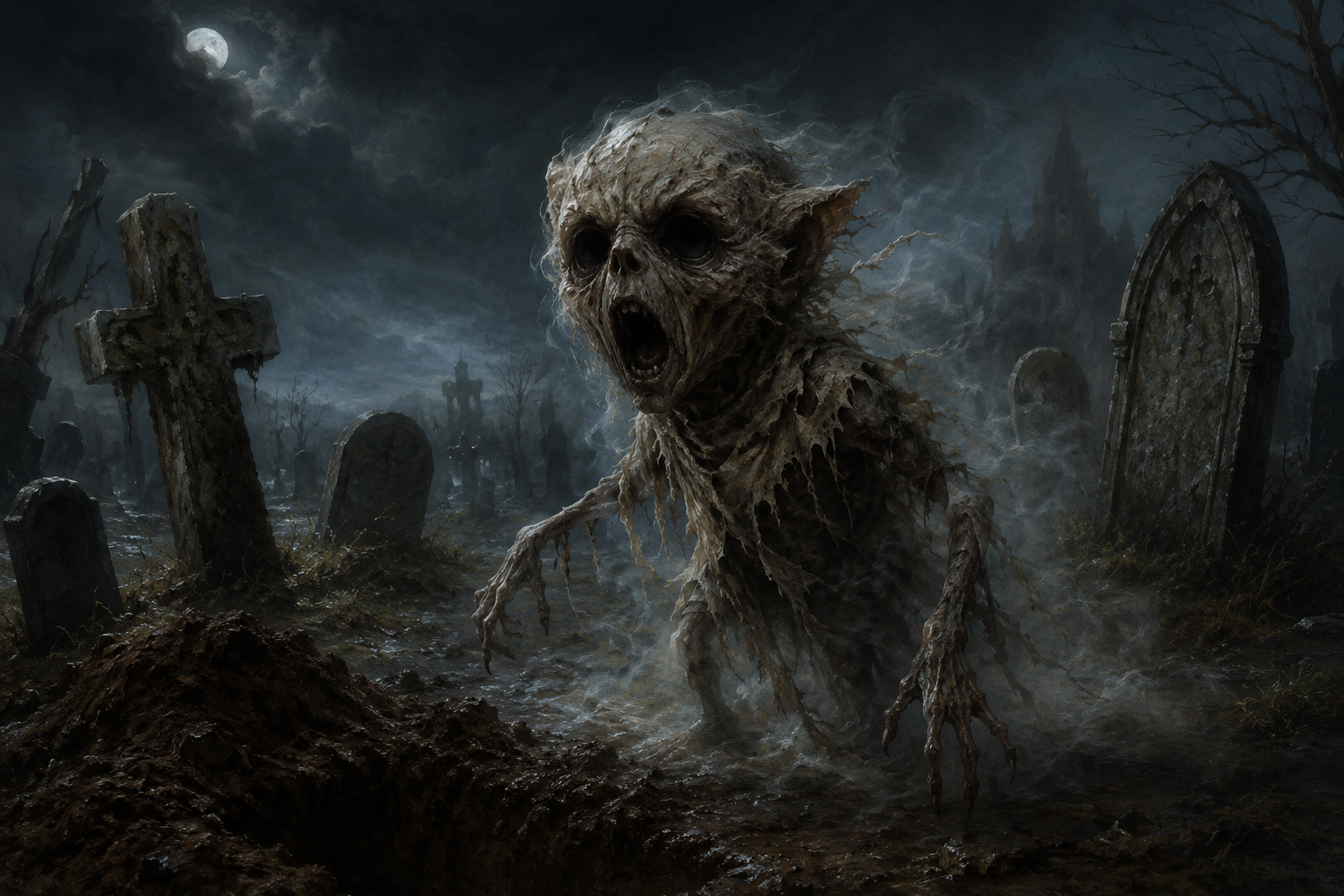
It comes small and thin, dressed in the ruins of burial cloth or the clothes it died in. Its body is child-sized, but its head is too large and too bestial, with a corpse-pale face pulled into animal angles. Its limbs are narrow as sticks. Its fingers are cold with grave soil. Its eyes are sunken pits of shadow, empty of pupil, iris, and mercy.
The first warning is usually the sound. A child cries from a graveyard, ditch, barn, plague cart, or sealed house. Anyone who follows the voice finds mist crawling along the ground, livestock trembling in their stalls, dogs refusing the road, and a shadow that falls where no shadow should.
A drekavac belongs naturally to plague villages, abandoned sickrooms, mass graves, and places touched by the Red Death. It is not proof that the dead child was wicked. It is proof that death was not allowed to finish cleanly.
Overview
A drekavac is a small undead plague-haunter that carries sickness through touch, shadow, and sound. It clings to places where children died badly: plague houses, burial trenches, cattle sheds, sickbeds, roadside ditches, sealed cottages, and graveyards expanded in panic.
The creature is not a random corpse-monster. A drekavac points to a broken passage from life to death. Someone was not named. Someone was not buried. Someone was shut in too soon, carried away too quickly, or erased from the record because the truth was inconvenient.
Adventurers can destroy the creature with weapons, cleansing magic, blessed salt, sunlight, or rites of remembrance. But a drekavac is strongest when the fight is only part of the problem. The monster asks a sharper question: who let the child become a sound instead of a soul?
Appearance
From a distance, a drekavac can be mistaken for a lost child crouched in rags. That mistake rarely survives the first look at its face.
Its oversized head hangs above a wasted body, suggesting dog, goat, corpse, and nightmare without fully becoming any one thing. Its mouth opens too wide when it cries. Its grave-rags cling wetly to its limbs. Cold mist leaks from its sleeves, mouth, and torn hems, pooling around its feet like breath from an opened trench.
In lantern light, its shadow is worse than its body. The shadow stretches too far, bends away from the flame, or falls toward the living with deliberate hunger. A drekavac may remain still while its shadow reaches first.
Habitat
Drekavacs haunt places where death was mishandled and memory has soured. They are most often found in plague villages, neglected graveyards, abandoned sickrooms, cattle sheds, sealed cottages, roadside burial ditches, and the edges of old quarantine grounds.
A drekavac seldom strays far from the place that made it. It may follow an old funeral road, return nightly to a family threshold, creep along the route of a plague cart, or linger near a grave boundary where the dead were placed outside accepted burial custom. In regions touched by the Red Death, a drekavac may mark a place where death occurred but did not pass cleanly into rest.
Its lair is usually small, filthy, and emotionally charged: a child’s grave, a locked room, a rotten cart, a well, a plague trench, a barn corner, or a collapsed cottage where the living once refused to enter.
Ecology
A drekavac is not part of the natural order. It does not eat, sleep, breed, or age. It is sustained by disease, fear, neglect, and the broken bond between the living and the dead.
Animals sense the wrongness before people do. Dogs refuse familiar lanes. Horses shy at empty corners. Cattle sicken or stop giving milk. Birds fall silent near the grave or room where the drekavac hides.
Although the creature may spread fatal disease, it should not create endless undead outbreaks. A new drekavac rises only when disease, child-death, failed burial, and supernatural corruption converge. Most plague deaths remain tragic mortal deaths. The drekavac is the exception: a sign that something about the death, burial, or remembrance went terribly wrong.
Behaviour
A drekavac announces itself through sound before it attacks. Its cry resembles a sick child calling from the dark, but the voice soon stretches into something animal, wet, and accusing.
It does not always rush its victims. It waits at thresholds, beneath windows, beside wells, in cattle sheds, or near the place where the dead were hidden. It may follow one household for nights before striking. It may lure the compassionate away from safety. It may plague animals first, turning the village’s economy and food supply into part of the horror.
The creature is drawn to guilt, but it is not just. It may begin near those responsible for its death, then spread sickness to servants, neighbours, healers, travellers, children, and anyone who answers its cry.
Mechanics Tabs
The rules below are mechanics tabs for different game versions.
Drekavac 5.5e / 2024
Drekavac Pathfinder 1e
Drekavac 5.5e / 2024
Small Undead, Neutral Evil
Armor Class: 14
Hit Points: 52 (15d6)
Speed: 20 ft.
| STR | DEX | CON | INT | WIS | CHA |
|---|---|---|---|---|---|
| 7 (-2) | 14 (+2) | 10 (+0) | 9 (-1) | 13 (+1) | 17 (+3) |
Saving Throws: Wis +3, Cha +5
Skills: Intimidation +5, Perception +3, Stealth +6
Damage Resistances: cold, necrotic; bludgeoning, piercing, and slashing from nonmagical attacks that are not silvered
Damage Immunities: poison
Condition Immunities: charmed, exhaustion, frightened, poisoned
Senses: darkvision 60 ft., passive Perception 13
Languages: understands the languages it knew in life but speaks only in cries, whispers, and broken phrases
Challenge: 4 (1,100 XP)
Proficiency Bonus: +2
Traits
Unnatural Aura. Beasts within 30 feet of the drekavac sense its unnatural presence. A beast that starts its turn in the aura must succeed on a DC 13 Wisdom saving throw or become frightened until the start of its next turn. A creature handling the beast can use its reaction to make a DC 15 Wisdom (Animal Handling) check, giving the beast advantage on the saving throw on a success.
Mist of the Grave. The drekavac can move through a space as narrow as 1 inch wide without squeezing while it is in dim light, darkness, fog, mist, smoke, or grave vapour. It cannot end its movement inside a solid object.
Sunlight Aversion. While in sunlight, the drekavac has disadvantage on attack rolls and ability checks, and it cannot use Mist of the Grave.
Blessed Salt. The drekavac cannot willingly cross an unbroken line of blessed salt. A creature can use an action to throw a handful of blessed salt at the drekavac within 20 feet. The drekavac must succeed on a DC 13 Dexterity saving throw or take 7 (2d6) radiant damage.
Rite-Bound Undead. If a creature casts Remove Curse, Lesser Restoration, Dispel Evil and Good, or similar cleansing magic directly on the drekavac, the drekavac must make a DC 15 Charisma saving throw. On a failed save, it takes 21 (6d6) radiant damage. If the caster also speaks the dead child’s name, completes an appropriate burial rite, returns a death token, or performs a meaningful act of remembrance tied to the haunting, the drekavac is destroyed instead.
Actions
Multiattack. The drekavac makes two attacks, using Chilling Grasp or Shadow Touch in any combination.
Chilling Grasp. Melee Spell Attack: +5 to hit, reach 5 ft., one target. Hit: 10 (2d6 + 3) cold damage plus 7 (2d6) necrotic damage, and the target must succeed on a DC 13 Constitution saving throw or become infected with grave fever.
Shadow Touch. Melee Spell Attack: +5 to hit, reach 10 ft., one creature in dim light or darkness. Hit: 12 (2d8 + 3) necrotic damage, and the target must succeed on a DC 13 Constitution saving throw or become infected with grave fever.
Sick-Child Cry. Each creature of the drekavac’s choice within 30 feet that can hear it must make a DC 13 Wisdom saving throw. On a failed save, a creature takes 10 (3d6) psychic damage and is frightened until the end of the drekavac’s next turn. On a failure by 5 or more, the creature is also incapacitated until the start of the drekavac’s next turn as the cry sounds like the voice of someone it failed, lost, or could not save. On a successful save, a creature takes half as much damage and is not frightened. A creature that succeeds on this save is immune to this drekavac’s Sick-Child Cry for 24 hours.
Grave Mist. The drekavac becomes misty until the start of its next turn. During this time, it has resistance to all damage except force and radiant damage, can move through creatures’ spaces, and does not provoke opportunity attacks. It cannot attack while misty.
Reaction
Wrong-Way Shadow. When a creature the drekavac can see misses it with a melee attack while both are in dim light or darkness, the drekavac forces that creature to make a DC 13 Dexterity saving throw. On a failed save, the creature is touched by the drekavac’s shadow, takes 7 (2d6) necrotic damage, and must make a saving throw against grave fever.
Disease: Grave Fever
A creature infected with grave fever begins showing symptoms after 1d4 hours unless magic or treatment intervenes. The symptoms include chills, swollen glands, nightmare crying, and dark marks like small grave-soiled fingerprints around the throat or wrist.
While infected, the creature has disadvantage on Constitution checks and cannot remove exhaustion during a long rest unless it succeeds on a DC 13 Constitution saving throw at the end of that rest. On a failed save, the creature gains 1 level of exhaustion. After two successful saves, the disease ends.
A creature that dies while infected with grave fever in a place of failed burial, mass plague, or broken rites may rise as a drekavac at the DM’s discretion. This should be rare and story-driven, not automatic.
Notes
The drekavac is a CR 4 plague-haunter, not a front-line brute. It should use darkness, mist, frightened animals, narrow village terrain, and disease pressure to make the encounter memorable.
Its strongest encounter spaces are graveyards, plague houses, barns, sickrooms, wells, narrow lanes, abandoned shrines, and rooms where lantern placement affects shadows.
Blessed salt and rite-based destruction give the party meaningful non-combat answers. The creature is still dangerous in a fight, but the strongest resolution comes from discovering the name, recovering the body, and repairing the wrong that made the haunting possible.
Drekavac Pathfinder 1e
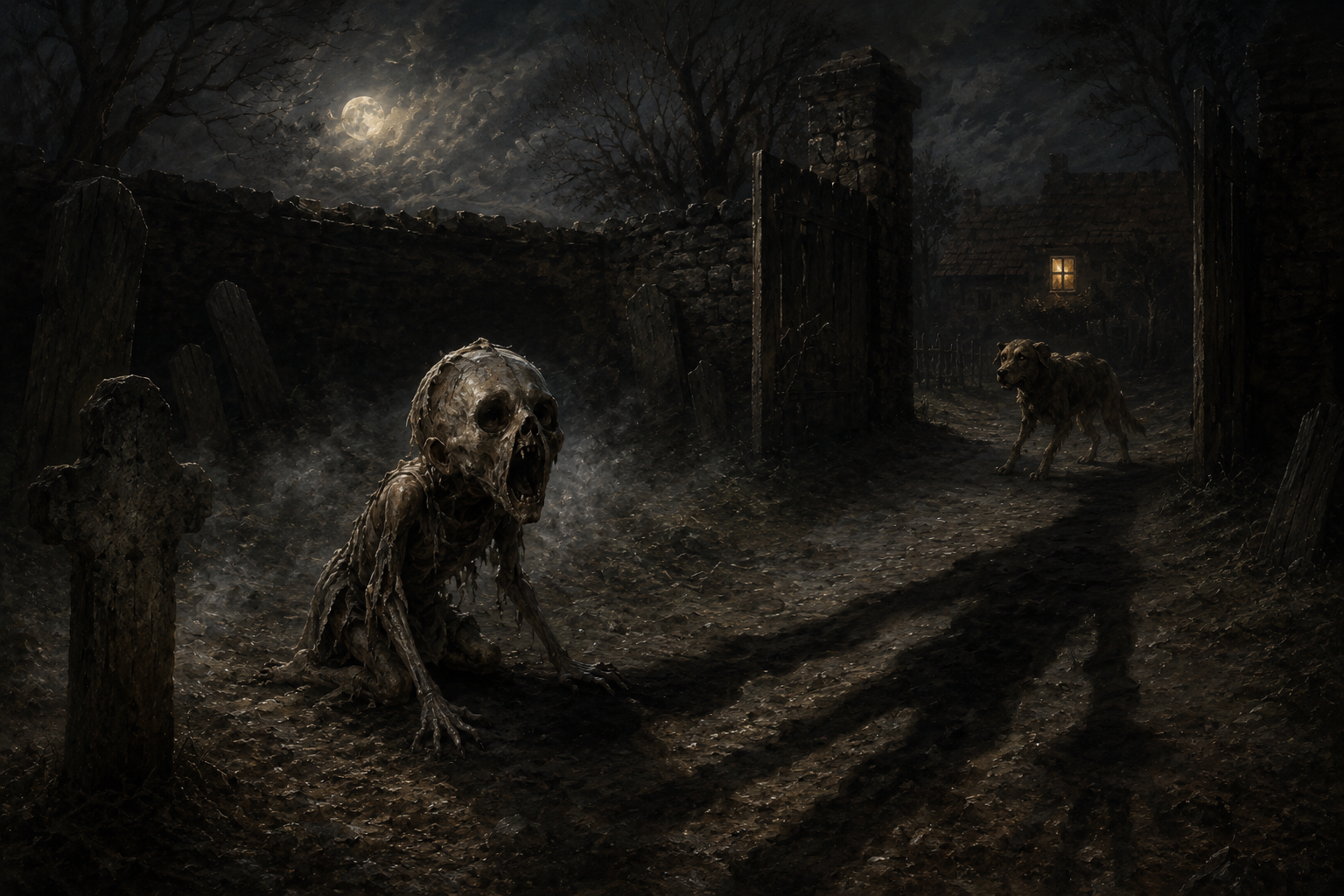
Dressed in graveyard rags, this pitiful creature cries out like a sick child. An oversized, bestial head perches atop its spindly, child-sized body, and its eyes are nothing but sunken pools of shadow with no trace of life in them. A cloying mist wreathes its frail form, accompanied by the stench of death and disease.
Originally posted on Archives of Nethys
Source Pathfinder #31: Stolen Land pg. 78
Drekavacs are the undead remains of children who perished from disease, particularly in plague-ridden areas where many such deaths occurred in a short period of time. Able to become as insubstantial as the mist rising from a graveyard on a cold, dark night, drekavacs are carriers of disease, seeking to infect the living with the afflictions that slew them. According to some stories, drekavacs only result from young plague victims who remain unburied or died bereft of the proper funeral rites; performing those rites may allow their spirits to rest and no longer haunt the world of the living.
| Drekavac CR 3 |
| XP 800 NE Small undead Init +1; Senses Darkvision 60 ft.; Perception +8 Aura unnatural aura (30 ft.) |
| Defense |
| AC 15, touch 12, flat-footed 14 (+1 Dexterity, +3 natural, +1 size) hp 30 (4d8+12) Fort +4, Ref +2, Will +7 DR 5/silver; Immune undead traits |
| Offense |
| Speed 20 ft. Melee chilling grasp +5 touch (1d6 cold plus disease) or shadow +5 touch (disease) Special Attacks create spawn, disease, diseased shadow Spell-Like Abilities (CL 5th; Concentration +8) At will – gaseous form |
| STATISTICS |
| Strength 10, Dexterity 12, Constitution -, Intelligence 9, Wisdom 12, Charisma 17 Base Atk +3; CMB +2; CMD 13 Feats Iron Will, Weapon Finesse Skills Intimidate +10, Perception +8, Stealth +12 Languages Common |
| ECOLOGY |
| Environment any Organization solitary or pack (2-5) Treasure none |
| Special Abilities |
| Create Spawn (Su) A child slain by a drekavac’s disease has a 1-in- 6 chance of rising as another drekavac 3 days after death. The new drekavac is not in any way controlled by its maker, and is immediately capable of exercising its full powers, including creating spawn of its own. It does not possess any of the abilities it had in life. Disease (Su) Drekavacs are spirits of disease and contagion. While most drekavacs carry Bubonic Plague, drekavacs who died from other afflictions may carry those diseases instead. Any illness caused by a drekavac must be potentially fatal. Other diseases commonly carried include demon fever, Filth fever, and Slimy Doom. If a drekavac is reduced to 0 hit points (from weapons or other sources, including channeled energy), all of the diseases it caused are cured, although the victims must recover from any effects normally, and slain victims are not restored. Bubonic Plague: Touch – injury; save Fort DC 15; onset 1 day; frequency 1/day; effect 1d4 Constitution damage, 1 Charisma damage, victim is fatigued; cure 2 consecutive saves. Diseased Shadow (Su) Any creature touched by a drekavac’s shadow is also affected by the creature’s disease ability. If there is a question about which way the drekavac’s shadow falls, roll 1d8 to determine a random square around the creature. A character with a light source cannot be touched by the drekavac’s shadow, but the light causes the shadow to fall directly opposite the character (unless there is another light source there as well). A drekavac can deliberately touch a creature with its shadow as a standard action by making a successful touch attack. A target missed by the drekavac’s chilling grasp attack must make a DC 15 Reflex save to avoid being touched by the creature’s shadow as well. This save DC is Charisma-based. Sunlight Aversion (Ex) Drekavacs hate natural sunlight and immediately flee from it. A drekavac caught in natural sunlight is staggered. Unnatural Aura (Su) animals, wild or domesticated, can sense the unnatural presence of a drekavac at a distance of 30 feet. They do not willingly approach nearer than that and panic if forced to do so unless a master succeeds at a DC 25 Handle Animal, Ride, or wild empathy check. Panicked animals remain so as long as they are within 30 feet of the drekavac. Vulnerability to Magic (Ex) A remove curse or remove disease spell cast directly upon a drekavac (DC equal to the drekavac’s disease ability) immediately destroys the creature, allowing the afflicted soul to move on. Destroying a drekavac with remove curse or remove disease does not cure any of the creatures diseases. Vulnerability to Salt (Ex) Drekavacs are vulnerable to salt that has been consecrated in the same fashion as Holy Water, and cannot cross an unbroken line of blessed salt. A handful of blessed salt thrown at a drekavac inflicts the same damage as a flask of Holy Water . |
Combat Tactics
A drekavac avoids fair fights. It uses darkness, mist, corners, graves, wells, barns, and narrow lanes to keep control of the encounter.
It opens with its cry to frighten and divide victims, then attacks through touch and shadow. Its shadow is often more dangerous than its claws. In dim light, it tries to place itself so lanterns, doorways, and moonlight make its shadow fall across the living.
If pressed, it becomes mist and slips through cracks, grave markers, floorboards, or broken masonry. It flees natural sunlight and avoids blessed salt. Parties that fight it without investigating the haunting may destroy the body but leave the cause unresolved.
The best encounters force players to manage light, animals, disease, frightened villagers, and moral urgency at the same time.
Adventure Hooks
The Cry Beneath the Wall
Every night, a child cries from beneath the old graveyard wall. The villagers insist all plague dead were buried properly, but the wall was rebuilt after the outbreak, and several bodies were left outside the former burial boundary.
The drekavac cannot rest until the forgotten trench is found and the dead are named.
The Reeve’s Cattle
A reeve hires the adventurers to kill whatever is spreading disease through his herd. The poor know another story: during the plague, he sealed infected tenants inside their cottages to save the manor and its livestock.
The drekavac appears first among the cattle, then at the reeve’s nursery window.
The Plague Cart Returns
A cart used during the plague is found overturned in a hollow road, though it was supposedly burned years ago. Each night, the drekavac crawls from beneath it and follows the old wheel ruts toward the village.
Inside the cart are stolen coins, death tokens, and a ledger showing who was buried alive beneath the dead.
Treasure
A drekavac carries no treasure. The value lies in what was left with the dead, stolen from them, or hidden to conceal the circumstances of their burial.
Useful finds include a child’s silver charm, a household death token, a carved wooden animal, a torn name-cloth, a plague ledger, a sealed purse taken from the infected, a funerary bell, or a healer’s satchel containing antiplague, antitoxin, and notes naming the first victims.
These objects should matter as evidence, memory, guilt, or ritual anchors. The best treasure in a drekavac story is usually not coin. It is the thing that proves who the child was.
Ending the Haunting
A drekavac can be destroyed in combat, but that may only silence the scream for a time. If the place that made the monster remains unchanged, the sickness may end while the wound remains.
The haunting may end permanently if the characters:
- Identify the dead child by name.
- Recover or properly inter the body.
- Complete the burial or household rites denied to the dead.
- Return a stolen death token, charm, or grave marker.
- Cleanse the plague house, cart, well, or grave pit tied to the haunting.
- Publicly expose the official, family, healer, or landlord responsible for the failed burial.
- Protect a living relative still bound to the haunting.
- Record the dead honestly in village, temple, clan, or civic memory.
If the party kills the drekavac but ignores the truth, the consequence should not always be another monster. Sometimes the punishment is social: a village feud, a family curse, a lord’s scandal, a broken inheritance, a forbidden well, a cattle blight, or a Red Death marker that draws corpse-hunters, priests, plague wardens, or worse undead attention.
Source, Folklore, and Game Context
The drekavac comes from South Slavic folklore, where its name is commonly associated with screaming, shrieking, or crying out. Traditional descriptions vary widely by region. It may appear as an undead child, an unquiet corpse, a grave-haunting revenant, a doglike humanoid, a soldier-ghost, or a strange animal omen. The stable core of the creature is not a single anatomy, but a night cry, a fear of unquiet death, and the sense that something has gone wrong between burial and rest. For an accessible overview of the folkloric figure, see Drekavac.
Older traditions often connect the drekavac with improper death, failed rites, graveyards, death omens, illness, and cattle disease. Some accounts describe its cry as a warning of human death, while animal-associated forms may foreshadow sickness among livestock. In this late medieval myth-history, those elements translate naturally into plague panic, unclaimed dead, denied burial, erased names, mass graves, and the Red Death’s failure to let death pass cleanly into memory and rest.
The Pathfinder version of the drekavac appears in Pathfinder Adventure Path #31: Stolen Land and is available through Archives of Nethys as a Small undead creature associated with plague, mist-like movement, diseased shadow, sunlight aversion, blessed salt, and destruction through disease-cleansing or curse-breaking magic. See Archives of Nethys: Drekavac and Pathfinder #31: Stolen Land.
For game use, the drekavac works best as a plague-haunting rather than a generic undead child. Its horror comes from the social failure around the death: who was not buried, who was not named, who was sealed away, who profited, and who still hears the crying after everyone else insists the matter is finished.
Keep this reference growing
If this page helped with your reading or game, you can support its upkeep or explore the curated books.
Explore the Bookshop — epics, classics and stories behind imagined worlds.