
Devourer — The Soul Gaoler
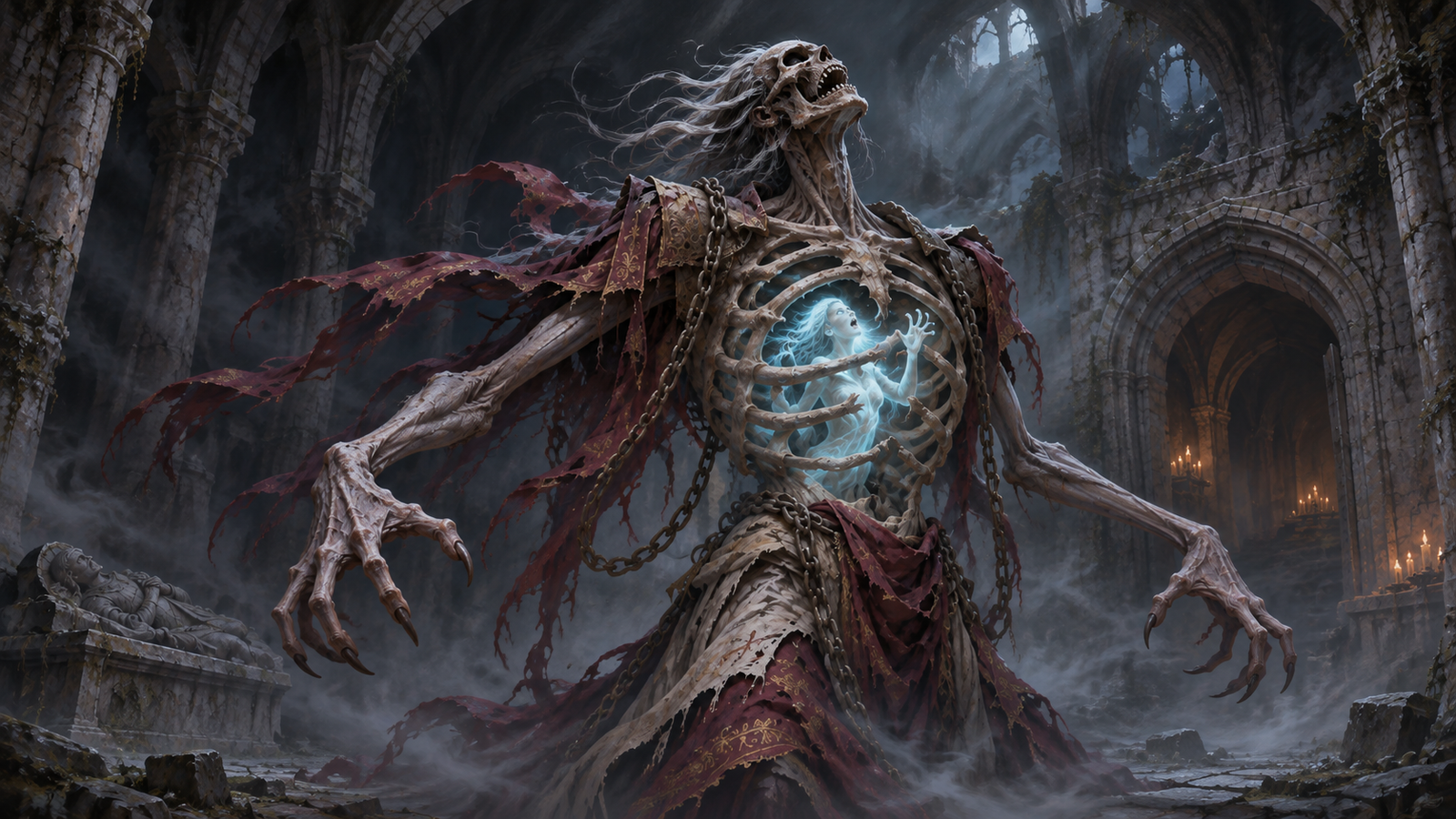
The watchers first hear a voice from the burial vault asking to be set free. When the bronze door swings open, the speaker is revealed as a tiny figure imprisoned between the ribs of a towering corpse. The gaunt monster bends its skull toward the intruders, and the voice calls out their names.
At a Glance
| Creature | Large Undead; a gaunt, intelligent soul-jailer |
|---|---|
| Alignment | Neutral Evil |
| Origin | Former fiends or mortal spellcasters transformed by death magic |
| Haunts | Crypts, ruined citadels and forgotten planar crossings |
| Signs | A captive voice inside a corpse; souls missing from the dead |
| Threat | Soul imprisonment, energy-draining claws and stolen magic |
| Defences | Free the imprisoned soul; prevent new captives; disrupt its magic |
A devourer does not feed on flesh. It captures the final remnant of a living person and burns that soul to sustain terrible magic. Its body is a long-limbed corpse of desiccated bone and sinew, so large that a man can stand beneath its hanging arms. Within the ribs, the captive appears as a miniature apparition, still able to move and sometimes to plead.
Game Statistics
Devourer — D&D 2024
Large Undead, Neutral Evil · CR 11 (7,200 XP; PB +4) · Original adaptation
AC 17 (natural armour); Initiative +2 (12); HP 172 (15d10 + 90); Speed 30 ft.
| Ability | Score | Modifier | Save |
|---|---|---|---|
| STR | 24 | +7 | +7 |
| DEX | 14 | +2 | +2 |
| CON | 22 | +6 | +10 |
| INT | 16 | +3 | +3 |
| WIS | 16 | +3 | +7 |
| CHA | 20 | +5 | +9 |
Skills Arcana +7, Perception +7; Damage Resistances Cold, Necrotic; Damage Immunity Poison; Condition Immunities Charmed, Exhaustion, Frightened, Poisoned; Senses Darkvision 120 ft., Passive Perception 17; Languages Abyssal, Infernal and one mortal language stolen from its captives; Telepathy 60 ft.
Traits
Soul Prison. The devourer can hold the soul of one dead Humanoid. While a soul is imprisoned, its owner cannot be returned to life by ordinary resurrection magic; destroying the devourer or a Wish frees the soul. The devourer cannot trap another soul until the first is freed or destroyed.
Stolen Power. While a soul is imprisoned, the devourer can use Soul Blight and cast Fear (save DC 17) or Blight (save DC 17) once each per day without components. Without a captive soul these powers are unavailable.
Actions
Multiattack. The devourer makes two Claw attacks.
Claw. Melee Attack Roll: +11, reach 10 ft., one creature. Hit: 18 (2d10 + 7) Slashing plus 9 (2d8) Necrotic damage.
Soul Blight (Recharge 5–6). Constitution Saving Throw: DC 17, each living creature in a 20-ft. Emanation originating from the devourer. Failure: 36 (8d8) Necrotic damage and the creature cannot regain Hit Points until the end of its next turn. Success: half damage only.
Reactions
Seize the Departing Soul (1/Day). When a Humanoid within 10 ft. dies while the devourer has no captive soul, it catches that soul in its chest. The dead Humanoid’s soul remains imprisoned until freed. This reaction cannot be used against a creature whose soul is already bound elsewhere or protected against soul capture.
Original D&D 2024 CR 11 monster adaptation, not official Monster Manual or SRD devourer statistics.
Devourer — D&D 2014
Large Undead, Neutral Evil · CR 11 (7,200 XP) · Original adaptation
AC 17 (natural armour); HP 172 (15d10 + 90); Speed 30 ft.
| STR | DEX | CON | INT | WIS | CHA |
|---|---|---|---|---|---|
| 24 (+7) | 14 (+2) | 22 (+6) | 16 (+3) | 16 (+3) | 20 (+5) |
Saving Throws Constitution +10, Wisdom +7, Charisma +9; Skills Arcana +7, Perception +7; Damage Resistances Cold and Necrotic; Damage Immunity Poison; Condition Immunities Charmed, Exhaustion, Frightened, Poisoned; Senses Darkvision 120 ft., Passive Perception 17; Languages Abyssal, Infernal and one mortal language stolen from its captives; Telepathy 60 ft.
Traits
Imprison Soul. The devourer can contain a single slain humanoid’s soul in its ribs. The victim cannot be raised from the dead by ordinary resurrection spells while imprisoned. A Wish spell or the devourer’s destruction releases the captive soul.
Essence Magic. While its chest holds a soul, the devourer can cast Fear (save DC 17) and Blight (save DC 17), each once per day without components. It also gains access to Soul Blight. All these powers cease when the soul is lost.
Actions
Multiattack. Two Claw attacks.
Claw. Melee Weapon Attack: +11 to hit, reach 10 ft., one creature. Hit: 18 (2d10 + 7) slashing damage plus 9 (2d8) necrotic damage.
Soul Blight (Recharge 5–6). Each living creature within 20 ft. makes a DC 17 Constitution saving throw or takes 36 (8d8) necrotic damage and cannot regain hit points until the end of its next turn. On a success, the target takes half damage without the healing restriction.
Reactions
Seize the Departing Soul (1/Day). When a Humanoid within 10 ft. dies and the devourer has no captive, it captures the departing soul until the devourer is destroyed or the soul is freed by Wish. Protected or already bound souls cannot be captured this way.
Original D&D 2014-compatible CR 11 adaptation, distinct from commercial published devourers.
Devourer — Pathfinder 1e
NE Large Undead (Extraplanar) · CR 11 (12,800 XP) · Bestiary
Initiative +7; Senses Darkvision 60 ft., Perception +20; AC 25, touch 12, flat-footed 22 (+3 Dex, +13 natural, −1 size); HP 133 (14d8 + 70); Fort +9, Ref +7, Will +12; Defence Spell Deflection, Undead traits; SR 22.
Speed 30 ft., Fly 20 ft. (perfect); Melee 2 Claws +18 (1d8 + 9 plus Energy Drain); Space/Reach 10 ft./10 ft.; Special Attacks Devour Soul, Energy Drain (one negative level, DC 20).
| STR | DEX | CON | INT | WIS | CHA |
|---|---|---|---|---|---|
| 28 (+9) | 16 (+3) | — | 19 (+4) | 16 (+3) | 21 (+5) |
BAB +10; CMB +20; CMD 33; Feats Blind-Fight, Cleave, Combat Casting, Combat Expertise, Improved Initiative, Improved Sunder, Power Attack.
Skills Bluff +19, Diplomacy +14, Fly +19, Intimidate +19, Knowledge (arcana) +21, Knowledge (planes) +18, Perception +20, Sense Motive +17, Spellcraft +21, Stealth +6; Languages Abyssal, Celestial, Infernal and one mortal language stolen from its captives; Telepathy 100 ft.; Ecology any environment, solitary, standard treasure.
Special Abilities
Devour Soul (Su). A melee touch attack as a Standard Action inflicts 12d6 + 18 damage, or 3d6 + 18 on a successful DC 22 Fortitude save. A creature killed by it has its soul trapped between the ribs. One captive soul at a time. The captive generates five essence points per Hit Die, and every use of a spell-like ability spends points equal to the spell level. A captive loses one permanent negative level for every five points expended. The soul may be released by destroying the devourer or successfully using the counter in Spell Deflection. If fully consumed, it requires Miracle or Wish to restore.
Spell Deflection (Su). If a targeted mental or banishment spell overcomes the devourer’s SR, a captive soul receives it instead. The caster can attempt a DC 25 caster-level check; success frees the imprisoned soul. The source specifies the affected spells, including Banishment, Confusion, Dominate Person and Suggestion.
Spell-Like Abilities (CL 18th, at will while essence remains): Animate Dead (4 points); Bestow Curse (4, DC 19); Confusion (4, DC 19); Control Undead (7, DC 22); Death Knell (2, DC 17); Ghoul Touch (2, DC 17); Inflict Serious Wounds (3, DC 18); Lesser Planar Ally (4); Ray of Enfeeblement (1); Spectral Hand (2); Suggestion (3, DC 18); True Seeing (6); Vampiric Touch (3, DC 18). A typical encounter begins with 3d4 + 3 essence points remaining.
Source: Pathfinder RPG Bestiary — Devourer, Paizo 2009, OGL 1.0a.
Devourer — D&D 3.5e
Always Neutral Evil · Large Undead (Extraplanar) · CR 11 · SRD
HD 12d12 (78 hp); Initiative +4; Speed 30 ft.; AC 24 (−1 size, +15 natural), touch 9, flat-footed 24; BAB/Grapple +6/+19; Attack Claw +15 melee (1d6 + 9); Full Attack 2 Claws +15 melee (1d6 + 9); Space/Reach 10 ft./10 ft.; Fort +4, Ref +4, Will +11.
| STR | DEX | CON | INT | WIS | CHA |
|---|---|---|---|---|---|
| 28 (+9) | 10 (+0) | — | 16 (+3) | 16 (+3) | 17 (+3) |
Special Attacks Energy Drain, Trap Essence, Spell-Like Abilities; Special Qualities Darkvision 60 ft., Spell Deflection, Spell Resistance 21, Undead traits.
Skills Climb +24, Concentration +18, Diplomacy +5, Jump +24, Listen +18, Move Silently +15, Search +10, Sense Motive +11, Spot +18, Survival +3 (+5 tracking); Feats Blind-Fight, Combat Casting, Combat Expertise, Improved Initiative, Weapon Focus (claw); Organisation solitary; Treasure none; Advancement 13–24 HD (Large), 25–36 HD (Huge).
Special Abilities
Energy Drain (Su). A living creature struck by a Claw or Spectral Hand gains one negative level. A DC 19 Fortitude save prevents the level becoming permanent when the rules allow the save.
Trap Essence (Su). Instead of its ordinary attacks, the devourer makes one melee attack against a creature. The attack inflicts no weapon damage, but can kill and trap the victim’s essence (Fort DC 19 negates). One captive at a time. The soul fuels five uses of the devourer’s Spell-Like Abilities per Hit Die or level of the captive. Every five uses inflicts one negative level on that essence. Destroying the devourer or using Limited Wish, Miracle or Wish frees the soul. Upon release, the captive faces DC 19 Fortitude saves against each negative level gained during imprisonment.
Spell-Like Abilities (CL 18th; once per round while the trapped soul remains): Confusion (DC 17), Control Undead (DC 20), Ghoul Touch (DC 15), Lesser Planar Ally, Ray of Enfeeblement, Spectral Hand, Suggestion (DC 16), True Seeing. At an encounter’s start, assume 3d4 + 3 levels worth of essence, sufficient for multiple uses as detailed by the source.
Spell Deflection (Su). Mental compulsions and selected banishment spells that overcome SR can strike the captive essence instead. The devourer’s source lists the qualifying spells, including Banishment, Confusion, Geas/Quest, Holy Word and Suggestion; some destroy or release the captive and deny the creature its magical fuel.
Source: D&D 3.5e System Reference Document — Devourer, OGL 1.0a.
What Is Happening Right Now?
At an abandoned watch-house beside an old pilgrim road, two travellers have been found dead without a mark upon them. The third returns at dawn, shaking with fear: she saw one of her companions imprisoned as a pale, struggling figure between the ribs of an enormous corpse. A relic-keeper insists that the vault below the road has stood sealed for a century. The survivor knows where its bronze doors open, but refuses to descend again.
The Monster in the Vault
The devourer knows the routes that living travellers take toward its lair. It gathers the dying, not trophies of flesh, and prefers a wounded pilgrim, a desperate magician or a wounded guard separated from companions. A creature trapped in its chest may still know who it is and may recognise someone in the party. Its voice is both a warning and a weapon: the devourer may use a loved one’s plea to lure rescuers close. Even a priest prepared to offer Resurrection must first contend with the imprisonment of the soul.
Signs Before the Encounter
- Worn footprints lead into the burial vault, but no trail comes out
- A living witness describes a voice that spoke from the chest of an enormous corpse
- A priest cannot restore a recently slain traveller and finds no ordinary cause
- The wight at the end of the corridor bows to a larger shadow that never appears in daylight
The Prisoner in the Vault
The captive’s pleading voice reaches the corridor before the devourer comes into view. Behind the shattered pillars, a blue-white face shifts between its ribs. The creature waits until one rescuer has passed the broken screen of stone, then advances with its claws extended. Should the soul be freed, the pale light inside its chest goes out and its stolen magic fails. The gold scattered across the floor matters little beside the chance to restore the dead.
Those who can reach the exit may save themselves and the dying without facing the creature’s claws. A priest or planar scholar who recognises its nature might know how to release the soul held in its ribs. The imprisonment resembles Trap the Soul, but there is no enchanted gemstone to shatter: the prison is the devourer’s own body, and the captive’s release depends on the powers and countermeasures of the creature itself.
The Souls It Was Before
Former devils. Some devourers were once lawful spirits in the service of Hell. Their fall into Neutral Evil undeath severs old authority; they may still speak as magistrates and demand oaths no infernal superior recognises.
Former daemons. Others come from the waste of Abaddon. Such beings regard the captive soul as fuel and keep careful accounts of how much power remains. Their discipline is cold rather than lawful.
Former demons. A devourer born from an Abyssal fiend often retains a taste for humiliation, but the need for stolen souls governs its new existence. It need not remain loyal to old demonic patrons or schemes.
Ruined mortal spellcasters. Others were once humans or other mortal necromancers who traded too much for planar power. They may remember a home, a family name or an unfinished bargain without retaining any compassion for those left behind.
Three Encounters
The Starved Vault. The abbey’s dead have been gathered behind an iron grille, yet no body bears the marks of a blade. The devourer prowling the crypt has spent its last captive soul and now hunts for another. Its ribs are dark, and the magic once drawn from the prisoner no longer answers it. A dying porter lies hidden beneath the altar, guarded by the only novice who survived the first attack. The devourer can seize a departing soul if the porter dies nearby; the living must reach him before its claws do.
The Keeper of the Unquiet Gate. A ruined archway between Midgard and the Ethereal Plane is watched by a towering corpse. The captive in its chest is the gate’s former keeper, who alone remembers the words that will close the passage. A procession of spirits has begun to emerge at dusk. To stop it, the company must get close enough to hear the prisoner’s whispered instructions and free the soul before the devourer consumes what remains of it.
The Reckoning of the Dead Scribe. A monastery’s missing records are found in the hands of a silent messenger who refuses to cross the threshold of its chapel. His former master, a necromancer believed dead for thirty years, has returned as a devourer. The figure trapped in its ribs was once the monastery’s scribe and knows where the stolen deeds and burial accounts were concealed. His release could restore property to families robbed of their land, but the necromancer’s surviving servants will destroy the evidence before allowing that truth to be heard.
When the Soul Prison Breaks
The freed voice may belong to a prisoner whose body is lost, an enemy who remembers the party’s faces, or an ally whose absence has already changed events elsewhere. Freeing a soul is not automatically the same as restoring its former life.
Friends may demand burial, resurrection, or a journey to recover the victim’s remains. If the devourer escapes, it hunts for another captive and avoids the tactics that nearly destroyed it.
Related Undead and Magic
A wraith creates subordinate spirits and drains vitality; a spectre assaults the living through its incorporeal touch; a revenant hunts one named murderer; a devourer traps souls to power its magic. A nightwalker belongs to the deeper nightshade family and commands the dead for a different purpose. Read the Create Greater Undead spell when preparing a necromancer encounter.
Sources and Licences
The local devourer remembers one mortal language from its imprisoned souls instead of universal Common. The original source creatures may list Common; this is an explicit campaign change that preserves the number of languages and the stated telepathy.
Pathfinder 1e: Devourer, Pathfinder RPG Bestiary, Paizo 2009, OGL 1.0a. D&D 3.5e: Devourer, System Reference Document, OGL 1.0a. The D&D 2024 and D&D 2014 stat blocks, the starvation variation and all setting-specific encounters are independent adaptations, not official Wizards of the Coast statistics.
Return to the Undead Bestiary.
Full Open Game License 1.0a and Section 15 notices
OPEN GAME LICENSE Version 1.0a
The following text is the property of Wizards of the Coast, Inc. and is Copyright 2000 Wizards of the Coast, Inc (“Wizards”). All Rights Reserved.
1. Definitions: (a)”Contributors” means the copyright and/or trademark owners who have contributed Open Game Content; (b)”Derivative Material” means copyrighted material including derivative works and translations (including into other computer languages), potation, modification, correction, addition, extension, upgrade, improvement, compilation, abridgment or other form in which an existing work may be recast, transformed or adapted; (c) “Distribute” means to reproduce, license, rent, lease, sell, broadcast, publicly display, transmit or otherwise distribute; (d)”Open Game Content” means the game mechanic and includes the methods, procedures, processes and routines to the extent such content does not embody the Product Identity and is an enhancement over the prior art and any additional content clearly identified as Open Game Content by the Contributor, and means any work covered by this License, including translations and derivative works under copyright law, but specifically excludes Product Identity. (e) “Product Identity” means product and product line names, logos and identifying marks including trade dress; artifacts; creatures characters; stories, storylines, plots, thematic elements, dialogue, incidents, language, artwork, symbols, designs, depictions, likenesses, formats, poses, concepts, themes and graphic, photographic and other visual or audio representations; names and descriptions of characters, spells, enchantments, personalities, teams, personas, likenesses and special abilities; places, locations, environments, creatures, equipment, magical or supernatural abilities or effects, logos, symbols, or graphic designs; and any other trademark or registered trademark clearly identified as Product identity by the owner of the Product Identity, and which specifically excludes the Open Game Content; (f) “Trademark” means the logos, names, mark, sign, motto, designs that are used by a Contributor to identify itself or its products or the associated products contributed to the Open Game License by the Contributor (g) “Use”, “Used” or “Using” means to use, Distribute, copy, edit, format, modify, translate and otherwise create Derivative Material of Open Game Content. (h) “You” or “Your” means the licensee in terms of this agreement.
2. The License: This License applies to any Open Game Content that contains a notice indicating that the Open Game Content may only be Used under and in terms of this License. You must affix such a notice to any Open Game Content that you Use. No terms may be added to or subtracted from this License except as described by the License itself. No other terms or conditions may be applied to any Open Game Content distributed using this License.
3. Offer and Acceptance: By Using the Open Game Content You indicate Your acceptance of the terms of this License.
4. Grant and Consideration: In consideration for agreeing to use this License, the Contributors grant You a perpetual, worldwide, royalty-free, non-exclusive license with the exact terms of this License to Use, the Open Game Content.
5. Representation of Authority to Contribute: If You are contributing original material as Open Game Content, You represent that Your Contributions are Your original creation and/or You have sufficient rights to grant the rights conveyed by this License.
6. Notice of License Copyright: You must update the COPYRIGHT NOTICE portion of this License to include the exact text of the COPYRIGHT NOTICE of any Open Game Content You are copying, modifying or distributing, and You must add the title, the copyright date, and the copyright holder’s name to the COPYRIGHT NOTICE of any original Open Game Content you Distribute.
7. Use of Product Identity: You agree not to Use any Product Identity, including as an indication as to compatibility, except as expressly licensed in another, independent Agreement with the owner of each element of that Product Identity. You agree not to indicate compatibility or co-adaptability with any Trademark or Registered Trademark in conjunction with a work containing Open Game Content except as expressly licensed in another, independent Agreement with the owner of such Trademark or Registered Trademark. The use of any Product Identity in Open Game Content does not constitute a challenge to the ownership of that Product Identity. The owner of any Product Identity used in Open Game Content shall retain all rights, title and interest in and to that Product Identity.
8. Identification: If you distribute Open Game Content You must clearly indicate which portions of the work that you are distributing are Open Game Content.
9. Updating the License: Wizards or its designated Agents may publish updated versions of this License. You may use any authorized version of this License to copy, modify and distribute any Open Game Content originally distributed under any version of this License.
10. Copy of this License: You MUST include a copy of this License with every copy of the Open Game Content You Distribute.
11. Use of Contributor Credits: You may not market or advertise the Open Game Content using the name of any Contributor unless You have written permission from the Contributor to do so.
12. Inability to Comply: If it is impossible for You to comply with any of the terms of this License with respect to some or all of the Open Game Content due to statute, judicial order, or governmental regulation then You may not Use any Open Game Material so affected.
13. Termination: This License will terminate automatically if You fail to comply with all terms herein and fail to cure such breach within 30 days of becoming aware of the breach. All sublicenses shall survive the termination of this License.
14. Reformation: If any provision of this License is held to be unenforceable, such provision shall be reformed only to the extent necessary to make it enforceable.
15. COPYRIGHT NOTICE
Open Game License v 1.0a Copyright 2000, Wizards of the Coast, Inc.
System Reference Document Copyright 2000-2003, Wizards of the Coast, Inc.; Authors Jonathan Tweet, Monte Cook, Skip Williams, Rich Baker, Andy Collins, David Noonan, Rich Redman, Bruce R. Cordell, John D. Rateliff, Thomas Reid, James Wyatt, based on original material by E. Gary Gygax and Dave Arneson.
Pathfinder Roleplaying Game Core Rulebook © 2009, Paizo Publishing, LLC; Author: Jason Bulmahn, based on material by Jonathan Tweet, Monte Cook, and Skip Williams.
Pathfinder RPG Bestiary © 2009, Paizo Publishing, LLC; Author: Jason Bulmahn, based on material by Jonathan Tweet, Monte Cook, and Skip Williams.
Keep this reference growing
If this page helped with your reading or game, you can support its upkeep or explore the curated books.
Explore the Bookshop — epics, classics and stories behind imagined worlds.