
Punchinello — King of Puppets, Nascent Demon Lord
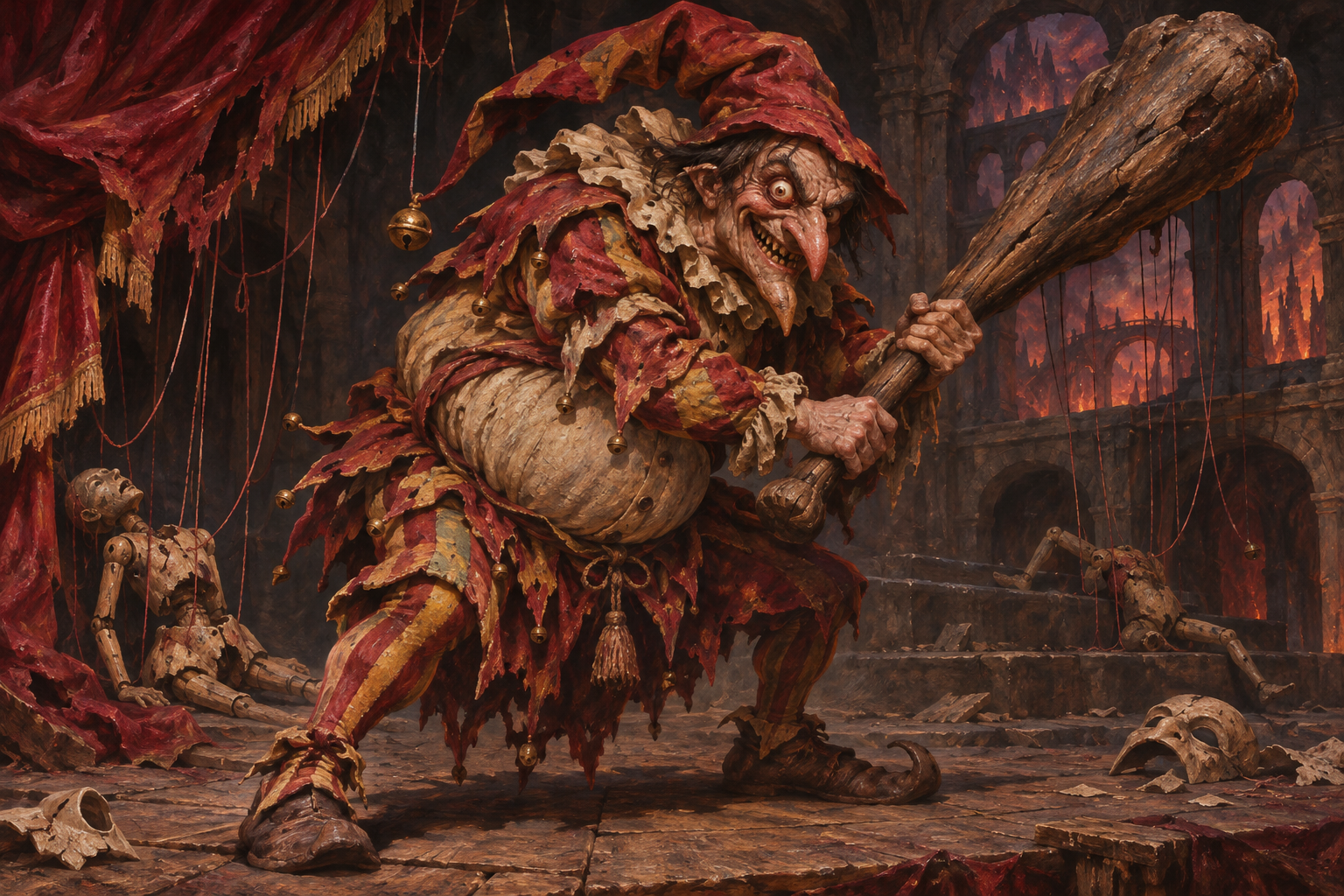
The laughter begins before the beating. A crooked little jester shoulders through the crowd with a greatclub much too large for his hands; every witness who tries to intervene feels a helpless grin drag across their face. Punchinello calls the next victim to the stage. His audience is not allowed to leave.
At a Glance
| Names | Punchinello; Master Punch; King of Puppets |
|---|---|
| Nature | Unique nascent demon lord; Chaotic Evil |
| Size and type | Medium fiend/demon (outer-planar outsider in older rules) |
| Challenge | D&D 2024 CR 22*; D&D 2014 CR 22*; Pathfinder 1e CR 22; D&D 3.5e CR 22* |
| Behaviour | Humiliates a victim, demands complicity from onlookers, and strikes anyone who challenges his performance; flees when an encore buys his escape |
| Signature threats | Scaramouche the thunderous greatclub; paralysing mirth; possession; the supernatural encore |
| Typical habitat | Abyssal playhouses, travelling spectacles, corrupt city theatres and mortal gatherings opened to demonic influence |
| Portfolio | Violent spectacle, disproportionate retaliation, mockery |
| Domains | Chaos, Destruction, Evil, Strength |
| Symbol | Leering jester’s face |
| Divine relic | Scaramouche |
| Campaign range | Co-sovereign of the Crooked Stage, Layer 527 of the Abyss; material-world visits through possession or summoning |
| Company | Usually alone; may employ bogeymen, vrocks, fiendish crocodiles or mortal accomplices |
*Original conversion with provisional, unplaytested CR. The Pathfinder statistics come from a credited third-party source, with arithmetic corrections identified in the source notes.
What Is Happening Right Now?
In 1454 CE, the House of Applause prepares a performance with a captive substituted for a puppet. Joey has found a concealed exit, Toby scents a missing actor below the stage and Judy suspects impostors are using her name. Characters may rescue the captives, expose the impostors or turn the rival sovereigns against one another without confronting either at full strength.
Punchinello — Monster Statistics
Punchinello — D&D 2024
Medium Fiend (Demon), Chaotic Evil — CR 22 (41,000 XP); Proficiency Bonus +7. Original, unplaytested conversion.
AC 21 (unnatural agility, natural armour); Initiative +7 (17); HP 399 (38d8 + 228); Speed 40 ft., Fly 40 ft. (hover; supernatural air-walking)
| Ability | Score | Mod | Save |
|---|---|---|---|
| STR | 28 | +9 | +9 |
| DEX | 24 | +7 | +14 |
| CON | 22 | +6 | +13 |
| INT | 20 | +5 | +5 |
| WIS | 14 | +2 | +9 |
| CHA | 26 | +8 | +15 |
Saving Throws Dex +14, Con +13, Wis +9, Cha +15. Skills Acrobatics +14, Deception +15, Intimidation +15, Perception +9, Performance +22, Sleight of Hand +14. Resistances Acid, Cold, Fire. Immunities Lightning and Poison damage; Charmed, Poisoned conditions. Senses Truesight 120 ft., Passive Perception 19. Languages Abyssal, Common, Draconic, Infernal; Telepathy 300 ft.
Traits
Magic Resistance. Punchinello has Advantage on saving throws against spells and other magical effects.
Legendary Resistance (3/Day). If Punchinello fails a saving throw, he can choose to succeed instead.
Aura of Mirth. Once per round, when a creature within 60 feet that can see or hear Punchinello tries to damage him, he can demand a DC 23 Wisdom saving throw (no action). On a failure, the triggering action or reaction is wasted and the creature has the Incapacitated condition from laughter until the start of its next turn. A wasted spell does not expend a spell slot or other limited-use resource. On a success, or as soon as Punchinello deals damage to it, that creature is immune to his aura for 24 hours. This is a magical, emotion-altering effect; it does not affect a creature that is immune to the Charmed condition.
Encore (1/Day). The first time Punchinello would drop to 0 HP, he instead drops to 1 HP and immediately regains 71 (5d8 + 49) HP. He can then move up to half his Speed without provoking Opportunity Attacks. He cannot use this ability if he is destroyed by a feature that explicitly prevents restoration.
Actions
Multiattack. Punchinello makes three Scaramouche attacks.
Scaramouche. Melee Attack Roll: +16, reach 5 ft., one target. Hit: 31 (4d10 + 9) Bludgeoning damage plus 9 (2d8) Thunder damage. If the target is Large or smaller, it must succeed on a DC 24 Strength saving throw or have the Prone condition.
Empty-Handed Blow. Melee Attack Roll: +16, reach 5 ft., one target. Hit: 20 (2d10 + 9) Bludgeoning damage; DC 24 Strength save or Prone if the target is Large or smaller.
Puppet-String Possession (1/Day). Magic action: One Humanoid Punchinello can see within 30 feet makes a DC 23 Charisma saving throw. On a failure, Punchinello’s own body becomes Unconscious while his mind controls the target for up to 1 minute (Concentration). The target is aware but cannot choose its movement or actions; Punchinello uses its available non-spell actions and movement in place of his own. The victim repeats the save whenever it takes damage and at the end of each of its turns, ending possession on success. If his body takes damage, Punchinello must make a Concentration save normally. The effect also ends if the two bodies are more than 120 feet apart, Punchinello releases the victim, or he loses Concentration. When it ends he returns to his body and it awakens. He cannot make Scaramouche attacks while possessing another creature.
Spellcasting. Punchinello casts these spells without material components, using Charisma (spell save DC 23). The spell’s regular action and Concentration apply. At will: Dimension Door (self only), Minor Illusion. 3/Day each: Confusion, Dispel Magic, Mislead. 1/Day: Plane Shift (self only).
Bonus Actions
Stage Step (3/Day). Punchinello teleports up to 30 feet to a space he can see.
Legendary Actions
Punchinello can take three Legendary Actions each round, one at the end of another creature’s turn, regaining spent uses at the start of his turn.
Exit, Stage Left (1 Action). Punchinello moves up to half his Speed without provoking Opportunity Attacks.
Heckle (1 Action). One creature he can see and that can hear him within 60 feet makes a DC 23 Wisdom save or has Disadvantage on its next attack roll before the end of its next turn.
The Punchline (2 Actions). Punchinello makes one Scaramouche attack.
Lair Actions
In the House of Applause, Punchinello’s seat in the Crooked Stage, at initiative count 20 (losing ties), choose one effect; do not repeat a choice consecutively. He cannot use these effects throughout Judy’s territory merely by being a co-sovereign.
Moving Backdrop. A 15-foot-square unoccupied piece of scenery within 60 feet slides up to 15 feet. It cannot automatically crush creatures or close the last exit.
False Applause. One enemy within 60 feet that can hear the performance makes a DC 20 Wisdom save or cannot take reactions until the next count 20. A creature immune to being charmed is unaffected.
Trapdoor. A 10-foot-square section of the stage within 60 feet becomes difficult terrain until next count 20. Creatures standing there make a DC 20 Dexterity save or fall prone.
Regional Effects
Within one mile of the House of Applause, echoes of applause can be heard in empty performance halls. In the same area, scenery and doors sometimes shift; a DC 15 Wisdom (Survival) check identifies a stable route. Mundane exits and the established planar hazards remain meaningful. These effects cease 1d10 days after Punchinello’s permanent defeat; Judy’s independent influence remains.
Divine Relic — Scaramouche
Scaramouche is a very rare +2 greatclub requiring attunement. A hit deals an extra 1d6 thunder damage. Once per long rest on a hit against a Large or smaller creature, the bearer can require a DC 16 Strength save or knock it prone. Punchinello’s own action includes his personal Slapstick and trip powers; do not add the item’s bonuses again. The club has no independent intelligence or curse.
Cleric Domains
Eligible cult clergy may choose the campaign Chaos or Strength subclass with GM approval. Destruction and Evil describe spheres of worship; neither is an official same-named modern subclass. The chosen domain’s spells are always prepared at the listed cleric levels.
| Cleric level | Chaos | Strength |
|---|---|---|
| 3 | Bane, Disguise Self, Mirror Image, Shatter | Heroism, Shield of Faith, Enhance Ability, Magic Weapon |
| 5 | Blink, Dispel Magic | Haste, Protection from Energy |
| 7 | Confusion, Freedom of Movement | Freedom of Movement, Stoneskin |
| 9 | Modify Memory, Telekinesis | Greater Restoration, Skill Empowerment |
Punchinello — D&D 2014
Medium fiend (demon), chaotic evil — Challenge 22 (41,000 XP). Original, unplaytested conversion.
Armor Class 20 (natural armor); Hit Points 378 (36d8 + 216); Speed 40 ft., fly 40 ft. (hover)
| STR | DEX | CON | INT | WIS | CHA |
|---|---|---|---|---|---|
| 28 (+9) | 24 (+7) | 22 (+6) | 20 (+5) | 14 (+2) | 26 (+8) |
Saving Throws Dex +14, Con +13, Wis +9, Cha +15. Skills Acrobatics +14, Deception +15, Intimidation +15, Perception +9, Performance +22, Sleight of Hand +14. Damage Resistances acid, cold, fire, bludgeoning/piercing/slashing from nonmagical attacks. Damage Immunities lightning, poison. Condition Immunities charmed, poisoned. Senses truesight 120 ft., passive Perception 19. Languages Abyssal, Common, Draconic, Infernal; telepathy 300 ft.
Traits
Magic Resistance. Punchinello has advantage on saving throws against spells and other magical effects.
Legendary Resistance (3/Day). If Punchinello fails a saving throw, he can choose to succeed instead.
Aura of Mirth. The first time each round a creature within 60 feet that can see or hear Punchinello attempts to attack him or subject him to a harmful spell or effect, it must make a DC 23 Wisdom saving throw. On a failure it is incapacitated by laughter until the start of its next turn and the attempted action is lost. A creature that succeeds, or that Punchinello has injured, is immune for 24 hours. The aura is a magical charm effect, so a creature immune to being charmed is unaffected.
Encore (1/Day). The first time Punchinello is reduced to 0 hit points, he instead falls to 1 hit point and regains 67 (5d8 + 45) hit points. He may then use his reaction, if available, to move 20 feet without provoking opportunity attacks.
Actions
Multiattack. Punchinello makes three melee attacks with Scaramouche, or two Slam attacks.
Scaramouche. Melee Weapon Attack: +16 to hit, reach 5 ft., one target. Hit: 31 (4d10 + 9) bludgeoning damage plus 7 (2d6) thunder damage. If the target is Large or smaller, it must succeed on a DC 24 Strength saving throw or be knocked prone.
Slam. Melee Weapon Attack: +16 to hit, reach 5 ft., one target. Hit: 20 (2d10 + 9) bludgeoning damage, and the target must succeed on a DC 24 Strength saving throw or be knocked prone if Large or smaller.
Puppet-String Possession (1/Day). One humanoid within 30 feet that Punchinello can see must succeed on a DC 23 Charisma saving throw or be possessed for up to 1 minute (concentration as if concentrating on a spell). Punchinello’s body falls unconscious; the victim remains aware but Punchinello controls its movements and non-spell actions. The victim repeats the save at the end of each turn and whenever it takes damage, ending the effect on success. Damage to Punchinello’s body may break his concentration; the effect ends if the bodies separate by more than 120 feet. He cannot attack from his own body while possessing another.
Innate Spellcasting. His spellcasting ability is Charisma (spell save DC 23). He requires no material components. At will: dimension door (self only), minor illusion, Tasha’s hideous laughter. 3/day each: confusion, dispel magic, mislead. 1/day: plane shift (self only). Casting uses the spell’s normal action and concentration.
Bonus Actions
Quick Exit (3/Day). Punchinello teleports up to 30 feet to a visible unoccupied space.
Legendary Actions
Punchinello can take three legendary actions, choosing from the options below. Only one may be used at a time at the end of another creature’s turn. He regains all spent actions at the start of his turn.
Skitter (Costs 1 Action). He moves up to half his speed without provoking opportunity attacks.
Mock (Costs 1 Action). One creature within 60 feet that can hear Punchinello must make a DC 23 Wisdom saving throw or have disadvantage on its next attack roll before the end of its next turn.
Scaramouche (Costs 2 Actions). He makes a Scaramouche attack.
Lair Actions
In the House of Applause, Punchinello’s seat in the Crooked Stage, at initiative count 20 (losing ties), choose one effect; do not repeat a choice consecutively. He cannot use these effects throughout Judy’s territory merely by being a co-sovereign.
Moving Backdrop. A 15-foot-square unoccupied piece of scenery within 60 feet slides up to 15 feet. It cannot automatically crush creatures or close the last exit.
False Applause. One enemy within 60 feet that can hear the performance makes a DC 20 Wisdom save or cannot take reactions until the next count 20. A creature immune to being charmed is unaffected.
Trapdoor. A 10-foot-square section of the stage within 60 feet becomes difficult terrain until next count 20. Creatures standing there make a DC 20 Dexterity save or fall prone.
Regional Effects
Within one mile of the House of Applause, echoes of applause can be heard in empty performance halls. In the same area, scenery and doors sometimes shift; a DC 15 Wisdom (Survival) check identifies a stable route. Mundane exits and the established planar hazards remain meaningful. These effects cease 1d10 days after Punchinello’s permanent defeat; Judy’s independent influence remains.
Divine Relic — Scaramouche
Scaramouche is a very rare +2 greatclub requiring attunement. A hit deals an extra 1d6 thunder damage. Once per long rest on a hit against a Large or smaller creature, the bearer can require a DC 16 Strength save or knock it prone. Punchinello’s own action includes his personal Slapstick and trip powers; do not add the item’s bonuses again. The club has no independent intelligence or curse.
Cleric Domains
Eligible cult clergy may choose the campaign Chaos or Strength subclass with GM approval. Destruction and Evil describe spheres of worship; neither is an official same-named modern subclass. The chosen domain’s spells are always prepared at the listed cleric levels.
| Cleric level | Chaos | Strength |
|---|---|---|
| 1 | Bane, Disguise Self | Heroism, Shield of Faith |
| 3 | Mirror Image, Shatter | Enhance Ability, Magic Weapon |
| 5 | Blink, Dispel Magic | Haste, Protection from Energy |
| 7 | Confusion, Freedom of Movement | Freedom of Movement, Stoneskin |
| 9 | Modify Memory, Telekinesis | Greater Restoration, Skill Empowerment |
Punchinello — Pathfinder 1e
CR 22; XP 615,000; CE Medium outsider (chaotic, demon, evil, extraplanar). Third-party Pathfinder creature; numerical clarifications to the credited original.
Init +12; Senses darkvision 60 ft., true seeing; Perception +32; Aura cloak of chaos (DC 26), aura of mirth (60 ft., Will DC 31).
Defense
AC 39, touch 27, flat-footed 26 (+12 Dex, +1 dodge, +4 deflection, +12 natural); hp 418 (27d10 + 270); encore. Fort +29, Ref +31, Will +23 (includes +4 resistance from constant cloak of chaos); improved evasion. DR 20/cold iron and good; Immune charm, compulsion and death effects, electricity, poison; Resist acid 30, cold 30, fire 30; SR 33.
Offense
Speed 40 ft.; air walk (constant). Melee Scaramouche +41/+41/+36/+31/+26 (2d8 + 20/19–20 plus 1d6 sonic and trip) or 2 slams +39 (2d10 + 12 plus trip). Special Attacks aura of mirth, slapstick. Spell-Like Abilities CL 22nd; concentration +30:
- Constant — air walk, cloak of chaos (self only, DC 26), true seeing
- At will — chaos hammer (DC 22), confusion (DC 22), greater teleport (self plus 50 pounds of objects only), hideous laughter (DC 20), mirage arcana (DC 23)
- 3/day each — quickened dimension door; greater dispel magic; quickened harm (DC 24); mislead (DC 24); power word stun; word of chaos (DC 25)
- 1/day each — crushing hand; divine power; greater possession (DC 26); plane shift (DC 25); summon one demon of CR 20 or less (100% success)
Statistics
| STR | DEX | CON | INT | WIS | CHA |
|---|---|---|---|---|---|
| 35 (+12) | 35 (+12) | 31 (+10) | 20 (+5) | 14 (+2) | 26 (+8) |
Base Atk +27; CMB +39 (+43 overrun); CMD 66 (67 vs. overrun). Feats Acrobatic Steps, Dimensional Agility (B), Dodge, Greater Overrun, Improved Critical (greatclub), Improved Overrun, Iron Will, Lunge, Mobility, Nimble Moves, Power Attack, Quicken Spell-Like Ability (dimension door), Quicken Spell-Like Ability (harm), Spring Attack, Step Up. Skills Acrobatics +42, Bluff +38, Intimidate +38, Knowledge (local) +32, Knowledge (planes) +35, Perform (comedy) +38, Perform (dance) +38, Perception +32, Sense Motive +32, Sleight of Hand +42, Stealth +42. Languages Abyssal, Common, Draconic, Infernal; telepathy 300 ft. Environment any land or underground (Abyss). Organization unique. Treasure double standard (Scaramouche, a +2 impact speed greatclub; other treasure).
Cult and Obedience
Areas of concern: disproportionate retaliation, violent spectacle, mockery. Domains: Chaos, Destruction, Evil, Strength. Subdomains: Demon, Ferocity, Rage, Whimsy. Favoured weapon: greatclub. Unholy symbol: a leering jester’s face. Worshippers: murderers, cruel performers, violent city gangs and patrons who reward humiliation.
Obedience: publicly beat a Tiny or larger victim unconscious or dead and mock the victim before a witness; grant a +4 profane bonus on saving throws against fatigue or exhaustion. Boons: first boon hideous laughter 2/day; second boon divine power 2/day; third boon harm 2/day. These are source-derived cult abilities and not universal powers granted to every worshipper.
Special Abilities
Aura of Mirth (Su). A creature within 60 feet that attempts a hostile action against Punchinello must succeed on a DC 31 Will save or be dazed by laughter for 1 round. A successful save or damage taken from Punchinello makes that creature immune for 24 hours. This is a mind-affecting emotion effect; DC is Charisma-based.
Encore (Su). The first time each day Punchinello is reduced to 0 or fewer hit points, he immediately receives an effect identical to breath of life at caster level 22, regaining 5d8 + 22 hit points. This is automatic and does not consume an action.
Slapstick (Su). Manufactured weapons wielded by Punchinello deal 1d6 additional sonic damage on each hit. His natural and wielded weapons count as chaotic, evil and epic for bypassing damage reduction.
Trip (Ex). Punchinello may attempt a free trip combat manoeuvre after a successful manufactured or slam attack without provoking an attack of opportunity; he cannot be tripped in retaliation if the attempt fails.
Improved Evasion (Ex). On a successful Reflex save for half damage, Punchinello instead takes none; on a failed save, he takes half.
Realm Effects
Within the House of Applause in the Crooked Stage, on initiative count 20, Punchinello may shift one unoccupied 15-ft.-square backdrop up to 15 ft., or cause enemies in one 10-ft. square within 60 ft. to make Reflex DC 25 saves or fall prone. The latter area is difficult terrain until next count 20. Do not repeat a choice consecutively. Within one mile, strange echoes and shifting scenery may complicate navigation; DC 20 Survival identifies a stable route. Effects fade 1d10 days after his permanent defeat; Judy’s territory remains under her own influence.
Divine Relic — Scaramouche
Scaramouche is a +2 impact speed greatclub (Medium weapon damage 2d8). Its speed property adds one attack at highest BAB during a full attack and does not stack with haste. Slapstick and the free trip ability belong to Punchinello, not another wielder.
Cleric Domains
Eligible clergy select two from Chaos, Destruction, Evil, Strength subject to ordinary alignment, granted-power and domain-slot rules. The source’s Demon, Ferocity, Rage and Whimsy subdomains remain available under their published replacement-power and replacement-spell rules; choose a subdomain instead of its parent.
| Spell level | Chaos | Destruction | Evil | Strength |
|---|---|---|---|---|
| 1 | Protection from Law | True Strike | Protection from Good | Enlarge Person |
| 2 | Align Weapon (chaos only) | Shatter | Align Weapon (evil only) | Bull’s Strength |
| 3 | Magic Circle against Law | Rage | Magic Circle against Good | Magic Vestment |
| 4 | Chaos Hammer | Inflict Critical Wounds | Unholy Blight | Spell Immunity |
| 5 | Dispel Law | Shout | Dispel Good | Righteous Might |
| 6 | Animate Objects | Harm | Create Undead | Stoneskin |
| 7 | Word of Chaos | Disintegrate | Blasphemy | Grasping Hand |
| 8 | Cloak of Chaos | Earthquake | Unholy Aura | Clenched Fist |
| 9 | Summon Monster IX (chaos only) | Implosion | Summon Monster IX (evil only) | Crushing Hand |
Punchinello — D&D 3.5e
Medium outsider (chaotic, evil, extraplanar), Chaotic Evil — Challenge Rating 22*. Original 3.5e conversion, unplaytested.
Hit Dice 27d8 + 270 (391 hp); Initiative +16; Speed 40 ft. (8 squares); air walk (constant); Armor Class 39, touch 27, flat-footed 26 (+12 Dex, +1 dodge, +4 deflection, +12 natural); BAB/Grapple +27/+39; Space/Reach 5 ft./5 ft.
Attack and Full Attack
Attack Scaramouche +41 melee (2d8 + 20, 19–20/x2, plus 1d6 sonic and trip), or slam +39 melee (2d10 + 12 plus trip). Full Attack Scaramouche +41/+41/+36/+31/+26 melee (bonus speed attack included), or 2 slams +39 melee (2d10 + 12 each, trip). Special Attacks aura of mirth, spell-like abilities, slapstick, trip.
Special Qualities and Saves
Darkvision 60 ft., true seeing; improved evasion; encore; damage reduction 20/cold iron and good; spell resistance 33; immunity to electricity, poison, death effects, charm and compulsion effects; resistance to acid, cold and fire 30. Fort +29, Ref +31, Will +23, incorporating the constant cloak of chaos +4 resistance bonus. Aura of mirth 60 ft., Will DC 31.
Abilities
| STR | DEX | CON | INT | WIS | CHA |
|---|---|---|---|---|---|
| 35 (+12) | 35 (+12) | 31 (+10) | 20 (+5) | 14 (+2) | 26 (+8) |
Skills Balance +42, Bluff +38, Hide +42, Intimidate +38, Knowledge (the planes) +35, Listen +32, Move Silently +42, Perform (comedy) +38, Perform (dance) +38, Sense Motive +32, Sleight of Hand +42, Spot +32. Feats Dodge, Improved Critical (greatclub), Improved Initiative, Improved Overrun, Iron Will, Mobility, Power Attack, Quicken Spell-Like Ability (dimension door), Quicken Spell-Like Ability (harm), Spring Attack. Languages Abyssal, Common, Draconic, Infernal; telepathy 300 ft. Environment Abyss; Organization unique; Treasure double standard (Scaramouche, a unique +2 speed greatclub with increased damage dice).
Spell-Like Abilities
Caster level 22nd; Charisma-based DCs. All use their normal action unless noted. Constant: air walk, cloak of chaos (self only), true seeing. At will: chaos hammer (DC 22), confusion (DC 22), greater teleport (self plus 50 pounds of objects), hideous laughter (DC 20), mirage arcana (DC 23). 3/day each: dimension door (quickened), greater dispel magic, harm (quickened, DC 24), mislead (DC 24), power word stun, word of chaos (DC 25). 1/day each: crushing hand, divine power, magic jar (DC 23, possession equivalent), plane shift (DC 25), summon one demon of CR 20 or lower (automatic arrival, treated as a summoned ally for encounter design). The weapon’s sonic effect applies only to physical strikes.
Unique Abilities
Aura of Mirth (Su). A creature within 60 ft. attempting a hostile action against Punchinello must make a Will save (DC 31) or become dazed with laughter for 1 round. A successful save, or damage taken from Punchinello, confers immunity to the aura for 24 hours. A mind-affecting effect; DC = 10 + half Hit Dice + Cha modifier.
Encore (Su). The first time in a day that Punchinello reaches 0 or fewer hit points, he automatically regains 5d8 + 22 hit points. If the recovered total is above 0, he remains active. It cannot restore him if an effect explicitly prevents life restoration.
Slapstick (Su). Every hit with a manufactured weapon deals 1d6 sonic damage in addition to its other damage. Punchinello’s attacks count as chaotic and evil for bypassing damage reduction; his weapon is treated as epic for that purpose.
Trip (Ex). After a successful hit with Scaramouche or a slam, Punchinello can attempt to trip the target as a free action without a separate touch attack; a failed attempt cannot be used to trip him in return.
Improved Evasion (Ex). A successful Reflex save against an effect that allows half damage deals none; a failed save deals half.
*The CR is a working adaptation, not an official 3.5e publication rating. The spell magic jar is used rather than importing a later-edition possession spell.
Realm Effects
Within the House of Applause in the Crooked Stage, on initiative count 20, Punchinello may shift one unoccupied 15-ft.-square backdrop up to 15 ft., or cause enemies in one 10-ft. square within 60 ft. to make Reflex DC 25 saves or fall prone. The latter area is difficult terrain until next count 20. Do not repeat a choice consecutively. Within one mile, strange echoes and shifting scenery may complicate navigation; DC 20 Survival identifies a stable route. Effects fade 1d10 days after his permanent defeat; Judy’s territory remains under her own influence.
Divine Relic — Scaramouche
Scaramouche is a +2 speed greatclub with unique 2d8 base damage. Its speed property adds one attack at highest BAB during a full attack and does not stack with haste. Slapstick and the free trip ability belong to Punchinello, not another wielder.
Cleric Domains
Eligible clergy select two from Chaos, Destruction, Evil, Strength subject to ordinary alignment, granted-power and domain-slot rules.
| Spell level | Chaos | Destruction | Evil | Strength |
|---|---|---|---|---|
| 1 | Protection from Law | Inflict Light Wounds | Protection from Good | Enlarge Person |
| 2 | Shatter | Shatter | Desecrate | Bull’s Strength |
| 3 | Magic Circle against Law | Contagion | Magic Circle against Good | Magic Vestment |
| 4 | Chaos Hammer | Inflict Critical Wounds | Unholy Blight | Spell Immunity |
| 5 | Dispel Law | Mass Inflict Light Wounds | Dispel Good | Righteous Might |
| 6 | Animate Objects | Harm | Create Undead | Stoneskin |
| 7 | Word of Chaos | Disintegrate | Blasphemy | Grasping Hand |
| 8 | Cloak of Chaos | Earthquake | Unholy Aura | Clenched Fist |
| 9 | Summon Monster IX (chaos only) | Implosion | Summon Monster IX (evil only) | Crushing Hand |
The King of the Crooked Stage
Punchinello is five feet of bent shoulders, darting feet and obscene confidence, with a greatclub called Scaramouche balanced across his hump. His grin is both a threat and a challenge. The demon is at his happiest when a crowd can watch him hurt someone and then laugh at its own cowardice. He does not seek conquest by banners or decrees: he wants an audience that mistakes his violence for a joke, and he wants the next tyrant to learn that same trick.
On Midgard, his devotees rarely agree on what devotion means. The First Mask of Naples treasures old forbidden performances, while the Laughing Company turns festivals and private banquets into cruelty. They copy one another’s tricks, steal performers and blame one another when a demon answers. Punchinello commands no settled mortal government and gives no promise of favour. Their rivalries, victims and frightened accomplices offer characters ways to unravel a deadly entertainment without fighting the demon himself.
The Mortal Faces of the Laughing Company
The threat has names and faces. In Rouen, Aveline de Vire plans a lethal twist to a public comedy. Ysabeau Bellerose carries a whispering red mask across the Channel while searching for a missing courier and trying to save her brother. In London, Edmund Mallow stages a murderous banquet and hopes to humiliate his rivals. None is a mere anonymous cultist, and none can reliably command the others.
Follow the performers rather than a paper trail: question the carpenter who changed Aveline’s gallows, listen to the voice inside Ysabeau’s crate and confront the guest who knows Mallow’s banquet will end in violence. Saving Ysabeau’s brother may win a useful but compromised ally. Ruining Aveline’s show turns her attention towards the party. Making Mallow the butt of a public joke may provoke a brutal response. See the Laughing Company for the linked mortal stories.
Punchinello shares the Crooked Stage, Layer 527 of the Abyss, with Judy. He makes a theatre of coercion and cruelty; she answers with accusation, defiance and revenge. The layer changes around their quarrel, and neither ruler can permanently dispossess the other. Punchinello still visits greater demon courts as a fool, spy, hired killer and dangerous guest. A lord who laughs at his antics may find an enemy clubbed to death; a lord who laughs at Punchinello may become the next performance. His loyalty beyond his own realm lasts exactly as long as the entertainment, advantage or terror it purchases.
His mortal followers may be found wherever somebody can make cruelty look like entertainment. One murderous devotee may hide among honest travelling players; a wealthy host may pay for an obscene puppet show without realising the final victim is not an actor. Acting and puppetry are not inherently suspect. The danger lies in the rigged stage, coerced audience, sudden violence and laughter that continues when everyone wants it to stop.
The Mystery of Judy
Judy is acknowledged as Punchinello’s rival and co-sovereign of the Crooked Stage, yet her ultimate identity remains unsettled. Some witnesses describe a single demon who can stand against him; others insist that Judy is a name assumed by successive victims who resist. A few believe both accounts. When his followers mention Judy, ask what they fear: the return of a dangerous equal, or evidence that the laughing king was once defeated.
The Other Players in the Cruel Comedy
Punchinello performs in the House of Applause, but his cast never stays the same. The spouse who fights back, the missing child, the bewildered constable, the incompetent doctor, the hangman, the Devil and the crocodile may be played by real people, wooden puppets, fiends or unwilling victims. One painted role does not prove the existence of a permanent demon of that name. The scene works best when each character has a personal reason to help, betray or escape.
- Judy — the Adversary Behind the Curtain. Judy is a demon and Punchinello’s acknowledged co-sovereign of Layer 527, not a servant in his travelling company. Her personal origin is disputed: the name may belong to one ancient demon, successive demonic manifestations or the force that remembers the crimes of his court. When adventurers ask about her, witnesses offer incompatible accounts of who holds the title, not whether she rules the Gallery of Witnesses. One verifiable clue can change which account the party believes.
- The Child — the Missing Innocent. A small empty cradle, a wooden figure or a vanished apprentice can reveal what a troupe has done. This is a person to be protected or found, not a mandatory monster or a compulsory combat target. The audience’s willingness to intervene determines whether Punchinello’s spectacle succeeds.
- The Crocodile Beneath the Booth — the Hungry Interruption. The named beast of Layer 527 is not a servant bound by oath, although ordinary fiendish crocodilians also appear among Punchinello’s possible minions. Its arrival destroys his rehearsed order: it follows scent and hunger, not a cue from the stage. A handler can lure it with food, but cannot bargain on its behalf. Use an ordinary crocodile or an established fiendish giant crocodile as appropriate, rather than giving every painted puppet a new fiend stat block.
- Joey — the Painted Herald. This living human master of ceremonies wears a theatrical name, not the identity of the later historical clown. Joey announces the applause, notices dissent and distracts guards when the curtain closes. He has helped powerful people harm spectators, but covertly guides some prisoners through Layer 527. Revealing his complicity or bargaining for a captive he hopes to save makes him an important NPC rather than another demon to defeat.
- The Constable or Beadle — Authority Made Ridiculous. The officer arrives to stop the performance and is bribed, mocked or publicly overruled. A corrupt officer can become the demon’s willing instrument; an honest one is a possible ally whose authority Punchinello is trying to break. Show the difference in conduct rather than treating every servant of the law as evil.
- The Doctor — the False Cure. A supposed healer can conceal injuries, pronounce a victim fit to continue, or offer restorative magic at a dreadful price. Equally, an actual physician pressed into service may know where survivors are kept. Medical skill is not evidence of cult membership.
- The Hangman — the Last Sentence. An executioner’s masked role is useful when Punchinello engineers a wrongful public punishment. The executioner may be a fearful official, a condemned soul or a stage construct. His rope is not a special weapon that overrides normal defences; he is dangerous because a crowd has accepted the sentence.
- The Devil — the Unwelcome Rival. A horned devil-mask sometimes appears at the end of the play. It may cover a demon, a disguised visitor, or a frightened actor expected to lose to Punchinello. Do not identify this character with Asmodeus or the sovereign of the Nine Hells merely because the costume has horns; any real infernal emissary has its own interests and hierarchy.
- The Ghost or Skeleton — the Witness Who Returns. A haunting can expose a victim whom the audience has chosen to forget. It need not be another servant of Punchinello, and a genuine ghost may turn his spectators against him. Establish whether it is an illusion, an undead creature or a living witness under a spell before assigning combat statistics.
- Toby — the Hound Who Does Not Laugh. Toby is a small living dog of the Crooked Stage, no fiend or supernatural detector of dishonesty. His keen nose, alarm bark and refusal to approach dangerous booths can help rescuers find a missing witness. He can be frightened, hurt or saved, and he is worth protecting in his own right. The later historical performing dog named Toby is not this original 1454 campaign creature.
Two different Scaramouches: Punchinello’s Scaramouche is his named greatclub, not a member of his company. Scaramouche of Naples is a separate, mortal human actor and swordsman. His name does not make him the club’s spirit, an Abyssal subordinate or a species of Fey.
Using the Supporting Cast
The named cast now has playable local statistics for Toby, Joey and the masked hangman in the Crooked Stage guide.
Choose two or three roles for an encounter rather than filling the stage with every possible character. Joey cues coerced applause, the Constable prevents ordinary witnesses from leaving, Toby may track an escapee, and a crocodile waits beneath a trapdoor. Give the party an actionable way to change each part of the performance: reveal the clown’s signal, persuade or disarm the officer, release the crocodile’s handler from coercion, and lead the audience out before Punchinello can turn their fear into complicity. Defeating a supporting figure does not automatically defeat the demon, but breaking the performance denies him the terrified crowd he wants. The consequences continue across Layer 527 after the party departs.
Signs of His Passing
- An audience laughs a heartbeat after the joke, even when nobody understood the words.
- Wooden puppets have fresh cracks like crushed bone; their strings are knotted around a tiny club.
- Witnesses repeat the same excuse for a beating: someone else began laughing first.
- A theatre’s doors are open from the street but refuse to release spectators once the curtain rises.
Running Punchinello
Temperament and Bargains
He opens with a joke, selects the person least able to answer him, and demands that the strongest witness approve. He will bargain for a spectacle, safe exit or the delivery of a hated rival, but a promise from him is a performance, not a contract. If refused, he tries to turn one witness against another before resorting to Scaramouche.
Combat Pattern
- Before initiative: reveal at least one unnatural response—an involuntary laugh, the club’s thunder, or a puppet addressing its puppeteer. Give the party a chance to move civilians away.
- First exchange: he closes on an exposed enemy, attacks with Scaramouche and tests whether his Aura of Mirth has divided the party.
- When pressed: he teleports or air-walks to a new angle and uses illusion or confusion against clustered enemies. If a mortal leader is available, possession may be more valuable than another club strike.
- When defeated once: Encore buys a brief, furious return. If the audience has deserted him or several opponents are still standing, he uses it to escape rather than die for pride.
Fair and Effective Counterplay
His mirth is a supernatural mental assault, not a compulsory out-of-game joke. Protection against magically induced laughter can help. If Punchinello’s aura is triggered by a creature seeing or hearing him, it must avoid both forms of perception to remain outside the trigger: silence alone does not protect a creature that can still see him, and concealment alone does not protect one that can still hear him. Other protection follows the creature’s listed statistics. A party can turn the crowd against him by removing victims, expose the puppeteer controlling a possessed witness, or deny the demon a stage where he can isolate opponents. If he summons a powerful demonic ally, treat that arrival as a major escalation and account for both foes when judging encounter difficulty. Spells that bind, banish, ward against possession or interrupt a magical disguise work according to the chosen edition’s normal rules. He has no invented weakness to a special club, mask or costume.
The Last Laugh
Destroying Punchinello’s present body does not automatically cure the habits that invited him. Surviving accomplices still wield authority; frightened witnesses still know who threatened them. What changes is that laughter can stop, people can speak openly, and the stage can belong to its actors again.
An Encounter: The Show That Goes Wrong
A travelling puppet booth appears at a crowded fair. Nobody remembers inviting the player, and no one who enters can find the rear exit. The crowd roars as a crooked little jester beats a wooden constable. Then a real constable is dragged onto the stage and the puppet lifts a real club.
The danger. Punchinello wants the crowd to applaud a genuine killing. The reluctant Joey has already shown two spectators where a panel can be lifted. Toby has caught the scent of a missing child beneath the boards, while a crocodile is moving under the stage. The demon laughs hardest when the audience thinks it must join in to survive.
Choices. The characters can carry the child out, pull open the backcloth, turn the crowd against the performance, persuade Joey to reveal the exit or confront Punchinello. A clever interruption may rescue the audience without defeating a CR 22 demon. An open fight remains deadly, and a demon who escapes can choose a different stage next time.
Aftermath. Rescuing someone earns allies among the performers. Embarrassing Punchinello earns a personal enemy, who may change his next performance to punish those who ruined the joke. Killing a mortal player does not automatically close the Crooked Stage.
Sources, Adaptation and Image Credits
Creature and original Pathfinder rules: Creature Codex, “Nascent Demon Lord, Punchinello”, an independently authored third-party Pathfinder 1e creation. The name, Scaramouche, Aura of Mirth, Encore, the CR 22 concept and core identity derive from that entry. This page offers newly written encounter material and adaptations to other editions, which are not Wizards of the Coast or Paizo official monster statistics. The Crooked Stage, the setting’s Layer 527, the contested co-sovereignty of Punchinello and Judy, and the bounded seat-specific lair and regional powers are original additions to this campaign setting, not geography established in the Creature Codex source, where Punchinello is a wandering nascent demon lord.
Pathfinder numerical clarification: the source’s AC components add to 39, not 40. With 27 outsider Hit Dice, the ability modifiers and listed Iron Will feat, the saving throws before cloak of chaos are Fort +25, Ref +27 and Will +19; the constant spell’s +4 resistance bonus yields Fort +29, Ref +31 and Will +23. Its seventh-level word of chaos has DC 25 at Charisma 26. These are editorial arithmetic corrections, not a claim to an officially revised source stat block.
Historical inspiration and the supporting cast: the Italian Pulcinella appears in later theatrical traditions, and the documented English Punch and Judy repertory developed from the seventeenth century onwards. The Victoria and Albert Museum’s history records the English appearance in 1662, while the London Museum traces the changing cast, including crocodile, constable and clown. Joey’s association with the historical Joseph Grimaldi, the dog Toby and the later hangman name Jack Ketch belong to later performance traditions, not to the attested public stage of 1454. The supporting company above is an original fantasy interpretation, not an assertion that the independently authored Creature Codex source assigns each role to a named demon. The source specifically establishes Judy’s uncertainty and Punchinello’s minions of bogeymen, fiendish dire crocodiles and vrocks. Its fiction does not establish that a Punch and Judy show was performed under that name in the setting’s campaign year.
Artwork: Original painted Punchinello hero created for this entry. A historical depiction of the theatrical Punch by Louis-Joseph Ghémar is available in the public domain via Wikimedia Commons.
Keep this reference growing
If this page helped with your reading or game, you can support its upkeep or explore the curated books.
Explore the Bookshop — epics, classics and stories behind imagined worlds.