
Lurking Ray, Lurker Above
Lurking Ray, Lurker Above
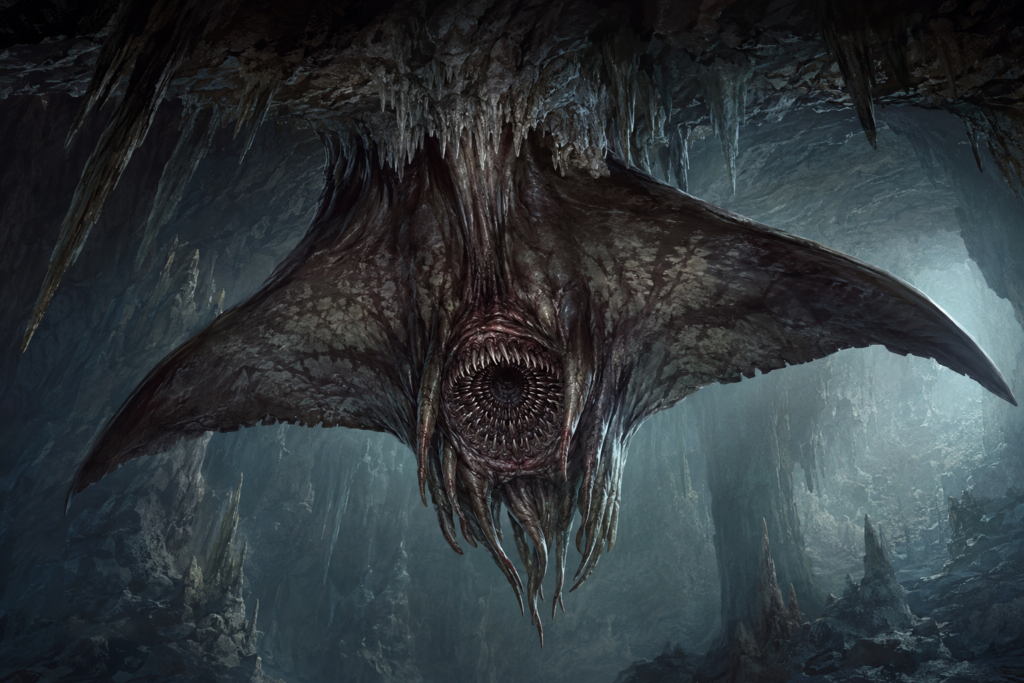
“The ceiling is not stone—it is hungry.”
What first appears to be a stalactite unfurls into a vast manta-like shape, sailing silently downwards with its rasping mouth spread wide.
The Lurker Above is the adult male form of the lurking ray, a family of subterranean aberrations that envelop, constrict, and suffocate their prey. It clings to cavern ceilings, changes the colour and texture of its hide to resemble stone, and waits for living creatures to pass beneath it.
When prey enters range, the lurker releases its hold and glides almost silently through the cavern. Its immense, flexible body folds around its victim, crushing the target while forming an airtight seal that prevents speech, verbal spellcasting, and breathing.
Appearance
A lurker above resembles a grotesque subterranean manta ray with a broad, flexible body that can stretch as much as 15 feet from tip to tip. Its upper surface is rough, mottled, and irregular, allowing it to imitate limestone, basalt, mineral deposits, or weathered masonry.
At rest, the creature draws its broad body upwards and clings to the ceiling using suckers and short gripping tendrils. Its folded outline resembles a thick stalactite, mineral curtain, or heavy outcropping of natural stone.
When it attacks, the lurker unfurls into a wide, leathery shape. Its underside is softer and paler than its stone-like upper hide. A broad, rasping mouth opens along the underside, surrounded by muscular folds capable of sealing tightly around captured prey.
The lurker has no conventional face. It senses movement through scent, vibration, limited vision, and sensory tissues distributed across its body.
A fully fed adult weighs nearly 500 pounds.
Behaviour
Lurkers above are nearly mindless predators governed by hunger, concealment, and simple hunting instincts. They do not negotiate, construct deliberate traps, collect treasure, recognise social status, or form complex plans.
A lurker selects a ceiling above a passage, ledge, chamber entrance, water source, or other place likely to attract prey. It remains motionless and matches the surrounding rock until a suitable creature enters striking range.
Its preferred attack is a silent descending glide. Rather than falling directly downwards, the lurker can cross a considerable cavern while losing very little height. This allows it to attack creatures far from the apparent stalactite beneath which it was concealed.
Once it captures a victim, the lurker concentrates on maintaining its grip. It constricts the target, seals away its air, and continues crushing it until the prey escapes, dies, or the lurker is driven away.
Although capable of powered flight, its ascent is an awkward display of slowly flapping flesh. It prefers climbing and gliding whenever the terrain permits.
Habitat
Lurkers above inhabit almost any underground environment, including:
- natural caverns and limestone cave systems;
- abandoned mines and quarries;
- deep fissures and sinkholes;
- ruined subterranean temples;
- buried fortifications and dungeons;
- forgotten underworld passages;
- vaulted sewers and cistern chambers.
They favour high, irregular ceilings covered with stalactites, mineral curtains, broken masonry, or deep shadows. A suitable hunting chamber provides enough space for the creature to unfold and sufficient horizontal distance for it to glide.
A hunting ground may contain bones, broken lanterns, damaged helmets, or possessions left where victims were taken. Experienced delvers may notice that one ceiling formation is broader, less dusty, more symmetrical, or differently coloured than the surrounding stone.
Mechanics
Lurker Above 5E 2024
Lurker Above Pathfinder
Lurker Above 5E 2024 Statistics
The following stat block is an original SpiralWorlds conversion designed for the 2024 fifth-edition rules.
Lurker Above
Huge Aberration, Unaligned
Armor Class 17 (natural armor)
Hit Points 126 (12d12 + 48)
Speed 10 ft., climb 10 ft., fly 40 ft.
Initiative +5 (15)
| STR | DEX | CON | INT | WIS | CHA |
|---|---|---|---|---|---|
| 23 (+6) | 14 (+2) | 19 (+4) | 2 (−4) | 15 (+2) | 7 (−2) |
Saving Throws Con +7, Wis +5
Skills Perception +5, Stealth +8
Damage Resistances bludgeoning, cold, fire
Condition Immunities prone
Senses blindsight 10 ft., darkvision 60 ft., passive Perception 15
Languages None
Challenge 7 (2,900 XP; PB +3)
Traits
Amorphous Body. The lurker can move through a space as narrow as 1 foot wide without squeezing.
Ceiling Camouflage. While the lurker remains motionless and attached to a rocky ceiling, it is indistinguishable from an ordinary stalactite or section of stone unless a creature examining it succeeds on a DC 18 Wisdom (Perception) or Intelligence (Investigation) check.
Light Sensitivity. While in Bright Light, the lurker has Disadvantage on attack rolls and Wisdom (Perception) checks that rely on sight.
Silent Glide. When the lurker begins its turn attached to a ceiling, it can fly up to 100 feet in a straight line during that turn, provided it ends the movement at least 5 feet lower than where it began and does not ascend during the movement. The glide produces no more sound than a whisper.
Smothering Grip. A creature grappled by the lurker also has the Restrained condition, cannot speak, cannot provide the Verbal component of a spell, and is choking. At the end of each of the target’s turns, it gains 1 Exhaustion level. When the grapple ends and the creature can breathe again, it removes all Exhaustion levels gained from this trait. A creature that does not need to breathe does not gain Exhaustion from this trait.
Spider Climb. The lurker can climb difficult surfaces, including along ceilings, without needing to make an ability check.
Actions
Multiattack. The lurker makes two Slam attacks. It can replace one Slam attack with Constrict if it is grappling a creature.
Slam. Melee Attack Roll: +9, reach 15 ft. Hit: 17 (2d10 + 6) Bludgeoning damage. If the target is a Large or smaller creature and the lurker is not already grappling another creature, the target has the Grappled condition (escape DC 17). The lurker can grapple only one creature at a time.
Constrict. One creature grappled by the lurker takes 23 (3d10 + 6) Bludgeoning damage.
5E Tactics
The lurker remains motionless until a creature reaches a favourable position beneath it. It uses Silent Glide to close the distance, attacks with Slam, and begins constricting and smothering its captive as soon as it establishes a grapple.
After securing prey, it uses Slam and Constrict against its captive. It does not deliberately identify spellcasters or vulnerable characters. It attacks the nearest suitable living creature and maintains its grip unless injured badly enough to retreat.
If reduced to 31 hit points or fewer before subduing its prey, the lurker releases its victim and attempts to escape into a dark fissure or high gallery.
Lurker Above Pathfinder First Edition Statistics
Lurker Above CR 7
XP 3,200
N Huge aberration
Init +5; Senses blindsense 10 ft., darkvision 60 ft., scent; Perception +5
Defense
AC 19, touch 9, flat-footed 18 (+1 Dex, +10 natural, −2 size)
hp 85 (10d8+40)
Fort +7, Ref +4, Will +9
Defensive Abilities amorphous; DR 10/piercing or slashing; Resist cold 10, fire 10
Weaknesses light sensitivity
Offense
Speed 10 ft., climb 5 ft., fly 40 ft. (poor)
Melee slam +15 (3d6+15 plus grab)
Space 15 ft.; Reach 10 ft.
Special Attacks constrict (3d6+15), smother
Statistics
Str 30, Dex 12, Con 19, Int 2, Wis 15, Cha 9
Base Atk +7; CMB +19 (+23 grapple); CMD 30 (can’t be tripped)
Feats Blind-Fight, Combat Reflexes, Improved Initiative, Skill Focus (Perception), Skill Focus (Stealth)
Skills Climb +18, Fly +1, Perception +5, Stealth +8 (+16 in rocky areas)
Racial Modifiers +4 Stealth (+12 in rocky areas)
Ecology
Environment any underground
Organization solitary
Treasure standard
Special Abilities
Amorphous (Ex)
The lurker above has a malleable and shapeless body. It is immune to precision damage, including sneak attack damage, and to critical hits.
Smother (Ex)
When a lurker above grapples a target, it forms an airtight seal around its prey.
A grappled target cannot speak, cannot cast spells with verbal components, and must hold its breath. A victim that can no longer hold its breath becomes subject to the normal suffocation rules.
This page provides complete mechanics for the 2024 fifth-edition rules and Pathfinder First Edition. Earlier-edition incarnations are discussed in the publication history but are not mechanically reproduced here.
Combat
Before Combat
The lurker clings to the ceiling and uses its natural camouflage and Stealth to imitate the surrounding stone. In Pathfinder First Edition, its Stealth modifier increases to +16 in rocky areas.
It waits until prey has moved beneath or beyond its resting place before releasing its grip. Whenever possible, it attacks from darkness and selects the nearest creature separated from immediate aid.
During Combat
The lurker strikes with its broad body and attempts to establish a grapple. Once it secures a victim, it constricts and smothers the target until the prey escapes or the lurker is forced to retreat.
Its instinctive priorities are:
- seize the nearest suitable living creature;
- maintain its grip;
- constrict and smother its captive;
- retreat into darkness if severely injured.
Its Intelligence score of 2 should remain evident. It does not deliberately identify healers or spellcasters, perform elaborate feints, operate mechanisms, or coordinate sophisticated tactics.
Counterplay
The encounter remains dangerous without becoming arbitrary when the surroundings provide observable warnings and practical responses.
- Examine the ceiling: deliberate Perception checks can expose its false-stone camouflage in Pathfinder First Edition.
- Use bright light: sustained illumination interferes with its senses and attacks.
- Spread out: separation prevents the creature from descending into the centre of a clustered party.
- Use piercing or slashing attacks in Pathfinder: these damage types overcome its damage reduction.
- Break the grapple quickly: a captured creature loses access to speech and verbal spellcasting before suffocation becomes fatal.
- Use nonverbal abilities: actions and spells that require no speech may remain available.
- Move into low passages: cramped chambers prevent the lurker from making effective gliding attacks.
Ecology
Lurkers above are the adult males of the lurking-ray species. Every lurking ray begins life as a small, bag-shaped creature known as an Executioner’s Hood.
As the creature matures, its sex determines its adult form. Males develop broad, manta-like bodies and become lurkers above. Females become the immense, slab-shaped predators known as Trappers.
The male body is adapted for active hunting. It can stretch wide, glide silently, and sustain awkward powered flight. Males are less capable than female trappers of surviving on minerals absorbed from stone, so they hunt living prey more frequently.
A lurker above absorbs minerals from rocky surfaces through the small tendrils along its body. This sustains it when prey is scarce but cannot replace meat indefinitely. The creature prefers living flesh and responds strongly to movement, scent, and vibrations.
Lurkers above are usually solitary. Their limited intelligence prevents true social organisation, and hungry adults may consume adolescent males of their own species. They generally spare immature females and drive them towards nearby hunting grounds, ensuring that potential mates remain within reach when they mature.
Breeding is fatal for the male. The female trapper devours the adult lurker during fertilisation and later protects the resulting clutch of juvenile executioner’s hoods beneath her body.
Gliding
The lurker above is a poor powered flier but an exceptional glider. By releasing itself from a cavern ceiling and spreading its body, it can travel more than 100 feet horizontally while descending only 5 or 6 feet.
This ability allows it to:
- cross wide subterranean chambers;
- attack creatures far from its resting position;
- descend behind a travelling group;
- pass over pits, underground rivers, and broken ground;
- approach without the noise produced by its awkward powered flight.
In Pathfinder First Edition, its listed fly speed and the Fly skill govern ordinary round-by-round movement. The extended glide is primarily an encounter-positioning ability unless the Game Master chooses to model the descent in greater detail.
Encounter Design
A lurker above works best as a concealed environmental predator rather than as a monster placed openly in an empty room.
Suitable battlefields include:
- a narrow ledge crossing a deep chasm;
- a stalactite-filled cavern containing several plausible hiding places;
- a mine gallery where timber supports obstruct upward attacks;
- an underground river crossing;
- a ruined vault with a high, broken ceiling;
- a chamber where another hazard draws attention towards the floor;
- a battlefield containing scattered areas of bright light and darkness.
The monster is most effective when it can isolate one target, but its presence should not be completely unforeseeable. Bones, damaged equipment, missing cave animals, disturbed ceiling dust, an unnatural stone outline, or a successful Perception check in Pathfinder First Edition can warn attentive characters.
Because smother suppresses speech and verbal spellcasting, the party should have an opportunity to detect the creature, disrupt its ambush, or rapidly rescue its victim.
Scaling the Encounter
For an easier encounter, place the lurker in a low chamber with limited gliding space, provide clear signs of previous attacks, or begin the battle under bright illumination.
For a harder encounter, use a high cavern containing narrow ledges, darkness, deep drops, unstable footing, or another subterranean threat that divides the party’s attention.
Multiple lurkers should be used sparingly. Their solitary ecology and ability to silence and immobilise several characters can make the encounter considerably more dangerous than its combined Challenge Rating initially suggests.
Role in the World
Lurkers above haunt abandoned mines, ancient natural caverns, forgotten underworld passages, buried strongholds, subterranean shrines, and deep ruins. Miners and delvers recognise them as one of the principal reasons experienced underground travellers inspect the ceiling before entering an unfamiliar chamber.
Regional names include cave mantle, stone sail, hanging maw, and false stalactite. These names describe the same creature rather than separate species.
A lurker may share a cave system with other elevated ambush predators, including the Cloaker and Cave Fisher. Such creatures are competitors rather than natural allies.
Historic and Mythic Context
The lurker above is a fantasy roleplaying monster rather than a creature drawn directly from historic mythology. Its design reflects longstanding fears associated with underground places: stone formations mistaken for living creatures, cavern mouths imagined as devouring bodies, unseen predators descending from darkness, and the danger of entering places where the ceiling cannot be clearly observed.
The creature entered the published fantasy roleplaying bestiary tradition in Gary Gygax’s 1977 Monster Manual. Its original incarnation was a lethal ceiling-dwelling ambusher that descended upon explorers and smothered them beneath its broad body.
Scott Greene later adapted the lurker above for The Tome of Horrors, based on original material by Gary Gygax. Pathfinder subsequently developed the creature as the adult male within a three-stage lurking-ray life cycle that includes the juvenile executioner’s hood and adult female trapper.
Its manta-like form transfers the silhouette of a marine predator into a lightless cavern. Instead of hiding beneath sand or dark water, it conceals itself among stalactites and glides through the air.
Adventure Hooks
The Empty Mine
Workers disappear from a productive silver mine without cries, blood, or signs of struggle. Their abandoned lamps are found beneath a newly exposed cavern whose ceiling is crowded with mineral formations.
The Ray’s Brood
A captured Executioner’s Hood has begun changing shape. Its owner wants the creature destroyed before it matures, but its development suggests that a female Trapper and at least one adult lurker above inhabit the nearby tunnels.
The Ceiling Crossing
A well-travelled subterranean passage becomes impassable after several pack animals vanish. The lurker does not wait directly above the path; it launches from a distant gallery and glides across a chasm to strike travellers from behind.
Game Master Guidance
The lurker above is most memorable when its attack changes how the players perceive the environment. After its first descent, every stalactite becomes suspicious and every high ceiling becomes threatening.
Do not rely upon unavoidable deception. Reward deliberate searches, strong illumination, scouting, knowledge of subterranean creatures, examination of previous victims, and precautions against attacks from above.
The creature is a predator, not a tactician. It repeats successful behaviour and responds to immediate threats. It does not understand elaborate deceptions, operate mechanisms, recognise rank, negotiate, or pursue revenge.
Related Creatures
- Lurking Ray: The complete family, including its life cycle, ecology, society, and variants.
- Executioner’s Hood: The juvenile form of every lurking ray.
- Trapper: The larger and more intelligent adult female.
- Cloaker: An unrelated ray-shaped subterranean aberration with different abilities and behaviour.
- Cave Fisher: A specialised subterranean predator that hunts from elevated ledges.
- World Bestiary: The complete SpiralWorlds monster index.
- Aberrations: The SpiralWorlds aberration index.
Licensing and Attribution
5E 2024 Attribution
This work includes material from the System Reference Document 5.2.1 (“SRD 5.2.1”) by Wizards of the Coast LLC, available at https://www.dndbeyond.com/srd. The SRD 5.2.1 is licensed under the Creative Commons Attribution 4.0 International License, available at https://creativecommons.org/licenses/by/4.0/legalcode.