
Bram Stoker’s Dracula (1992)
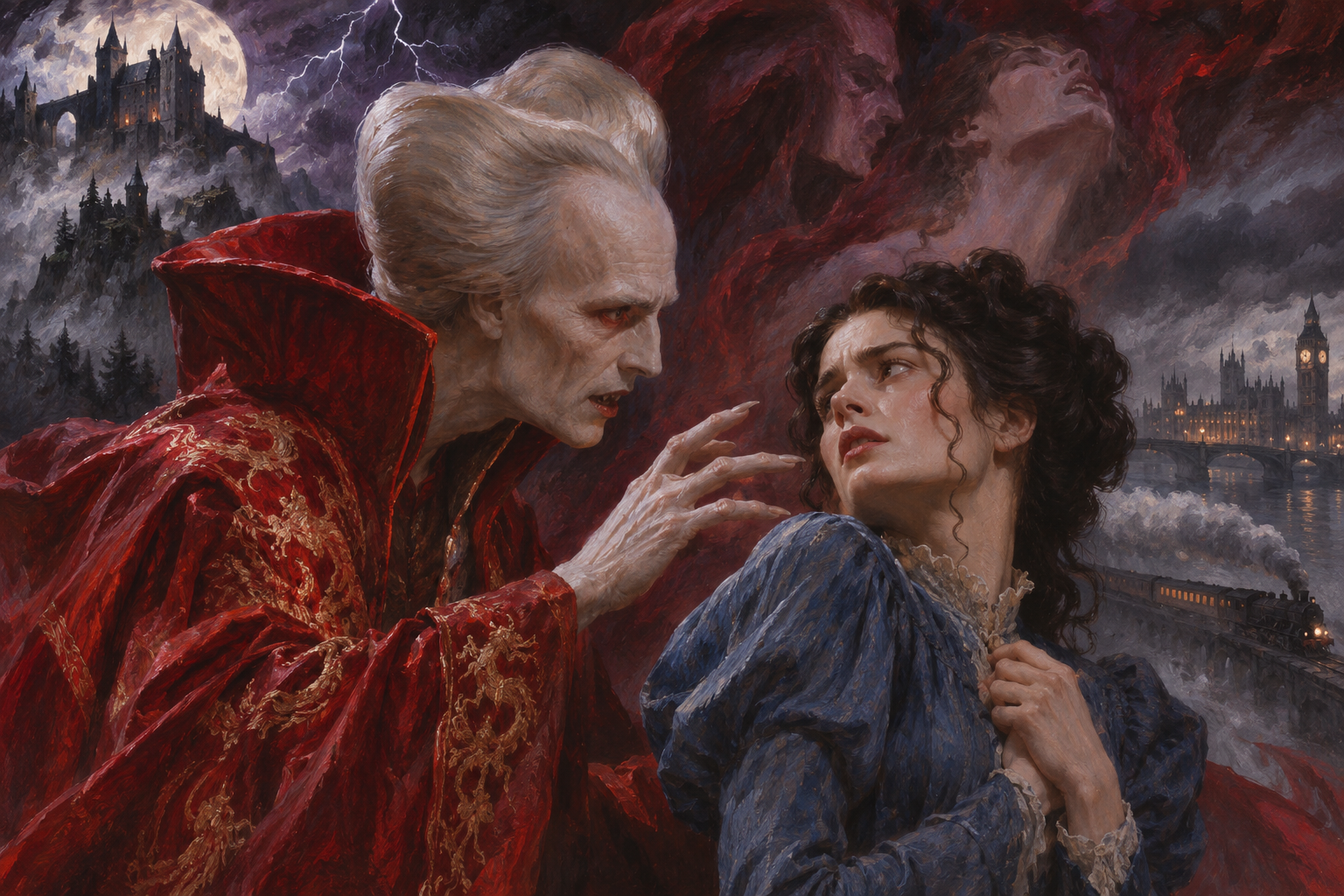
A grieving prince becomes a vampire, and a journey from a Transylvanian castle to London turns desire into a dangerous form of possession.
Francis Ford Coppola’s Bram Stoker’s Dracula (1992) is a lavish, feverish Gothic romance that delights in theatrical illusion, elaborate costume and transformations of the body. Gary Oldman’s Count is seductive and frightening, Winona Ryder’s Mina becomes the centre of a complicated longing, and Anthony Hopkins’s Van Helsing pursues the vampire with a mixture of scholarship, anger and determination. The film draws on Bram Stoker’s novel while making conspicuous changes to its central romance.
At a Glance
| Film | Bram Stoker’s Dracula (1992) |
|---|---|
| Director | Francis Ford Coppola |
| Screenplay | James V. Hart, adapting Bram Stoker’s 1897 novel |
| Principal cast | Gary Oldman, Winona Ryder, Anthony Hopkins, Keanu Reeves, Sadie Frost and Tom Waits |
| Music | Wojciech Kilar |
| Costume design | Eiko Ishioka |
| Genre | Gothic horror and supernatural romance |
| Film setting | Transylvania and nineteenth-century London; separate from the site’s campaign present |

Why This Film Matters
Coppola’s film embraces the artificial possibilities of cinema. Shadows move in ways their owners do not, costumes turn characters into living heraldic images, and changes of shape suggest a vampire who cannot be contained by one human form. The result is both sumptuous and disquieting. It also helped re-establish Dracula as a romantic figure without making his predatory nature disappear.
The film’s central tension is whether grief and love can excuse domination. Its appeal lies in the clash between overwhelming desire and the danger posed to everyone drawn into the Count’s orbit. Even the beautiful moments can be frightening because the vampire is not asking for an ordinary relationship between equals.
The Story — Without Major Spoilers
Following a tragedy in his distant past, a Transylvanian warrior rejects the life he once served and becomes a vampire. Centuries later, young solicitor Jonathan Harker travels to his castle to conduct business. Dracula discovers that Harker’s fiancée Mina resembles his lost wife and is drawn toward London, bringing a destructive supernatural obsession into the lives of her friends and household.
As Lucy Westenra’s condition becomes alarming, Professor Abraham Van Helsing begins to recognise the cause. Dracula’s influence and transformations complicate the efforts of those attempting to protect Mina, Lucy and Jonathan. The film blends an investigation with a Gothic romance, continually asking who possesses knowledge, power and the freedom to choose.
Characters and Performances
Gary Oldman as Dracula moves between aged aristocrat, seductive stranger and terrifying supernatural being. These appearances are parts of a single film character rather than separate species that need their own bestiary entries. Winona Ryder as Mina is central to the film’s reinvention of the story as a tragic romance, but her agency and vulnerability become especially important once the vampire’s attention falls upon her.
Anthony Hopkins as Abraham Van Helsing supplies the investigator’s relentless energy. His combination of knowledge and fear makes a useful contrast with Keanu Reeves’s Jonathan Harker, an ordinary man trapped in extraordinary circumstances. Sadie Frost’s Lucy demonstrates how the horror reaches beyond the Count’s initial obsession, while Tom Waits’s Renfield shows its ruinous effect upon another person.
The World on Screen
The film moves between a stylised Transylvanian castle and a London of drawing rooms, rail journeys, physicians and growing uncertainty. Its imagery carries the atmosphere of the late nineteenth century, but that belongs to the movie’s telling. SpiralWorlds’ Wallachia and its vampire prince exist in the campaign present, and neither needs to reproduce the film’s chronology, technology or romance.
Rats, wolves, bats, blood, shadow and mist provide a visual vocabulary for Dracula’s reach. In a game, those forms can inspire different threats and clues, but they should not be treated as an automatic list of powers possessed by the setting’s Vlad III.
Behind the Camera
Francis Ford Coppola directed James V. Hart’s screenplay with lavish visual effects, theatrical sets and imaginative optical trickery. Eiko Ishioka’s costumes express both history and supernatural transformation; Wojciech Kilar’s music gives the romance and terror a sweeping, ritual quality. The film’s deliberate extravagance sets it apart from the restraint of the early Universal version and the vigorous Gothic style of Hammer.
Adaptation, Themes and Critical Assessment
Despite its title, this is not a line-by-line reproduction of Bram Stoker’s Dracula. The Count’s personal history, the treatment of Mina and the central reincarnation romance are major creative decisions in Coppola’s film, not elements that should be presented as the novel’s established story.
What works: Oldman’s varied portrayal, striking costumes, inventive in-camera effects, a memorable score and an unusually bold treatment of vampire longing. Limitations: the stylistic excess can overwhelm character development, the romantic framing complicates the victims’ experiences, and the film’s tonal shifts do not always cohere. It is a powerful interpretation, not the definitive identity of Dracula across every work.
Legacy and Related Viewing
Compare Dracula (1931) for Bela Lugosi’s formal, unsettling Count and Dracula (1958) for Christopher Lee and Peter Cushing’s more physically confrontational vampire story. The actors and screen continuities are different, as are their relationships with the source novel.
Explore in SpiralWorlds
Meet Vlad III Dracula, Vampire Prince of Wallachia, and visit Wallachia for his separate campaign story. Gary Oldman’s film Count is a fictional screen interpretation, not the same biography or an instruction to import a reincarnation romance into the setting. The Vampire and Vampire Spawn provide other playable undead counterparts.
The Abraham Van Helsing NPC gives the campaign its own vampire hunter, independent of Anthony Hopkins’s performance. For the literary roots, explore Bram Stoker. A campaign journey can also lead to London and the roads of eastern Europe without adopting the film’s nineteenth-century timetable.
Ideas for the Table
The disputed portrait. A stranger is recognised in a painting centuries old. The witnesses disagree about whether the resemblance indicates immortality, a family line or a deliberate fraud. The party must find the painter’s accounts and establish who acquired the work.
The hunter’s method. A physician believes that a household’s illness has supernatural causes, while the relatives fear persecution or scandal. The players can test the evidence and decide whether to seek the aid of a skilled vampire hunter. Wrong conclusions have consequences for living people as well as for the suspect.
The castle of borrowed memories. A vampire offers companions glimpses of people they have lost. Some are accurate recollections, others are carefully engineered lies. Characters must decide which information is trustworthy and whether a promise of reunion justifies entering the vampire’s refuge.
Sources and Credits
- American Film Institute — Bram Stoker’s Dracula (1992), film credits and production background.
- British Film Institute — Bram Stoker’s Dracula, film record.
- Bram Stoker — Dracula, original novel.
The theatrical poster remains for historical identification. Film imagery and fictional portrayals belong to their respective rights holders. This is independent criticism and original tabletop commentary.
Keep this reference growing
If this page helped with your reading or game, you can support its upkeep or explore the curated books.
Explore the Bookshop — epics, classics and stories behind imagined worlds.