
SpiralWorlds Player’s Manual · Character Creation
Skills & Proficiencies
5.5e proficiencies · Pathfinder 1e skill ranks · D&D 3.5e skill points
Skills describe trained competence in tasks such as climbing, hiding, recalling lore, noticing danger, negotiating or practising a trade. The three supported rules systems handle that training differently. Choose the campaign edition first and use only its procedure.
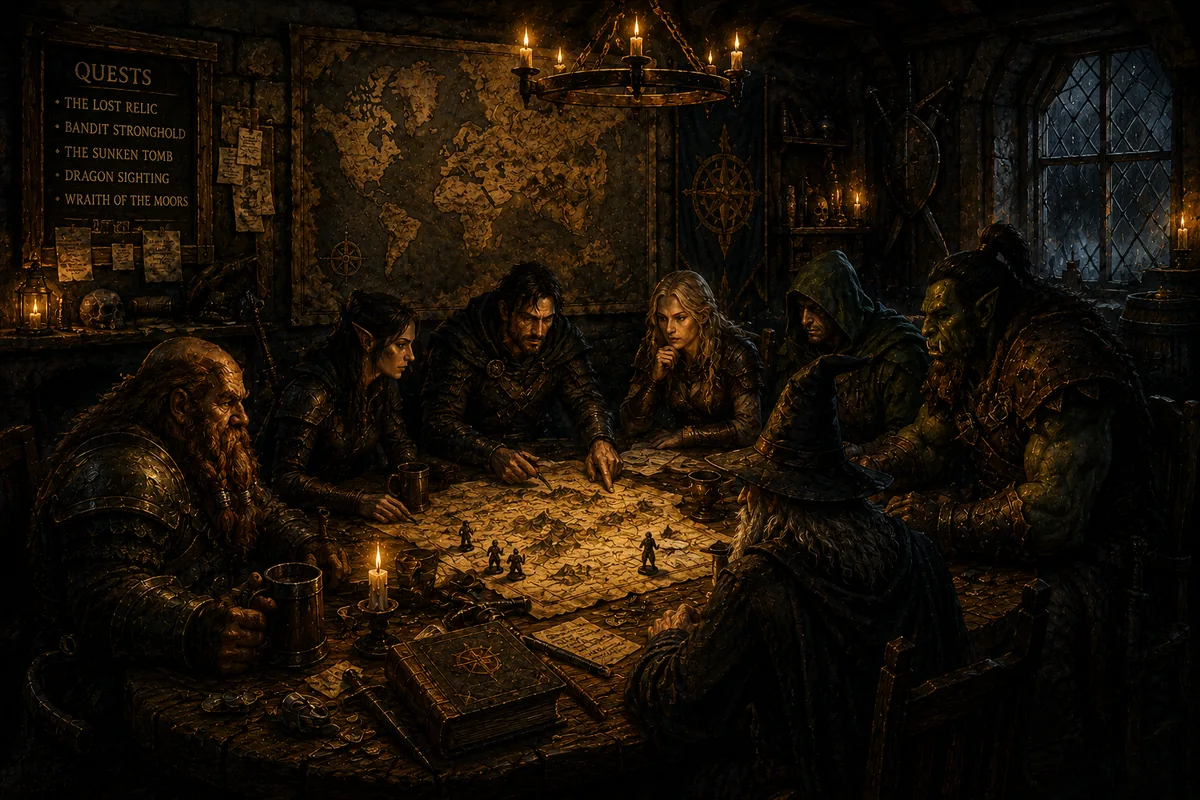
What a skill represents
Training is not the same as permission
Do not treat a skill list as the character’s whole education. A soldier can know local law, a craftswoman can understand trade, and a courtier can know horses even when those details are not represented by a dedicated mechanical skill. Use the rules for checks and the character record for broader knowledge.
Rules procedure
Record skills using your edition
D&D 5.5e / 2024
There are no skill ranks. At character creation, your background supplies proficiency in two specified skills and one tool, while your class supplies its own proficiencies and any choices listed in the class entry.
1. Record the Proficiency Bonus. A level-1 character normally has a +2 Proficiency Bonus. This bonus rises with total character level.
2. Mark your skill proficiencies. Record the skills granted by your background and the skills chosen or granted by your class. If another feature grants a proficiency, record that too.
3. Calculate a proficient skill. When a skill is relevant to an ability check and you are proficient in it, add your Proficiency Bonus to the ability modifier. If you are not proficient, you normally make the ability check without adding the Proficiency Bonus.
4. Record Expertise only if a feature grants it. Expertise normally doubles the Proficiency Bonus for the relevant ability check. The Proficiency Bonus itself cannot normally be added to the same roll more than once.
5. Keep tools separate. Tool proficiency is not a skill rank. Your 2024 background normally grants one tool proficiency; class or other features may grant more.
6. Do not assume one fixed ability for every use. Skills are associated with common abilities, but the Games Master can call for a different ability when the situation warrants it—for example, a display of raw physical threat might use Strength with Intimidation proficiency rather than Charisma.
Pathfinder 1e
PF1e uses skill ranks. Your class determines a base number of ranks gained each level, then your Intelligence modifier and other rules can alter that total.
1. Find the class’s Skill Ranks per Level. Use the PF1e class entry. Add the character’s Intelligence modifier. A character receives at least 1 skill rank per level even with a low Intelligence modifier.
2. Apply other legitimate rank sources. Some race traits, favored-class choices or class features grant additional ranks. Use only those actually present in the chosen PF1e build.
3. Spend ranks. At 1st level, a character can normally place no more than 1 rank in any one skill. In general, maximum ranks in a skill equal total character level.
4. Identify class skills. Each PF1e class has a class-skill list. If you have at least 1 rank in a class skill, you gain the PF1e +3 class-skill bonus on checks with it.
5. Calculate the check. A typical trained skill check uses d20 + ranks + relevant ability modifier + class-skill bonus if applicable + other modifiers.
The old table on this page listed classes such as Alchemist, Cavalier, Gunslinger, Inquisitor, Magus, Ninja, Oracle and Summoner. Those values are no longer presented as universal character-creation rules here. Use the actual PF1e class entry for the class being played.
D&D 3.5e
D&D 3.5e uses skill points and ranks, but its system is not the same as Pathfinder 1e.
1. Calculate 1st-level skill points. Find the class’s skill-point base, add the Intelligence modifier, then multiply the result by 4. For example, a 3.5e Fighter uses (2 + Intelligence modifier) × 4 at 1st level, while a Rogue uses (8 + Intelligence modifier) × 4.
2. Apply legitimate racial or other bonuses. In the 3.5e SRD, a Human gains 4 extra skill points at 1st level and 1 extra skill point at each later level. Apply such benefits only when they belong to the chosen 3.5e race and build.
3. Spend class-skill points. One skill point buys 1 rank in a class skill.
4. Spend cross-class skill points. One skill point buys only ½ rank in a cross-class skill.
5. Observe rank limits. At 1st level, the ordinary maximum is 4 ranks in a class skill and 2 ranks in a cross-class skill. More generally, class-skill maximum ranks equal character level + 3; cross-class maximum ranks are half that amount.
6. Calculate the check. A typical skill check is d20 + skill ranks + relevant ability modifier + miscellaneous modifiers.
5.5e quick reference
The 2024 skill list
These are the eighteen standard 2024 skills. The ability shown is the one most commonly associated with the skill; the Games Master can use another ability when the situation justifies it.
Strength
Athletics
Dexterity
Acrobatics · Sleight of Hand · Stealth
Intelligence
Arcana · History · Investigation · Nature · Religion
Wisdom
Animal Handling · Insight · Medicine · Perception · Survival
Charisma
Deception · Intimidation · Performance · Persuasion
Constitution
No standard skill is normally tied to Constitution, though the Games Master can call for Constitution ability checks when endurance is the issue.
Training in the world
Explain where the skill came from
Languages remain separate. A creature type does not automatically create a spoken language in SpiralWorlds. Use the character’s actual upbringing and the edition’s language allowance. The Languages / Speak Language reference handles languages and communication.
For a first character
Choose skills that will actually get used
A novice does not need to predict every challenge in the campaign. Start by covering the character’s expected role and one or two personal interests.
Before moving on
Skills checklist
- The campaign edition is fixed.
- 5.5e characters have not been given skill ranks.
- 5.5e background and class skill proficiencies are recorded.
- The correct Proficiency Bonus is recorded for 5.5e.
- PF1e skill ranks use the chosen class and Intelligence modifier.
- PF1e +3 class-skill bonuses are applied only to class skills with at least 1 rank.
- 3.5e 1st-level skill points are multiplied by 4.
- 3.5e class and cross-class costs and rank limits are kept separate.
- Pathfinder and 3.5e skill rules have not been mixed.
- The training source makes sense for the character’s history.
- Languages are recorded separately.
Legacy note
What this rebuild replaces
Open legacy explanation
The old page was a Pathfinder-only instruction page presented inside a shared character-creation sequence. It told every reader to calculate class-skill ranks, granted a +3 class-skill bonus and listed PF1e classes and rank totals. Those rules now appear only in the PF1e tab. The 5.5e and 3.5e procedures are kept mechanically separate.
The original /the-basics-7/5-allocate-skill-ranks/ URL is retained for link continuity even though the visible page identity is now Skills & Proficiencies.
Sources and licensing
Rules sources
- D&D 2024 Basic Rules — Creating a Character
- D&D 2024 Basic Rules — Playing the Game
- System Reference Document 5.2.1
- Pathfinder 1e Core Rulebook — Getting Started
- Pathfinder 1e Core Rulebook — Skills
- d20 SRD — D&D 3.5e Skills Summary
SRD 5.2.1 attribution: This work includes material from the System Reference Document 5.2.1 by Wizards of the Coast LLC, licensed under Creative Commons Attribution 4.0 International.
Open Game License v1.0a + Section 15
Open Game Content designation: Pathfinder 1e and D&D 3.5e mechanical material on this page is Open Game Content only to the extent that it derives from material previously released as Open Game Content. SpiralWorlds setting material, examples, artwork, CSS, page design and editorial presentation are excluded.
OPEN GAME LICENSE Version 1.0a
The following text is the property of Wizards of the Coast, Inc. and is Copyright 2000 Wizards of the Coast, Inc (“Wizards”). All Rights Reserved.
1. Definitions: (a) “Contributors” means the copyright and/or trademark owners who have contributed Open Game Content; (b) “Derivative Material” means copyrighted material including derivative works and translations, potation, modification, correction, addition, extension, upgrade, improvement, compilation, abridgment or other form in which an existing work may be recast, transformed or adapted; (c) “Distribute” means to reproduce, license, rent, lease, sell, broadcast, publicly display, transmit or otherwise distribute; (d) “Open Game Content” means the game mechanic and includes the methods, procedures, processes and routines to the extent such content does not embody Product Identity and is an enhancement over the prior art and any additional content clearly identified as Open Game Content by the Contributor; (e) “Product Identity” includes product and product line names, logos and identifying marks, artifacts, creatures, characters, stories, storylines, plots, thematic elements, dialogue, incidents, language, artwork, symbols, designs, depictions, likenesses, formats, poses, concepts, themes and graphic, photographic and other visual or audio representations and other material identified as Product Identity; (f) “Trademark” means the logos, names, marks, signs, mottos and designs used by a Contributor to identify itself or its products; (g) “Use”, “Used” or “Using” means to use, Distribute, copy, edit, format, modify, translate and otherwise create Derivative Material of Open Game Content; (h) “You” or “Your” means the licensee in terms of this agreement.
2. The License: This License applies to Open Game Content that contains a notice indicating that the Open Game Content may only be Used under and in terms of this License. You must affix such a notice to any Open Game Content that You Use. No terms may be added to or subtracted from this License except as described by the License itself.
3. Offer and Acceptance: By Using the Open Game Content You indicate Your acceptance of the terms of this License.
4. Grant and Consideration: In consideration for agreeing to use this License, the Contributors grant You a perpetual, worldwide, royalty-free, non-exclusive license with the exact terms of this License to Use the Open Game Content.
5. Representation of Authority to Contribute: If You are contributing original material as Open Game Content, You represent that Your Contributions are Your original creation and/or You have sufficient rights to grant the rights conveyed by this License.
6. Notice of License Copyright: You must update the COPYRIGHT NOTICE portion of this License to include the exact text of the COPYRIGHT NOTICE of any Open Game Content You are copying, modifying or distributing, and You must add the title, copyright date and copyright holder’s name to the COPYRIGHT NOTICE of original Open Game Content You Distribute.
7. Use of Product Identity: You agree not to Use any Product Identity except as expressly licensed in another, independent Agreement with the owner of each element of Product Identity.
8. Identification: If you distribute Open Game Content You must clearly indicate which portions of the work that you are distributing are Open Game Content.
9. Updating the License: Wizards or its designated Agents may publish updated versions of this License. You may use any authorized version of this License to copy, modify and distribute Open Game Content originally distributed under any version of this License.
10. Copy of this License: You MUST include a copy of this License with every copy of the Open Game Content You Distribute.
11. Use of Contributor Credits: You may not market or advertise the Open Game Content using the name of any Contributor unless You have written permission from the Contributor to do so.
12. Inability to Comply: If it is impossible for You to comply with any terms of this License with respect to some or all Open Game Content due to statute, judicial order or governmental regulation then You may not Use the affected Open Game Material.
13. Termination: This License terminates automatically if You fail to comply with its terms and fail to cure such breach within 30 days of becoming aware of the breach. All sublicenses survive termination.
14. Reformation: If any provision is held unenforceable, that provision shall be reformed only to the extent necessary to make it enforceable.
15. COPYRIGHT NOTICE
Open Game License v 1.0a Copyright 2000, Wizards of the Coast, Inc.
System Reference Document. Copyright 2000, Wizards of the Coast, Inc.; Authors Jonathan Tweet, Monte Cook, Skip Williams, based on material by E. Gary Gygax and Dave Arneson.
Pathfinder Roleplaying Game Core Rulebook. © 2009, Paizo Publishing, LLC; Author: Jason Bulmahn, based on material by Jonathan Tweet, Monte Cook, and Skip Williams.
END OF LICENSE