
Black Forest — Roads, Silver and Hidden Waters
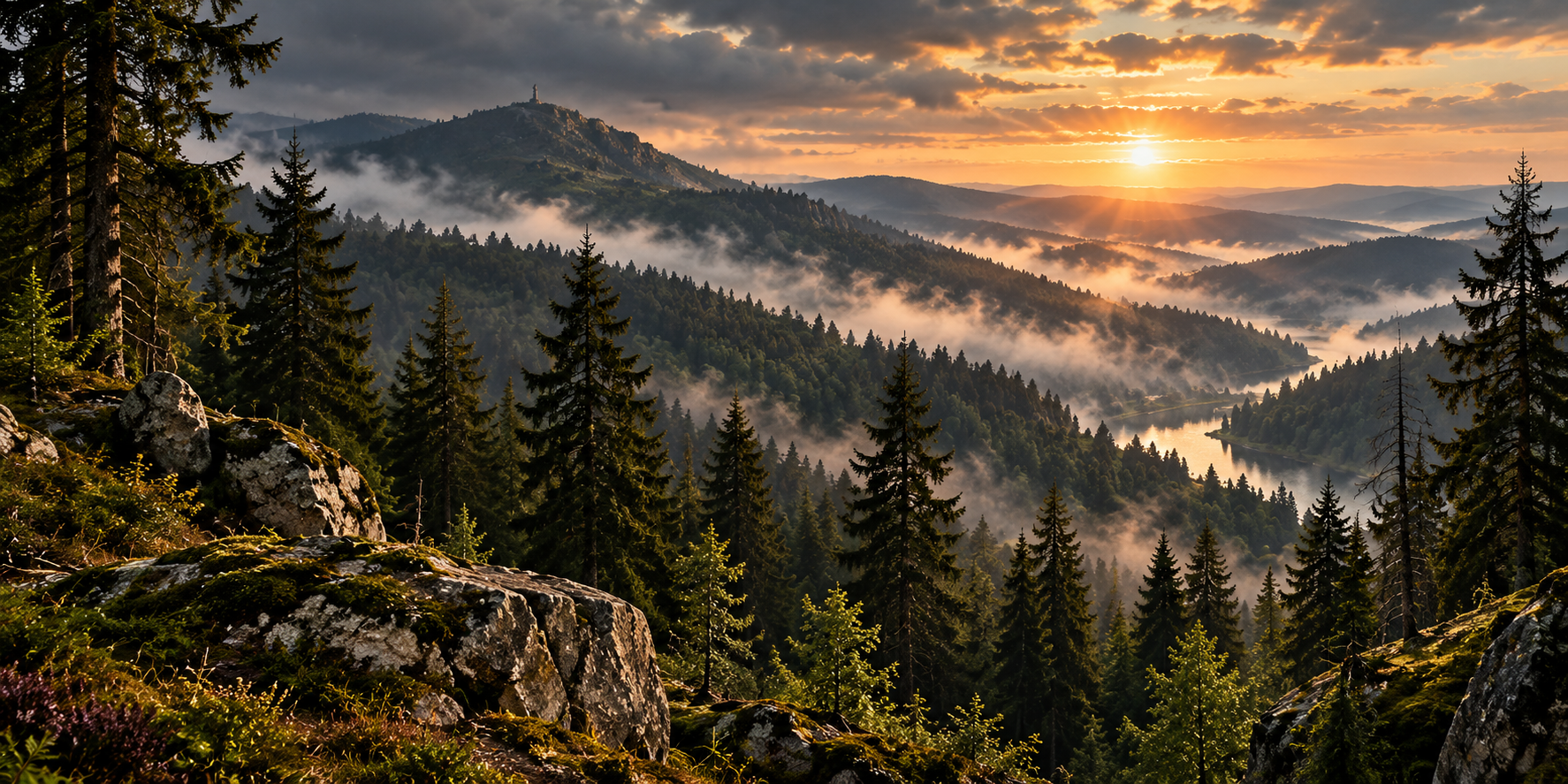
Black Forest at a Glance
- Region: the forested mountains of south-western Imperial territory, between the Upper Rhine lands and the Baar.
- Terrain: steep wooded valleys, exposed high pastures, streams, dark upland lakes, and worked as well as abandoned mines.
- Settlements and routes: the Kinzig valley, Schiltach and Wolfach; the approaches to Offenburg and Rottweil; silver-mining country above Freiburg.
- Authority: different lords, towns, miners and valley communities claim rights to roads, timber, pasture and ore. The forest is not a single lordship or an empty wilderness.
It is easier to get lost in a disputed forest than an uninhabited one. Tracks lead to charcoal clearings, timber yards, farms, mining galleries and small settlements. A traveller needs to know both the route and who maintains the next bridge. A lord’s letter may be accepted in one valley and refused across the ridge.
What Is Happening Right Now?
The silver must reach the mint. Miners and carriers working the Schauinsland ore veins supply valuable metal to Freiburg’s market and mint. A disputed tunnel entrance has stopped the carts. The mine owners call it sabotage; workers want a guarantee that the timbers are safe before anyone goes below.
Road tolls are contested. The Kinzig valley carries timber, ore and merchants between the Upper Rhine and Rottweil, yet a bailiff at Wolfach may refuse a neighbouring lord’s escort agreement. On the high tracks, carters who have heard the Muetesheer will not take a laden wagon after sunset. Merchants suspect robbers are using that fear to keep witnesses off the road. The councils need the toll income; the carters want an escort willing to travel the whole route.
Roads, Mines and Lake Country
The Kinzig Valley — A Road through the Mountains
The Kinzig gives travellers a natural east-west corridor between the Rhine and the upper Neckar. Schiltach and Wolfach stand on routes used by traders and officials for generations; farther west, Gengenbach guards the valley’s approach to the Rhine plain. Fortified houses, river crossings and valley markets matter more to a journey than the names of distant peaks. Ask about the road ahead before assuming a marked trail is passable with loaded mules.
Schauinsland — Silver under the Rock
Ore working on the heights above Freiburg is no recent discovery. Disputes over mining rights were sufficiently important to produce a written settlement, the Dieselmuth mining law, in 1372. In the campaign present, mine managers, investors, timber suppliers and labourers have different interests when a gallery floods or a vein is claimed twice. A trapped miner needs rescue regardless of whose seal appears on the mining grant.
Mummelsee — The Water beneath Hornisgrinde
Below the Hornisgrinde lies the dark water of Mummelsee. People of the neighbouring valleys tell of the Seefräulein, lake-women who once came into houses to help with the work until the friendship was broken. Some families still speak of gifts left on the shore; others warn that the water keeps its own terms and does not forgive curiosity.
A daughter sent to collect herbs along the shore has not returned by evening. Her parents fear the lake, a charcoal-burner says he saw strangers on the path, and her brother insists she has gone willingly. Whoever searches must choose whether to question the households first or follow the narrow ground between water and trees before darkness falls.
Under the Trees and Beside the Water
The Muetesheer — Riders above the Nagold
In the northern forest the old people speak of the Muetesheer, a furious procession heard over the hills of Baiersbronn and the Nagold valley. Its horns carry across the valleys on nights when no mortal hunting party could follow the ridges. Dogs howl at empty tracks; horses sweat and refuse the bridle. A charcoal-burner who has heard the riders once will put out his fire and lie beneath his cart rather than answer a horn from the trees.
Not every rider is an ordinary ghost. Those who have seen an antlered Wild Hunt scout running ahead of the company warn that the procession can change its course to pursue a traveller who calls out or breaks its passage. A messenger carrying a disputed forest charter must reach Nagold by dawn, but the huntsmen have taken the ridge road. The safer valley route crosses land guarded by a rival bailiff; neither choice is free of consequence.
The Wolf of Thummlingen
Near Thummlingen there are stories of a wolf that walks like a man when it thinks itself unobserved. One farmer has lost sheep, another swears he saw a neighbour return barefoot from the trees carrying torn clothes, and a third is demanding a public hunt. The tale of the werewolf is well known in these northern valleys, and lycanthropy is no harmless village accusation. If the danger is real, the afflicted person may need help before the hunting party catches an innocent labourer. A healer seeking wolfsbane will find that its poison is almost as feared as the curse.
Lights on the Hohloh Moor
Above the wooded valleys near Hohloh, the ground gives way to peat and black water at the Wildsee. In poor weather the safe track disappears under mist. A pale light moving between the pools is called an Irrwisch by the local guides. They leave such lights alone. The will-o’-wisp is a crueler thing than an errant lantern: it waits for a traveller to stumble, then feeds on the terror of the dying. A caravan missing near the moor may have followed a false guide—or a very human thief who knows the same paths.
The Little Folk beneath the Roots
In the Calw country, tales of the Erdleutlein, the earth folk, travel with woodcutters and stone workers. A hidden doorway behind the roots of a fallen beech, a coin returned to the wrong doorstep, a hammer heard from beneath a bank: such signs may mark the neighbours whom a village rarely sees. They are not always enemies. The household that honours an old bargain might find a broken tool repaired overnight, while a landlord who drives workers onto forbidden ground may discover every saw and axle spoiled before morning.
Some of the little folk keep their own paths beneath ruined walls and disused workings. Their elders remember boundaries older than the latest noble grant. A mine owner offering coin for their labour may be answered with a demand to reopen an ancient route, recover a stolen object or leave a burial slope undisturbed. Treating them as mere pests is an excellent way to lose a profitable seam.
Feldsee and the Spirit That Carries a Scythe
High beneath the Feldberg, the cold Feldsee lies enclosed by steep, dark forest. Stories say dangerous spirits were bound beneath its waters; when the mist thickens, the air carries murmured names from below the surface. Travellers who hear their own name called are warned to keep walking and never look back. The worst of these presences is the Dengelegeist, a restless figure bearing a long scythe. It emerges with the fog and leads those who follow its silhouette toward the lake’s sheer banks.
Farther west the Kandel has its own feared night gatherings and stories of witches crossing the heights. A missing charcoal-burner may have fled to an illicit gathering, or may lie injured in a ravine; his neighbours argue over which explanation is safer to tell the magistrate. Those willing to follow the trail can find the truth, and perhaps something that would prefer its mountain left alone.
The Glass Man and the Bargain of Hearts
Charcoal-burners and glassmakers tell of the Glasmännlein, the little glass-man who appears in the fir woods near Tannenbühl to grant carefully chosen wishes. To a poor burner his offer sounds like rescue from debt; to a greedy merchant it may seem too small a prize. He asks for wit as well as courage, and he takes a dim view of those who demand riches without considering what they will do with them.
There is another patron of desperate men: Holländer-Michel, a huge dark figure dressed like a timber-raftsman. He offers money, influence and a comfortable life in return for the petitioner’s living heart, which he replaces with cold stone. A prosperous mill-owner who has become incapable of pity may have made such a bargain. Recovering his heart could restore a family and ruin a creditor who preferred him ruthless. In the timber camps, the sudden wealth of a pitiless contractor has become a source of dread: he never joins the men by the fire, never forgives a debt, and counts every injury in lost coin.
The White Women and the Unquiet Ruins
Among the old castles of the northern forest, people tell of white-clad women appearing beside abandoned halls and treasure sealed behind stone. A woman who steps silently along a ruined wall may be guarding a family secret, seeking the return of an heirloom or warning of a death that has not yet happened. Some ruins harbour true spectres as well as less dangerous apparitions. The owner of a disputed estate may offer good coin to have the figure driven away; the dead may be the only witness to the theft that made him rich.
Foresters recognise where brown bears have torn open a fallen trunk and where lynx have followed deer between the trees. They sell that knowledge to herders and road wardens, but the same men are often asked to carry messages past the pools and ruined halls that others avoid. After dusk their price rises, and in some valleys even a lord cannot buy an escort.
Deep pools and hidden streams inspire a dozen different tales. Some are told to keep children away from dangerous water; some preserve memories of older bargains with beings who rarely appear to strangers. Around Mummelsee the lake-women are remembered for their visits to village households, not for marauding through every valley. Charcoal-burners and carriers still face more immediate trouble from rotten crossings, falling timber and men who claim the forest’s produce as their own.
Charcoal-burners, hunters and miners have their own signs and boundaries under the trees. A pit that has stopped smoking may have been abandoned, or its workers may have moved to a richer seam of timber. A guide who can tell the difference is worth hiring before anyone follows an unfamiliar track into the ravines.
Travel, Law and Practical Play
Follow valleys when carrying cargo. Ridge paths may save distance for an unburdened walker but become poor choices in rain, snow or darkness. Pay close attention to bridge conditions, the last reliable settlement, horses’ footing and whether the next lord recognises a previous toll receipt.
Starting situation: a mine foreman needs a trustworthy party to carry a sealed account book through the Kinzig corridor. The book would expose a false ore claim; the carrier is missing, while a charcoal burner says he saw a company of armed men on an unused path. The party can find the carrier, bargain with the armed men, take the book to its rightful owner or expose the buyers who want it destroyed.
Historical and Folklore Sources

The Schauinsland mining history documents the medieval workings, Freiburg’s silver supply and the 1372 Dieselmuth agreement. The regional history of the Kinzig route records its long use across the mountains. The Mummelsee legend is a Black Forest tradition preserved in a written version by Friedrich Gottschalck in 1814. Around the lake, the story has passed from household to household, changing in the telling.
For the wider forest’s legends, the Calw district archive’s Die Sagen der Heimat (Friedrich Fick, 1928) preserves traditions of the wild hunters, giants, earth folk, women of the waters, restless spirits and witches. Sigrid Früh and Wolfgang Schultze’s collection of northern Black Forest tales locates the Muetesheer at Baiersbronn and Nagold and includes the Thummlingen werewolf, wandering lights and haunted ruins. Hochschwarzwald’s regional folklore account recounts the bound spirits of Feldsee, the Dengelegeist and the witches of Kandel. These are later recorded versions of local traditions, not transcripts from any single campaign year. Wilhelm Hauff’s Das kalte Herz, published in 1827, preserves the literary tale of the Glasmännlein and Holländer-Michel in the Black Forest’s charcoal-burning and timber-trading world.
Continue east to the Baar, south-east toward the Swabian Alb, or west along the Kinzig road toward the Rhine markets.
Keep this reference growing
If this page helped with your reading or game, you can support its upkeep or explore the curated books.
Explore the Bookshop — epics, classics and stories behind imagined worlds.