
Drekavac — The Screaming Plague-Haunter
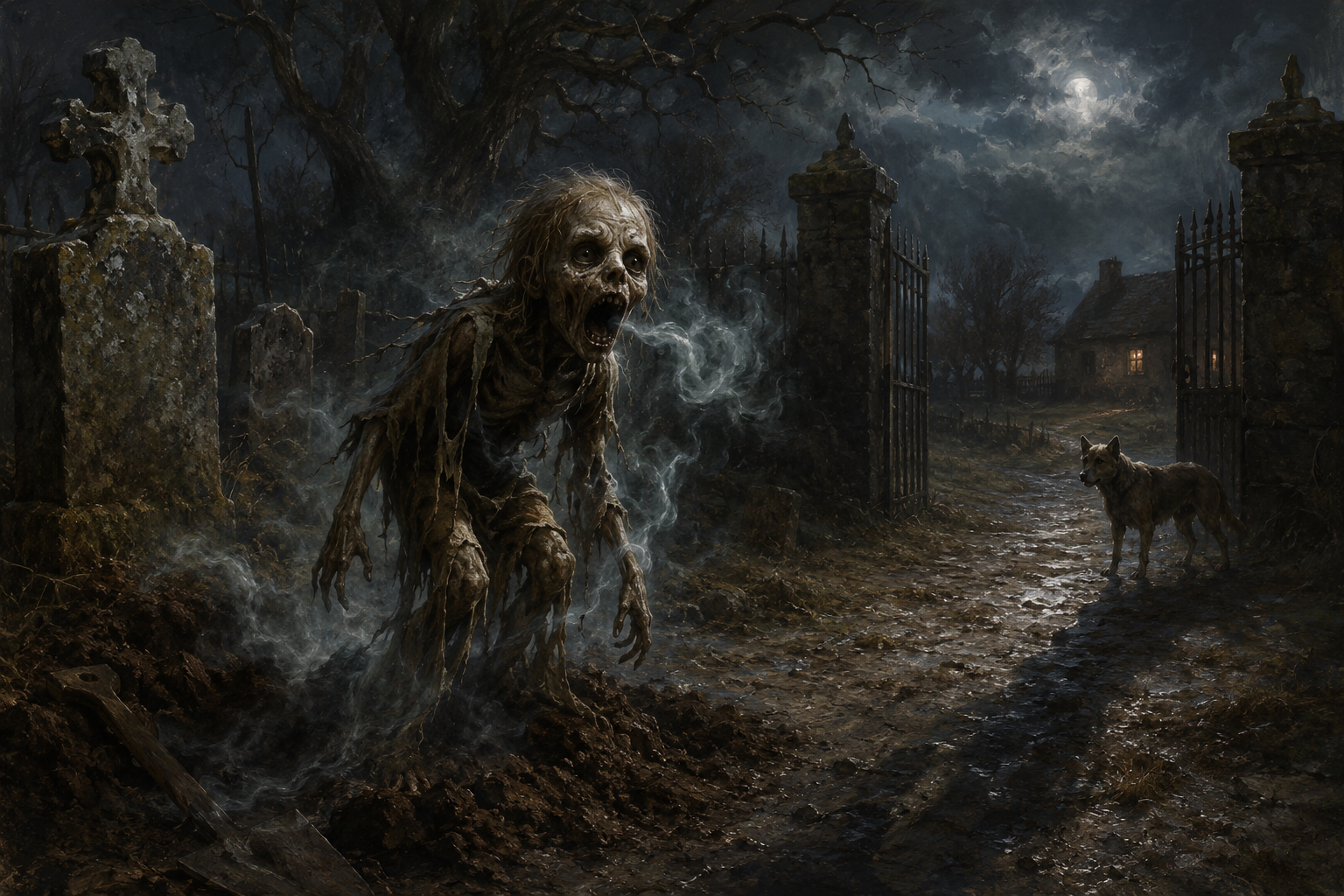
The crying begins beneath the graveyard wall after midnight. At first it sounds like a child who has lost the road home. Then the dogs begin to howl, the cattle break their tethers, and a column of mist rises from a trench that the village has never marked. A small figure steps out of the vapour, its funeral rags dragged across the stones. Every lantern throws its shadow in the wrong direction.
At a Glance
- Creature
- Drekavac — the screaming, disease-bearing unquiet dead of the South Slavic lands
- Nature
- Small Neutral Evil Undead; a hostile plague spirit born from a death denied proper rest
- Origin
- Often a child lost to an epidemic and left unnamed or unburied, though regional traditions describe other forms
- Haunts
- Graveyards, plague pits, abandoned cottages, cattle sheds, forest roads and burial trenches in the Balkans
- Signs
- A sick child’s cry, panicked animals, wrong-way shadows, fever in the household and ground-hugging mist
- Threats
- Chilling touch, diseased shadow, contagious illness, mist-form escape and the possibility of further drekavacs
- Weaknesses
- Natural sunlight, blessed salt and magic that lifts disease or breaks the soul’s curse
- Release
- Finding the body’s name, restoring denied burial rites and setting right the wrong that trapped the dead
The drekavac does not speak with the voice it possessed in life. Its cry is a warning, a lure and the last remnant of a name no one dared record. Its body is thin and child-sized, beneath a head too large and strangely bestial for its shoulders. The eyes are dark, without iris or pupil. A damp mist hangs about the grave-rags, carrying the stench of sickrooms that were shut before their patients died.
The village’s failure does not make the dead child wicked. It makes the undead creature dangerous. A drekavac has become the instrument of sickness and spite, not a child seeking a comforting embrace. To protect the living, the party must face the thing that has risen. To lay it to rest, they must discover why it rose.
Drekavac Statistics
Drekavac — D&D 2024
Small Undead, Neutral Evil · CR 4 (1,100 XP; PB +2) · Original conversion
AC 14 (grave-hardened flesh); Initiative +2 (12); HP 52 (15d6); Speed 20 ft.
| STR | DEX | CON | INT | WIS | CHA |
|---|---|---|---|---|---|
| 7 (−2) | 14 (+2) | 10 (+0) | 9 (−1) | 13 (+1) | 17 (+3) |
Saving Throws Wis +3, Cha +5; Skills Intimidation +5, Perception +3, Stealth +6; Damage Resistances Cold, Necrotic, and Bludgeoning, Piercing and Slashing damage from attacks that aren’t Silvered; Damage Immunity Poison; Condition Immunities Charmed, Exhaustion, Frightened, Poisoned; Senses Darkvision 60 ft., Passive Perception 13; Languages understands the languages learned in life but can speak only in broken cries.
Traits
Unnatural Aura. A Beast starting its turn within 30 ft. of the drekavac makes a DC 13 Wisdom Saving Throw. On failure it is Frightened until the beginning of its next turn. A creature handling the Beast may use its Reaction to make a DC 15 Wisdom (Animal Handling) check; on success the Beast has Advantage on its save. A Beast succeeding on this saving throw is immune to the aura for 24 hours.
Sunlight Aversion. In natural sunlight the drekavac has Disadvantage on attack rolls and ability checks, and it cannot use Grave Mist.
Blessed Salt. The undead cannot willingly cross an unbroken line of consecrated salt. A creature can use an Action to throw a handful of blessed salt at it within 20 ft.; the drekavac makes a DC 13 Dexterity Saving Throw, taking 7 (2d6) Radiant damage on failure, half on success.
Rite-Bound Undead. When Remove Curse, a disease-cleansing spell, or similar magic is cast directly on the drekavac, it must make a DC 15 Charisma Saving Throw. On failure it takes 21 (6d6) Radiant damage. If the rite also restores its name, burial, stolen token or another necessary remembrance, a failed save destroys the creature outright. Disease-cleansing magic still cures an infected living victim by its normal rules.
Actions
Multiattack. The drekavac makes two attacks using Chilling Grasp or Diseased Shadow.
Chilling Grasp. Melee Attack Roll +5, reach 5 ft., one creature. Hit: 10 (2d6+3) Cold plus 7 (2d6) Necrotic damage, and the target makes a DC 13 Constitution Saving Throw against Grave Fever.
Diseased Shadow. Melee Attack Roll +5, reach 10 ft., one creature in Dim Light or Darkness. Hit: 12 (2d8+3) Necrotic damage, and the target makes a DC 13 Constitution Saving Throw against Grave Fever. A light held next to the creature prevents its own shadow being struck, but may cast the drekavac’s shadow across another target.
Sick-Child Cry (Recharge 5–6). Creatures of the drekavac’s choice that can hear it within 30 ft. make a DC 13 Wisdom Saving Throw. On failure they take 10 (3d6) Psychic damage and are Frightened until the end of the drekavac’s next turn; on a failure by 5 or more they also have the Incapacitated condition until the start of its next turn. On success they take half damage and gain immunity to this drekavac’s cry for 24 hours.
Grave Mist (Recharge 5–6). The drekavac becomes a vaporous figure until the start of its next turn. It has Resistance to all damage except Force and Radiant, can pass through cracks at least 1 inch wide, may move through other creatures’ spaces and does not provoke Opportunity Attacks. While misty it cannot attack, Grapple or cast spells. It cannot end its turn inside a solid object.
Reactions
Wrong-Way Shadow. When a creature misses the drekavac with a melee attack in Dim Light or Darkness, that creature makes a DC 13 Dexterity Saving Throw. On failure it takes 7 (2d6) Necrotic damage and must make the Grave Fever saving throw.
Disease: Grave Fever
A creature failing its infection save becomes sick after 1d4 hours. It suffers chills, swollen glands and nightmares; while infected it has Disadvantage on Constitution ability checks and cannot remove Exhaustion after a Long Rest unless it succeeds on a DC 13 Constitution Saving Throw at that rest’s end. On failure it gains one level of Exhaustion. Two consecutive daily successful saves end the infection, as does appropriate disease-curing magic. If a child dies while infected, roll 1d6: on a 1, the body rises as a new drekavac after three days unless funerary rites prevent it. The new undead is independent of its creator. Destroying the original drekavac ends its supernatural Grave Fever infections, though existing Exhaustion remains until recovered normally.
Original D&D 2024 CR 4 conversion retaining the plague-haunting campaign version. Not an official Monster Manual stat block.
Drekavac — D&D 2014
Small Undead, Neutral Evil · CR 4 (1,100 XP) · Original conversion
AC 14 (grave-hardened flesh); HP 52 (15d6); Speed 20 ft.
| STR | DEX | CON | INT | WIS | CHA |
|---|---|---|---|---|---|
| 7 (−2) | 14 (+2) | 10 (+0) | 9 (−1) | 13 (+1) | 17 (+3) |
Saving Throws Wis +3, Cha +5; Skills Intimidation +5, Perception +3, Stealth +6; Damage Resistances Cold, Necrotic, and Bludgeoning, Piercing and Slashing damage from nonmagical attacks that aren’t silvered; Damage Immunity Poison; Condition Immunities Charmed, Exhaustion, Frightened, Poisoned; Senses Darkvision 60 ft., Passive Perception 13; Languages understands the languages learned in life but can speak only in broken cries.
Traits
Unnatural Aura. A Beast starting its turn within 30 ft. of the drekavac makes a DC 13 Wisdom saving throw. On failure it is Frightened until the beginning of its next turn. A creature handling the Beast may use its Reaction to make a DC 15 Wisdom (Animal Handling) check; on success the Beast has Advantage on its save. A Beast succeeding on this saving throw is immune to the aura for 24 hours.
Sunlight Aversion. In natural sunlight the drekavac has Disadvantage on attack rolls and ability checks, and it cannot use Grave Mist.
Blessed Salt. The undead cannot willingly cross an unbroken line of consecrated salt. A creature can use an Action to throw a handful of blessed salt at it within 20 ft.; the drekavac makes a DC 13 Dexterity saving throw, taking 7 (2d6) Radiant damage on failure, half on success.
Rite-Bound Undead. When Remove Curse, a disease-cleansing spell, or similar magic is cast directly on the drekavac, it must make a DC 15 Charisma saving throw. On failure it takes 21 (6d6) Radiant damage. If the rite also restores its name, burial, stolen token or another necessary remembrance, a failed save destroys the creature outright. Disease-cleansing magic still cures an infected living victim by its normal rules.
Actions
Multiattack. The drekavac makes two attacks using Chilling Grasp or Diseased Shadow.
Chilling Grasp. Melee Spell Attack +5, reach 5 ft., one creature. Hit: 10 (2d6+3) Cold plus 7 (2d6) Necrotic damage, and the target makes a DC 13 Constitution saving throw against Grave Fever.
Diseased Shadow. Melee Spell Attack +5, reach 10 ft., one creature in Dim Light or Darkness. Hit: 12 (2d8+3) Necrotic damage, and the target makes a DC 13 Constitution saving throw against Grave Fever. A light held next to the creature prevents its own shadow being struck, but may cast the drekavac’s shadow across another target.
Sick-Child Cry (Recharge 5–6). Creatures of the drekavac’s choice that can hear it within 30 ft. make a DC 13 Wisdom saving throw. On failure they take 10 (3d6) Psychic damage and are Frightened until the end of the drekavac’s next turn; on a failure by 5 or more they also have the Incapacitated condition until the start of its next turn. On success they take half damage and gain immunity to this drekavac’s cry for 24 hours.
Grave Mist (Recharge 5–6). The drekavac becomes a vaporous figure until the start of its next turn. It has Resistance to all damage except Force and Radiant, can pass through cracks at least 1 inch wide, may move through other creatures’ spaces and does not provoke Opportunity Attacks. While misty it cannot attack, Grapple or cast spells. It cannot end its turn inside a solid object.
Reactions
Wrong-Way Shadow. When a creature misses the drekavac with a melee attack in Dim Light or Darkness, that creature makes a DC 13 Dexterity saving throw. On failure it takes 7 (2d6) Necrotic damage and must make the Grave Fever saving throw.
Disease: Grave Fever
A creature failing its infection save becomes sick after 1d4 hours. It suffers chills, swollen glands and nightmares; while infected it has Disadvantage on Constitution ability checks and cannot remove Exhaustion after a Long Rest unless it succeeds on a DC 13 Constitution saving throw at that rest’s end. On failure it gains one level of Exhaustion. Two consecutive daily successful saves end the infection, as does appropriate disease-curing magic. If a child dies while infected, roll 1d6: on a 1, the body rises as a new drekavac after three days unless funerary rites prevent it. The new undead is independent of its creator. Destroying the original drekavac ends its supernatural Grave Fever infections, though existing Exhaustion remains until recovered normally.
Original D&D 2014 CR 4 conversion retaining the plague-haunting campaign version. Not an official Monster Manual stat block.
Drekavac — Pathfinder 1e
NE Small Undead · CR 3 (800 XP) · Published Pathfinder creature
Initiative +1; Senses Darkvision 60 ft., Perception +8; Aura Unnatural Aura (30 ft.).
AC 15, touch 12, flat-footed 14 (+1 Dex, +3 Natural, +1 Size); HP 30 (4d8+12); Fort +4, Ref +2, Will +7; DR 5/Silver; Immunities Undead traits; Weaknesses Sunlight Aversion, Vulnerability to Magic, Vulnerability to Salt.
Speed 20 ft.; Melee Chilling Grasp +5 Touch (1d6 Cold plus Disease) or Shadow +5 Touch (Disease); Special Attacks Create Spawn, Disease, Diseased Shadow; Spell-Like Abilities CL 5th, concentration +8: Gaseous Form at will.
| STR | DEX | CON | INT | WIS | CHA |
|---|---|---|---|---|---|
| 10 (+0) | 12 (+1) | — | 9 (−1) | 12 (+1) | 17 (+3) |
BAB +3; CMB +2; CMD 13; Feats Iron Will, Weapon Finesse; Skills Intimidate +10, Perception +8, Stealth +12; Languages Common; Environment Any; Organisation solitary or pack (2–5); Treasure none.
Special Abilities
Create Spawn (Su). A child who dies from a drekavac’s disease has a 1-in-6 chance of rising as another drekavac three days later. The new creature is independent, possesses all its Undead abilities, and does not retain its former living abilities.
Disease (Su). The drekavac usually carries Bubonic Plague, but its disease may instead be another potentially fatal infection. The normal form is Bubonic Plague: Touch injury; Fort DC 15; onset 1 day; frequency 1/day; effect 1d4 Constitution damage, 1 Charisma damage, and Fatigued; cure two consecutive successful saves. The living recover from ability damage normally after the disease ends. Destroying the drekavac immediately cures every supernatural infection it inflicted, but does not restore lost ability scores or revive the dead.
Diseased Shadow (Su). Contact with the creature’s shadow exposes the target to its disease. The drekavac can strike with the shadow as a Standard Action using a Touch Attack. If Chilling Grasp misses, the target must still make a DC 15 Reflex save to avoid a touch from the shadow. When direction matters, roll 1d8 to determine the adjacent square in which the shadow falls. A creature carrying a light source cannot itself be touched by the drekavac’s shadow, although the light may throw the shadow towards another creature.
Sunlight Aversion (Ex). The drekavac flees natural sunlight; while caught in it the creature is Staggered.
Unnatural Aura (Su). Animals sense it at 30 ft. and will not approach, panicking if forced within that distance unless a handler succeeds at a DC 25 Handle Animal or Ride check (or Wild Empathy check).
Vulnerability to Magic (Ex). A Remove Curse or Remove Disease spell cast directly upon the drekavac can destroy it, with DC 15 as specified by the published special ability. Destroying it in this way does not clear the infections it has already caused.
Vulnerability to Salt (Ex). The drekavac cannot cross an unbroken line of blessed salt. A handful of salt consecrated as Holy Water deals the same damage to it as a flask of Holy Water.
Published Pathfinder 1e Drekavac, Pathfinder Adventure Path #31: Stolen Land (2010), © Paizo Publishing, LLC; author Tim Hitchcock. Standard rules also draw on the Pathfinder Roleplaying Game Core Rulebook.
Drekavac — D&D 3.5e
Neutral Evil · Small Undead · CR 3 · Original conversion
HD 4d12 (26 hp); Initiative +1; Speed 20 ft.; AC 15 (+1 Dex, +3 Natural, +1 Size), touch 12, flat-footed 14; BAB/Grapple +2/−2; Fort +1, Ref +2, Will +7; Space/Reach 5 ft./5 ft.; DR 5/Silver; Undead traits; Senses Darkvision 60 ft., Perception represented by Spot and Listen.
| STR | DEX | CON | INT | WIS | CHA |
|---|---|---|---|---|---|
| 10 (+0) | 12 (+1) | — | 9 (−1) | 12 (+1) | 17 (+3) |
Attack Chilling Grasp +4 Melee Touch (1d6 Cold plus Disease) or Shadow +4 Melee Touch (Disease); Special Attacks Create Spawn, Diseased Shadow, Plague Touch; Skills Hide +12, Intimidate +9, Listen +8, Spot +8; Feats Iron Will, Weapon Finesse; Spell-Like Abilities at will Gaseous Form (CL 5th).
Special Abilities
Plague Touch (Su). Any creature touched by the Chilling Grasp or Diseased Shadow must make a DC 15 Fortitude save or contract the drekavac’s supernatural illness. Onset 1 day, frequency daily, 1d4 Constitution damage, 1 Charisma damage, and Fatigue. Two consecutive successful daily saves end it. Destroying the drekavac by weapons, turning or other means cures infections caused by its touch, without restoring ability damage or reviving anyone. A Remove Curse or Remove Disease spell cast directly upon the creature destroys it on a successful DC 15 caster-level check, but does not cure existing infections when used in this fashion.
Diseased Shadow (Su). Its shadow delivers Plague Touch. The undead can aim its shadow as a Standard Action with a +4 Touch Attack. After a failed Chilling Grasp attack the target must still make a DC 15 Reflex save to avoid the shadow. A creature bearing its own light cannot be touched by the drekavac’s shadow, though another creature may be exposed on the opposite side.
Create Spawn (Su). A child who dies of its plague rises as an independent drekavac after three days on a roll of 1 on 1d6 unless the body is properly consecrated and interred.
Unnatural Aura (Su). Within 30 ft., animals are frightened and cannot be made to approach without DC 25 Handle Animal or Ride check, or equivalent Wild Empathy.
Sunlight Aversion (Ex). The drekavac seeks to flee natural sunlight and is Staggered while exposed.
Blessed Salt (Su). Cannot cross an unbroken line of salt consecrated as Holy Water. Thrown blessed salt deals Holy Water damage.
Original D&D 3.5e conversion based on the Pathfinder CR 3 creature. It is not a published D&D 3.5e SRD monster.
What Is Happening Right Now?
In a village above the river, the reeve has shut the burial gate. He claims that every soul taken by the great sickness was given the proper rite. A child cries beyond the wall each night; the cattle refuse to sleep and the reeve’s youngest daughter has begun to suffer a fever. An old mason knows where the wall was moved when the burial ground filled, but he has never dared tell the priest how many graves lie beyond it.
What the Cry Means
The creature’s shriek may herald a death, or be the sound that leads another traveller into its grasp. A drekavac hunts where the rituals of burial failed, where a plague cart was overturned, or where the dead were hidden to preserve a lord’s reputation. It leaves no written accusation. Its only testimony is the repeated cry that witnesses have chosen not to hear.
Beyond the formal burial grounds of Bosnia and Croatia, it may be seen on forest paths, riverbanks or ruined cattle sheds. Farmers speak of a creature that foretells illness in the herd, while families fear a child’s voice calling from the cemetery. The living cannot rely upon a single description: some manifestations look like a small corpse, others have the head of a beast, and still others appear only as a voice in the mist. The version most often encountered by grave-watchers wears ragged shrouds and carries the sickness that killed it.
What the Dead Have Become
Its eyes are black hollows; its breath carries the fever of a closed sickroom. A touch from its cold fingers can infect a healthy person, but the shadow that falls beside it is nearly as dangerous. A lantern does not always drive the drekavac away: the flame may cast its shadow over another companion. Natural sunlight weakens the undead and makes its concealment harder. A continuous line of blessed salt forms a boundary it cannot cross. Such defences will protect the living long enough for the company to find the burial that was stolen.
The drekavac is not the same kind of restless dead as a Ghost or Revenant. It seeks no particular murderer to avenge itself upon. It spreads its own fatal sickness. Unlike an Apocalypse Zombie, it may turn to mist and pass unseen through openings. It has the mind of an unquiet spirit but is driven more by its curse than by a mortal plan.
Signs of the Plague Haunting
- Dogs and cattle panic thirty paces before the undead can be seen
- A death-token or small silver charm is found beyond the official burial boundary
- Cries rise from a boarded cottage where the household was supposedly evacuated
- Fever spreads among those who followed a thin figure down a lane after dark
- The same shadow crosses a wall although the lantern has been moved
- Bright morning sun stops the cries, yet the burial trench remains cold
At the Table
Begin with the people, not with the monster. The reeve fears exposure, the healer fears another outbreak, and the gravedigger has been paid to keep silent. The sound beyond the wall draws attention to a place no map marks. When the creature attacks it seldom stands against a company with weapons raised. It crosses a lane in mist, touches the unguarded, and leaves an infected shadow behind. The immediate fight is dangerous; the larger choice is how to protect the village without hiding the cause of the suffering again.
Let the characters use the surroundings. A lantern can move shadows; a lantern carried close to the body gives that person protection from the shadow even as its light may expose an ally. Blessed salt can bar an opening, and morning sunshine can force the creature back into a cellar or grave. The Remove Disease and Remove Curse traditions may destroy the undead when directed upon it. They may also cure the living, but the appropriate effect depends on the rules of the chosen game.
The Forgotten Name
The company cannot put a soul at peace until it knows whose name to speak. The forgotten child may have worn a silver charm, lived among the tenants a landlord condemned, or died in a sealed house because villagers feared infection. The grave may have been moved without its body, leaving the marker on the wrong side of a wall. Restoring the grave, telling the truth of the death and completing the rites offers the dead something the village once refused to grant.
Encounters Beyond the Burial Gate
The Cry Beneath the Wall. The burial ground was expanded during the plague, then narrowed once the danger passed. The mason who rebuilt the wall knows there are bodies beneath the new foundations. The drekavac cries only where the soil was never blessed.
The Reeve’s Cattle. A wealthy reeve hires the company to stop sickness in his herd. A tenant insists that the reeve once sealed infected families inside their cottages while preserving his livestock. The cries have moved from the empty houses towards the reeve’s nursery.
The Plague Cart Returns. A cart used to carry the dead has reappeared on a lonely road, though the villagers swear it was burned. Beneath its boards is a purse of stolen coins and a ledger recording the families who were never buried. Each night the drekavac follows its old wheel tracks.
The Cost of the Sickness
The creature carries no treasure. Its grave may hold a child’s token, an unburned death-roll, a silver pendant or a healer’s satchel. These are not trophies of victory; they are evidence. An adventurer who brings the book back to the village can expose the concealed plague, restore an inheritance or return the dead to their kin. The disease itself is related to Bubonic Plague, though the supernatural form may spread by a shadow and be tied to the monster that created it.
The great epidemics of the preceding century still shape the laws and fears of Midgard. In the age of plague and broken authority, villages were closed, labour was scarce and death records were lost or altered. The drekavac belongs to those places where an official decree could not replace the rites owed to the dead.
Laying the Dead to Rest
When a drekavac is killed, the supernatural sickness may lift, but the village remains responsible for its missing dead. A company can finish what was left undone: identify the child, recover or mark the body, return a stolen token, cleanse the burial ground and record the death truthfully. Those acts bring a more lasting peace than silence. The priest can reopen the gate; the reeve must answer for the people he abandoned; the healer can attend the living without concealing their illness.
Other Forms and Traditions
Some South Slavic tales name a screaming beast that foretells disease among livestock; others tell of the night-wandering souls of soldiers or the unquiet dead. Such beings need not share every disease power described here. The Slavic Bestiary records other creatures of the roads and graveyards, while the Vila belongs to a different order of being despite sharing the woods and mountains.
Sources and Licensing
The Pathfinder 1e creature is taken from Archives of Nethys — Drekavac, originally published in Pathfinder Adventure Path #31: Stolen Land (2010), author Tim Hitchcock, Paizo Publishing. The D&D 2024, D&D 2014 and D&D 3.5e panels are original conversions and do not claim official Monster Manual status. Regional traditions vary: for context, see South Slavic mythological beings in Folklorica and South Slavic children’s folklore research. The creature’s place among plague villages and failed burials is an interpretation for the campaign.
Return to the Undead Bestiary.
Full Open Game License 1.0a and Section 15 notices
OPEN GAME LICENSE Version 1.0a
The following text is the property of Wizards of the Coast, Inc. and is Copyright 2000 Wizards of the Coast, Inc (“Wizards”). All Rights Reserved.
1. Definitions: (a)”Contributors” means the copyright and/or trademark owners who have contributed Open Game Content; (b)”Derivative Material” means copyrighted material including derivative works and translations (including into other computer languages), potation, modification, correction, addition, extension, upgrade, improvement, compilation, abridgment or other form in which an existing work may be recast, transformed or adapted; (c) “Distribute” means to reproduce, license, rent, lease, sell, broadcast, publicly display, transmit or otherwise distribute; (d)”Open Game Content” means the game mechanic and includes the methods, procedures, processes and routines to the extent such content does not embody the Product Identity and is an enhancement over the prior art and any additional content clearly identified as Open Game Content by the Contributor, and means any work covered by this License, including translations and derivative works under copyright law, but specifically excludes Product Identity. (e) “Product Identity” means product and product line names, logos and identifying marks including trade dress; artifacts; creatures characters; stories, storylines, plots, thematic elements, dialogue, incidents, language, artwork, symbols, designs, depictions, likenesses, formats, poses, concepts, themes and graphic, photographic and other visual or audio representations; names and descriptions of characters, spells, enchantments, personalities, teams, personas, likenesses and special abilities; places, locations, environments, creatures, equipment, magical or supernatural abilities or effects, logos, symbols, or graphic designs; and any other trademark or registered trademark clearly identified as Product identity by the owner of the Product Identity, and which specifically excludes the Open Game Content; (f) “Trademark” means the logos, names, mark, sign, motto, designs that are used by a Contributor to identify itself or its products or the associated products contributed to the Open Game License by the Contributor (g) “Use”, “Used” or “Using” means to use, Distribute, copy, edit, format, modify, translate and otherwise create Derivative Material of Open Game Content. (h) “You” or “Your” means the licensee in terms of this agreement.
2. The License: This License applies to any Open Game Content that contains a notice indicating that the Open Game Content may only be Used under and in terms of this License. You must affix such a notice to any Open Game Content that you Use. No terms may be added to or subtracted from this License except as described by the License itself. No other terms or conditions may be applied to any Open Game Content distributed using this License.
3. Offer and Acceptance: By Using the Open Game Content You indicate Your acceptance of the terms of this License.
4. Grant and Consideration: In consideration for agreeing to use this License, the Contributors grant You a perpetual, worldwide, royalty-free, non-exclusive license with the exact terms of this License to Use, the Open Game Content.
5. Representation of Authority to Contribute: If You are contributing original material as Open Game Content, You represent that Your Contributions are Your original creation and/or You have sufficient rights to grant the rights conveyed by this License.
6. Notice of License Copyright: You must update the COPYRIGHT NOTICE portion of this License to include the exact text of the COPYRIGHT NOTICE of any Open Game Content You are copying, modifying or distributing, and You must add the title, the copyright date, and the copyright holder’s name to the COPYRIGHT NOTICE of any original Open Game Content you Distribute.
7. Use of Product Identity: You agree not to Use any Product Identity, including as an indication as to compatibility, except as expressly licensed in another, independent Agreement with the owner of each element of that Product Identity. You agree not to indicate compatibility or co-adaptability with any Trademark or Registered Trademark in conjunction with a work containing Open Game Content except as expressly licensed in another, independent Agreement with the owner of such Trademark or Registered Trademark. The use of any Product Identity in Open Game Content does not constitute a challenge to the ownership of that Product Identity. The owner of any Product Identity used in Open Game Content shall retain all rights, title and interest in and to that Product Identity.
8. Identification: If you distribute Open Game Content You must clearly indicate which portions of the work that you are distributing are Open Game Content.
9. Updating the License: Wizards or its designated Agents may publish updated versions of this License. You may use any authorized version of this License to copy, modify and distribute any Open Game Content originally distributed under any version of this License.
10. Copy of this License: You MUST include a copy of this License with every copy of the Open Game Content You Distribute.
11. Use of Contributor Credits: You may not market or advertise the Open Game Content using the name of any Contributor unless You have written permission from the Contributor to do so.
12. Inability to Comply: If it is impossible for You to comply with any of the terms of this License with respect to some or all of the Open Game Content due to statute, judicial order, or governmental regulation then You may not Use any Open Game Material so affected.
13. Termination: This License will terminate automatically if You fail to comply with all terms herein and fail to cure such breach within 30 days of becoming aware of the breach. All sublicenses shall survive the termination of this License.
14. Reformation: If any provision of this License is held to be unenforceable, such provision shall be reformed only to the extent necessary to make it enforceable.
15. COPYRIGHT NOTICE
Open Game License v 1.0a Copyright 2000, Wizards of the Coast, Inc.
System Reference Document Copyright 2000–2003, Wizards of the Coast, Inc.; Authors Jonathan Tweet, Monte Cook, Skip Williams, Rich Baker, Andy Collins, David Noonan, Rich Redman, Bruce R. Cordell, John D. Rateliff, Thomas Reid and James Wyatt, based on original material by E. Gary Gygax and Dave Arneson.
Pathfinder Roleplaying Game Core Rulebook Copyright 2009, Paizo Publishing, LLC; Author Jason Bulmahn, based on material by Jonathan Tweet, Monte Cook and Skip Williams.
Pathfinder Adventure Path #31: Stolen Land Copyright 2010, Paizo Publishing, LLC; Author Tim Hitchcock.
Keep this reference growing
If this page helped with your reading or game, you can support its upkeep or explore the curated books.
Explore the Bookshop — epics, classics and stories behind imagined worlds.