
Banshee — The Keening Woman
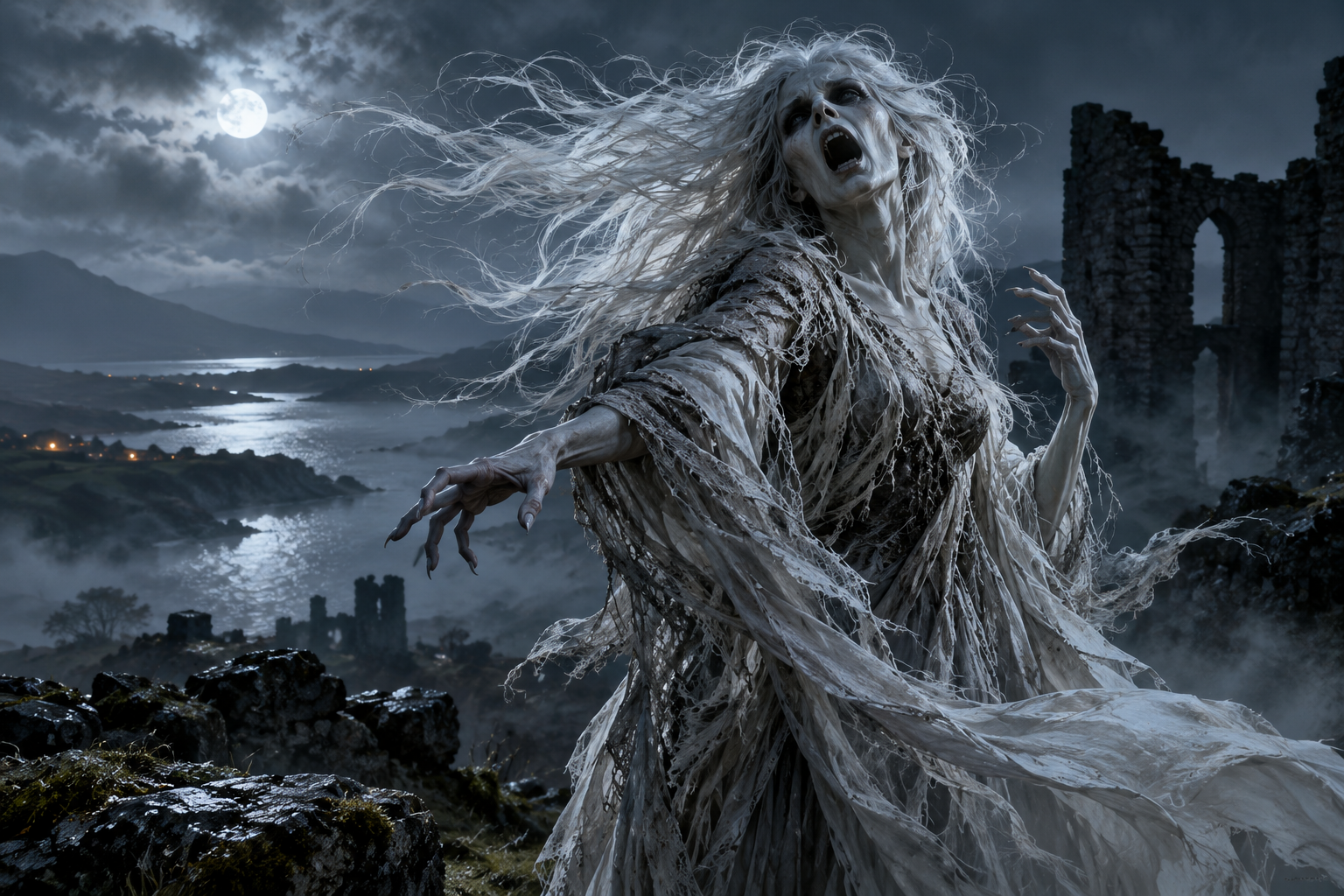
A woman cries beneath the window before first light. Her voice moves through the orchard, but no footprints mark the wet ground. By morning, news reaches the household of a death in the family.
In Irish folklore the banshee (bean sí, woman of the fairy mound) is a mourner from the Otherworld. Her keening forewarns a death; it does not ordinarily cause one. Some cruel or grief-bound spirits take on a predatory undead form, and the oldest among them possess terrible power. The war-crow of the Morrígan is a different portent: a family mourner’s lament is not automatically the war-goddess’s voice.
At a Glance
| Creature | Banshee (bean sí); keening woman; elder banshee |
|---|---|
| Nature | Traditional family death-messenger; hostile spectral banshee; much stronger elder haunting |
| Size and type | Medium Undead in each of the eight combat stat blocks. A family’s supernatural mourner is not automatically hostile. |
| Challenge by edition | 5.5e / 2024: CR 4 and CR 13 · 5e / 2014: CR 4 and CR 13 · Pathfinder 1e: CR 4 and CR 13 · D&D 3.5e: CR 4 and CR 13 |
| Home and range | Family houses, burial grounds, graveyards and lonely roads in Ireland; other hauntings occur where grief and betrayal hold a spirit fast |
| Behaviour | A family mourner warns of death; a hostile banshee stalks intruders; an elder may torment a household over generations |
| Signs | Keening beneath a window, long loose hair, a silver comb, a lament heard ahead of a death |
| Threat and counterplay | Incorporeal movement, fear, touch attacks and wailing. Learn whether the spirit is a witness or a killer; control distance, seek sunlight and avoid hearing the wail. |
Banshee Statistics — Two Challenge Ratings, Four Editions
CR 4: a dangerous death-haunting with incorporeal movement, fear and a deadly voice. CR 13: an elder banshee with life-draining attacks, a far more powerful wail and the means to threaten an experienced party. The cry that foretells a family death is not itself an attack.
An ordinary hostile banshee can drive a household from its ancestral home; an elder may silence an entire hamlet with a single cry. The wail that foretells a family death is not always an attack, but the spirit that utters it can become murderous when its grave is disturbed or an ancient wrong is repeated.
Banshee — CR 4
Published 2024 rules creature. Medium Undead, Chaotic Evil
Armor Class 12; Initiative +2 (12)
Hit Points 54 (12d8); Speed 5 ft., Fly 40 ft. (hover)
Challenge 4 (1,100 XP)
Proficiency Bonus +2
| STR | DEX | CON | INT | WIS | CHA |
|---|---|---|---|---|---|
| 1 (−5) | 14 (+2) | 10 (+0) | 12 (+1) | 11 (+0) | 17 (+3) |
Saving Throws Str −5, Dex +2, Con +0, Int +1, Wis +2, Cha +3
Damage Resistances Acid, Bludgeoning, Fire, Lightning, Piercing, Slashing, Thunder
Damage Immunities Cold, Necrotic, Poison
Condition Immunities Charmed, Exhaustion, Frightened, Grappled, Paralyzed, Petrified, Poisoned, Prone, Restrained
Senses Darkvision 60 ft., Passive Perception 10
Languages Irish Gaelic, Elvish
Traits
Detect Life. Senses the direction, but not the exact location, of creatures within 1 mile other than Constructs and Undead.
Incorporeal Movement. Moves through creatures and objects as Difficult Terrain. Takes 5 (1d10) Force damage if ending a turn inside an object.
Actions
Multiattack. Makes two Corrupting Touch attacks and uses Horrify.
Corrupting Touch. Melee Attack Roll: +5 to hit, reach 5 ft., one target. Hit: 7 (1d8 + 3) Necrotic damage.
Horrify. Wisdom Saving Throw: DC 13 for one creature within 60 ft. that the banshee sees and that can see the banshee. Failure: Frightened until the start of the banshee’s next turn. Success: immune to this banshee’s Horrify for 24 hours.
Deathly Wail (1/Day). Unavailable in sunlight. Each hearing creature within 30 ft., except Constructs and Undead, makes a DC 13 Constitution saving throw. Failure: if the creature has 25 HP or fewer, it drops to 0 HP; otherwise takes 10 (3d6) Psychic damage. Success: no effect.
Source: 2024 Monster Manual banshee (purchase required on Roll20).
Elder Banshee — CR 13
Original elder banshee. Medium Undead, Chaotic Evil
Armor Class 17 (Spectral Ward); Initiative +4 (14)
Hit Points 195 (26d8 + 78); Speed 5 ft., Fly 60 ft. (hover)
Challenge 13 (10,000 XP)
Proficiency Bonus +5 — estimated for this original creature
| STR | DEX | CON | INT | WIS | CHA |
|---|---|---|---|---|---|
| 1 (−5) | 18 (+4) | 16 (+3) | 14 (+2) | 16 (+3) | 20 (+5) |
Saving Throws Dex +9, Con +8, Wis +8, Cha +10
Skills Perception +8
Damage Resistances Acid, Bludgeoning, Fire, Lightning, Piercing, Slashing, Thunder
Damage Immunities Cold, Necrotic, Poison
Condition Immunities Charmed, Exhaustion, Frightened, Grappled, Paralyzed, Petrified, Poisoned, Prone, Restrained
Senses Darkvision 60 ft., Passive Perception 18
Languages Irish Gaelic, Elvish
Traits
Detect Life. Knows the general direction of living creatures within 1 mile; excludes Constructs and Undead.
Incorporeal Movement. Moves through creatures and solid objects as Difficult Terrain. Takes 5 (1d10) Force damage if it ends a turn within an object.
Life-Draining Touch. When the elder banshee deals Necrotic damage with Corrupting Touch to a living creature, the elder banshee regains Hit Points equal to half the Necrotic damage actually dealt (rounded down). This does not work against Constructs or Undead.
Actions
Multiattack. Makes three Corrupting Touch attacks, and may replace one of them with Dread Glance.
Corrupting Touch. Melee Attack Roll: +10 to hit, reach 5 ft., one target. Hit: 15 (3d6 + 5) Necrotic damage.
Dread Glance. Wisdom Saving Throw: DC 18 for one creature the elder banshee can see within 60 ft. that can see her. Failure: Frightened until the end of the target’s next turn. Success: immune to this elder banshee’s Dread Glance for 24 hours.
Deathly Wail (1/Day). Unavailable in sunlight. Constitution Saving Throw: DC 18 for each creature within 40 ft. that hears the cry other than Constructs and Undead. Failure: if the target has 40 HP or fewer, it drops to 0 HP; otherwise it takes 54 (12d8) Psychic damage and is Frightened until the end of its next turn. Success: half the Psychic damage; no Frightened condition.
Legendary Actions
Uses: 2. At the end of another creature’s turn, the elder banshee can spend the stated number of uses on one option. She regains spent uses at the start of her turn; only one option can be used at the end of a given creature’s turn.
Ghostly Drift (Costs 1). Moves up to half her Fly Speed without provoking Opportunity Attacks.
Corrupting Touch (Costs 2). Makes one Corrupting Touch attack.
Banshee — CR 4
Published 2014 Basic Rules creature. Medium undead, chaotic evil
Armor Class 12
Hit Points 58 (13d8); Speed 0 ft., fly 40 ft. (hover)
Challenge 4 (1,100 XP)
| STR | DEX | CON | INT | WIS | CHA |
|---|---|---|---|---|---|
| 1 (−5) | 14 (+2) | 10 (+0) | 12 (+1) | 11 (+0) | 17 (+3) |
Saving Throws Wisdom +2, Charisma +5
Damage Resistances acid, fire, lightning, thunder; bludgeoning, piercing, slashing from nonmagical attacks
Damage Immunities cold, necrotic, poison
Condition Immunities charmed, exhaustion, frightened, grappled, paralyzed, petrified, poisoned, prone, restrained
Senses darkvision 60 ft., passive Perception 10
Languages Irish Gaelic, Elvish
Traits
Detect Life. Senses the direction, but not precise location, of creatures within 5 miles other than undead and constructs.
Incorporeal Movement. Moves through creatures and objects as difficult terrain. Takes 5 (1d10) force damage if ending a turn within an object.
Actions
Corrupting Touch. Melee Spell Attack: +4 to hit, reach 5 ft., one target. Hit: 12 (3d6 + 2) necrotic damage.
Horrifying Visage. Each non-undead creature within 60 ft. that sees the banshee makes a DC 13 Wisdom saving throw or is frightened for 1 minute. A target repeats the save at the end of each turn, with disadvantage if the banshee is in sight. On success or recovery, immune to this banshee’s visage for 24 hours.
Wail (1/Day). Only outside sunlight. Each creature within 30 ft. that hears her, except constructs and undead, makes a DC 13 Constitution save. Failure: drops to 0 hit points. Success: takes 10 (3d6) psychic damage.
Source: 2014 Basic Rules banshee.
Elder Banshee — CR 13
Original elder banshee. Medium undead, chaotic evil
Armor Class 17 (spectral ward)
Hit Points 195 (26d8 + 78); Speed 0 ft., fly 60 ft. (hover)
Challenge 13 (10,000 XP) — estimated for this original creature
| STR | DEX | CON | INT | WIS | CHA |
|---|---|---|---|---|---|
| 1 (−5) | 18 (+4) | 16 (+3) | 14 (+2) | 16 (+3) | 20 (+5) |
Saving Throws Dexterity +9, Constitution +8, Wisdom +8, Charisma +10
Skills Perception +8
Damage Resistances acid, fire, lightning, thunder; bludgeoning, piercing and slashing from nonmagical attacks
Damage Immunities cold, necrotic, poison
Condition Immunities charmed, exhaustion, frightened, grappled, paralyzed, petrified, poisoned, prone, restrained
Senses darkvision 60 ft., passive Perception 18
Languages Irish Gaelic, Elvish
Traits
Detect Life. Senses the direction of creatures other than undead and constructs within 5 miles, but not their exact locations.
Incorporeal Movement. Moves through objects and creatures as difficult terrain. Takes 5 (1d10) force damage if ending her turn within an object.
Life Drain. When Corrupting Touch deals necrotic damage to a living creature, the elder banshee regains hit points equal to half the necrotic damage dealt (rounded down). This does not function against constructs or undead.
Actions
Multiattack. Makes three Corrupting Touch attacks; may replace one attack with Dread Glance.
Corrupting Touch. Melee Spell Attack: +10 to hit, reach 5 ft., one target. Hit: 15 (3d6 + 5) necrotic damage.
Dread Glance. One creature within 60 ft. that sees the banshee makes a DC 18 Wisdom saving throw or is frightened for 1 minute. The target repeats its save at the end of each turn, ending the effect on a success. If the target saves or the effect ends, it is immune to this banshee’s Dread Glance for 24 hours.
Deathly Wail (1/Day). Unavailable in sunlight. All creatures within 40 ft. that can hear her, except constructs and undead, make a DC 18 Constitution saving throw. On a failure, a creature with 40 hit points or fewer drops to 0 hit points; a creature with more than 40 hit points takes 54 (12d8) psychic damage and is frightened until the end of its next turn. On success, it takes half the psychic damage and is not frightened.
Legendary Actions
Two per round. The elder banshee regains spent legendary actions at the start of her turn and may use only one option at the end of another creature’s turn.
Ghostly Drift (Costs 1). Moves up to half her flying speed without provoking opportunity attacks.
Corrupting Touch (Costs 2). Makes one Corrupting Touch attack.
Banshee — CR 4
Original Pathfinder conversion. XP 1,200; CE Medium undead (incorporeal)
Init +8; Senses darkvision 60 ft., life sense 1 mile (direction only); Perception +15
| STR | DEX | CON | INT | WIS | CHA |
|---|---|---|---|---|---|
| — | 18 (+4) | — | 12 (+1) | 14 (+2) | 18 (+4) |
DEFENSE
AC 19, touch 19, flat-footed 14 (+4 Dex, +4 deflection, +1 dodge)
hp 59 (7d8 + 28)
Fort +6, Ref +6, Will +7
Defensive Abilities incorporeal; Immune undead traits; Weakness sunlight silence
OFFENSE
Speed fly 40 ft. (perfect)
Melee incorporeal touch +9 (3d6 negative energy plus dread)
Special Attacks keening wail (1/day)
STATISTICS
Str —, Dex 18, Con —, Int 12, Wis 14, Cha 18
Base Atk +5; CMB +9; CMD 24
Feats Dodge, Improved Initiative, Skill Focus (Perception), Weapon Finesse
Skills Fly +22, Knowledge (religion) +11, Perception +15, Sense Motive +12, Stealth +14
Languages Irish Gaelic, Elven
ECOLOGY
Environment burial places, abandoned homes; Organization solitary; Treasure incidental relics
SPECIAL ABILITIES
Dread (Su). A living creature damaged by the touch must succeed at a DC 17 Will save or become shaken for 1 round. Mind-affecting fear effect; DC is Charisma-based.
Keening Wail (Su; 1/day). Standard action, 30-ft.-radius burst, affects creatures able to hear the banshee except undead and constructs. DC 17 Fortitude save; failure takes 6d6 sonic damage and becomes shaken for 1d4 rounds; success takes half damage and avoids the shaken condition. This is a sonic effect; the fear condition is mind-affecting.
Sunlight Silence (Su). In direct sunlight the banshee cannot use Keening Wail. It can still move and attack.
Life Sense (Su). Knows the direction (not position or identity) of living creatures within 1 mile; constructs and undead are excluded.
Elder Banshee — CR 13
Published Pathfinder Bestiary 2 creature. XP 25,600; CE Medium undead (incorporeal)
Init +15; Senses darkvision 60 ft., hear heartbeat; Perception +31
| STR | DEX | CON | INT | WIS | CHA |
|---|---|---|---|---|---|
| — | 32 (+11) | — | 5 (−3) | 20 (+5) | 19 (+4) |
DEFENSE
AC 26, touch 26, flat-footed 14 (+4 deflection, +11 Dex, +1 dodge)
hp 161 (19d8 + 76)
Fort +10, Ref +19, Will +18
Defensive Abilities incorporeal; Immune undead traits; Weakness sunlight powerlessness
OFFENSE
Speed fly 60 ft. (perfect)
Melee incorporeal touch +26 (14d6 negative energy plus terror)
Special Attacks wail
STATISTICS
Str —, Dex 32, Con —, Int 5, Wis 20, Cha 19
Base Atk +14; CMB +25; CMD 40
Feats Alertness, Combat Reflexes, Dodge, Improved Initiative, Iron Will, Lightning Reflexes, Mobility, Step Up, Weapon Focus (touch), Wind Stance
Skills Fly +19, Perception +31, Sense Motive +7
Languages Irish Gaelic, Elven
ECOLOGY
Environment any (usually a site of grief or betrayal); Organization solitary; Treasure standard
SPECIAL ABILITIES
Hear Heartbeat (Ex). Detects beating hearts of living creatures within 60 ft. as blindsight.
Terror (Su). A creature damaged by the touch makes a DC 23 Will save or cowers for 1d3 rounds. If magical fear protection is active, the touch also attempts to dispel one such protection using greater dispel magic (CL 14th). Negative energy damage can harm only the living and never heals undead. This is a mind-affecting fear effect; DC is Charisma-based.
Wail (Su). Once per minute as a full-round action; continues until the start of the next turn. Creatures within 40 ft. when the wail begins, or ending their turns in the radius during it, make one DC 23 Fortitude save per wail (−4 to this save when already under a fear effect). Failure: 140 damage. Success: sickened for 1d6 rounds. Damage taken during the wail forces a Will save (DC 15 + damage taken) to sustain the sound; failure interrupts it. A sonic death effect that penetrates magical silence created by spells of 3rd level or lower.
Sunlight Powerlessness (Ex). Cannot attack in direct sunlight and is staggered there, as described by the published Pathfinder monster.
Banshee — CR 4
Original D&D 3.5e conversion. Medium Undead (incorporeal); chaotic evil; CR 4 (estimated)
Hit Dice 7d12 (46 hp)
Initiative +8
Speed fly 40 ft. (perfect); no land speed
Armor Class 18 (+4 Dex, +4 deflection); touch 18, flat-footed 14
Base Attack/Grapple +3/—
Attack incorporeal touch +7 melee touch (3d6 negative energy plus dread)
Full Attack incorporeal touch +7 melee touch (3d6 negative energy plus dread)
Space/Reach 5 ft./5 ft.
| STR | DEX | CON | INT | WIS | CHA |
|---|---|---|---|---|---|
| — | 18 (+4) | — | 12 (+1) | 14 (+2) | 18 (+4) |
Special Attacks dread, keening wail (1/day)
Special Qualities incorporeal subtype, undead traits, darkvision 60 ft., death sense, sunlight silence
Senses darkvision 60 ft., Listen +14, Spot +14; death sense (direction of living creatures within 1 mile)
Languages Irish Gaelic, Elven
Saves Fort +2, Ref +6, Will +7
Abilities Str —, Dex 18, Con —, Int 12, Wis 14, Cha 18
Skills Hide +14, Knowledge (religion) +11, Listen +14, Move Silently +14, Spot +14
Feats Alertness, Improved Initiative, Weapon Finesse
Environment abandoned home or graveyard; Organization solitary; Treasure incidental; Advancement 8–10 HD (Medium)
Special Abilities
Dread (Su). A living creature injured by incorporeal touch makes a DC 17 Will save or becomes shaken for 1 round. A mind-affecting fear effect; Charisma-based.
Keening Wail (Su; 1/day). Standard action; all living creatures able to hear the cry within 30 ft. make a DC 17 Fortitude save. Failure deals 6d6 sonic damage and leaves the creature shaken for 1d4 rounds; success halves the damage and prevents fear. A sonic effect; the fear component is mind-affecting. Does not affect undead or constructs.
Death Sense (Su). Senses the general direction of living creatures within 1 mile, without learning precise squares or identities.
Sunlight Silence (Su). Cannot use Keening Wail while in direct sunlight.
Incorporeal Defences. Apply the 3.5e incorporeal subtype: ordinary weapons cannot harm the banshee, and corporeal magic weapons and many spells have the usual 50% chance of failing to affect it; force and ghost touch effects bypass that miss chance.
Elder Banshee — CR 13
Original elder banshee conversion. Medium Undead (incorporeal); chaotic evil; CR 13 (estimated)
Hit Dice 20d12 + 100 (230 hp; Deathly Endurance)
Initiative +13
Speed fly 60 ft. (perfect); no land speed
Armor Class 27 (+9 Dex, +7 deflection, +1 dodge); touch 27, flat-footed 17
Base Attack/Grapple +10/—
Attack incorporeal touch +20 melee touch (8d6 negative energy plus terror)
Full Attack two incorporeal touches +20 melee touch each (8d6 negative energy plus terror; Double Touch)
Space/Reach 5 ft./5 ft.
| STR | DEX | CON | INT | WIS | CHA |
|---|---|---|---|---|---|
| — | 28 (+9) | — | 14 (+2) | 18 (+4) | 24 (+7) |
Special Attacks double touch, terror, deathly wail
Special Qualities incorporeal subtype, undead traits, darkvision 60 ft., heartbeat sense 60 ft., deathly endurance, sunlight powerlessness
Senses darkvision 60 ft., Listen +29, Spot +29; heartbeat sense 60 ft.
Languages Irish Gaelic, Elven
Saves Fort +6, Ref +15, Will +16
Abilities Str —, Dex 28, Con —, Int 14, Wis 18, Cha 24
Skills Hide +32, Knowledge (religion) +25, Listen +29, Move Silently +32, Sense Motive +27, Spot +29
Feats Ability Focus (deathly wail), Alertness, Combat Reflexes, Dodge, Improved Initiative, Weapon Finesse, Weapon Focus (incorporeal touch)
Environment violated tomb, ancestral dwelling, ruined elven hall; Organization solitary; Treasure relics; Advancement 21–24 HD (Medium)
Special Abilities
Deathly Endurance (Su). The elder banshee gains 5 additional hit points per racial Hit Die; this is included in its total and is not a Constitution bonus.
Heartbeat Sense (Su). Has blindsight 60 ft. for living creatures with beating hearts; cannot sense constructs or undead this way.
Double Touch (Su). The elder banshee can make two incorporeal touch attacks at its full attack bonus when taking the full attack action.
Terror (Su). A living target damaged by its touch must succeed on a DC 27 Will save or be shaken for 1d4 rounds. Multiple applications do not increase the fear condition. A mind-affecting fear effect; Charisma-based.
Deathly Wail (Su). Once per minute, as a full-round action, begins a keening that lasts until the start of the elder banshee’s next turn. Living creatures able to hear the wail within 40 ft. when it begins or entering the radius before it ends make a single DC 29 Fortitude save (once per wail). Failure deals 14d6 sonic damage and stuns for 1 round; success halves the damage without stun. A sonic effect; not a mind-affecting fear effect. Each time she takes damage while sustaining the wail she must succeed on a Will save (DC 15 + damage taken), or the wail ends. Charisma-based DC includes Ability Focus.
Sunlight Powerlessness (Su). In direct sunlight the elder banshee is staggered and cannot attack or use Deathly Wail.
Incorporeal Defences. Applies the normal D&D 3.5e incorporeal rules, including the 50% chance to ignore relevant corporeal sources of magical damage; force and ghost touch attacks work normally.
The Woman Who Keens Before Death
At night a woman stands on the wall of an ancestral house, her long hair loose and a comb moving slowly through it. Nobody has invited her. Nobody sees her leave. Before sunrise, the household receives word that a son, mother, or brother has died far from home.
The Irish bean sí—woman of the fairy mound—is an Otherworld mourner. Her cry belongs to particular families, especially old Gaelic lineages. Tales connect different banshees with families such as the O’Neills, O’Connors and O’Briens. She might be a beautiful young woman, an old woman in white, or a small grey-haired figure; her appearance is not consistent. The announcement is the important part. An ordinary family banshee has no reason to attack the household she warns.
The Comb and the Warning
A banshee combs her hair with a treasured comb. Taking it is not a harmless trick. A Kilkenny account records a boy who kept a banshee’s comb; she came keening to his window until he returned it on a red-hot shovel, safely away from her grasp. In another account, a man who broke the comb received a personal death warning. Return the object rather than treating it as a universal weapon. The comb belongs to the folklore; it is not a guaranteed weakness in every game.
The human custom of keening at a wake gives the supernatural cry its familiar shape. A woman washing death-marked garments at a ford is a related omen tradition; the Scottish bean nighe should not be treated as an interchangeable name for every Irish banshee. The hostile banshee and elder banshee in the combat statistics are supernatural killers inspired by these traditions, not a claim that every Irish death-messenger attacks the living.
Signs, Behaviour and Counterplay
Before the appearance. The first warning is a woman’s keening where no singer should be: beyond a shuttered window, under an old yew, or at the far bank of a stream. A household recognises the tune before it recognises the face. Find out whose family is being warned and who is in danger; a true death-messenger has no reason to hunt those who listen.
When the spirit appears. A family mourner may turn away, continue her lament, or answer a respectful question before vanishing. A malicious banshee behaves differently. She watches from behind a wall or gravestone, closes on travellers who are separated from their companions, and uses her terrible voice when several victims stand within earshot. Barred doors do not contain a spirit that passes through stone.
What the characters can do. Track the origin of the sound and observe whether the figure threatens anyone. Keep a clear line of retreat, avoid bunching together, and seek daylight rather than cornering a hostile spirit indoors. Deafness or sound-blocking magic matters only where the selected rules actually require a listener to hear the wail; magical silence has different limits in different rule sets. For an elder banshee, learning the grievance that binds her to a family or returning a stolen possession may open a way to end the haunting without battle.
After the encounter. A warning followed by a death may leave a household frightened but grateful; a slain spectral killer leaves the question of what bound it to that place. Identify the deceased, the wrongdoing, or the stolen possession before declaring the haunting ended.
Encounters
The Cry at O’Neill Hall
At a hall in Ulster, a woman’s keening has sounded under the upper windows on three successive nights. A rider, missing since a border skirmish, is expected back before dawn. The household believes the spirit means to kill him. His bloodied horse returns without him, carrying a torn strip of his cloak. The characters can follow the horse’s route to a ruined bridge where the rider lies pinned beneath fallen timber. He can be saved, but the lament continues: another relative has already died on the far side of the river.
Two Voices at the Tomb
In Connacht, two women keen at a burial ground. One waits outside the gate and never crosses its threshold. The other moves among the graves without casting a shadow. The first is a family’s death-messenger, powerless to prevent what follows; the second is a hostile undead banshee mimicking her song. Villagers want both destroyed. Observant characters can separate omen from predator before the killer lures them into a narrow crypt where retreat is difficult.
The Stolen Silver Comb
A banshee’s keening follows a dying forest-keeper’s household. His niece hides an old silver comb, convinced it will keep the spirit away. An elder banshee arrives after sunset, enraged that a family possession taken from her grave has passed to a travelling dealer. Retrieving the comb and restoring it to its rightful resting place may end her pursuit; attempting to destroy the spirit instead risks a far deadlier encounter. The forewarned death remains a separate matter.
Sources and Further Exploration
Folklore: National Folklore Collection — The Bean Sí, Kilkenny; National Folklore Collection — The Banshee, Kilmacoliver; The Banshee’s Comb, Wexford; Ireland’s cultural portal. Game mechanics: 2024 Monster Manual rules (Roll20 purchase required); 2014 Basic Rules; Pathfinder Bestiary 2. The CR 4 creatures in the two modern D&D editions and the Pathfinder CR 13 creature follow their published sources. All other stat blocks are original adaptations, not official editions of those monsters; their stated challenge ratings require live-table testing.
Pathfinder Section 15. Pathfinder Roleplaying Game Bestiary 2, © 2010, Paizo Publishing, LLC; Authors Wolfgang Baur, Jason Bulmahn, Adam Daigle, Graeme Davis, Crystal Frasier, Joshua J. Frost, Tim Hitchcock, Brandon Hodge, James Jacobs, Steve Kenson, Hal MacLean, Martin Mason, Rob McCreary, Erik Mona, Jason Nelson, Patrick Renie, Sean K Reynolds, F. Wesley Schneider, Owen K.C. Stephens, James L. Sutter, Russ Taylor, and Greg A. Vaughan, based on material by Jonathan Tweet, Monte Cook, and Skip Williams.
Related magic: The Book of Mourning is an artifact associated with supernatural song and a wail-of-the-banshee effect; it is not ordinary banshee equipment.
See the Undead Bestiary and the Fey World.
Full Open Game License 1.0a and Section 15 notices
OPEN GAME LICENSE Version 1.0a
The following text is the property of Wizards of the Coast, Inc. and is Copyright 2000 Wizards of the Coast, Inc (“Wizards”). All Rights Reserved.
1. Definitions: (a)”Contributors” means the copyright and/or trademark owners who have contributed Open Game Content; (b)”Derivative Material” means copyrighted material including derivative works and translations (including into other computer languages), potation, modification, correction, addition, extension, upgrade, improvement, compilation, abridgment or other form in which an existing work may be recast, transformed or adapted; (c) “Distribute” means to reproduce, license, rent, lease, sell, broadcast, publicly display, transmit or otherwise distribute; (d)”Open Game Content” means the game mechanic and includes the methods, procedures, processes and routines to the extent such content does not embody the Product Identity and is an enhancement over the prior art and any additional content clearly identified as Open Game Content by the Contributor, and means any work covered by this License, including translations and derivative works under copyright law, but specifically excludes Product Identity. (e) “Product Identity” means product and product line names, logos and identifying marks including trade dress; artifacts; creatures characters; stories, storylines, plots, thematic elements, dialogue, incidents, language, artwork, symbols, designs, depictions, likenesses, formats, poses, concepts, themes and graphic, photographic and other visual or audio representations; names and descriptions of characters, spells, enchantments, personalities, teams, personas, likenesses and special abilities; places, locations, environments, creatures, equipment, magical or supernatural abilities or effects, logos, symbols, or graphic designs; and any other trademark or registered trademark clearly identified as Product identity by the owner of the Product Identity, and which specifically excludes the Open Game Content; (f) “Trademark” means the logos, names, mark, sign, motto, designs that are used by a Contributor to identify itself or its products or the associated products contributed to the Open Game License by the Contributor (g) “Use”, “Used” or “Using” means to use, Distribute, copy, edit, format, modify, translate and otherwise create Derivative Material of Open Game Content. (h) “You” or “Your” means the licensee in terms of this agreement.
2. The License: This License applies to any Open Game Content that contains a notice indicating that the Open Game Content may only be Used under and in terms of this License. You must affix such a notice to any Open Game Content that you Use. No terms may be added to or subtracted from this License except as described by the License itself. No other terms or conditions may be applied to any Open Game Content distributed using this License.
3. Offer and Acceptance: By Using the Open Game Content You indicate Your acceptance of the terms of this License.
4. Grant and Consideration: In consideration for agreeing to use this License, the Contributors grant You a perpetual, worldwide, royalty-free, non-exclusive license with the exact terms of this License to Use, the Open Game Content.
5. Representation of Authority to Contribute: If You are contributing original material as Open Game Content, You represent that Your Contributions are Your original creation and/or You have sufficient rights to grant the rights conveyed by this License.
6. Notice of License Copyright: You must update the COPYRIGHT NOTICE portion of this License to include the exact text of the COPYRIGHT NOTICE of any Open Game Content You are copying, modifying or distributing, and You must add the title, the copyright date, and the copyright holder’s name to the COPYRIGHT NOTICE of any original Open Game Content you Distribute.
7. Use of Product Identity: You agree not to Use any Product Identity, including as an indication as to compatibility, except as expressly licensed in another, independent Agreement with the owner of each element of that Product Identity. You agree not to indicate compatibility or co-adaptability with any Trademark or Registered Trademark in conjunction with a work containing Open Game Content except as expressly licensed in another, independent Agreement with the owner of such Trademark or Registered Trademark. The use of any Product Identity in Open Game Content does not constitute a challenge to the ownership of that Product Identity. The owner of any Product Identity used in Open Game Content shall retain all rights, title and interest in and to that Product Identity.
8. Identification: If you distribute Open Game Content You must clearly indicate which portions of the work that you are distributing are Open Game Content.
9. Updating the License: Wizards or its designated Agents may publish updated versions of this License. You may use any authorized version of this License to copy, modify and distribute any Open Game Content originally distributed under any version of this License.
10. Copy of this License: You MUST include a copy of this License with every copy of the Open Game Content You Distribute.
11. Use of Contributor Credits: You may not market or advertise the Open Game Content using the name of any Contributor unless You have written permission from the Contributor to do so.
12. Inability to Comply: If it is impossible for You to comply with any of the terms of this License with respect to some or all of the Open Game Content due to statute, judicial order, or governmental regulation then You may not Use any Open Game Material so affected.
13. Termination: This License will terminate automatically if You fail to comply with all terms herein and fail to cure such breach within 30 days of becoming aware of the breach. All sublicenses shall survive the termination of this License.
14. Reformation: If any provision of this License is held to be unenforceable, such provision shall be reformed only to the extent necessary to make it enforceable.
15. COPYRIGHT NOTICE
Open Game License v 1.0a Copyright 2000, Wizards of the Coast, Inc.
System Reference Document Copyright 2000–2003, Wizards of the Coast, Inc.; Authors Jonathan Tweet, Monte Cook, Skip Williams, Rich Baker, Andy Collins, David Noonan, Rich Redman, Bruce R. Cordell, John D. Rateliff, Thomas Reid and James Wyatt, based on original material by E. Gary Gygax and Dave Arneson.
Pathfinder Roleplaying Game Core Rulebook Copyright 2009, Paizo Publishing, LLC; Author Jason Bulmahn, based on material by Jonathan Tweet, Monte Cook and Skip Williams.
Pathfinder Roleplaying Game Bestiary 2 Copyright 2010, Paizo Publishing, LLC; Authors Wolfgang Baur, Jason Bulmahn, Adam Daigle, Graeme Davis, Crystal Frasier, Joshua J. Frost, Tim Hitchcock, Brandon Hodge, James Jacobs, Steve Kenson, Hal MacLean, Martin Mason, Rob McCreary, Erik Mona, Jason Nelson, Patrick Renie, Sean K Reynolds, F. Wesley Schneider, Owen K.C. Stephens, James L. Sutter, Russ Taylor and Greg A. Vaughan, based on material by Jonathan Tweet, Monte Cook and Skip Williams.
Keep this reference growing
If this page helped with your reading or game, you can support its upkeep or explore the curated books.
Explore the Bookshop — epics, classics and stories behind imagined worlds.