
Agriotherium — Primeval Bonecrusher
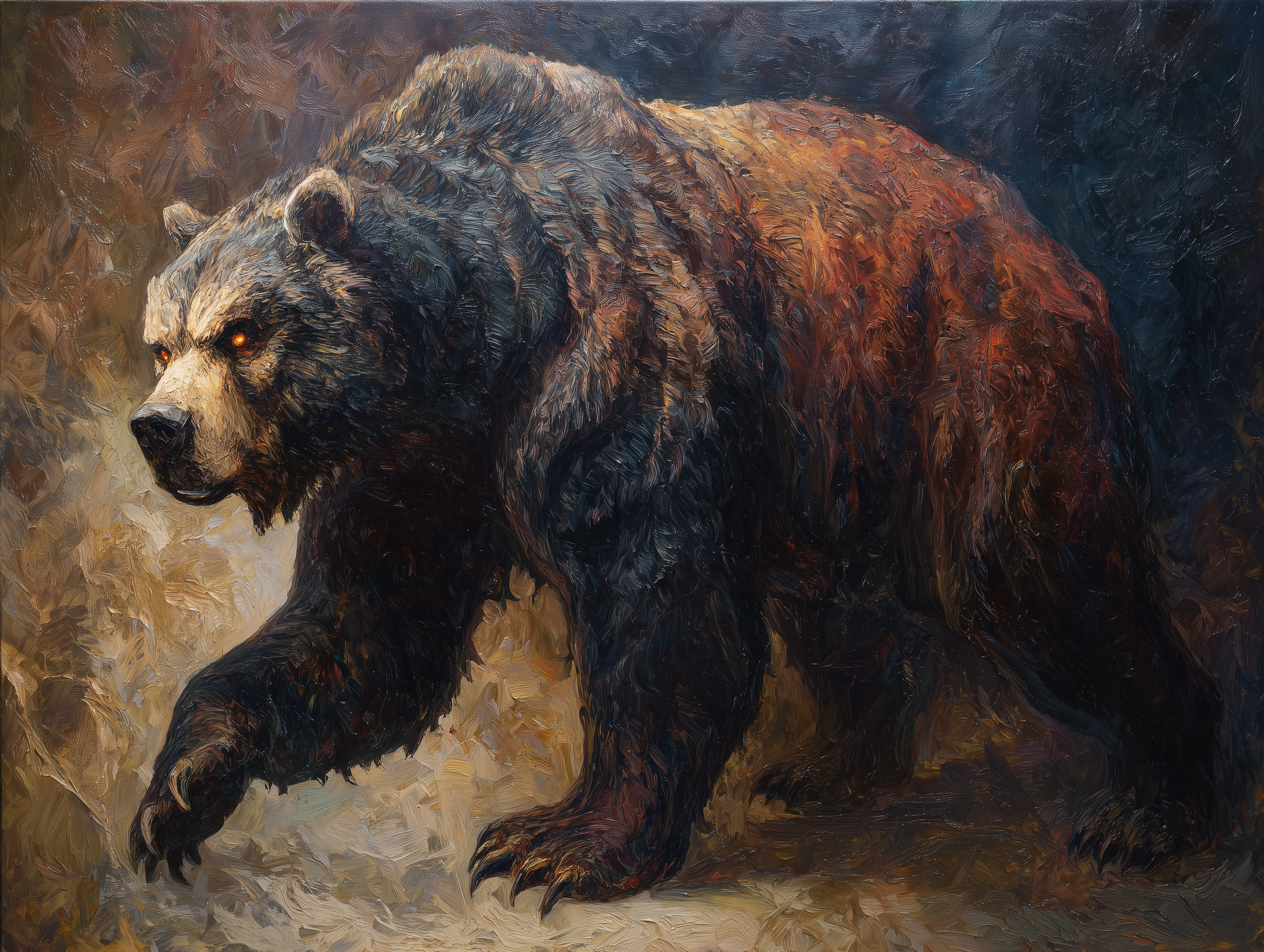
Prehistoric bear · giant omnivore-scavenger · powerful grappler · open-country megafauna
At the Table
At a Glance
- Creature
- Agriotherium, the Primeval Bonecrusher
- Size & Type
- Large prehistoric bear; Beast/Animal by edition
- Temperament
- Wary, food-driven and brutally defensive when pressed
- Combat Role
- Fast melee grappler that isolates one target
- Signature Attack
- Claw → grapple → rend → bone-crushing bite
- Habitat
- Grassland, scrub, open woodland and river valleys
- 5.5e / 2024
- CR 9
- 5e / 2014
- CR 9
- PF1e / 3.5e
- CR 10 / CR 9
Mechanics
Rules by Edition
Pick the edition you are running. Challenge Rating, creature type, grapple rules and action economy are calculated separately; do not mix mechanics between tabs.
Agriotherium — D&D 5.5e / 2024
Large Beast, Unaligned
AC 16 · Initiative +2 (12) · HP 168 (16d10 + 80) · Speed 50 ft.
| STR | DEX | CON | INT | WIS | CHA |
|---|---|---|---|---|---|
| 23 (+6), save +10 | 14 (+2), save +2 | 20 (+5), save +9 | 2 (−4), save −4 | 15 (+2), save +6 | 8 (−1), save −1 |
Skills Perception +6, Survival +6 · Senses Passive Perception 16 · Languages — · CR 9 (5,000 XP; PB +4)
Traits
Keen Smell. Agriotherium has Advantage on Wisdom (Perception) checks that rely on smell.
Relentless (1/Day). If damage reduces Agriotherium to 0 Hit Points, it drops to 1 Hit Point instead.
Rending Claws. Once on each of its turns, when Agriotherium hits the same creature with both Claw attacks, that creature takes an extra 10 (3d6) Slashing damage.
Actions
Multiattack. Agriotherium makes two Claw attacks and one Bone-Crushing Bite attack.
Claw. Melee Attack Roll: +10, reach 5 ft. Hit: 13 (2d6 + 6) Slashing damage. If the target is a Large or smaller creature, it has the Grappled condition (escape DC 18). Agriotherium can grapple only one creature in this way at a time.
Bone-Crushing Bite. Melee Attack Roll: +10, reach 5 ft. Hit: 17 (2d10 + 6) Piercing damage, plus 7 (2d6) Bludgeoning damage if the target is Grappled by Agriotherium.
Tactics
Agriotherium tries to establish a grapple with its first Claw, then keeps attacking the captive. Rending Claws rewards landing both forelimbs on the same creature, while Bone-Crushing Bite becomes more dangerous once the target is held.
Agriotherium — D&D 5e / 2014
Large beast, unaligned
Armor Class 16 (natural armor) · Hit Points 168 (16d10 + 80) · Speed 50 ft.
| STR | DEX | CON | INT | WIS | CHA |
|---|---|---|---|---|---|
| 23 (+6) | 14 (+2) | 20 (+5) | 2 (−4) | 15 (+2) | 8 (−1) |
Saving Throws Str +10, Con +9, Wis +6 · Skills Perception +6, Survival +6 · Senses passive Perception 16 · Languages — · Challenge 9 (5,000 XP)
Traits
Keen Smell. Agriotherium has advantage on Wisdom (Perception) checks that rely on smell.
Relentless (1/Day). If Agriotherium takes damage that would reduce it to 0 hit points, it is reduced to 1 hit point instead.
Rending Claws. Once on each of its turns, when Agriotherium hits the same creature with both claw attacks, the target takes an extra 10 (3d6) slashing damage.
Actions
Multiattack. Agriotherium makes two claw attacks and one bite attack.
Claw. Melee Weapon Attack: +10 to hit, reach 5 ft., one target. Hit: 13 (2d6 + 6) slashing damage. If the target is Large or smaller, it is grappled (escape DC 18). Agriotherium can grapple only one creature in this way at a time.
Bone-Crushing Bite. Melee Weapon Attack: +10 to hit, reach 5 ft., one target. Hit: 17 (2d10 + 6) piercing damage, plus 7 (2d6) bludgeoning damage if the target is grappled by Agriotherium.
Agriotherium — Pathfinder 1e
CR 10 · XP 9,600 · N Large animal
Init +6 · Senses low-light vision, scent; Perception +20
Defense
AC 22, touch 11, flat-footed 20 (−1 size, +2 Dex, +11 natural) · hp 157 (15d8 + 90) · Fort +14, Ref +11, Will +9 · Defensive Abilities ferocity
Offense
Speed 50 ft. · Melee 2 claws +20 (1d10 + 10 plus grab), bite +18 (1d12 + 5) · Space 10 ft.; Reach 5 ft. · Special Attacks gnaw, grab, rend (2 claws, 2d10 + 15)
Statistics
Str 31, Dex 15, Con 21, Int 2, Wis 14, Cha 10 · Base Atk +11 · CMB +22 (+24 bull rush, +26 grapple) · CMD 34 (36 vs. bull rush)
Feats Awesome Blow, Improved Bull Rush, Improved Initiative, Iron Will, Multiattack, Power Attack, Run, Toughness · Skills Perception +20.
Ecology
Environment temperate or warm plains, scrublands and open woodland · Organization solitary, pair, or female with 1–2 young · Treasure none.
Special Abilities
Ferocity (Ex). Agriotherium remains conscious and can continue fighting even if its hit point total is below 0. It remains staggered and continues losing hit points as normal.
Gnaw (Ex). Whenever Agriotherium succeeds at a combat maneuver check to maintain a grapple and chooses to deal damage, it deals its bite damage instead of the claw damage that established the hold.
Grab (Ex). When Agriotherium hits a Large or smaller creature with a claw, it can attempt to start a grapple as a free action without provoking an attack of opportunity. It gains a +4 bonus on combat maneuver checks made to start and maintain that grapple.
Rend (Ex). If Agriotherium hits one creature with both claw attacks in the same round, it deals an additional 2d10 + 15 damage. It can deal rend damage no more than once per round.
Tactics
Before Combat Agriotherium approaches from downwind where possible and tests a group before committing itself. During Combat it charges an exposed opponent, uses grab to establish a grapple and concentrates attacks on that target. Morale it retreats when severely wounded unless cornered or defending young.
D&D 3.5e · CR 9
Agriotherium
Large Animal, Neutral
Core Statistics
- Hit Dice
- 15d8 + 75 (142 hp)
- Initiative
- +2
- Speed
- 50 ft. (10 squares)
- Armor Class
- 18 (−1 size, +2 Dex, +7 natural), touch 11, flat-footed 16
- Base Attack / Grapple
- +11 / +25
- Space / Reach
- 10 ft. / 5 ft.
- Saves
- Fort +14, Ref +11, Will +10
- Challenge Rating
- 9
Offense
- Attack
- Claw +20 melee (1d10 + 10)
- Full Attack
- 2 claws +20 melee (1d10 + 10) and bite +18 melee (1d12 + 5)
- Special Attacks
- Ferocity, gnaw, improved grab, rend 2d10 + 15
- Special Qualities
- Dire, low-light vision, scent
Ability Scores
| STR | DEX | CON | INT | WIS | CHA |
|---|---|---|---|---|---|
| 31 (+10) | 15 (+2) | 21 (+5) | 2 (−4) | 12 (+1) | 10 (+0) |
Skills & Feats
- Skills
- Listen +14, Spot +14
- Feats
- Alertness, Awesome Blow, Improved Bull Rush, Multiattack, Power Attack, Run
Ecology
- Environment
- Warm plains
- Organization
- Solitary, pair, or female with 1–2 young
- Treasure
- None
- Advancement
- 16–24 HD (Large); 25–30 HD (Huge)
- Level Adjustment
- —
Combat
Dire (Ex). Agriotherium is treated as a dire animal when determining saving throws. Fortitude, Reflex and Will are all good saves for its racial Hit Dice.
Ferocity (Ex). Agriotherium continues to fight without penalty while disabled or dying.
Gnaw (Ex). If Agriotherium hits the same opponent with both claws, it may immediately make one bite attack against that opponent as a free action. During a grapple, a successful grapple check made to deal damage inflicts its bite damage instead.
Improved Grab (Ex). When Agriotherium hits a Medium or smaller opponent with a claw, it may start a grapple as a free action without provoking an attack of opportunity.
Rend (Ex). If both claws hit the same opponent in a round, Agriotherium tears into the victim for an additional 2d10 + 15 damage.
Skills. Agriotherium has a +2 racial bonus on Listen and Spot checks.
How It Fights
Agriotherium wants one opponent within reach, not a prolonged exchange with an entire party. It closes quickly, lands both claws to trigger gnaw and rend, then turns the grab into a grapple so its bite can keep working while the victim struggles to escape. Against several dangerous foes it relies on speed, bull rushes and sheer threat to keep other attackers away from the creature it has seized.
The Animal
A Bear Built to Take the Kill
Agriotherium is not a fantasy bear enlarged without consequence. Its danger comes from the things that make a very large bear frightening in the first place: speed over short distances, massive forequarters, powerful jaws, a strong sense of smell and the ability to turn a feeding dispute into a lethal grapple almost instantly.
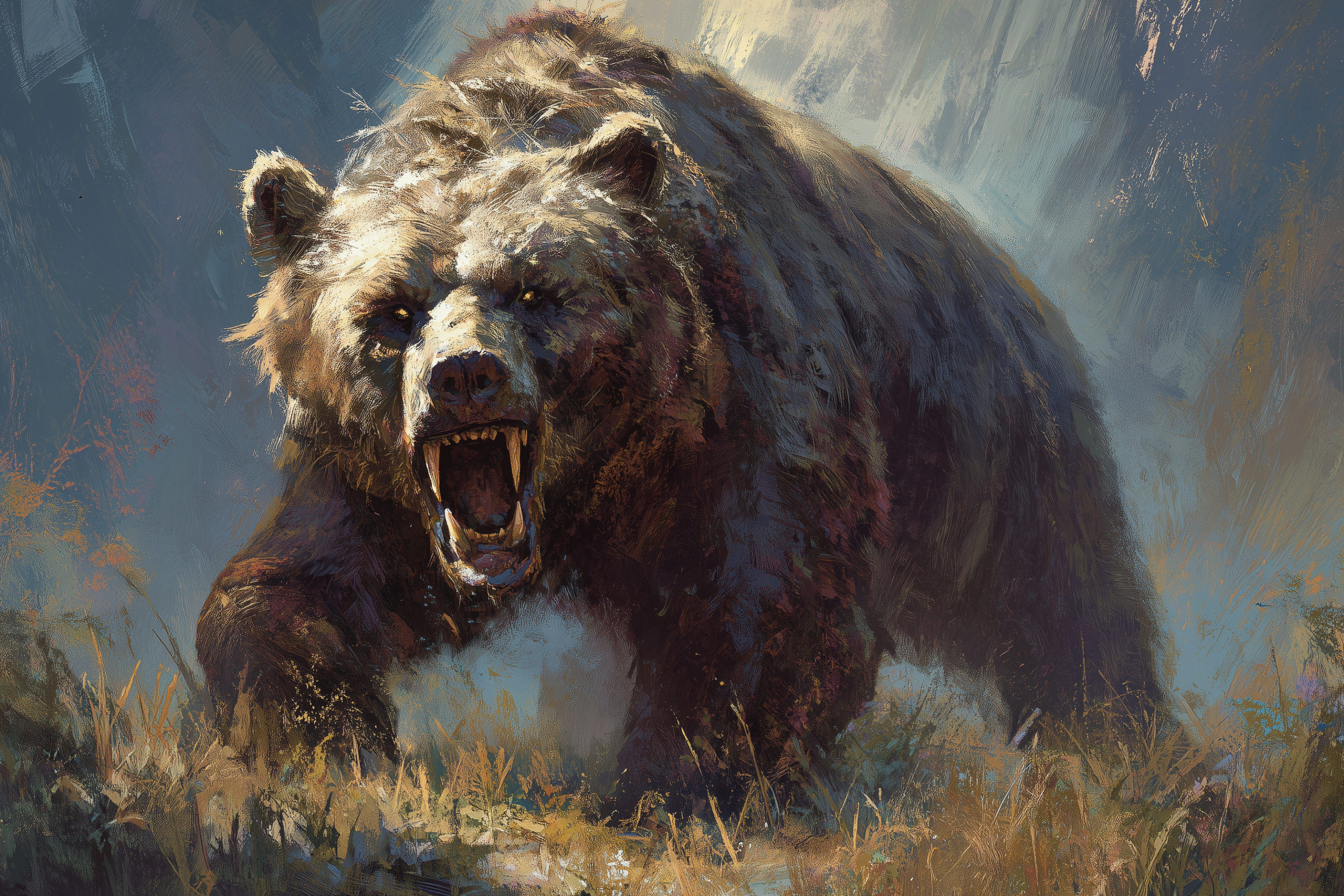
Most encounters do not begin with a charge. A hungry individual may follow the smell of blood, test a camp from downwind or walk directly toward a carcass and expect smaller competitors to move. Roaring, jaw-clacking, pawing and bluff charges can end an encounter before anyone is hurt. If those warnings fail, the animal tries to seize one opponent, drag it out of formation and concentrate its bite and claws on that target.
Behaviour
Agriotherium is usually solitary outside mating and the rearing of young. It ranges widely between feeding grounds and water, investigates carrion from a considerable distance and is more likely to displace a smaller predator than chase healthy prey simply because prey is present.
Its exact diet cannot be reconstructed with certainty from fossils. One influential ecomorphological study argued for an omnivorous scavenger that ate substantial plant material as well as animal matter, while later finite-element work on A. africanum found an exceptionally powerful skull capable of both killing large prey and processing carcasses without resolving which behaviour dominated. That uncertainty is useful at the table: one animal may raid fruiting woodland and carrion, another may become a habitual livestock killer.
If Violence Starts
An Agriotherium closes fast and commits its forelimbs first. It tries to seize a creature at the exposed edge of the group, hold it in place and bring its jaws to bear. It does not spread attacks around simply because several enemies are present; once it has a vulnerable target, it concentrates on that target until the hold breaks or a more immediate threat forces it to turn.
A food-driven animal can often be driven off by unexpectedly fierce resistance, fire, painful magic or the loss of the meal it was trying to claim. A mother defending young is much harder to deter. A cornered animal attacks whichever creature blocks the clearest escape route.
Signs an Agriotherium Is Near
- Very large bear-like tracks crossing open ground or following a river corridor.
- Heavy limb bones cracked open or deeply scored around a feeding site.
- A carcass dragged away from the place where it originally fell.
- Coarse hair caught on bark, thorns or rough stone at shoulder height.
- Wolves, great cats or other scavengers waiting at a distance from an otherwise valuable kill.
- Deep warning roars, huffing and jaw-clacking before the animal advances.
Using Agriotherium in Play
At a Carcass
This is the cleanest non-random encounter. The animal wants the food, not the characters. Players can retreat, surrender the carcass, distract it with another source of meat, frighten it off or choose to fight. That gives the encounter an objective before initiative is rolled.
As a Predator
Use a predatory Agriotherium when it has learned that livestock, pack animals or wounded travellers are unusually easy meals. It follows scent, attacks an isolated target and withdraws if the group proves more dangerous than the expected reward.
Defending Young
This version begins at much shorter decision distance. The animal may bluff once, but it does not abandon cubs simply because armed travellers refuse to move. The safest solution is often retreat rather than victory.
As an Ecological Clue
Agriotherium can signal that a region supports unusually large prey and a complete megafaunal food web. Its presence should affect other predators, scavengers and local travel routes even when the animal itself never enters combat.
Challenge Rating and Encounter Scale
Agriotherium is a serious single-monster fight in every rules set here. Its danger is concentrated rather than complicated: high speed gets it into melee, claws establish or reward a hold, and the bite punishes a target that remains trapped. Parties that maintain distance or break grapples quickly blunt much of its threat; a surprised or isolated character can be overwhelmed very quickly.
The Pathfinder 1e version is CR 10 because its natural-attack routine, grab, rend, ferocity and high combat-maneuver numbers are particularly punishing under that rules engine. The 5.5e/2024 and 2014 fifth-edition adaptations are CR 9, while the legacy 3.5e conversion remains CR 9.
Motivation and Reactions
| Situation | Likely response | What may end the encounter |
|---|---|---|
| Claiming a carcass | Approaches openly, threatens competitors and attacks if they refuse to yield. | Abandoning the carcass, offering another food source or convincing it that the fight will be costly. |
| Defending young | Charges rapidly and tries to drive intruders away from the cubs. | Retreating well beyond the denning area. |
| Following food | Trails pack animals, butchered meat or wounded travellers and tests the group. | Removing or surrendering the food, or presenting a stronger deterrent. |
| Cornered | Fights violently against the creature blocking the clearest escape route. | Opening a route and ceasing pursuit. |
Adventure Hooks
- The Missing Caravan. Agriotherium is feeding among a wrecked caravan, but it did not kill the travellers. Evidence identifying the real attackers lies beneath the carcasses it has claimed.
- Bone Orchard. A dry ravine is scattered with shattered bones. The newest remains belong to a messenger whose sealed documents must be recovered before scavengers disperse them.
- The Lord’s Trophy. A noble offers a reward for an enormous old Agriotherium that repeatedly drives hunting parties from their kills. Rival hunters are already in the animal’s territory.
- The Empty Hunting Ground. Wolves and great cats have abandoned a productive valley. A scarred Agriotherium has learned that travellers and pack animals mean easier food than wild prey.
- The Wrong Culprit. Villagers blame the bear for a string of livestock deaths, but the bite marks do not match. Agriotherium has merely been scavenging kills left by something else.
Natural History and Fossil Context
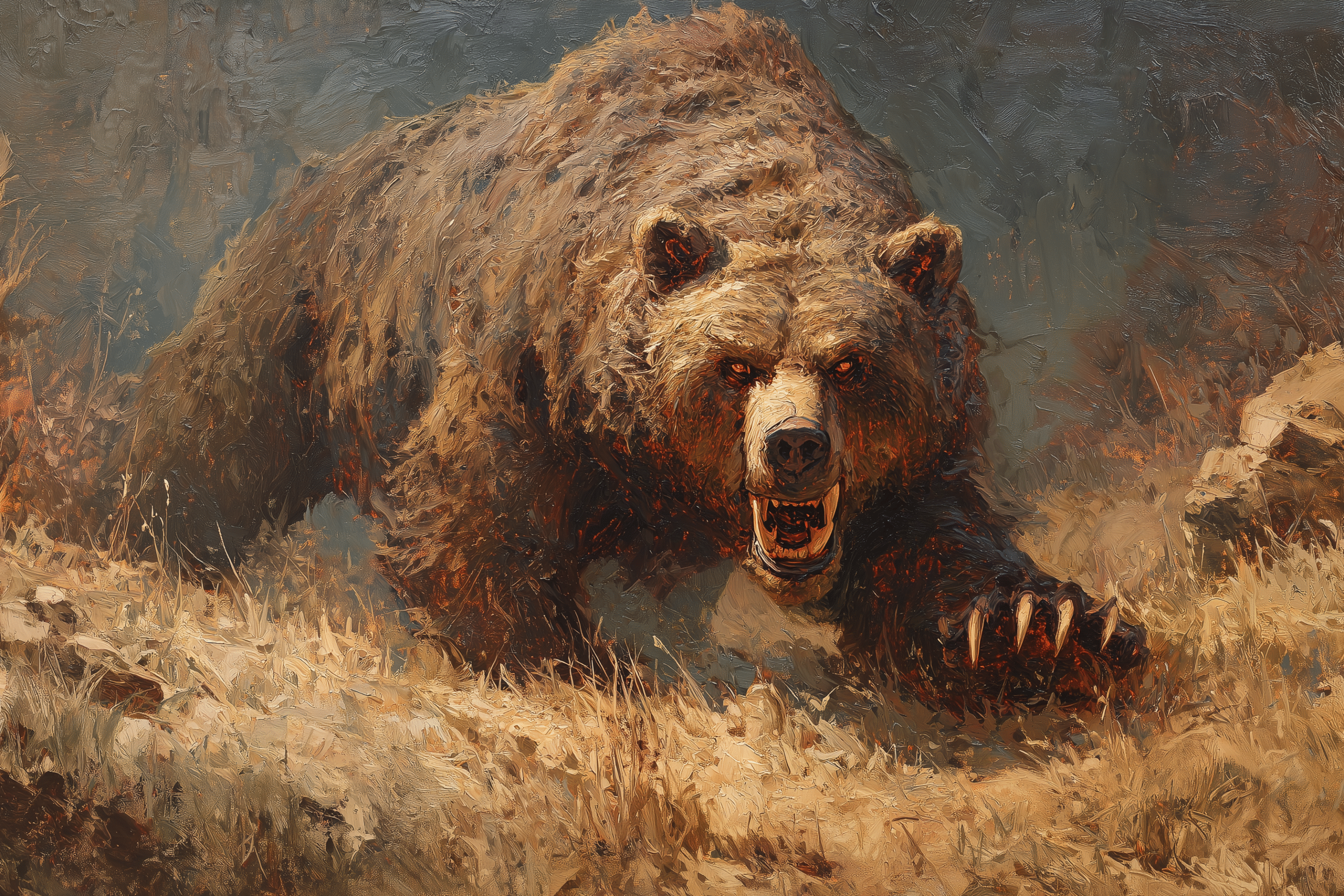
Agriotherium was a real genus of giant fossil bears. Fossils are known from Africa, Eurasia and North America, and research places members of the genus across the late Miocene and Pliocene, with regional records extending later in some classifications. A 2011 description of A. myanmarensis added central Myanmar to a distribution already known across much of the Old and New Worlds.
The famous “bonecrusher” reputation is best treated as an inference from anatomy rather than a literal fossil observation. Finite-element analysis of A. africanum estimated extremely high canine bite forces and found a skull well suited to withstand strong loads. The authors concluded that the animal was mechanically capable of killing large vertebrates or exploiting large carcasses, but the analysis did not determine which behaviour dominated.
Diet remains debated. Boris Sorkin argued from teeth and skeletal form that Agriotherium was an omnivorous scavenger with substantial plant intake rather than a specialised pursuit predator. Oldfield and colleagues later found that the skull mechanics did not settle predator versus scavenger, while their results did not support specialisation for processing tough vegetation. The safest reconstruction is therefore a powerful, flexible feeder whose exact habits varied by species, place and opportunity.
Research and Further Reading
- Oldfield et al., finite-element analysis of Agriotherium africanum cranial mechanics.
- Boris Sorkin, ecomorphology of Agriotherium and Arctodus.
- Ogino et al., Agriotherium myanmarensis from the late Miocene to early Pliocene of Myanmar.
- Samuels, Meachen-Samuels & Gensler, North American Agriotherium record.
- Carranza-Castañeda & Wang, complete Agriotherium humerus from Mexico.
After the Encounter
Agriotherium carries no deliberate treasure. A feeding site may contain the belongings of previous victims, while a mature animal’s skull, teeth, claws and hide can attract hunters, collectors and rulers who value dangerous trophies. Removing a dominant individual can also change the local food web, allowing wolves, great cats, scavengers or another large bear to occupy the territory it controlled.
Sources and Licensing
D&D 5.5e / 2024 and D&D 5e / 2014: Agriotherium is presented as an original fifth-edition adaptation using the relevant edition’s monster conventions. It is not an official SRD monster.
Pathfinder 1e: The Pathfinder rules presentation is an original conversion using Pathfinder First Edition rules conventions.
D&D 3.5e: The legacy statistics preserve the established 3.5e conversion identity while correcting calculations and presenting the abilities in a complete usable block.
Earlier tabletop appearance: Agriotherium appeared as the “savannah bear” in David Howery’s “Back to the Age of Mammals,” Dragon Magazine #167 (1991). That publication is identified for history only; its prose and artwork are not reproduced here.
Keep this reference growing
If this page helped with your reading or game, you can support its upkeep or explore the curated books.
Explore the Bookshop — epics, classics and stories behind imagined worlds.