
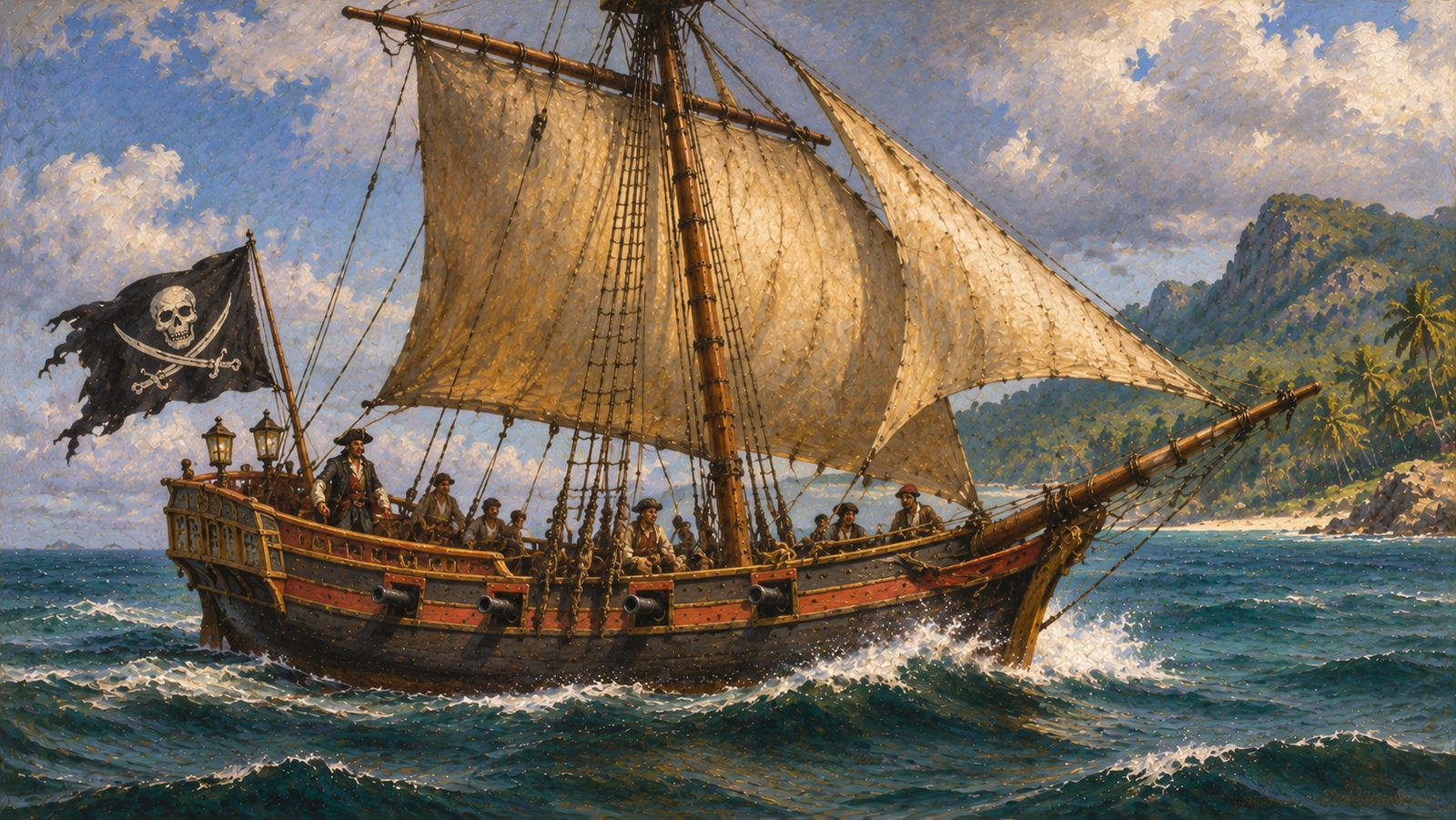
At a Glance
- Type
- Armed Jamaican privateering sloop
- Commander
- Henry Jennings
- Other names
- Barsheba; Bathsheba in some accounts
- Commission
- Issued by Governor Archibald Hamilton on 21 November 1715, nominally against piracy
- Reported burthen
- 40 tons, according to Colin Woodard
- Armament and crew
- Eight guns and eighty men in Colin Woodard’s account of the 1715 expedition
- Operating waters
- Port Royal, Nassau, Florida coast and Cuba
- Weaknesses
- Crowded accommodations, limited fresh water, vulnerable single mast in the campaign reconstruction
Bersheba is Henry Jennings’s armed privateering sloop. She carries a numerous company of sailors, boarders and divers, who can pursue valuable salvage as well as captured prizes. She is better suited to coastal anchorages and the shallow waters off Florida than to prolonged exchanges of gunfire with a heavily armed ocean-going ship. Her greatest asset is the experience of the people aboard her.
Hull, Deck and Rigging
The working deck is compact, with a tiller, hatches, eight light guns and a bowsprit. The campaign reconstruction uses one mast and a compact hull of approximately 65 by 20 feet. The actual dimensions and sail plan are not established in the records consulted. Salvage ropes, small boats, casks and tools crowd the deck when Jennings pursues wrecks. With a full company aboard, food, drinking water and cargo compete for limited hold space.
The sloop can use sheltered anchorages unavailable to larger ships. Her boats and divers can investigate shoals and wrecks, but the captain must secure provisions and protect his salvage claims before the weather turns.
Captain and Crew
Henry Jennings directs the company and negotiates with merchants and investors. Allen Bernard serves as his quartermaster in the 1716 documentary record. Sailors, divers, gunners and boat crews work alongside experienced privateers; use the veteran buccaneer and shipmate profiles as appropriate. The crew’s loyalty depends on profit, safe passage and agreed shares. Jennings’s dealings with Benjamin Hornigold, Charles Vane and Samuel Bellamy can affect which harbours and prizes the company can safely approach.
What Is Happening Now?
Jennings has returned from the Florida wrecks with a claim to valuable silver. His investors want a return, his divers want their wages and Spanish representatives dispute ownership of the recovered cargo. The sloop needs fresh stores and repairs before another expedition. Rival captains at Nassau are seeking the same pilots and information.
Adventure Hooks
- Salvage rights. A Spanish agent disputes Jennings’s ownership of silver recovered from a coastal wreck. The adventurers can investigate the competing claims or negotiate a settlement.
- The divers’ bargain. Several divers refuse to return to a submerged wreck until the company agrees on a fair share. One has seen an unfamiliar creature among the timbers.
- Commission in doubt. A merchant offers to purchase the cargo if Jennings can produce documents proving lawful ownership. His papers authorise the pursuit of pirates, not necessarily the seizure of salvage.
- A dangerous anchorage. A damaged spar and an approaching storm leave the sloop dependent on a local pilot and a safe berth.
Bersheba — Vehicle Rules
Bersheba
Original named-vessel profile; armed sloop. The figures below are game values, not a historical survey.
| Size | Gargantuan vehicle |
|---|---|
| Hull dimensions (approximate in play) | 65 ft. by 20 ft. |
| Travel speed | 3 mph |
| Minimum operating crew | 16 |
| Additional berths | 64 (crowded; 80 total aboard) |
| Cargo capacity | 15 tons subject to space occupied by crew, stores, salvage equipment and ammunition |
| Armor Class | 15 |
| Hit Points | 220 |
| Damage Threshold | 10 |
| Replacement value | 7,000 GP (estimate) |
| Armament | 8 mounted light cannon (4 per side; campaign loadout) |
Shipboard Combat
Light Cannon. Each mounted gun uses a crew of 3 and attacks only targets on its own side of the vessel. Aiming, loading and firing each require one Utilize action. A gunner can perform the firing action once the gun is loaded and aimed. Ranged Attack Roll: +6 to hit, range 200/800 ft., one target. Hit: 16 (3d10) bludgeoning damage. Each shot consumes one load of powder and shot. The cannon is a separate object (AC 19, 50 HP). Assign actual sailors to the guns; sailors required for safe operation cannot simultaneously serve as gunners.
Movement and manoeuvres. Travel speed assumes wind and a working crew; for tactical movement use 30 ft. per round under favourable wind, up to 60 ft. with a successful DC 15 Wisdom check using water vehicles, made by the helmsman as an action. Failure leaves ordinary speed; in a calm or with sails disabled, the vessel drifts with the current. Turning, hazards and boarding follow the ship combat procedure. This is an original encounter option.
Damage and repair. Attacks dealing less than the hull threshold do no hull damage. Treat crew and exposed fittings as separate targets. At 0 hull HP the ship begins to sink; characters have 1d6 rounds to abandon ship or make a DC 15 carpenter’s tools check as an action to delay sinking for 1 minute (once per sinking incident). At berth, restoring 1 HP requires 20 GP and one day, halved in a properly equipped shipyard.
Comparison: Sailing Ship; D&D 2024 Basic Rules — Equipment Named-vessel statistics and light cannon are original adaptations.
Bersheba
Original named-vessel profile; armed sloop. The figures below are game values, not a historical survey.
| Size | Gargantuan vehicle |
|---|---|
| Hull dimensions (approximate in play) | 65 ft. by 20 ft. |
| Travel speed | 3 mph |
| Minimum operating crew | 16 |
| Additional berths | 64 (crowded; 80 total aboard) |
| Cargo capacity | 15 tons subject to space occupied by crew, stores, salvage equipment and ammunition |
| Armor Class | 15 |
| Hit Points | 220 |
| Damage Threshold | 10 |
| Replacement value | 7,000 GP (estimate) |
| Armament | 8 mounted light cannon (4 per side; campaign loadout) |
Shipboard Combat
Light Cannon. Each mounted gun uses a crew of 3 and attacks only targets on its own side of the vessel. Aiming, loading and firing each require one action. A gunner can perform the firing action once the gun is loaded and aimed. Ranged Weapon Attack: +6 to hit, range 200/800 ft., one target. Hit: 16 (3d10) bludgeoning damage. Each shot consumes one load of powder and shot. The cannon is a separate object (AC 19, 50 HP). Assign actual sailors to the guns; sailors required for safe operation cannot simultaneously serve as gunners.
Movement and manoeuvres. Travel speed assumes wind and a working crew; for tactical movement use 30 ft. per round under favourable wind, up to 60 ft. with a successful DC 15 Wisdom check using water vehicles, made by the helmsman as an action. Failure leaves ordinary speed; in a calm or with sails disabled, the vessel drifts with the current. Turning, hazards and boarding follow the ship combat procedure. This is an original encounter option.
Damage and repair. Attacks dealing less than the hull threshold do no hull damage. Treat crew and exposed fittings as separate targets. At 0 hull HP the ship begins to sink; characters have 1d6 rounds to abandon ship or make a DC 15 carpenter’s tools check as an action to delay sinking for 1 minute (once per sinking incident). At berth, the same repair rate of 20 GP and one day per HP is a campaign estimate.
Comparison: Sailing Ship; Dungeon Master’s Guide (2014), chapter 5, waterborne vehicles and siege equipment. Named-vessel statistics and light cannon are original adaptations.
Bersheba
Gargantuan water vehicle; Squares 52 (65 ft. by 20 ft.); Cost 7,000 gp (replacement estimate).
Defense
AC 6; Hardness 5; hp 550 (broken at 275 or fewer); Base Save +0.
Offense
Maximum Speed 180 ft. (current); Acceleration 30 ft.; CMB +4; CMD 14; Ramming Damage 4d8.
Description
Propulsion current (air); Driving Check Profession (sailor) or Knowledge (nature), +10 to DC for air-current propulsion; Forward Facing bow; Driving Device tiller; Driving Space four squares around the helm; Crew 16; Decks 1; Capacity 15 tons of cargo or 64 additional people (80 total aboard) in crowded conditions; Weapons 8 light cannon (4 each side). These are original vehicle specifications.
Light cannon. Original direct-fire siege firearm: Large, damage 4d6 bludgeoning, critical ×4, range increment 100 ft., crew 3, load 2 full-round actions, aim 1 full-round action, misfire 1. Use the siege-engine rules for crew, attacks, ammunition and firearm misfires. Only guns bearing on the target can fire. Operating crew and gun crews are separate assignments.
Rules framework: Ultimate Combat — Vehicles and Siege Engines. Not an official published named-ship profile.
Bersheba
Original sailing vessel with shipboard artillery.
| Transport | Armed sloop |
|---|---|
| Cost (replacement estimate) | 7,000 gp |
| Dimensions | 65 ft. by 20 ft. |
| Operating crew | 16 |
| Capacity | 15 tons or 64 additional people (80 total aboard) |
| Travel speed | 3 mph |
| Hull AC | 4 |
| Hull hardness | 5 |
| Hull hit points | 130 |
| Weapons | 8 light cannon (4 each side) |
Handling. Use Profession (sailor) for wind and difficult manoeuvres; use the edition’s object damage rules for the hull. In tactical encounters the ship moves 30 ft. per round under favourable wind; a DC 15 Profession (sailor) check as a standard action permits 60 ft. for that round. If all sails fail, the vessel drifts.
Light cannon. Original Large siege weapon: 4d6 bludgeoning damage, critical ×3, range increment 100 ft., crew 3, two full-round actions to load and one to aim; the gunner makes a ranged attack using base attack bonus and Dexterity modifier (apply -4 if nonproficient). Firing is a standard action. One charge of powder and shot is consumed. Hull hardness applies to each hit as normal. Use separate crew assignments for each weapon and for navigation.
Repairs. Use Craft (shipbuilding) and the object rules. At 0 hull HP the vessel founders; evacuate or use a DC 15 Craft (shipbuilding) check as a full-round action to delay sinking for 1 minute, once per incident.
Reference: D&D 3.5e SRD — transport and object rules. Hull and cannon statistics are campaign adaptations.
History and Sources
The Jamaican sloops Eagle and Barsheba receive commissions dated 21 November 1715. Jennings’s company then takes silver from Spanish recovery operations following the wreck of the treasure fleet off Florida. Surviving accounts identify Allen Bernard as Jennings’s quartermaster aboard Bersheba in 1716. Colin Woodard describes the Barsheba as a forty-ton sloop carrying eighty men and eight guns during the 1715 expedition, and describes her with ten guns in April 1716. A later contemporary report describes Jennings commanding a sloop with ten guns and one hundred men, without establishing that it is the same vessel. The game profile represents the earlier eight-gun configuration. The fate of Bersheba is uncertain.
Historical references: Sailing the Black Flag — Henry Jennings and the documentary record; The Wreck of the 1715 Spanish Treasure Fleet; Colin Woodard, The Republic of Pirates (2007); Articles exhibited against Lord Archibald Hamilton, late governor of Jamaica (Library of Congress digitisation). The original hero illustration, including its pirate flag, is an artistic interpretation, not a documented depiction of Jennings’s colours or the ship’s actual rig. Game hull dimensions, cargo capacity, armament distribution and vehicle rules are representative reconstructions rather than historical measurements.
See Vehicles, Sailing Ship, Adventure, William and Ship Combat.
Original named-vessel adaptations; Pathfinder rules framework: Pathfinder Roleplaying Game Ultimate Combat © 2011, Paizo Publishing, LLC; Jason Bulmahn et al.
Keep this reference growing
If this page helped with your reading or game, you can support its upkeep or explore the curated books.
Explore the Bookshop — epics, classics and stories behind imagined worlds.