
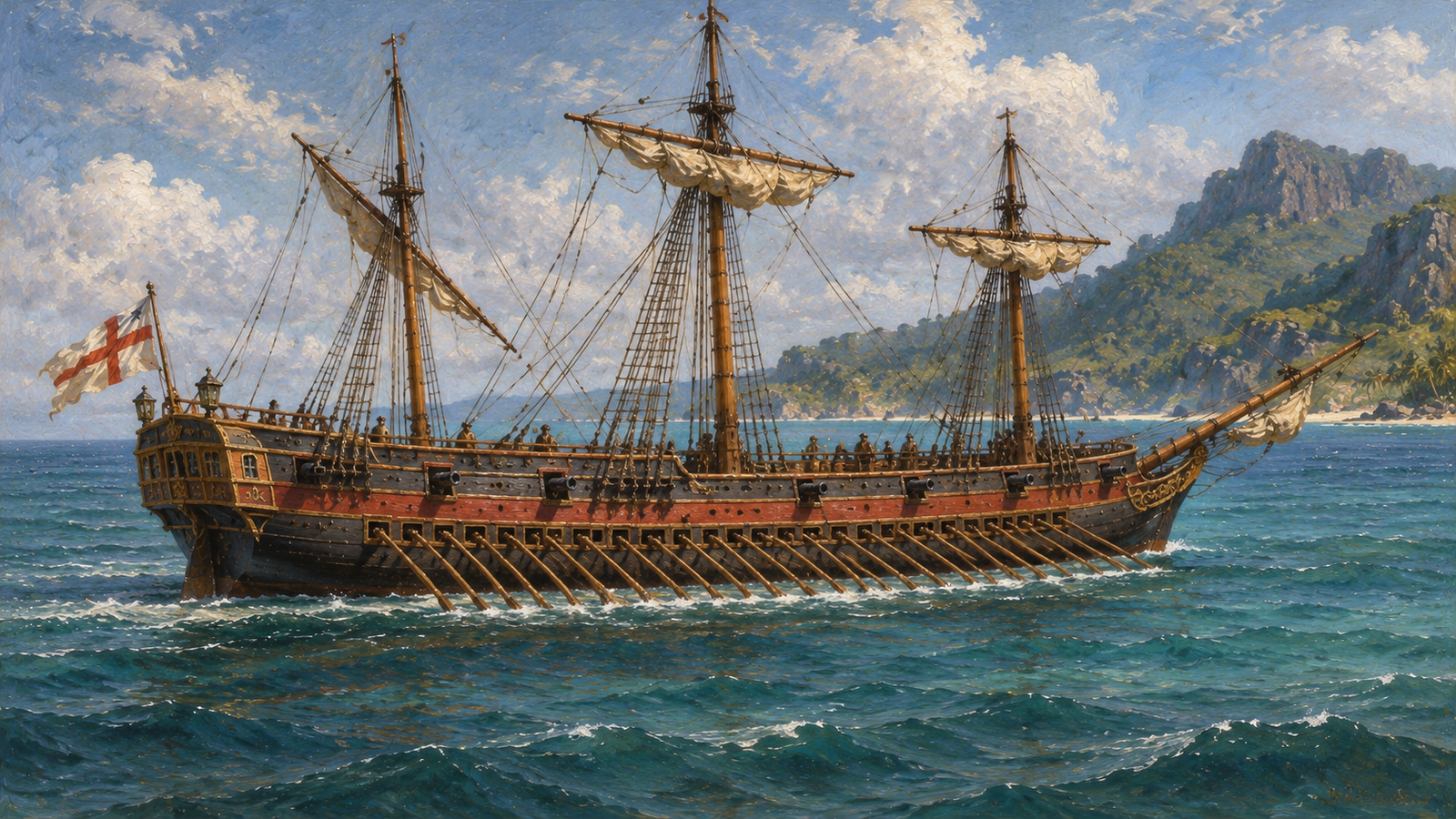
At a Glance
- Type
- Three-masted armed galley with auxiliary sweeps
- Commander
- William Kidd
- Historical burthen
- 287 tons
- Recorded armament
- 34 guns in the 1695 declaration; 30 in later trial testimony
- Propulsion
- Sail and oars; 23 pairs of sweeps reported
- Crew
- Approximately 150 after recruitment in New York
- Operating waters
- Atlantic and Indian Ocean
- Weaknesses
- High manpower demand, leaking hull, vulnerable sweeps and exhausted crew
Adventure Galley is an ocean-going privateering ship with a valuable advantage over ordinary sailing vessels: long sweeps can propel her even when the wind drops. Her heavily armed hull and three-masted rig allow long voyages in search of prizes, while her oars are useful in sheltered waters and calms. The additional rowing positions, provisions and sailors impose a substantial cost on the captain’s enterprise.
Hull, Decks and Rigging
The galley has a long timber hull, a gun deck, a working upper deck and three masts. Sweeps pass through separate openings along the sides in this reconstruction. When not needed, they are secured aboard to leave working space for the guns. Pumping, repairing seams, maintaining the rig and keeping the powder dry occupy a considerable part of the crew’s time. The ship can manoeuvre under oars in still water, but she is not a Mediterranean galley built solely for rowing. Her seaworthiness depends on sails, navigation and maintenance.
The game model uses a 120-by-25-foot hull, 34 guns and 46 sweeps. These dimensions and the arrangement of the ports are representative estimates, not measurements from a surviving builder’s plan. Compared with a conventional Warship, the galley trades hold space and manpower for auxiliary propulsion.
Captain and Crew
William Kidd commands under a privateering commission. His investors expect profitable prizes, his crew expects agreed shares and his officers expect the captain to honour his orders. The death of gunner William Moore following a dispute with Kidd in 1697 leaves a bitter division among the surviving crew. The surgeon, Robert Bradinham, faces illness and shortages during the voyage. The first mate, shipmates and veteran buccaneers provide profiles for the company. Assign sailors to navigation, rowing or gunnery rather than treating all guns and sweeps as fully manned regardless of crew size.
What Is Happening Now?
The galley lies near Madagascar following the disputed capture of the Quedagh Merchant. Her hull needs attention, her pumps labour and many sailors are tired of waiting for prize money. Kidd searches for the papers that may establish the legality of his capture. Some officers favour transferring to a sounder vessel; others want to keep their hard-won ship. The company’s survival rests on decisions made before the hull deteriorates further.
Adventure Hooks
- Dead calm. A merchant vessel lies beyond a reef while the wind fails. The galley can move under oars, but her captain must decide how many sailors he can spare from repairs and navigation.
- The leaking hull. A carpenter discovers damage that cannot be repaired easily at sea. The adventurers must secure materials, an anchorage or a replacement ship.
- Disputed prize. A merchant produces a French pass while Kidd’s investors demand proof of lawful capture. The crew’s desire for payment threatens any settlement.
- Missing sailors. A shore party fails to return from a watering expedition. Kidd offers his magical Sea’s Eye to help recover the missing men.
Adventure Galley — Vehicle Rules
Adventure Galley
Original named-vessel profile; armed sail-and-oar galley. The figures below are game values, not a historical survey.
| Size | Gargantuan vehicle |
|---|---|
| Hull dimensions (approximate in play) | 120 ft. by 25 ft. |
| Travel speed | 3 mph under sail; 1.5 mph under oars |
| Minimum operating crew | 30 under sail; 56 under oars (46 rowers and 10 navigation crew) |
| Additional berths | 125 (crowded, in sailing configuration; 155 total aboard) |
| Cargo capacity | 70 tons subject to space occupied by stores, sweeps, crew and ammunition |
| Armor Class | 15 |
| Hit Points | 500 |
| Damage Threshold | 20 |
| Replacement value | 32,000 GP (estimate) |
| Armament | 34 cannon (17 per side; representative campaign loadout) |
Shipboard Combat
Light Cannon. Each mounted gun uses a crew of 4 and attacks only targets on its own side of the vessel. Aiming, loading and firing each require one Utilize action. A gunner can perform the firing action once the gun is loaded and aimed. Ranged Attack Roll: +6 to hit, range 300/1,200 ft., one target. Hit: 27 (5d10) bludgeoning damage. Each shot consumes one load of powder and shot. The cannon is a separate object (AC 19, 50 HP). Assign actual sailors to the guns; navigation crew and rowers cannot simultaneously serve as gunners.
Movement and manoeuvres. Travel speed assumes wind and a working crew; for tactical movement use 30 ft. per round under favourable wind, up to 60 ft. with a successful DC 15 Wisdom check using water vehicles, made by the helmsman as an action. Failure leaves ordinary speed; in a calm or with all sails disabled, once configured for rowing, the vessel can instead move 15 ft. per round under oars with 46 rowers and 10 navigation crew. A successful DC 15 Wisdom check using water vehicles permits 30 ft. that round. Turning, hazards and boarding follow the ship combat procedure. This is an original encounter option.
Switching propulsion. With the minimum crew for the new mode available, the helmsman can spend an action to order the change. The transition takes 1 minute; during that time the ship retains its previous movement if available, otherwise drifts. Sail and rowing speeds do not stack. With fewer than 46 but at least 23 rowers, halve rowing speed; fewer than 23 cannot propel the ship under oars. The 10 navigation crew are additional to rowers. Rowers cannot fire cannon or perform other shipboard duties during the same round. After 1 hour of continuous rowing, rest or rotate the rowers for at least 10 minutes before resuming rowing. Rough seas may prevent use of the sweeps at the GM’s discretion. These are original campaign rules.
Damage and repair. Attacks dealing less than the hull threshold do no hull damage. Treat crew and exposed fittings as separate targets. At 0 hull HP the ship begins to sink; characters have 1d6 rounds to abandon ship or make a DC 15 carpenter’s tools check as an action to delay sinking for 1 minute (once per sinking incident). At berth, restoring 1 HP requires 20 GP and one day, halved in a properly equipped shipyard.
Comparison: Warship; D&D 2024 Basic Rules — Equipment Named-vessel statistics and light cannon are original adaptations.
Adventure Galley
Original named-vessel profile; armed sail-and-oar galley. The figures below are game values, not a historical survey.
| Size | Gargantuan vehicle |
|---|---|
| Hull dimensions (approximate in play) | 120 ft. by 25 ft. |
| Travel speed | 3 mph under sail; 1.5 mph under oars |
| Minimum operating crew | 30 under sail; 56 under oars (46 rowers and 10 navigation crew) |
| Additional berths | 125 (crowded, in sailing configuration; 155 total aboard) |
| Cargo capacity | 70 tons subject to space occupied by stores, sweeps, crew and ammunition |
| Armor Class | 15 |
| Hit Points | 500 |
| Damage Threshold | 20 |
| Replacement value | 32,000 GP (estimate) |
| Armament | 34 cannon (17 per side; representative campaign loadout) |
Shipboard Combat
Light Cannon. Each mounted gun uses a crew of 4 and attacks only targets on its own side of the vessel. Aiming, loading and firing each require one action. A gunner can perform the firing action once the gun is loaded and aimed. Ranged Weapon Attack: +6 to hit, range 300/1,200 ft., one target. Hit: 27 (5d10) bludgeoning damage. Each shot consumes one load of powder and shot. The cannon is a separate object (AC 19, 50 HP). Assign actual sailors to the guns; navigation crew and rowers cannot simultaneously serve as gunners.
Movement and manoeuvres. Travel speed assumes wind and a working crew; for tactical movement use 30 ft. per round under favourable wind, up to 60 ft. with a successful DC 15 Wisdom check using water vehicles, made by the helmsman as an action. Failure leaves ordinary speed; in a calm or with all sails disabled, once configured for rowing, the vessel can instead move 15 ft. per round under oars with 46 rowers and 10 navigation crew. A successful DC 15 Wisdom check using water vehicles permits 30 ft. that round. Turning, hazards and boarding follow the ship combat procedure. This is an original encounter option.
Switching propulsion. With the minimum crew for the new mode available, the helmsman can spend an action to order the change. The transition takes 1 minute; during that time the ship retains its previous movement if available, otherwise drifts. Sail and rowing speeds do not stack. With fewer than 46 but at least 23 rowers, halve rowing speed; fewer than 23 cannot propel the ship under oars. The 10 navigation crew are additional to rowers. Rowers cannot fire cannon or perform other shipboard duties during the same round. After 1 hour of continuous rowing, rest or rotate the rowers for at least 10 minutes before resuming rowing. Rough seas may prevent use of the sweeps at the GM’s discretion. These are original campaign rules.
Damage and repair. Attacks dealing less than the hull threshold do no hull damage. Treat crew and exposed fittings as separate targets. At 0 hull HP the ship begins to sink; characters have 1d6 rounds to abandon ship or make a DC 15 carpenter’s tools check as an action to delay sinking for 1 minute (once per sinking incident). At berth, the same repair rate of 20 GP and one day per HP is a campaign estimate.
Comparison: Warship; Dungeon Master’s Guide (2014), chapter 5, waterborne vehicles and siege equipment. Named-vessel statistics and light cannon are original adaptations.
Adventure Galley
Colossal water vehicle; Squares 120 (120 ft. by 25 ft.); Cost 32,000 gp (replacement estimate).
Defense
AC 2; Hardness 10; hp 1200 (broken below 600); Base Save +0.
Offense
Maximum Speed 150 ft. (air current) or 60 ft. (muscle); Acceleration 30 ft.; CMB +8; CMD 18; Ramming Damage 8d8.
Description
Propulsion current (air) or muscle (46 sweeps); Driving Check Profession (sailor) or Knowledge (nature), +10 to DC for air-current propulsion; Profession (sailor) for muscle propulsion; Forward Facing bow; Driving Device steering gear; Driving Space nine squares around the helm; Crew 30 under sail; 56 under oars (46 rowers and 10 navigation crew); Decks 2; Capacity 70 tons of cargo or 125 additional people with 30 sailing crew (155 total aboard) in crowded conditions; Weapons 34 cannon (17 each side; representative loadout). These are original vehicle specifications.
Auxiliary sweeps. Select air-current or muscle propulsion; speeds are not additive. A change of mode takes 10 rounds, during which the previous propulsion continues if available. With 23–45 rowers the maximum muscle speed is 30 ft.; with fewer than 23 rowers muscle propulsion is unavailable. Ten navigation crew remain necessary in either rowing configuration. Rowers cannot operate weapons simultaneously. After an hour of continuous rowing, rotate or rest the rowers for 10 minutes. Rough seas may make sweeps unusable at the GM’s discretion. These are original campaign rules.
Light cannon. Original direct-fire siege firearm: Large, damage 6d6 bludgeoning, critical ×4, range increment 150 ft., crew 4, load 2 full-round actions, aim 1 full-round action, misfire 1. Use the siege-engine rules for crew, attacks, ammunition and firearm misfires. Only guns bearing on the target can fire. Operating crew, rowers and gun crews are separate assignments.
Rules framework: Ultimate Combat — Vehicles and Siege Engines. Not an official published named-ship profile.
Adventure Galley
Original sail-and-oar vessel with shipboard artillery.
| Transport | Armed ocean-going sail-and-oar galley |
|---|---|
| Cost (replacement estimate) | 32,000 gp |
| Dimensions | 120 ft. by 25 ft. |
| Operating crew | 30 under sail; 56 under oars (46 rowers and 10 navigation crew) |
| Capacity | 70 tons or 125 additional people with 30 sailing crew (155 total aboard) |
| Travel speed | 3 mph under sail; 1.5 mph under oars |
| Hull AC | 2 |
| Hull hardness | 5 |
| Hull hit points | 240 |
| Weapons | 34 cannon (17 each side; representative loadout) |
Handling. Use Profession (sailor) for wind and difficult manoeuvres; use the edition’s object damage rules for the hull. In tactical encounters the ship moves 30 ft. per round under favourable wind; a DC 15 Profession (sailor) check as a standard action permits 60 ft. for that round. If becalmed or the sails fail, once configured for rowing, the galley can move 15 ft. per round under oars, or 30 ft. with a successful DC 15 Profession (sailor) check as a standard action.
Switching propulsion. With the minimum crew for the new mode available, the helmsman can spend a standard action to order the change. The transition takes 1 minute; during that time the ship retains its previous movement if available, otherwise drifts. Sail and rowing speeds do not stack. With fewer than 46 but at least 23 rowers, halve rowing speed; fewer than 23 cannot propel the ship under oars. The 10 navigation crew are additional to rowers. Rowers cannot fire cannon or perform other shipboard duties during the same round. After 1 hour of continuous rowing, rest or rotate the rowers for at least 10 minutes before resuming rowing. Rough seas may prevent use of the sweeps at the GM’s discretion. These are original campaign rules.
Light cannon. Original Large siege weapon: 6d6 bludgeoning damage, critical ×3, range increment 150 ft., crew 4, two full-round actions to load and one to aim; the gunner makes a ranged attack using base attack bonus and Dexterity modifier (apply -4 if nonproficient). Firing is a standard action. One charge of powder and shot is consumed. Hull hardness applies to each hit as normal. Use separate crew assignments for each weapon and for navigation.
Repairs. Use Craft (shipbuilding) and the object rules. At 0 hull HP the vessel founders; evacuate or use a DC 15 Craft (shipbuilding) check as a full-round action to delay sinking for 1 minute, once per incident.
Reference: D&D 3.5e SRD — transport and object rules. Hull and cannon statistics are campaign adaptations.
History and Sources
The Adventure Galley is launched at Deptford in December 1695. The letter-of-marque declaration of 11 December records 287 tons, 34 guns and a complement of 70; evidence from the 1701 trial records 30 guns and a similar initial crew. Kidd recruits further sailors in New York. His Indian Ocean voyage ends with the abandonment of the deteriorating galley in 1698, near Madagascar. He transfers to the captured Quedagh Merchant, later known as Adventure Prize. Reported oar counts vary; the campaign uses the 23 pairs described by the USS Kidd museum. No confirmed original hull plan is available in the sources consulted.
Historical sources: USS Kidd — Meet the Man; Adventure Galley — documentary record; The Real Captain Kidd — reproduced voyage documents. Hero illustration, hull dimensions, gun arrangement, capacities and vehicle mechanics are original campaign reconstructions. The flag is illustrative rather than a verified depiction of her colours on a particular voyage.
See Vehicles, Galley, Warship, Whydah Gally, and ship combat.
Original named-vessel adaptations; Pathfinder rules framework: Pathfinder Roleplaying Game Ultimate Combat © 2011, Paizo Publishing, LLC; Jason Bulmahn et al.
Keep this reference growing
If this page helped with your reading or game, you can support its upkeep or explore the curated books.
Explore the Bookshop — epics, classics and stories behind imagined worlds.