
The First Mask — Forbidden Players of Naples

At a Glance
| Name | The First Mask; La Prima Maschera |
|---|---|
| Type | Old Neapolitan troupe of occult performers and collectors who honour Punchinello |
| Campaign present | 1454 CE |
| Ethos | Often chaotic evil among the willing keepers; many hired players are neither initiates nor villains |
| Haunt | Harbour stores and private theatres in Naples |
| Reach | Travelling actors, rare props and trading contacts; no territorial control |
| Members | A small circle of devoted keepers and a changing company of paid or coerced performers |
| Origins | Disputed stories surround an old bronze mask and a vanished performance |
| Notable characters | Donna Serafina Vico, Pietro Bellante and Caterina Sessa |
| Methods | Forbidden plays, stolen scripts, enchanted masks, dangerous stage tricks and occasional summoning |
| Rivals | The independent Laughing Company and anyone who has survived its cruel rites |
| Symbol | A heavy bronze mask with a beaked nose and closed mouth |
| Tonight | Three unattended bells ring together after a performer vanishes through a sealed wall |
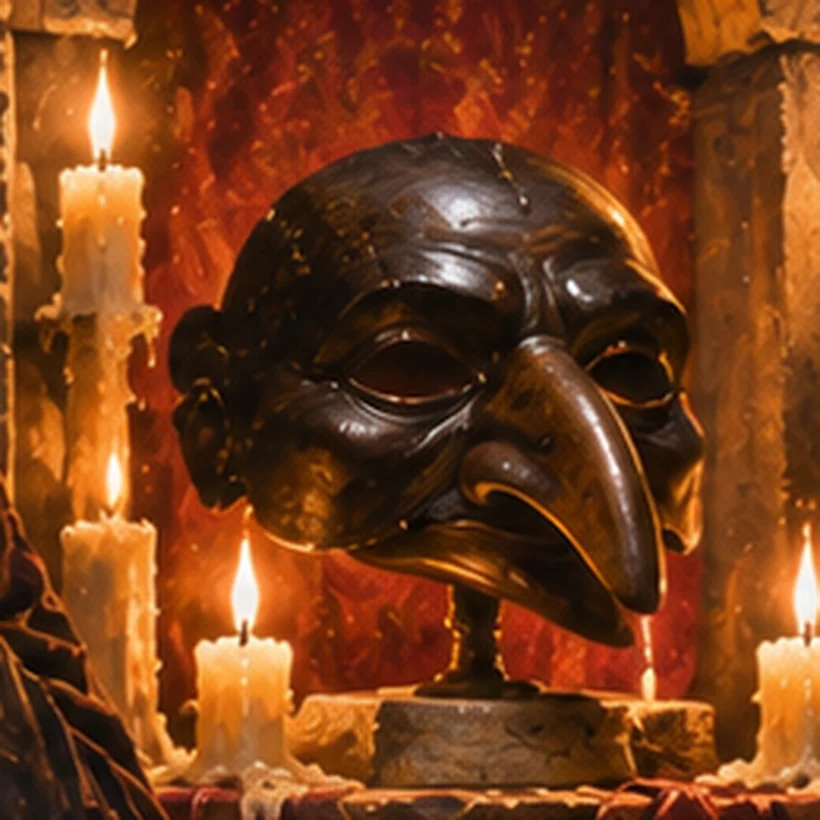
The bronze mask laughs from inside its locked cupboard. Three bells ring, although the bell-ropes hang still. In a harbour playhouse in Naples, a performer has vanished between one line and the next. Donna Serafina Vico wants the old script back before anyone discovers what the First Mask called into the room.
What Is Happening Right Now?
Three bells have sounded at once in a harbour cellar in Naples, although nobody touched them. The bronze mask of the First Mask has begun laughing in a child’s voice. Donna Serafina Vico believes a rival has sabotaged the old ritual. Pietro Bellante, who actually attempted a private invocation, fears something has answered him.
Marietta Grasso, an accountant employed by a shipping house, saw one of the players disappear behind a curtain into a wall with no door. She has stolen the rehearsal script and plans to leave Naples at dawn. Serafina wants the script recovered, Pietro wants the witness silenced, and Caterina Sessa wants to discover whether the missing player is alive. The characters can reach all three before anyone agrees what happened.
The Old Bronze Face
The First Mask claims to have kept the oldest surviving performances dedicated to Punchinello. Its heavy bronze mask has a curved beak and a closed mouth. Players who wear it sometimes hear laughter coming from behind their own eyes. The circle prizes rare scripts, dangerous tricks and the right to perform its own versions of the old stories. Its members disagree on almost everything else, including whether the mask contains a spirit or merely attracts one.
The First Mask is not Punchinello’s government or priesthood. No demon has appointed its keepers to command other devotees. In fact, the troupe’s stiff ceremonies are precisely the sort of thing Punchinello may destroy for sport. A flamboyant company in northern Europe has stolen some of its tricks; this is an artistic feud, a contest of cruelty and a personal insult, not a constitutional dispute.
The Players and Their Secrets
Donna Serafina Vico — Keeper of the First Mask
A wealthy shipping widow and collector of occult theatre, Serafina supplies costumes, rooms and money. She values her reputation as the keeper of the oldest stories, yet knows the demon may laugh at her pretensions. She would ransom a relic rather than destroy it and would trade a minor player to protect the bronze mask.
Pietro Bellante — Master of Three Bells
Pietro sets the stage tricks and manages the bells that punctuate each forbidden act. His desire for an authentic supernatural performance has made him reckless. He secretly invoked something during rehearsal and is now pretending the resulting disappearance was planned. If cornered, he tries to make everyone else part of the same mistake.
Caterina Sessa — Keeper of the Old Scripts
Caterina preserves playbooks, costume inventories and the names of players who never returned. She suspects the ancient performance has been altered so often that nobody remembers its first ending. She wants the missing player found; whether she helps the characters depends on how they treat Marietta and the apprentices.
The Rest of the Troupe
The First Mask uses hired sailors, actors, carpenters, musicians and frightened household staff. Only some are willing devotees. The three named keepers are not a tidy chain of command: each can sabotage a scene or carry out a private bargain. A performer who refuses to hurt an innocent person may find the others turning the night’s comedy against them. The independent actor Scaramouche of Naples knows a way into the playhouse and a secret about a vanished apprentice, but has given conflicting promises to those hunting the truth.
Where the Troupe Hides
The Harbour Vault
Behind a private storehouse, a stone room holds the bronze mask, painted backdrops and shelves of old playbooks. Strange laughter sometimes comes from a sealed prop cupboard. Ordinary guards watch the alley; the secrets are within, not in a fortress around Naples.
The House of Three Bells
A small private theatre disguised as a respectable household salon. The stage has removable boards, hidden passages and a cramped gallery above the rafters. Pietro’s bells can signal cues—or summon dangerous attention when worked with actual magic.
The Road Beyond Naples
Agents carry masks and scripts to markets and ports around the Mediterranean. Some trade with northern entertainers, some steal from them, and others are running away. Their journeys are subject to ordinary weather, ships and human risk.
Forbidden Performances
In one old play a proud lord is struck down by a puppet who refuses to kneel. In another the audience must choose which player takes the final blow. The First Mask has turned such scenes into cruel rituals, using real victims where a decent troupe would use tricks. A bell signals the moment an actor may abandon the written script.
Most of the tricks are mundane theatre craft. Genuine enchantment comes only from identifiable magic, occult objects or a summoned creature, and should be resolved using the relevant rules. The bronze mask is dangerous because of what may inhabit or answer it, not because anyone who wears a mask becomes a wizard. Punchinello is free to interrupt the performance, mock his followers and leave without granting them anything.
The troupe lures recruits with money, artistic fame, forbidden lore and access to rare props. It keeps them through fear, jealous rivalry and threats to their loved ones. Protect an apprentice, and the characters gain a guide through the backstage passages. Humiliate a keeper, and that keeper may seek revenge even if the wider circle disperses.
Three Encounters in Naples
The Bronze Mask Chooses
A player dons the beaked mask for a harmless rehearsal and cannot remove it. The voice behind it calls for a victim from the audience. Serafina demands that the act continue, but Caterina knows an old scene in which the player is freed by refusing to deliver the final blow.
The Three Bells Ring at Once
Inside the theatre, bells sound without hands and a missing actor’s shadow crosses the backdrop. Pietro has covered a trapdoor with scenery. The party can inspect the rigging, rescue the missing performer or find the real opening to the Crooked Stage before it closes.
A Bad Review from Rouen
A message from Aveline de Vire, one of the Laughing Company’s rival impresarios, mocks the First Mask as a troupe of solemn relic collectors and invites a public contest. Serafina wants her best players to accept. Pietro wants to ruin the rivals’ stage. Caterina fears that the invitation is a trap for the bronze mask. The characters may broker a trade, escort an unwilling performer or let the rivals destroy one another’s plans.
If No One Interferes
First week: Pietro repeats the forbidden ritual, and another actor vanishes. Serafina conceals the failure from the troupe.
Second week: Marietta flees with the altered script. Caterina quietly offers her protection, while Pietro sends violent pursuers.
Third week: the stolen northern performance reaches Naples. The keepers argue whether to imitate it, sabotage it or make a worse version.
Fourth week: a full ritual attracts something from Layer 527. It mocks both competing troupes and may turn the audience into unwilling actors.
When the Characters Change the Outcome
Free the missing player and Caterina may abandon the circle. Destroy or hide the bronze mask and Serafina loses the one prize she will not willingly surrender. Expose Pietro’s botched invocation and he tries to flee or silence the witnesses. The surviving characters and factions respond to those particular choices; nothing resets because an episode has ended.
Travel and Relationships
The First Mask moves by ordinary ships and roads. Naples is a thriving city, not its private demonic territory. Members may hire a ship’s passage, hide a prop among cargo or bribe a porter, but their influence depends on individual contacts.
The Laughing Company in Rouen, Calais and London shares Punchinello as a patron. It is neither a subordinate nor a superior order. The rivalry centres on stolen tricks, jealous performers and the danger of attracting a demon who despises pretension. A character who helps either group earns gratitude or enmity from individuals, not a universal safe-conduct pass.
Sources and Licensing
The First Mask, its 1454 meetings, leaders, changing cast of devoted, hired and coerced players, rites and quarrel with the Laughing Company are original fantasy material. Alfonso the Magnanimous held Naples in 1454, and Castel Nuovo was a royal residence; see Columbia University, Castelnuovo and Castelnuovo, fortress and palace of Alfonso. The later theatrical figure Pulcinella is associated with seventeenth-century Naples; see Treccani, Pulcinella. Neither historical source documents this fictional cult. The First Mask is a fantasy adaptation drawing on theatrical folklore, not an assertion that Pulcinella’s later historical stage tradition existed unchanged in 1454. Original painted hero and bronze-mask emblem were created for this page. Generic NPC links preserve their individual rules and credits.
Keep this reference growing
If this page helped with your reading or game, you can support its upkeep or explore the curated books.
Explore the Bookshop — epics, classics and stories behind imagined worlds.