
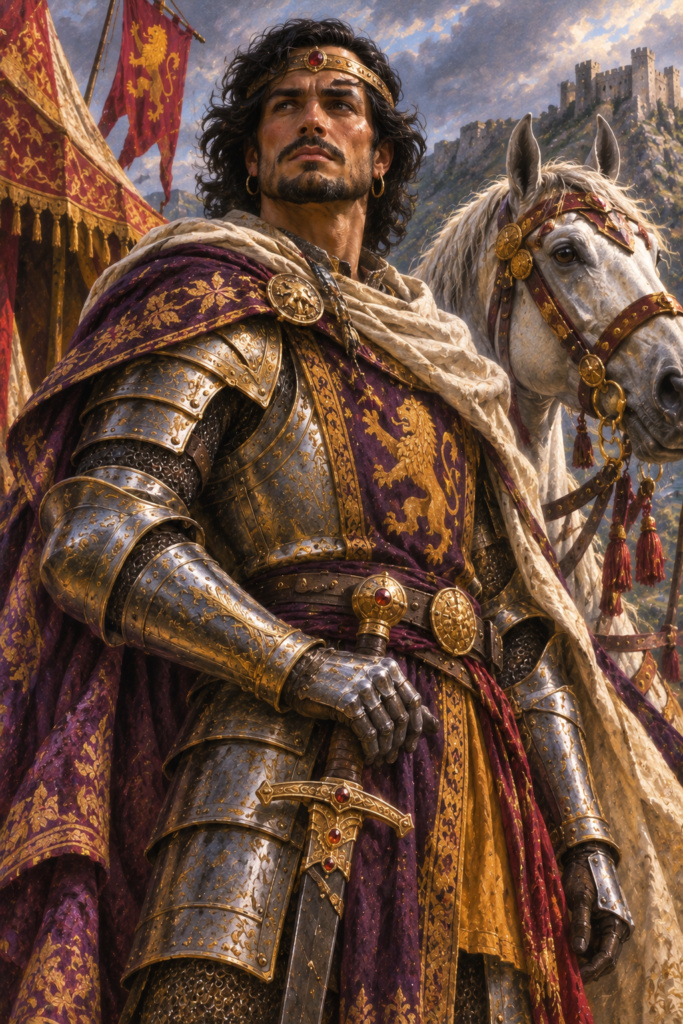
In the time of the Round Table, Sir Safir rides in borrowed arms to recover a woman seized by Sir Helior le Preuse. His elder brother Palamedes has followed the same trail, not recognising the shield that belonged to Ector de Maris. The two brothers are about to clash over a stranger they each wish to protect. The woman knows the truth of the abduction, but the men need to stop fighting long enough to hear her. The characters arrive just as a bloodied knight falls from his saddle at the gate.
At a Glance
- Identity
- Sir Safir, also Safere or Saphar, knight of the Round Table
- Nature
- Human, seasoned mortal knight
- Family
- Youngest son of King Esclabor; brother to Palamedes and Sir Segwarides
- Allegiance
- Arthur’s Round Table and the family of Esclabor; sometimes rides independently
- Home
- Arthur’s British kingdoms; the roads of Cornwall and Northumbria
- Alignment
- Neutral Good — acts decisively to defend threatened travellers, although he mistakes strength and victory for the right to decide another person’s destination
- Languages
- Brythonic and Persian
- Allies
- Palamedes, Segwarides, Epinogris and his lady once the dispute is settled
- Threat
- He may kill his own brother while both are wearing unfamiliar armour and arguing over the same rescue
What Is Happening Right Now?
Helior has ridden away with the companion of a grievously injured knight called Epinogris. Safir has followed the trail under a borrowed shield, defeated Helior and seized control of the escort. Palamedes hears the woman’s plea and mistakes Safir for another abductor. Both brothers challenge one another without names. The squire who can identify Safir lies unconscious near a well. The characters are close enough to stop the first sword stroke, or to be forced to bear witness to a terrible mistake.
First Meeting
Safir is a tall, vigilant horseman wearing armour marked by long travel. He uses Ector’s shield because his own was broken, not because he wishes to impersonate his friend permanently. He places himself between the captive and a new armed stranger, too quickly assuming she must travel with him. If the party asks her wishes directly, he looks surprised, then embarrassed. His sword is sharp; his conscience is sharper once the fighting stops.
Three Scenes Tonight
- The borrowed shield: a herald recognises Ector’s arms but knows the rider has different eyes and a foreign-accented call to his mount.
- The wounded knight: Epinogris is alive but cannot travel; his stolen companion holds the only reliable testimony about Helior’s attack.
- Two brothers in the dark: Safir and Palamedes clash without knowing their names, while the characters can interrupt with family knowledge before a sword finds a gap in the armour.
Appearance and Manner
Safir is leaner than Palamedes, with a strong straight posture, dark hair bound back for riding, a close-cut beard and a scar crossing one eyebrow. His armour takes ornament from the kingdom of his father but remains the practical equipment of a travelling knight. He speaks plainly and listens carefully to a wounded person. He has less patience with an armed man who assumes he can take a woman by right of victory.
Motivations, Pressure and Private Knowledge
- Ambition: be remembered for rescues and just deeds rather than as the youngest of Esclabor’s sons.
- Pressure: Palamedes’s reputation is larger than his own, and Safir fears an accusation of cowardice whenever he withdraws.
- Private knowledge: he knows exactly how Ector’s shield came into his hands, and who witnessed the exchange.
- Flaw: he assumes a hard-fought rescue grants him custody of the rescued person until the danger has passed.
- Turning point: revealing his identity to Palamedes and offering the lady her own choice prevents another bloody mistake.
Relationships and Allegiances
- King Esclabor: father whose far-reaching reputation shapes how Safir is received at court.
- Sir Palamedes: accomplished elder brother and the opponent he is in danger of killing unknowingly.
- Sir Segwarides: another brother, bound up in the intrigues of King Mark and the Tristan cycle.
- Ector de Maris: Arthurian knight whose borrowed shield conceals Safir’s identity.
- Sir Epinogris: injured Northumbrian knight whose companion was seized by Helior.
- Epinogris’s lady: the independent witness whose consent, safety and destination must govern the end of the rescue.
- Sir Helior le Preuse: violent captor, whose defeat does not grant the victor ownership over anyone.
- Lancelot: his future wartime ally in some traditions, though a choice of allegiance lies ahead rather than in the past.
Game Statistics
Safir is a skilled but mortal mounted knight. He fights to protect vulnerable companions, dismounts when necessary and uses one decisive lance attack on a charge, never a spurious series of mounted attacks. No divine spells, lair effects or outsider traits are inherent in his story.
Sir Safir — D&D 2024
Medium Humanoid (Human), Neutral Good
Armor Class 20 (plate armor, shield); Initiative +3 (13); Hit Points 135 (18d8 + 54); Speed 30 ft.; Challenge 8 (3,900 XP; PB +3)
| STR | DEX | CON | INT | WIS | CHA |
|---|---|---|---|---|---|
| 18 (+4) | 16 (+3) | 16 (+3) | 12 (+1) | 14 (+2) | 14 (+2) |
Saving Throws Str +7, Con +6, Wis +5; Skills Athletics +7, Insight +5, Perception +5, Persuasion +5; Senses Passive Perception 15; Languages Brythonic, Persian.
Traits
Steadfast Brother. Safir has Advantage on saving throws against the Frightened condition while he sees an ally who is conscious. Measured Mercy. Safir can make a melee attack nonlethal when it would reduce a creature to 0 Hit Points.
Actions
Multiattack. Safir makes three Longsword attacks, replacing one with Shield Bash if he wishes. The Lance is a separate single-attack action.
Longsword. Melee Attack Roll: +7, reach 5 ft. Hit: 15 (2d10 + 4) Slashing damage.
Shield Bash. Melee Attack Roll: +7, reach 5 ft. Hit: 8 (1d8 + 4) Bludgeoning damage; a Large or smaller target must make a DC 15 Strength saving throw or have the Prone condition.
Lance (Mounted Only). Melee Attack Roll: +7, reach 10 ft. Hit: 17 (2d12 + 4) Piercing damage, plus 9 (2d8) Piercing damage if the mount travelled at least 20 feet directly toward the target before the attack. He makes one Lance attack.
Bonus Action
Shield the Witness (Recharge 5–6). One ally within 30 feet whom Safir can see gains 10 Temporary Hit Points and may move up to half its Speed without provoking Opportunity Attacks.
Reaction
Parry. Safir adds 3 to his AC against one melee attack that would hit him, if he can see the attacker and is wielding a sword.
Tactics
He challenges the apparent abductor, shields the lady from Helior’s riders, and stops fighting the moment he recognises Palamedes’s name.
Sir Safir — D&D 2014
Medium humanoid (human), neutral good
Armor Class 20 (plate, shield); Hit Points 135 (18d8 + 54); Speed 30 ft.
| STR | DEX | CON | INT | WIS | CHA |
|---|---|---|---|---|---|
| 18 (+4) | 16 (+3) | 16 (+3) | 12 (+1) | 14 (+2) | 14 (+2) |
Saving Throws Str +7, Con +6, Wis +5; Skills Athletics +7, Insight +5, Perception +5, Persuasion +5; Senses passive Perception 15; Languages Brythonic, Persian; Challenge 8 (3,900 XP).
Traits
Steadfast Brother. Safir has advantage on saving throws against being frightened while an ally he can see is conscious. He can choose to knock out rather than kill an opponent reduced to 0 hit points with a melee attack.
Actions
Multiattack. Safir makes three longsword attacks, one of which can be replaced with shield bash. He makes a separate single lance attack when mounted.
Longsword. Melee Weapon Attack: +7 to hit, reach 5 ft., one target. Hit: 15 (2d10 + 4) slashing damage.
Shield Bash. Melee Weapon Attack: +7 to hit, reach 5 ft., one Large or smaller target. Hit: 8 (1d8 + 4) bludgeoning damage; DC 15 Strength saving throw or knocked prone.
Lance (Mounted Only). Melee Weapon Attack: +7 to hit, reach 10 ft., one target. Hit: 17 (2d12 + 4) piercing damage, plus 9 (2d8) piercing damage if the mount ran straight 20 feet before the attack. One attack only.
Bonus Actions
Shield the Witness (Recharge 5–6). An ally within 30 feet whom Safir can see gains 10 temporary hit points and may move up to half its speed without provoking opportunity attacks.
Reactions
Parry. Safir adds 3 to his AC against one melee attack that would hit him, provided he can see the attacker and is holding a sword.
Tactics
He fights one challenger openly and accepts proof that an apparent opponent is his brother; the woman and the wounded knight are never expendable objectives.
Sir Safir — Pathfinder 1e
CR 9; XP 6,400; Male human fighter 10; NG Medium humanoid (human); Init +6; Senses Perception +6.
Defense
AC 25, touch 13, flat-footed 22 (+10 armor, +2 shield, +2 Dex, +1 Dodge); hp 95 (10d10 + 30 plus 10 Toughness); Fort +10, Ref +5, Will +7; Defensive Abilities bravery +3 vs. fear.
Offense
Speed 30 ft. (armor training); Melee +1 longsword +20/+15 (1d8 + 10/17–20); Alternative masterwork lance +17 (1d8 + 6/×3; one mounted charge at +19); Space/Reach 5 ft./5 ft.
Statistics
Str 20, Dex 14, Con 16, Int 12, Wis 14, Cha 14; Base Atk +10; CMB +15; CMD 28.
Feats Weapon Focus (longsword), Greater Weapon Focus (longsword), Weapon Specialization (longsword), Improved Critical (longsword), Mounted Combat, Ride-By Attack, Spirited Charge, Power Attack, Dodge, Improved Initiative, Iron Will, Toughness.
Skills Ride +15, Handle Animal +15, Perception +6, Diplomacy +6; Languages Brythonic, Persian.
Special Abilities and Tactics
Weapon Training (Ex). +2 with heavy blades and +1 with spears, already included. Armor Training (Ex). Full plate permits the +2 Dexterity bonus and normal 30-foot speed. Safir makes one lance attack on the mounted charge rather than a full attack; he uses the longsword iteratives only after taking position.
Gear +1 full plate, heavy steel shield bearing Ector’s borrowed device, +1 longsword, masterwork lance, bay warhorse and Esclabor’s signet.
Sir Safir — D&D 3.5e
Male human fighter 10; Neutral Good Medium humanoid (human); CR 10; Init +6; Senses Spot +2, Listen +2.
Defense
AC 23, touch 12, flat-footed 21 (+9 armor, +2 shield, +1 Dex maximum, +1 Dodge); hp 85 (10d10 + 30); Fort +10, Ref +5, Will +7.
Offense
Speed 20 ft.; Melee +1 longsword +18/+13 (1d8 + 8/17–20); Alternative masterwork lance +16 (1d8 + 5/×3; one mounted charge at +18); Space/Reach 5 ft./5 ft.; Base Atk +10; Grp +15.
Statistics
Str 20, Dex 14, Con 16, Int 12, Wis 14, Cha 14; Skills Ride +15, Handle Animal +15, Diplomacy +5, Spot +2, Listen +2.
Feats Weapon Focus (longsword), Greater Weapon Focus (longsword), Weapon Specialization (longsword), Improved Critical (longsword), Mounted Combat, Ride-By Attack, Spirited Charge, Power Attack, Dodge, Improved Initiative, Iron Will; Languages Brythonic, Persian.
Special Abilities and Tactics
His sword’s attack and damage include the +1 enhancement, Strength, Weapon Focus, Greater Weapon Focus and Weapon Specialization. No Pathfinder weapon-training bonus applies. Full plate restricts the Dexterity AC contribution to +1. Lance charges allow one attack, with Spirited Charge multiplying damage when the edition’s conditions are met.
Possessions +1 full plate, Ector’s borrowed heavy steel shield, +1 longsword, masterwork lance, bay warhorse and Esclabor’s signet.
Run the Encounter
A knight wearing the wrong shield is not necessarily an impostor. Safir will halt if a reliable witness names him before Palamedes draws, and Palamedes will listen if the characters protect the woman without forcing her to choose one armed stranger over another. If the brothers have begun fighting, allow the party to stop the duel with names, Ector’s testimony or proof of Helior’s defeat. The true resolution is Epinogris’s safe reunion with his willing companion.
Five Encounters
- The stolen companion: the party reaches an injured Epinogris and learns which armed man has taken his lady.
- The false Ector: Safir rides with the shield of Ector de Maris, and other knights mistake him for its famous owner.
- Defeat at the ford: Helior le Preuse falls after a hard duel; his captive demands to speak without another knight claiming her.
- Brothers unrecognised: Safir and Palamedes clash while the characters race to find someone who knows their voices.
- Safe conduct: a recovered Epinogris asks the knights to escort both him and the lady to his hall past the followers of Helior.
Six Adventure Hooks
- A wounded stranger asks the party to find the woman who travelled with him before Helior took her.
- A shield bearing Ector’s colours is sighted on the road, though Ector insists he lent it to a friend.
- King Esclabor sends a herald with proof of Safir’s identity just as Palamedes draws his sword.
- Helior’s surviving men claim the woman as ransom for their defeated commander.
- Palamedes threatens an unknown knight over the woman he believes has been kidnapped twice; the party must decide whom to trust.
- An injured Epinogris needs safe passage back to Northumberland, but his companion insists on choosing the route herself.
Equipment and Resources
Heavy plate, sword, a lance, trained bay warhorse and a shield borrowed from Ector de Maris. His own family insignia is kept in the saddlebag, not displayed while travelling under the borrowed device. He also carries an Esclabor signet and provisions bought from independent merchants who know his brother.
Travel and Consequences
Safir can escort witnesses over the roads between Cornwall, the British heartlands and Northumbria. His encounter with Palamedes is a warning about name and disguise, not evidence that his brother is an enemy by nature. The characters who stop the fight may earn the goodwill of Esclabor’s whole family; those who encourage it may leave two powerful Round Table warriors permanently estranged.
Deeper History
Malory calls Safere a son of King Astlabor (Esclabor) and brother of Palomides and Segwarides. In Book X, Chapters LXXXIII–LXXXIV, he bears Ector de Maris’s shield, overcomes Helior le Preuse and meets Palomides, who attacks without recognising his own brother; they end the fight by giving their names. These deeds belong to the old Arthurian court. Safir is not an ordinary active knight of Britain in 1454; an armed stranger carrying Ector’s shield from an Otherworld crossing may instead revive the mystery of the mistaken duel.
Related People and Places
Arthurian character directory · King Esclabor · Palamedes · Ector de Maris · Lancelot · King Mark
Sources and Artwork
- Malory, Le Morte d’Arthur, Book X, Chapter LXXXII — Palamedes and his brothers.
- Malory, Book X, Chapter LXXXIII — Safere’s battle with Helior and mistaken duel with Palamedes.
- Malory, Book X, Chapter LXXXIV — the recognition, reconciliation and safe conduct of Epinogris.
- The existing painted portrait depicts Sir Safir in this campaign; game statistics and playable encounters are original, unofficial adaptations.
Keep this reference growing
If this page helped with your reading or game, you can support its upkeep or explore the curated books.
Explore the Bookshop — epics, classics and stories behind imagined worlds.