
Asha Vahishta — Best Truth, Keeper of the Sacred Fire
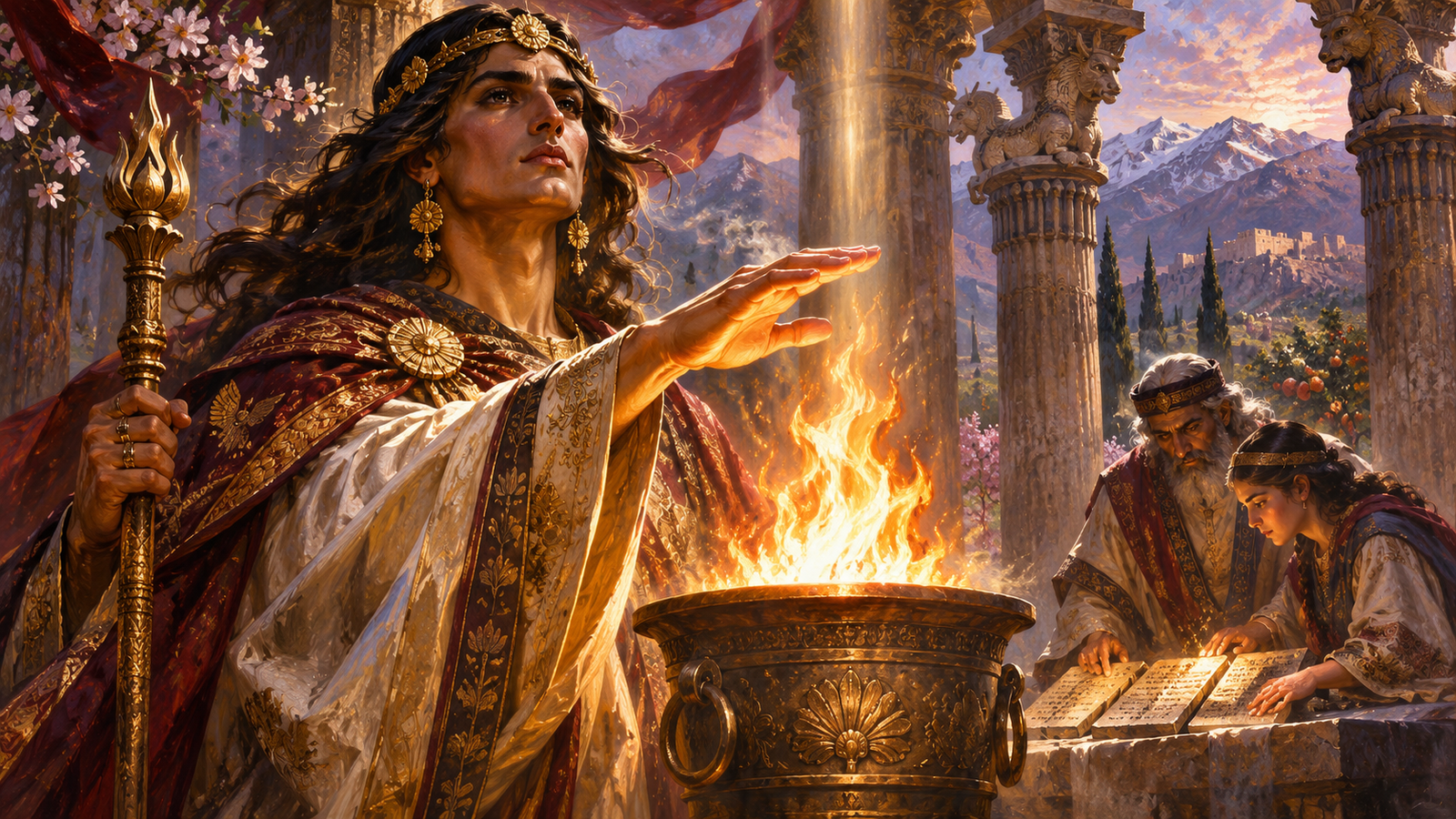
At a Glance
| Name | Aša Vahišta (Asha Vahishta); Middle Persian Ardwahišt; later Ordībehešt |
|---|---|
| Title | Best Truth; most beautiful Bounteous Immortal |
| Divine court | One of the six Amesha Spentas of Ahura Mazda |
| Ethos | Lawful Good — truth made manifest in fair conduct, protection and repair |
| Portfolio | Asha, righteous judgement, purity of fire, healing through truth and the final purification |
| Home | The Hall of the Unshadowed Flame, an estate within Garōdmān in the Celestial Realms |
| Associated powers | Atar, guardian of the sacred fire; Airyaman, a yazata of healing and companionship |
| Opposition | Angra Mainyu, the Lie, malign sickness and polluted ritual fire |
| Worshippers | Fire-keepers, truth-speakers, healers, village judges and those defending the falsely accused |
| Emblem | Original campaign image: a single golden flame between balanced scales, dark lapis ground |
| Domains | 2024 & 2014 Light; Pathfinder 1e Fire and Law; D&D 3.5e Fire and Law |
| Interventions | Omen → witness → fire-keeper → miracle → manifestation; direct divine presence is rare |
| Fate | Participates in the final renewal, Frashokereti; the present struggle is not finished in 1454 |

Every fire reveals something. The question is whether the living will bear what they see.
A fire-keeper lifts the lid of the shrine brazier. Inside the flame, the face of a missing apprentice appears, crying out from beneath a mine where no lamp has burned for fifty years. The priest who accused her of theft turns away. Asha Vahishta does not demand an easy execution: the divine power of Best Truth calls the living to find her, restore her name and repair the wrong. The flame will not do their work for them.
The Living God in the Iranian World
Across the Iranian highlands, household hearths and older sanctuaries preserve a sacred duty: to guard clean fire, make truthful declarations and refuse to trade an innocent life for political convenience. In 1454, far from the cities of mighty rulers, a fire-keeper can still summon a caravan master to account for a vanished porter or stand beside an apprentice whose testimony would cost a governor his office.
Asha Vahishta is among the six Bounteous Immortals. The old hymns describe a relationship between the divine power of asha—truth, righteousness and cosmic order—and the sacred flame. In later tradition Ardwahišt is particularly linked with fire and with the healing power of Airyaman’s sacred prayer. The fire is not an indiscriminate instrument of punishment. It is guarded because it gives light and makes acts of repair possible.
What Worshippers Do
Fire-keepers clean and protect ritual flames and avoid deliberate pollution. Healers tend wounds rather than leave the sick to be condemned as unclean. Just witnesses record testimony in language that both sides understand, using interpreters where required. A priest may refuse an oath that demands the suffering of an innocent. Nothing in the divinity’s alignment requires every worshipper to have identical convictions or behaviour.
Signs, Offerings and Taboos
Offerings are clean fuel, the labour of tending a hearth, honest restitution and aid to the suffering. A yellow flame that grows bright without consuming wood signals a witness still alive nearby; an iron scale warming on a cold morning warns that an old accusation needs review. Do not invent a universal cult of executions by sacred fire. Deliberate desecration, fraudulent testimony and cruelty disguised as purity estrange a devotee from favour. Confession without restitution is not enough.
Divine Relationships
Ahura Mazda protects the good creation; Vohu Manah gives moral discernment to living beings; Asha Vahishta demands that discernment become truthful action. Atar is the active yazata of the flame, and Airyaman is the allied healing power. Their roles remain distinct. Angra Mainyu and the Lie seek to make people believe that cruelty and false testimony are necessary for their survival.
Meeting Best Truth
Asha Vahishta first appears as an unburning light, a credible mortal witness, or a fire-keeper who refuses a bribe. A true manifestation may arrive when a sacred place and a community face complete ruin. He will protect people threatened by a powerful accuser, but will not affirm a fabricated confession or condemn a whole village because one member lied. He may challenge adventurers with evidence that damages their own reputation. Those who make amends can receive help; those who demand unquestioning vindication receive silence.
The Missing Apprentice — Yazd
Keeper Farrokh’s apprentice, Nushin, was accused of stealing a ceremonial seal and sent down a collapsed silver working. A governor already has the false confession. Players must find Nushin and her surviving records before the shaft floods, then choose whether to expose a respected priest who was threatened into silence. Success: the shrine is repaired and the innocent return. Failure: the false testimony becomes the basis for further arrests.
Fire Beneath the Physician’s Door — Rayy
The healer Shirin has been accused of allowing a demon to enter a plague ward. In truth, a fire has burned for days beneath the floor, heating a poisoned vessel and worsening the patients’ fever. The party must rescue patients, trace the source and protect Shirin from the frightened crowd. Success: a healing rite with Airyaman’s name restores trust. Failure: the ward is burned and the contagion escapes.
The Witness Who Was Two Men — Khorasan
Two caravans swear to opposite versions of a murder. Their interpreters disagree about a word in a pact, and both camps prepare for bloodshed. Asha Vahishta provides an unquenchable lantern, not a verdict. The characters must reconstruct the trade route, test a false weight and decide whether a dead guard’s surviving family deserves compensation. Success: the roads remain open. Failure: an oath-war drives refugees into the mountains.
Divine Estate — Hall of the Unshadowed Flame
In the high gardens of Garōdmān, the House of Song, a clean flame stands beneath a clear roof open to the stars. Every visitor can speak, but nobody is required to reveal a secret to strangers. The hall preserves testimony freely given by the living, lets the falsely condemned request a fair hearing, and refuses the demand that a single institution can purchase truth.
Estate effects: a willing witness can hear their own exact words replayed once without alteration; healing restores ordinary wounds but cannot rewrite memories; fires under the estate’s care illuminate without harming those given sanctuary. Regional signs: within six miles of a consecrated sanctuary, deliberate tampering with a sacred hearth leaves a detectable soot-pattern for one day; frightened animals seek its warm outer walls during storms; false accusations sometimes leave a cool shadow across the speaker’s shadow at dusk. These are campaign effects, not attested Avestan miracles.
In the eventual renewal of creation, fire has a role in purification. That destiny is not a licence for worshippers in 1454 to force people through ordeals or claim that every disease is punishment.
Game Statistics — Manifestations of Best Truth
Each ruleset presents an independent encounter with this divine power. The cosmic principle of Best Truth is not destroyed when a manifestation is defeated.
Asha Vahishta — Manifestation of Best Truth
Huge Celestial (Deity), Lawful Good — original epic encounter
AC 27 (radiant panoply); Initiative +17 (27); HP 528 (32d12 + 320); Speed 50 ft., Fly 90 ft. (Hover).
| STR | DEX | CON | INT | WIS | CHA |
|---|---|---|---|---|---|
| 28 (+9) | 24 (+7) | 30 (+10) | 32 (+11) | 36 (+13) | 30 (+10) |
Saving Throws Str +19, Dex +17, Con +20, Int +21, Wis +23, Cha +20; Skills Insight +33, Perception +23, Religion +21; Resistances Cold, Lightning, Radiant; Immunities Fire, Poison; Condition Immunities Charmed, Frightened, Poisoned; Senses Truesight 180 ft., Passive Perception 33; Languages Avestan, Old Persian and celestial speech; telepathy 180 ft.; CR 34 (unofficial epic extrapolation; XP not assigned); PB +10 (extrapolated).
Legendary Resistance (4/Day). On failing a saving throw, the manifestation can choose to succeed instead. Magic Resistance. Advantage on saving throws against spells and magical effects. Purity of Flame. An ally beginning its turn within 30 feet gains Advantage on its first saving throw against being Charmed or Frightened before its next turn; this does not reveal its moral character.
Actions
Multiattack. The manifestation makes three Staff of the Unshadowed Fire attacks. Staff of the Unshadowed Fire. Melee Attack Roll +19, reach 15 ft. Hit: 31 (4d10 + 9) Fire damage plus 18 (4d8) Radiant damage. The fire does not ignite objects the manifestation wishes to protect. Trial of the True Flame (Recharge 5–6). Every hostile creature of the manifestation’s choice in a 60-foot Emanation makes a DC 31 Constitution saving throw, taking 88 (16d10) Radiant damage on a failure or half on a success. A creature failing by 5 or more cannot benefit from invisibility until the end of its next turn.
Bonus Actions
Kindle Courage (3/Day). Up to three creatures within 60 feet each regain 25 Hit Points and may end the Frightened condition on themselves.
Reactions
Witness Against the Lie. When a creature within 60 feet is forced by magic to utter false testimony, the manifestation grants that creature a new saving throw with Advantage; success ends that compulsion.
Legendary Actions
Three legendary actions per round, one after another creature’s turn; regain all at the start of its turn. Unmask (1). One creature within 90 feet must make a DC 31 Wisdom save or lose the Invisible condition until the end of its next turn. Staff (2). Make one staff attack. Healing Ember (3). A creature within 90 feet regains 45 (10d8) Hit Points.
Personal Spellcasting
Spellcasting is Wisdom (spell save DC 31, +23 to hit). The manifestation casts as a twentieth-level cleric, using a Magic action, with verbal and somatic components; material components are replaced by its blazing symbol. The spell slots below recover on a Long Rest. Concentration applies normally; the divine manifestation does not bypass it.
| Cantrips (at will) | Light, Sacred Flame, Guidance, Mending, Thaumaturgy |
|---|---|
| 1st (4 slots) | Bless, Command, Cure Wounds, Detect Evil and Good |
| 2nd (3 slots) | Aid, Lesser Restoration, Zone of Truth |
| 3rd (3 slots) | Daylight, Dispel Magic, Revivify |
| 4th (3 slots) | Divination, Guardian of Faith |
| 5th (3 slots) | Flame Strike, Greater Restoration, Scrying |
| 6th (2 slots) | Heal, True Seeing |
| 7th (2 slots) | Fire Storm, Resurrection |
| 8th (1 slot) | Holy Aura |
| 9th (1 slot) | Mass Heal |
Encounter counterplay: the manifestation begins by offering a chance to confess or protect a witness. Its great power can be distracted by rescuing people from a collapsing sanctuary; it does not destroy innocent bystanders merely to defeat enemies.
Asha Vahishta — Avatar of the Clear Flame
Huge celestial, lawful good — original epic encounter
Armor Class 26 (divine light); Hit Points 495 (30d12 + 300); Speed 50 ft., fly 80 ft. (hover).
| STR | DEX | CON | INT | WIS | CHA |
|---|---|---|---|---|---|
| 28 (+9) | 24 (+7) | 30 (+10) | 30 (+10) | 34 (+12) | 30 (+10) |
Saving Throws Str +18, Dex +16, Con +19, Int +19, Wis +21, Cha +19; Skills Insight +30, Perception +21, Religion +19; Damage Resistances cold, lightning, radiant; Damage Immunities fire, poison; Condition Immunities charmed, frightened, poisoned; Senses truesight 120 ft., passive Perception 31; Languages Avestan, Old Persian and celestial speech; telepathy 120 ft.; Challenge 32 (unofficial epic extrapolation; XP not assigned); Proficiency Bonus +9 (extrapolated).
Legendary Resistance (4/Day). If the avatar fails a saving throw, it can choose to succeed instead. Magic Resistance. The avatar has advantage on saving throws against spells and magical effects.
Actions
Multiattack. Three Sacred Fire Staff attacks. Sacred Fire Staff. Melee Weapon Attack: +18 to hit, reach 15 ft., one target. Hit: 31 (4d10 + 9) fire damage plus 18 (4d8) radiant damage. Revelation of Asha (Recharge 5–6). Each enemy of the avatar’s choice within 60 feet must make a DC 29 Constitution saving throw, taking 77 (14d10) radiant damage on a failure, half on success. On a failed save a creature cannot benefit from invisibility for 1 round.
Bonus Actions
Compassionate Flame (3/Day). One creature within 60 feet regains 40 hit points and can immediately repeat one saving throw against being frightened.
Reactions
Honest Witness. When an ally within 60 feet makes a saving throw against a magical effect compelling a lie, the avatar grants advantage on the roll.
Legendary Actions
Three per round, one at the end of another creature’s turn; regain at start of the avatar’s turn. Reveal (1). A creature within 60 feet must succeed on a DC 29 Wisdom save or lose the benefit of invisibility until its next turn. Strike (2). Make one staff attack. Restore (3). Heal one creature within 60 feet for 36 (8d8) hit points.
Personal Spellcasting
Twentieth-level cleric spellcasting, Wisdom (save DC 29, +21 spell attack). The avatar uses actions, concentration and components under 2014 spellcasting rules, replacing material components with its divine emblem. Slot progression is independent of the 2014 cleric’s domain-spell grants; spells recover on a long rest.
| Cantrips (at will) | Light, Sacred Flame, Guidance, Mending, Thaumaturgy |
|---|---|
| 1st (4 slots) | Bless, Command, Cure Wounds, Detect Evil and Good |
| 2nd (3 slots) | Aid, Lesser Restoration, Zone of Truth |
| 3rd (3 slots) | Daylight, Dispel Magic, Revivify |
| 4th (3 slots) | Divination, Guardian of Faith |
| 5th (3 slots) | Flame Strike, Greater Restoration, Scrying |
| 6th (2 slots) | Heal, True Seeing |
| 7th (2 slots) | Fire Storm, Resurrection |
| 8th (1 slot) | Holy Aura |
| 9th (1 slot) | Mass Heal |
Counterplay: saving threatened witnesses and keeping the sacred fire clean can resolve the crisis without destroying the avatar’s form.
Asha Vahishta, Emanation of Best Truth — CR 32/MR 8
XP extrapolated epic encounter; LG Huge outsider (extraplanar, good, lawful, mythic); Init +11; Senses darkvision 60 ft., true seeing; Perception +50; Aura Unshadowed Fire (30 ft.).
DEFENSE AC 51, touch 29, flat-footed 44 (–2 size, +7 Dex, +22 natural including mythic +8, +8 deflection, +6 sacred); hp 607 (34d10 + 340 plus 80 mythic bonus hp); Fort +34, Ref +31, Will +37 (includes a +5 resistance bonus from divine vestments); DR 20/epic and evil; Immune disease, fire, poison; Resist cold 30, electricity 30; SR 43.
OFFENSE Speed 50 ft., fly 80 ft. (perfect); Melee +5 holy heavy mace +48/+43/+38/+33 (3d8+16 bludgeoning plus 2d6 holy); Space 15 ft.; Reach 15 ft.; Special Attacks trial by fire, mythic power (8/day; surge +1d10), Divine Intervention (see below).
Spell-Like Abilities (CL 30th; concentration +43; spell DC = 23 + spell level, Wisdom-based; no material components): 0—light, guidance, mending (at will); 1—bless, command, protection from evil (at will); 2—aid, consecrate, lesser restoration (at will); 3—daylight, dispel magic, prayer (at will); 4—divination, death ward (at will); 5—flame strike, hallow, true seeing (at will); 6—heal, greater dispel magic (3/day); 7—holy word, resurrection (3/day); 8—holy aura, fire storm (1/day); 9—mass heal, miracle (1/day; healing or protection only).
STATISTICS Str 32, Dex 24, Con 30, Int 32, Wis 36, Cha 30; Base Atk +34; CMB +47; CMD 78; Feats Improved Initiative (mythic), Combat Reflexes, Dodge, Mobility, Spring Attack, Weapon Focus (heavy mace), Power Attack (mythic), Cleave, Great Cleave, Improved Critical (heavy mace), Critical Focus, Blind-Fight, Iron Will (mythic), Great Fortitude, Lightning Reflexes, Toughness (mythic), Quicken Spell-Like Ability (greater dispel magic); Skills Diplomacy +47, Heal +50, Knowledge (religion) +48, Perception +50, Sense Motive +50, Spellcraft +48; Languages Avestan, Old Persian and Celestial; telepathy 180 ft.
Special Abilities
Unshadowed Fire (Su). Allies within 30 feet gain a +4 sacred bonus on saves against fear and charm; hostile creatures cannot use invisibility to avoid its perception. Trial by Fire (Su, 3/day). Standard action, 60-foot-radius burst centred on the emanation; enemies must succeed at a DC 37 Fortitude save or take 18d8 fire plus 18d8 sacred damage; success halves damage. The damage never affects unchosen innocents. Purifying Touch (Su, 3/day). Standard action: removes one disease, poison or curse from a willing touched creature at caster level 30. Mythic Rank 8. The four mythic feat selections are marked above. The rank grants +8 natural armour, +80 hp, eight uses/day of mythic power and surge +1d10. Four mythic ability increases are already included in the displayed scores: Strength +2, Constitution +2 and Wisdom +4. Nine mythic abilities: Clear Testimony (Su, 3/day): as an immediate action, permit one creature within 60 feet to repeat a failed Will save against compulsion. Guarded Hearth (Su): clean fires within 30 feet cannot be extinguished by nonmagical wind or water. Healing Ember (Su, 3/day): as a swift action, one ally within 60 feet recovers 60 hp. Rescue the Innocent (Su, 2/day): as an immediate action, teleport one willing ally within 30 feet to an unoccupied space within 60 feet; this does not provoke attacks of opportunity. Light Beyond Illusion (Su, 1/day): as a standard action grant an ally within 30 feet true seeing for 1 minute. Unbroken Vigil (Ex): the emanation never becomes fatigued or exhausted from sleep loss. Wisdom of Fire (Sp, 1/day): commune at CL 30 without material components. Refuse False Judgement (Su, 3/day): as an immediate action give one ally within 60 feet a +5 sacred bonus on a saving throw against compulsion. Final Mercy (Su, 1/day): when an ally within 30 feet would be reduced to 0 or fewer hp, as an immediate action leave it at 30 hp instead; this cannot restore a dead creature. All mythic abilities above use their stated action types and daily limits; their supernatural effects are independent of the base Unshadowed Fire, Trial by Fire and Purifying Touch abilities.
Domains for Clerics
Followers choose Fire and Law; their domain bonus slots and powers use Pathfinder 1e rules. Fire grants Fire Bolt and resistance; Law grants Touch of Law and Staff of Order. The following are the complete domain spell tracks, separate from the deity’s spell-like abilities.
Pathfinder 1e cleric domain spells
| Spell level | Fire domain | Law domain |
|---|---|---|
| 1 | Burning Hands | Protection from Chaos |
| 2 | Produce Flame | Align Weapon (law only) |
| 3 | Fireball | Magic Circle against Chaos |
| 4 | Wall of Fire | Order’s Wrath |
| 5 | Fire Shield | Dispel Chaos |
| 6 | Fire Seeds | Hold Monster |
| 7 | Elemental Body IV (fire form only) | Dictum |
| 8 | Incendiary Cloud | Shield of Law |
| 9 | Elemental Swarm (fire spell only) | Summon Monster IX (law spell only) |
Encounter note: CR 32 includes the MR 8 adjustment above the base creature’s estimated CR 28. It is a campaign encounter rating, not an official published XP award. Its epic balance requires playtesting.
Asha Vahishta, Divine Manifestation — CR 32, Divine Rank 6
LG Huge outsider (extraplanar, good, lawful); Hit Dice 34d8+340 (612 hp; maximum deity Hit Dice); Initiative +11; Speed 100 ft., fly 280 ft. (perfect); Armor Class 50 (–2 size, +7 Dex, +19 natural, +10 deflection, +6 divine), touch 31, flat-footed 43; Base Attack/Grapple +34/+59; Attack +5 holy heavy mace +54 melee (3d8+16 plus 2d6 holy); Full Attack +54/+49/+44/+39 melee; Space/Reach 15 ft./15 ft.; Special Attacks Divine Fiery Judgement, spell-like abilities; Special Qualities divine senses, deity immunities, DR 20/epic and evil, SR 44, true seeing.
Saves Fort +35, Ref +32, Will +38 (includes Divine Rank 6); Abilities Str 32, Dex 24, Con 30, Int 32, Wis 36, Cha 30; Skills Concentration +57, Diplomacy +53, Heal +56, Knowledge (religion) +54, Listen +56, Sense Motive +56, Spellcraft +54, Spot +56; Feats Improved Initiative, Combat Reflexes, Dodge, Mobility, Spring Attack, Weapon Focus (heavy mace), Power Attack, Cleave, Great Cleave, Improved Critical (heavy mace), Critical Focus, Blind-Fight, Iron Will, Great Fortitude, Lightning Reflexes, Toughness, Quicken Spell-Like Ability (greater dispel magic); Environment Garōdmān; Organization solitary; Challenge Rating 32 (campaign epic estimate); Treasure none; Alignment lawful good; Advancement —.
Spell-Like Abilities (caster level 34th, Wisdom-based for this campaign manifestation; save DC = 23 + spell level + divine rank 6; includes deity rank in the epic calculation; no verbal, somatic or material components): 0—light, guidance, mending (at will); 1—bless, command, protection from evil (at will); 2—aid, consecrate, lesser restoration (at will); 3—daylight, dispel magic, prayer (at will); 4—divination, death ward (at will); 5—flame strike, hallow, true seeing (at will); 6—heal, greater dispel magic (3/day); 7—holy word, resurrection (3/day); 8—holy aura, fire storm (1/day); 9—mass heal, miracle (1/day; healing or protection only).
Divine Fiery Judgement (Su, 3/day). Standard action. In a 60-foot-radius spread centred on the manifestation, chosen enemies take 18d8 fire and 18d8 sacred damage (Fortitude DC 43 half). The save DC is 10 + half HD (17) + Charisma modifier (10) + divine rank (6); it is an original ability and is not a printed salient divine ability. Word of Witness (Su). Lies that a witness is compelled magically to speak are audibly discordant within 60 ft. This reveals the coercion but never rewrites a memory or supplies missing facts.
Domains for Clerics
Clerics may select Fire and Law. Fire’s granted power commands or rebukes fire creatures and turns water creatures; Law grants +1 caster level for Law spells. The 3.5e spell lists and mechanics below are separate from both Pathfinder and the deity’s own spell-like repertoire.
D&D 3.5e cleric domain spells
| Spell level | Fire domain | Law domain |
|---|---|---|
| 1 | Burning Hands | Protection from Chaos |
| 2 | Produce Flame | Calm Emotions |
| 3 | Resist Energy (fire or cold only) | Magic Circle against Chaos |
| 4 | Wall of Fire | Order’s Wrath |
| 5 | Fire Shield | Dispel Chaos |
| 6 | Fire Seeds | Hold Monster |
| 7 | Fire Storm | Dictum |
| 8 | Incendiary Cloud | Shield of Law |
| 9 | Elemental Swarm (fire spell only) | Summon Monster IX (law spell only) |
Divine-scale rule: The Divine Rank 6 grants +6 divine bonuses to AC, attacks, saves and appropriate checks; the D&D 3.5e form uses maximum deity HD, divine speed and other native divine traits. The power can withdraw the manifestation without abandoning the cosmic principle of Asha.
Clerical Gifts and Duties
A cleric of Best Truth chooses the Light Domain in D&D 2024 and D&D 2014; the exact spells differ by edition. The ability to guide worshippers through fire never turns clerics into indiscriminate pyromancers. Their obligations are to offer light where witnesses fear speaking, protect the sick, and serve a good creation even when doing so costs prestige.
D&D 2024 — Light Domain (subclass at cleric level 3)
| Cleric level | Always-prepared domain spells |
|---|---|
| 3 | Burning Hands; Faerie Fire; Scorching Ray; See Invisibility |
| 5 | Daylight; Fireball |
| 7 | Arcane Eye; Wall of Fire |
| 9 | Flame Strike; Scrying |
D&D 2014 — Light Domain (subclass at cleric level 1)
| Cleric level | Always-prepared domain spells |
|---|---|
| 1 | Burning Hands; Faerie Fire |
| 3 | Flaming Sphere; Scorching Ray |
| 5 | Daylight; Fireball |
| 7 | Guardian of Faith; Wall of Fire |
| 9 | Flame Strike; Scrying |
In Pathfinder 1e and D&D 3.5e the full Fire and Law domain lists appear in their own panels above. Domain grants are worshipper features; the power’s personal 0–9 spell repertoire belongs to its own stat block and uses different resources.
Divine Boons and Curses
Witness’s Hearth (boon): once per long rest, a worshipper who has offered truthful testimony may reroll a saving throw against a magical effect that would force them to lie; the second roll stands. In Pathfinder or D&D 3.5e, this is a +4 sacred bonus to one such Will save per day instead. Ember of Remorse (curse): a wilful false witness feels a stinging warmth when touching the sacred brazier. The sensation lasts only while they persist in deliberate falsehood, causes no physical damage and ends when they begin meaningful restitution. Both are original campaign gifts, not universal church doctrine.
Companions and Messengers
Atar tends the sanctified flame as a distinct divine power; Airyaman brings the healing prayer and companionship. Neither is reduced to a summoned combat statistic on this page. They may appear through mortal priests, miraculous assistance or separate deity entries. The order of intervention is deliberate: omen, mortal helper, lesser supernatural servant, miracle, manifestation and, only in the greatest events, the direct power of Best Truth.
Relic — Coal of the First Vigil
A bead of light rests in a bronze lantern whose wick never burns away. It cannot be bought. When carried by someone deliberately concealing a crime, its light contracts to a single red point; that sign is a warning to investigate, not proof of guilt. The lantern was fashioned for this setting, not borrowed from the Avesta.
Four playable editions of the relic
D&D 2024 — Wondrous Item, Legendary (Requires Attunement)
The lantern has 5 charges and regains 1d4+1 at dawn. As a Magic action, spend 1 charge to cast Zone of Truth (save DC 18), or 3 to cast Greater Restoration on one touched willing creature, no material component. The light is Bright for 30 feet, Dim for 30 feet beyond, and can be covered. It neither forces confession nor reads memories.
D&D 2014 — Wondrous Item, Legendary (Requires Attunement)
The lantern has 5 charges, regaining 1d4+1 daily at dawn. While carrying it, you can use an action to expend 1 charge for Zone of Truth (DC 18), or 3 charges for Greater Restoration on a willing touched creature without material components. Its light is bright for 30 feet and dim for another 30 feet.
Pathfinder 1e — Major Artifact
Once per day, its bearer may use zone of truth (Will DC 20) or restoration (caster level 15) as a standard action. The fire has no ordinary monetary or crafting formula. Destroying it requires that it be extinguished by a willing lie spoken by its original keeper in the Hall of Best Truth.
D&D 3.5e — Major Artifact
Once per day, the bearer may use zone of truth (Will DC 20) or restoration (caster level 15) as a standard action. The relic has no ordinary price or crafting prerequisites. Destruction requires the same betrayal at the Hall of Best Truth.
Sources and Licensing
The identity of Asha Vahishta, the link to fire and the association with Airyaman and healing are drawn from Iranian sacred traditions. The painted figure, emblem, shrine names, characters, named encounters, relic and combat rules are new campaign interpretations. In particular, this invented symbol is not a historical seal, and the portrayal is not an assertion that a divinity’s sacred image had this form.
Keep this reference growing
If this page helped with your reading or game, you can support its upkeep or explore the curated books.
Explore the Bookshop — epics, classics and stories behind imagined worlds.