
Chan Chan — Capital of the Chimú Kingdom
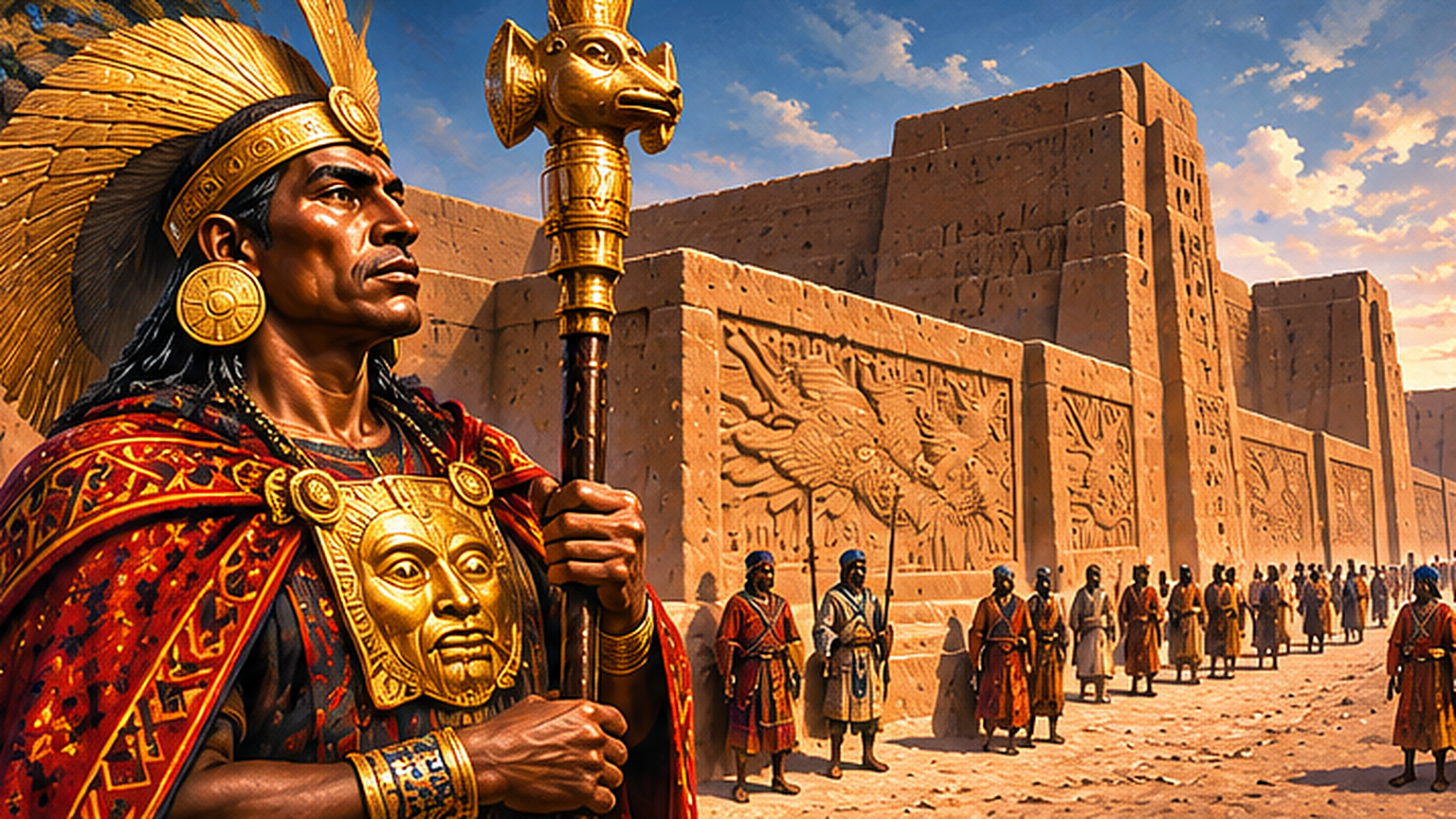
Chan Chan · Chimú Kingdom · Moche Valley · Northern Pacific coast · 1454 CE
At a Glance
| Place | Great earthen capital of the independent Chimú kingdom |
|---|---|
| Landscape | Dry Pacific coastal plain fed by irrigation valleys and river channels |
| Authority | Chimú royal court, palace administrators and district officials |
| Work and trade | Irrigated agriculture, metalworking, textiles, fishing and coastal exchange |
| Major pressures | Water access, court succession, dependent valleys and the growing Inca state |
| Travel | Coastal routes, canal banks, river valleys and inland passes |
| Campaign present | 1454 CE — the Chimú are not yet under Inca rule |

Chan Chan rises out of the desert in walls of earth. Within the vast enclosures, runners deliver orders to workshops where metal rings under hammers, weavers carry baskets of thread, and canal overseers argue about water while palace attendants prepare gifts for powerful visitors. Beyond the city lie fields that exist only because generations of engineers have drawn water into the dry country. That water is the kingdom’s strength—and its most dangerous weakness.
What Is Happening Right Now?
The Chimú kingdom stands at the height of its wealth and influence. It is independent in 1454, while Pachacuti’s Inca state expands through the highlands to the south. Merchants bring alarming rumours about new roads, allied rulers and military musters, yet the coastal court disagrees about the threat. Some prefer to secure the mountain trade; others consider the highlanders rivals who must never gain the river valleys.
In the capital, an irrigation district is receiving less water than its records permit. An official accuses village farmers of stealing their own allotment. Workshop families suspect that a competing palace compound has redirected the flow for its gardens. The coming harvest will reveal who has influence—and who is disposable.
Palaces, Workshops and Places to Explore
The Great Walled Compounds
High earthen walls divide elite compounds, storehouses, courts and work districts. Visitors find guarded entrances, restricted rooms and long passages, not the open squares of a free trading town. Each enclosure has stewards, dependants and a history of rivalry. Orders that arrive under one royal seal may be challenged at another gate.
The Workshops
Expert artisans produce fine metalwork, ornaments, ceramics and textiles. Their labour is prestigious and closely controlled. A craftsman’s disappearance is not merely a family tragedy: it can halt an important diplomatic gift and expose the officials responsible for his safety.
The Canals and Fields
Irrigation systems carry river water to farmland in an otherwise arid landscape. Gatekeepers and canal workers are powerful because they know how long a field can survive without flow. A blocked channel can be an accident, a desperate act by farmers or deliberate pressure from the court.
The Coastal Approaches
Fishing communities and shoreline traders supply food and information. Sea conditions, shifting sands and changing river mouths shape every approach. Boats familiar with the coast can move news faster than caravans, but no navigator offers passage without considering the rulers who control the landing.
The Sacred Enclosures
Offerings, ancestors and celestial observances are part of the city’s authority. Some enclosed spaces are guarded not because they contain gold but because the living court has obligations to the dead. Those obligations can prevent an administrator from taking the easiest military or financial decision.
People and the Conduct of Power
The Chimú royal court protects skilled work, stored wealth and the cultivated valleys. It also keeps a sharp hierarchy: artisans may be honoured for their craft while having little say in how their work is used. Palace officials who keep canals running can command genuine loyalty; those who deprive poorer districts of water produce fear and resistance.
Naylamp Suy, a canal inspector, has records proving that a respected official ordered an unlawful diversion. His family lives in the affected district, leaving him torn between the court and those who will suffer if he remains silent.
Yana Chiri, a metalworker supervising a court workshop, knows which diplomatic gifts were sent to highland visitors. She is willing to bargain for the safety of her apprentices but will not help thieves take the workshop’s stock.
Coastal village headpeople are crucial negotiating partners: the court can demand provisions, but it cannot easily replace people who know the fisheries and mouths of local rivers.
Markets, Lodging and Useful Help
Approved visitors can find shelter through merchants, palace servants, work communities or rural households outside the guarded enclosures. Food comes from irrigated fields, coastal fisheries and organised stores. Metalworkers, weavers and boat builders offer important services, but access to the finest goods depends upon patronage. There is no freely available stock of royal treasures for a wandering buyer.
Magic is encountered through local sacred people and places, not in anonymous commercial shops. Ritual specialists may help determine whether a broken canal has merely failed or been deliberately profaned, but the consequences of their judgement can be political as well as spiritual.
Magic and Sacred Services
Priestly attendants of the sacred enclosures and respected water guardians maintain rites associated with the sea, the ancestors and the lifeblood of the canals. A household may seek a blessing for a fishing boat or guidance over a water dispute. One canal keeper claims a carefully guarded stone basin reveals when an irrigation gate has been opened by magic. The palace wants possession of the basin; the farmers argue that its authority belongs with the valley whose fields it protects.
Dangers and Adventure Hooks
- The vanished water. A farming district’s irrigation channel runs dry before planting. Follow the flow through canal gates to discover whose work has redirected it; the threatened villages have already armed their guards.
- The unfinished tribute. A master metalworker disappears on the eve of a major court presentation. His apprentices are accused of theft, while his tools have been taken to a rival compound.
- Rumours from the mountains. An envoy arrives carrying an offer from a highland ruler. Two Chimú officials seek to suppress different parts of the message for different reasons.
- The old enclosure. Workers repairing a damaged palace wall uncover a sealed room. The court orders them to continue, but ancestral custodians insist the contents belong to a household long excluded from power.
Roads, Water and Borders
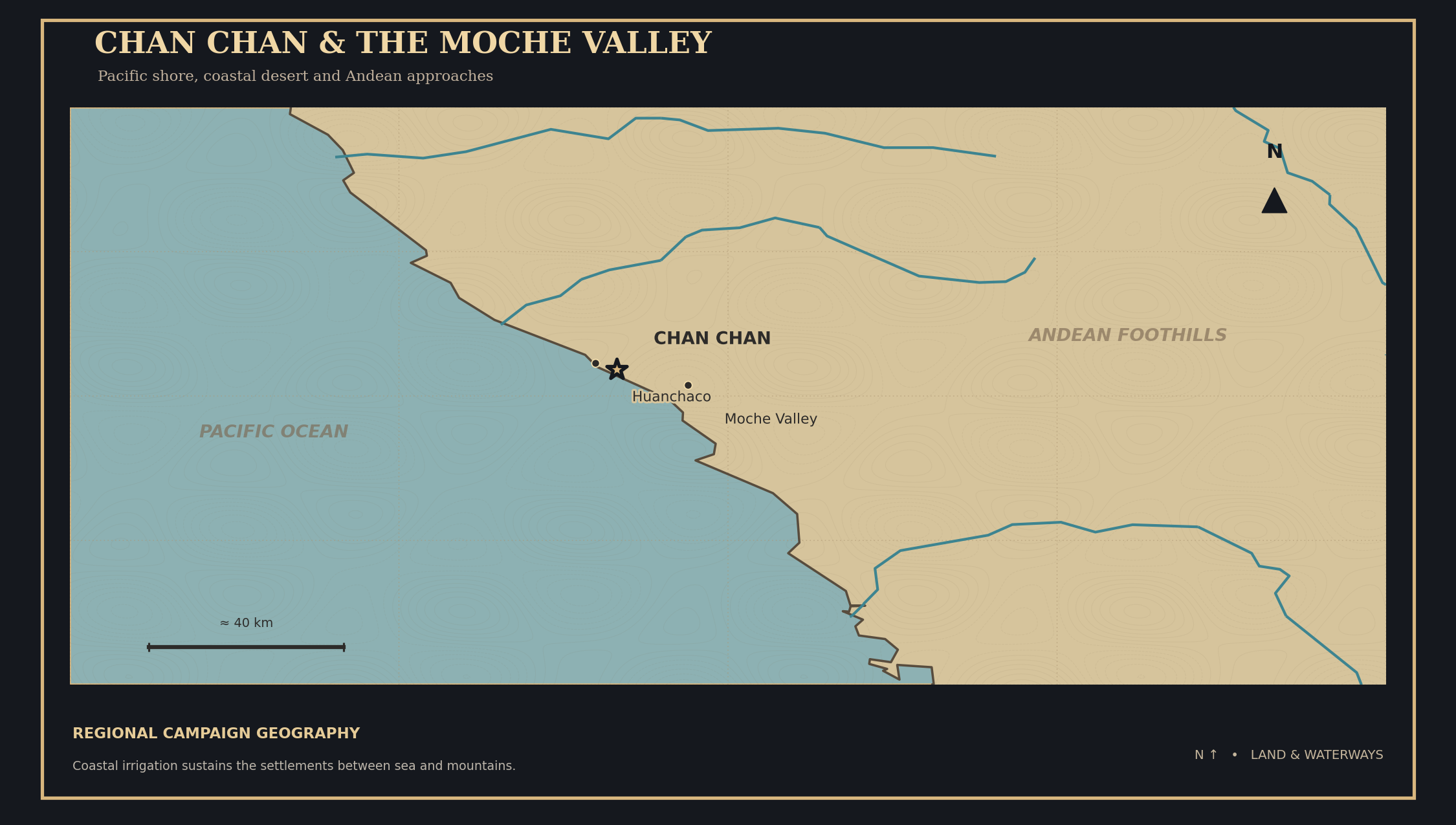
The arid coastal valleys are linked by routes that follow settlements, river mouths and reliable water. Inland approaches climb toward the Andes and the lands connected with Cusco. The great coastal city relies on irrigated fields, storage and labour; travelling without water or a recognised host can be dangerous even close to its walls.
Foreigners cannot assume that a palace permit grants them free passage through a village’s fishing grounds or fields. Entering those communities is a separate negotiation. Relations with the expanding Inca state remain unsettled rather than settled by conquest.
Deeper History
The Chimú kingdom flourishes on the north coast of what readers call Peru. Its large capital, Chan Chan, was built in earthen architecture on a monumental scale and sustained by carefully managed water, agricultural production and craft specialisation. In 1454 it remains independent. Its conquest by the Inca belongs to a later phase of the fifteenth century, not the present.
Historical Sources and Onward Routes
UNESCO — Chan Chan Archaeological Zone · Australian Museum — Chimú State · Metropolitan Museum — Andes chronology.
Return to the Central Andes, the South America atlas or the world atlas.
Keep this reference growing
If this page helped with your reading or game, you can support its upkeep or explore the curated books.
Explore the Bookshop — epics, classics and stories behind imagined worlds.