
Hittite–Hurrian Pantheon — Gods of the Thousand Temples
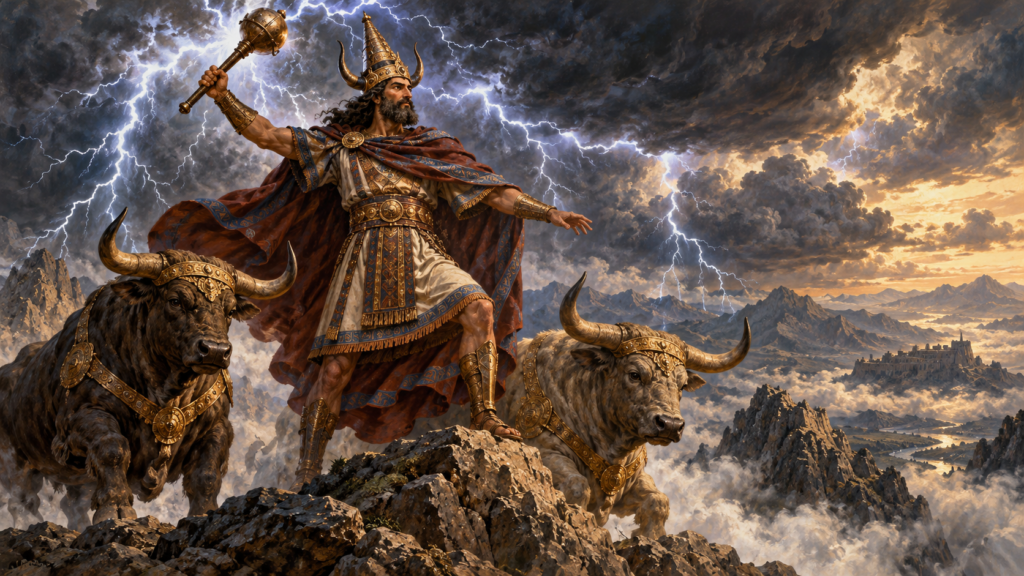
At a Glance
Hittite, Hattian and Hurrian gods of Anatolia and northern Syria
Kumme, the mountain kingdom of Buxenus in Arcadia
Teshub and Hebat; Sharruma guards their mountain paths
Kumarbi, dethroned but still gathering challengers
Hattusa, Arinna, Yazılıkaya, Kummanni, Carchemish, Urkesh and Aleppo
Šeri and Ḫurri, the sacred bulls; Namni and Hazzi, the mountain powers
Thunder above clear valleys; bees gathering at abandoned groves; sunlight on sealed gates
Illuyanka, Hedammu and the growing stone challenger Ullikummi
The mountain road to Kumme is never quiet. Bronze bells sound in the valleys, rain moves across the cedar forests, and beyond the clouds the chariot of the storm king passes between two sacred peaks. Here the powers who raised and overthrew the kings of heaven still contend for the world. A shepherd may be the first to notice their displeasure; a frightened queen may hear their promises; an adventurer may stand between them when the stone giants wake.
The Hittite–Hurrian pantheon gathers related but different religious traditions of ancient Anatolia and northern Mesopotamia. The gods of Hatti, the earlier Hattian country and Hurrian sanctuaries entered one another’s festivals and royal theology. Their cults did not lose their histories merely because scribes placed their names in the same procession. Their distinct cities, stories, names and conflicting claims endure.
What Is Happening Right Now?
Near the old sanctuary of Yazılıkaya, night travellers hear the sound of twelve feet marching in perfect time beneath the rock. In the high country, storms break around a single unmoving peak where a stone figure is slowly rising. At Arinna, a solar procession reaches the sanctuary before sunrise and finds its doors already open. These events are related only in the sense that the divine family is watching them; no god has told mortal priests the full explanation.
Where the Gods Live: Kumme in the Mountains of Buxenus
Beyond the settled divine roads of Arcadia lies the storm-wreathed kingdom of Kumme in Buxenus. Its black-stone terraces rise above waterfalls, cedar slopes and thunderheads. This is neither the Mesopotamian Divine Cities nor an annex of their pantheon. The mountain court is an independent divine realm with its own rites, households, kingship and memories of war.
Teshub reigns from the High Hall of Thunder. Hebat’s lion-guarded court preserves sanctuary; Sharruma walks the mountain roads and the narrow paths above the clouds. Lower down, the terraced fields of Telipinu feed pilgrims, while the watchers of Shimegi and Kushuh mark day and night. No single orderly palace can contain every power: Arinna’s solar sanctuary keeps its own light, and the dark earth of Lelwani remains apart from the living court.
Earthly sacred places mirror the realm without becoming interchangeable: the remembered sacred city of Kumme, the mountains Hazzi and Namni, the temples of Arinna, and the rock reliefs of Yazılıkaya. Kumarbi has no place at the reigning table. His older claims travel through the buried foundations of Urkesh and the caves below the divine kingdom.
The Names of the Divine Procession
The storm god bears the names Teššub among the Hurrians and Tarḫunna among the Hittites. The Sun Goddess of Arinna is honoured in her ancient city even where the royal court invokes her alongside Hebat. Šauška speaks in the sacred language of Hurrian cities and is known beyond them through her association with Ishtar. Anu and Ea belong also to the great traditions of the Two Rivers. A name can join courts without erasing the people who first spoke it.
Principal Deities
Teshub / Tarhunna · Hebat · Sharruma · Kumarbi · Sun Goddess of Arinna / Wurusemu · Shaushka · Telipinu · Hannahanna · Inara · Kamrusepa · Ishara · Shimegi · Kushuh · Lelwani · Tashmishu / Shuwaliyat · Ashtabi
Teshub / Tarhunna — King of Storms
Power: Storm, rain, battle, sovereign protection.
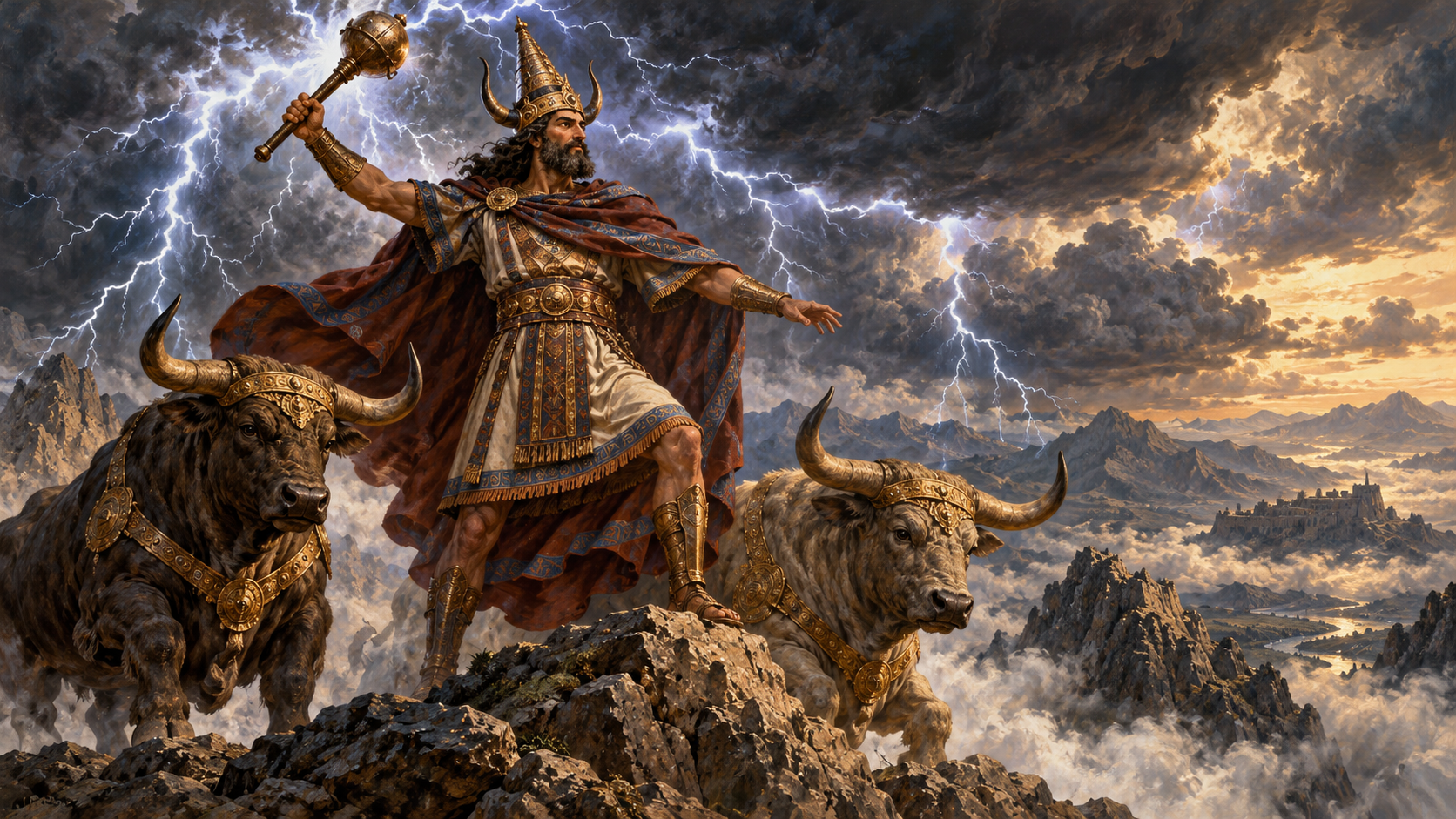
The Hurrian Teššub and Hittite Tarḫunna are corresponding royal storm-god traditions. Thunder is his voice, and the bulls Šeri and Ḫurri draw his chariot. His victory over the primordial claimants to heaven is never secure while Kumarbi plots a new champion.
The storm god answers courage more readily than flattery. His shrines crown exposed hills, river sources and the entrances to mountain passes. Merchants request rain without flood; farmers ask that spring storms break at the right time; warriors ask him to hold the sky while they defend their homes.
Hebat — Queen of the High Court
Power: Protection, sovereignty, divine motherhood.
Ḫebat is Teshub’s consort and mother of Šarruma, queen of a great Hurrian divine procession. Later Hittite royal religion identified her with the Sun Goddess of Arinna; the older cults retain their own histories. Her presence is shown at Yazılıkaya beside the storm god.
Her sanctuaries are places where frightened travellers can stand before a queen whose protection has consequences. She welcomes petitions for children and refuge, but condemns rulers who sacrifice households to save their own palaces. Divine felines guard the long ceremonial approaches.
Sharruma — Guardian of the Young King
Power: Mountains, protection, guidance.
Šarruma, son of Teššub and Ḫebat, is the protecting god seen embracing King Tudḫaliya IV in the reliefs of Yazılıkaya. Mountain tracks, royal peril and the vulnerable under his care give his worship an intimate scale despite his exalted parents.
His followers guide caravans through snowfields, guard young heirs and serve as companions who walk beside rather than above their charges. A bronze image of Sharruma beside a mountain animal is often carried before a dangerous climb.
Kumarbi — The Dethroned Father
Power: Primordial power, dynastic succession, divine rivalry.
Kumarbi overthrew Anu and was himself displaced by Teššub in the Hurrian kingship cycle. He is a cunning, formidable old god, not simply a monster. His schemes include Hedammu and the stone-born giant Ullikummi. His older cult centre was Urkesh.
Shrines to Kumarbi stand where older foundations lie beneath newer temples. His adherents include displaced princes, underground diviners and families who believe the first enthroned powers were never given justice. He bargains in advantage, patience and knowledge of the forgotten ages.
Sun Goddess of Arinna / Wurusemu — Lady of Arinna
Power: Sunlight, protection, kingship, battle.
The Sun Goddess of Arinna is the paramount goddess of Hatti, often associated with the Hattian name Wurušemu. In the imperial period she was closely identified with Hebat, but her sacred city and older royal cult remain distinctive.
Her holy city is remembered in the warmth of winter stone. Priests carry sunlight into fortified towns when plague, cold and fear turn neighbours against one another. The goddess protects the living kingdom as fiercely as its crown.
Shaushka — She of Love and Battle
Power: Desire, warfare, healing, transformation.
The Hurrian Šauška is a powerful goddess of love and warfare, associated with Ishtar but rooted in Hurrian worship. Ninatta and Kulitta appear in her following. Her rites and stories preserve gendered ambiguity and change, and the crossing of familiar boundaries.
Soldiers, singers, lovers and those remaking their lives seek Shaushka. Her shrines contain music as well as weapons; her favour can undo an army without a battle, or restore a disgraced person to public standing.
Telipinu — The God Who Vanished
Power: Fertility, fields, growth, restoration.
When Telipinu leaves in anger, crops, animals and human fertility fail. In his surviving myth a bee sent by Hannahanna finds him, and Kamrusepa’s healing rite restores cosmic order. The tale is of danger and return, not a simple seasonal death.
Farmers honour him through fields, grain, bread, animals and the long work of recovery after disaster. Those who provoke his anger may discover that neither prayer nor force can hurry healing.
Hannahanna — The Old Mother
Power: Motherhood, wisdom, divine counsel.
Ḫannaḫanna is an ancient mother goddess who sees the thing that the most powerful gods overlook. It is she who sends the bee to find the vanished Telipinu, when the stronger searchers have failed.
Her worship is domestic without being small: midwives, elders, beekeepers and community healers keep shrines where children are named and feuds are quieted. Her interventions are practical, often delivered by the weakest messenger.
Inara — The Serpent-Trapper
Power: Wild country, cunning, protection.
Inara assists the storm god against the dragon Illuyanka by holding a feast that leaves the serpent vulnerable. In one form of the story the mortal Hupasiya becomes entangled in her plan and pays a terrible price for crossing her boundary.
Her worshippers include hunters, scouts and keepers of festival games. She honours intelligence and courage, but her myth warns against imagining that a divine companion lives by mortal rules.
Kamrusepa — Mistress of Healing Rites
Power: Medicine, ritual purification, appeasement.
Kamrušepa knows how fury can be drawn from the world without simply killing its bearer. In the Telipinu myth she performs the ritual that makes restoration possible after the bee has awakened the missing god.
Her shrines smell of herbs, warmed stones and clean water. Healers consult her for the after-effects of a curse, a wounded spirit or a sickness born of divine anger. A remedy often requires speaking an ugly truth aloud.
Ishara — The Dread Witness
Power: Sacred promises, protection, affliction.
Išḫara was worshipped in north Syria and the Hurrian world; her associations encompass oaths and dangerous divine sanctions. She is not simply a duplicate of any Mesopotamian love or war goddess.
People invoke her when assurances must be strong enough to survive greed, fear and the deaths of witnesses. In her temples, a person who truly regrets wrongdoing is not necessarily doomed; restoring what was broken matters.
Shimegi — The Watching Sun
Power: Sun, daylight, vision.
Šimige is the Hurrian sun god, distinct from the Sun Goddess of Arinna of the older Hittite-Hattian cult. He brings visible daylight to an intricate divine family that also honours the Moon and the royal storm.
His altars stand at eastern gatehouses and on mountain paths from which dawn can be seen. Scouts and witnesses pray to him before difficult journeys. A thing exposed by his light cannot always be repaired by merely naming it.
Kushuh — Lord of the Moon
Power: Moon, cycles, measured nights.
Kušuḫ is the Hurrian moon god, paired in many traditions with Nikkal. His place among the divine retinue matters in night travel, the changing lunar light and celestial reckoning.
Moon-watchers, herders and night caravans honour him. His sanctuaries keep careful observations of tides of darkness and light, but his priests are also practical guides for travellers lost after sunset.
Lelwani — Power of the Dark Earth
Power: Underworld, death, final passage.
Lelwani is an Anatolian underworld deity whose gender and identifications shifted across traditions and periods. In some later accounts Lelwani was identified with Allatu. The realm of the dead is not the ordered court of Kumme.
Tomb keepers, mourners and those who retrieve the unburied come before Lelwani with unadorned offerings. The dark earth is frightening because it is final, not because everyone there deserves punishment.
Tashmishu / Shuwaliyat — Companion of the Storm King
Power: Divine service, protection, alliance.
Tašmišu, identified with the Hittite Šuwaliyat, serves as the close ally and companion of Teššub in Hurrian divine narratives. He is not simply a minor weather spirit: he stands beside the storm king when the old powers challenge heaven.
His worship is found among messengers, trusted companions and those who act for others when their leader cannot be everywhere. Shrines at mountain crossings honour the friend who carries a warning through a storm rather than the hero who takes all the glory.
Ashtabi — The War-Bearer
Power: Battle, martial courage, armed defence.
Aštḫabi is a Hurrian war god within the storm god’s divine circle. He is an independent martial power rather than merely another name for Teššub.
His worship is strong among guards and trained defenders. Fighters offer broken weapons after battles and ask that their courage outlast their fear, not that slaughter become holy.
Shared gods in the neighbouring divine tradition: Anu · Ea / Enki
The Wider Divine Company
- Nikkal: Consort of Kušuḫ, honoured beside the moon god in the Hurrian divine company.
- Kubaba: Great goddess of Carchemish, with a distinct civic cult in northern Syria and Anatolia.
- Pirwa: Associated with horses and movement in Anatolian religious texts.
- The Gulses: Divine powers of fate and birth, invoked together at the beginning of a life.
- Allanzu and Kunzishalli: Younger goddesses within Hebat’s procession at Yazılıkaya.
- Šeri and Ḫurri: Sacred bulls of Teššub; divine companions, not duplicate kings of the pantheon.
- Namni and Hazzi: Mountain powers associated with the storm god and his procession.
- Illuyanka, Ullikummi and Hedammu: The serpent, the stone challenger and the ravenous sea creature who threaten the reigning gods.
- Anu and Ea / Enki: Elder powers whose histories reach into the divine traditions of Mesopotamia.
Adventures of the Thousand Temples
The Stone That Learns to Walk
At the mountain pass above Kizzuwatna, an isolated quarry produces blocks of basalt that become heavier each night. The stoneworkers have disappeared, leaving footprints larger than any giant’s. A priest of Teshub demands destruction; Kumarbi’s singer insists that the blocks are a sleeping child. The characters may evacuate the villages, recover the ancient copper blade of Ea or try to awaken the creature on their own terms.
The Bee and the Empty Granaries
Fields around Lihzina have turned grey overnight. Every hive in the valley has formed one cloud, heading toward an abandoned holy grove. The last bee-keeper claims Telipinu has vanished again, but a Kamrusepa healer says the anger was stolen rather than simply incurred. The adventurers must follow the swarm and recover the rite while famine approaches.
The Feast of the Serpent
In Kiskilussa, a feast is held for Inara, and a river-serpent arrives with its brood. The creature is dangerous but seems to have accepted an invitation. A local hunter volunteers to bind it, unaware of the price attached to an old divine bargain. The party can save the feast, the village and the hunter only by learning what was actually promised.
Sources and Historical Context
Cult lists, royal prayers, myths and the reliefs of Yazılıkaya preserve these different traditions. Kumme’s location in Arcadia and the present-day encounters are original campaign lore.
- Warbinek, Defining the Hittite “Pantheon”, its Hierarchy and Circles
- Güterbock, Perspectives on Hittite Civilization (University of Chicago)
- Catalog of Hittite Texts — Mythology
- Hittite and Hurrian Religions — Encyclopedia of Religion
- Hittite and Hurrian Pantheon — Yazılıkaya scholarly overview
Related collections: Gods and Pantheons; Mesopotamian Pantheon; Arcadia.
Keep this reference growing
If this page helped with your reading or game, you can support its upkeep or explore the curated books.
Explore the Bookshop — epics, classics and stories behind imagined worlds.