
Norns — Urðr, Verðandi and Skuld, Keepers of the Well
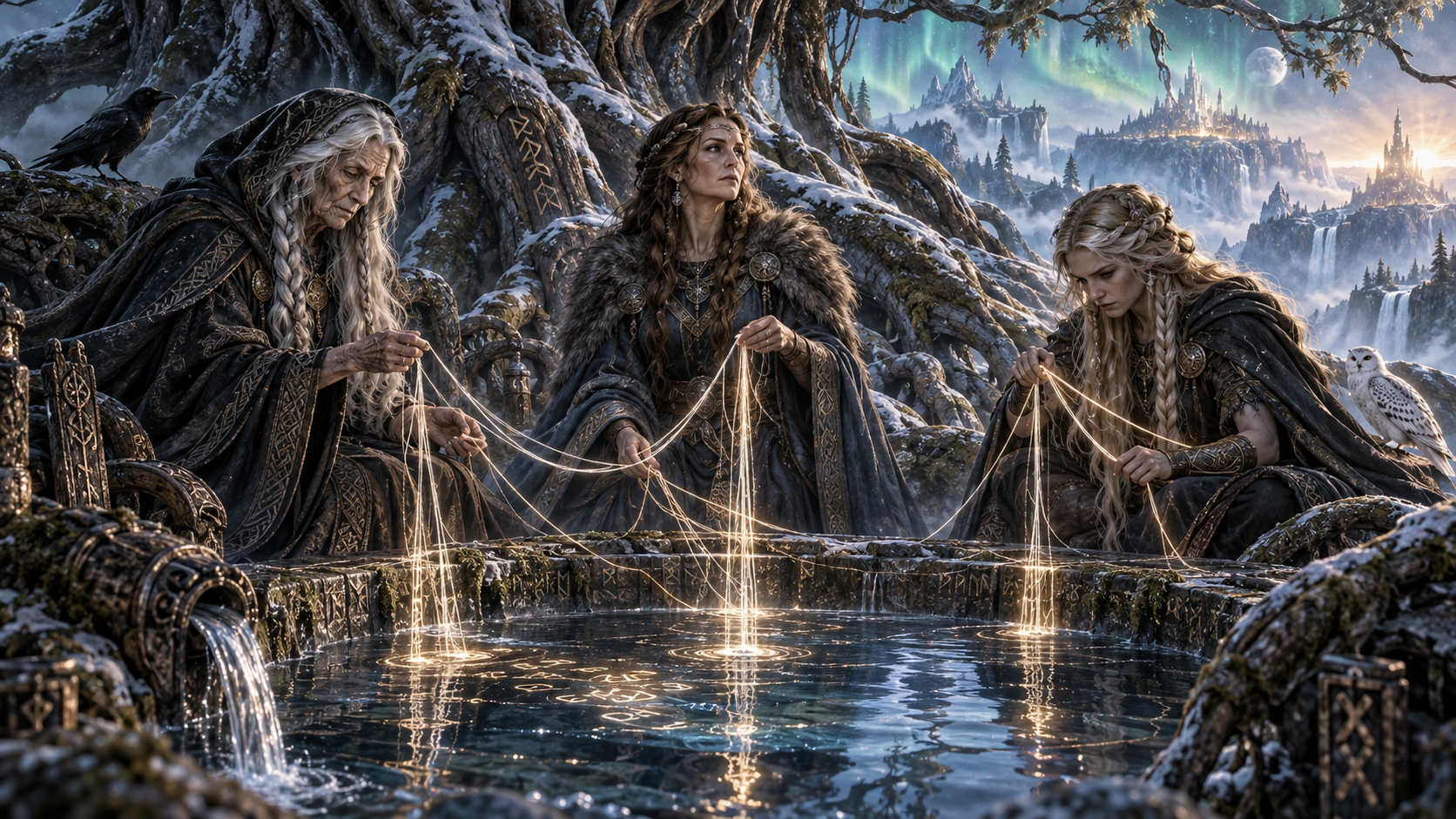
Urðr, Verðandi and Skuld are the three great Norns who dwell beside the Well of Urðr beneath Yggdrasill. They do not rule fate as distant accountants of a finished future. They preserve sequence, consequence, obligation and the terrible weight of what has already been set in motion.
At a Glance
- Pantheon: Asgardian Pantheon
- Nature: Unique fate-powers; the three greatest named Norns
- Names: Urðr, Verðandi, Skuld
- Home: The Well of Urðr beneath Yggdrasill
- Alignment: Neutral
- Concerns: Fate, consequence, birth, lifespan, obligation, prophecy, oaths, sequence
- Symbol: Three carved marks above a dark well-ring
- Sacred place: Wells, judgement places, ancient ash trees and oath-sites
- Worshippers: Seers, midwives, judges, genealogists, rulers facing succession, oath-keepers and travellers seeking lawful passage through Yggdrasill
The three are often simplified as Past, Present and Future. That is useful at a glance, but their names carry sharper meanings. Urðr is fate and what has become. Verðandi is becoming: the event in motion, the choice being made, the thing taking form. Skuld is debt, obligation and what must or should follow. Together they make fate less like a locked scroll and more like a chain of acts whose consequences cannot always be escaped.
What the Norns Do
The Norns shape lives, but they do not make mortal choice meaningless. A warrior can still choose whether to keep an oath. A king can still refuse a warning. A murderer can still repent, flee, confess or kill again. The Norns decide neither virtue nor courage. They reveal what those choices have made possible, what they have closed, and what is now owed.
At the Well of Urðr they also tend Yggdrasill itself. Water and pale clay from the well are carried to the World Tree so its living structure does not wither. This makes them more than prophets. They are custodians of the order through which worlds, lives, oaths and consequences remain connected.
Urðr — What Has Become
Urðr is the weight of the accomplished deed. She remembers the oath as spoken, the wound as given, the child as born, the kingdom as inherited and the betrayal as it actually happened rather than as later songs prefer to tell it.
Those who seek Urðr do not receive comfort merely because they regret the past. She can reveal hidden ancestry, the forgotten first cause of a feud, the true wording of an oath or the buried act that created a present curse. Her gift is accurate memory with consequence attached.
Verðandi — What Is Becoming
Verðandi is the living instant in which possibility becomes deed. Of the three, she is most concerned with action. She watches the promise before it is broken, the blade before it falls, the confession before it is spoken and the traveller before the road finally chooses a direction.
Her prophecies are rarely simple predictions. She shows pressure points: the person who can still be persuaded, the gate that can still be closed, the battle that can still be avoided, the sacrifice that can still be refused. Her knowledge makes choice sharper rather than easier.
Skuld — What Is Owed
Skuld is often called the future, but debt is closer to her nature. She is what follows because something has been done, promised, inherited or left unpaid. A blood-feud, a crown, a curse, a rescue, a child, a victory and a broken treaty can all create a Skuld.
She is not a goddess of punishment. A debt may be terrible, glorious, merciful or freely embraced. A hero who promises to return for the dead creates an obligation no less real than a tyrant who creates enemies through cruelty.
The Norns and Yggdrasill
The World Tree is a living transitive axis, and the Norns are among its greatest authorities. They do not own Yggdrasill. They tend one of its holiest wells and understand how route, ancestry, oath and consequence alter passage through the Tree.
A party seeking the Norns must therefore reach them properly. A stolen branch-token, false name or forced portal may carry travellers somewhere near the Well without granting them standing there. Those who lie beside the water may discover that the answer they receive is perfectly true and ruinous.
The Norns and the Gods
Odin seeks knowledge because knowledge can change how a being acts. The Norns remind him that knowledge does not erase cost. Their relationship is therefore neither simple obedience nor rivalry: Odin pursues ways through destiny, while the Norns preserve the truth of what each attempt creates.
Frigg also possesses deep foreknowledge. Her wisdom overlaps with the Norns without making her their servant. She understands the terrible difference between knowing an event and being able to speak, prevent or alter it without causing something worse.
The Norns Are Not the Moirai
The Norns and the Greek Moirai are separate powers. Similarities between northern and Hellenic fate traditions do not make them one divine group. They have different names, sources, cosmologies, relationships and sacred places.
The Norns belong beside Yggdrasill and the Well of Urðr. The Moirai belong within the Hellenic divine world. No internal link should merge them, redirect one into the other or use one page as a substitute for the other.
Worship, Offerings and Sacred Practice
The Norns do not maintain an ordinary temple hierarchy. Their worship is strongest at wells, old ash trees, birth-houses, judgement places and sites where difficult oaths are sworn.
- At births: clean water, woven wool and carved family names may be offered while asking for a life to be seen clearly rather than made easy.
- Before judgement: litigants may wash their hands before speaking, acknowledging that words create consequence.
- Before succession: rulers and heirs may name debts, promises and disputed claims before taking a crown.
- Before dangerous travel: pilgrims on Yggdrasill may offer water, ashwood tokens or a truthful confession before asking for the right road.
Signs of the Norns
- still water ripples after an oath is spoken;
- three marks appear in wet wood or clay;
- an old family name is heard where no speaker stands;
- a prophecy changes tense rather than changing meaning;
- a broken promise is repeated word for word by someone who could not have heard it;
- well-water turns briefly white around a guilty hand.
5.5e Divine Encounter
The Norns are a divine trio, not an ordinary monster encounter. Defeating them in combat can win an audience, break a local manifestation or force them to withdraw from a scene; it does not erase fate or permanently destroy the powers at the Well.
The Norns, Keepers of Urðr
Medium Celestials (unique trio), Neutral
Armor Class 24
Hit Points 630 (shared divine vitality)
Speed 30 ft.
STR 16 (+3) DEX 22 (+6) CON 24 (+7) INT 28 (+9) WIS 30 (+10) CHA 26 (+8)
Saving Throws Dex +16, Con +17, Int +19, Wis +20, Cha +18
Skills History +19, Insight +20, Perception +20, Religion +19
Damage Resistances cold, fire, lightning, radiant; bludgeoning, piercing and slashing from nonmagical attacks
Damage Immunities psychic
Condition Immunities charmed, frightened, paralyzed, stunned
Senses truesight 120 ft., passive Perception 30
Languages all, telepathy 120 ft.
Challenge 35 (divine encounter)
Triune Presence
The Norns occupy three spaces within 60 feet of one another but share one hit-point total, saving throw pool and concentration. They take three turns each round, one for Urðr, one for Verðandi and one for Skuld. If reduced below 420 hit points, one turn is lost; below 210 hit points, a second turn is lost. At 0 hit points the manifestation ends and the trio withdraws into the Well unless the encounter’s story establishes another result.
Immutable Record
A creature cannot alter the Norns’ memory of an event with illusion, enchantment or memory-changing magic. A creature can still lie to them; the lie simply becomes another event they remember.
Fate Does Not Remove Choice
Whenever a Norn reveals a probable outcome, that revelation never compels a creature to take the predicted action unless a separate game effect explicitly says so.
Actions
Fate’s Measure. Ranged Spell Attack: +20 to hit, range 120 ft., one target. Hit: 36 (8d8) force damage plus 22 (4d10) psychic damage. The target cannot benefit from advantage on its next d20 Test before the end of its next turn.
Urðr — Recall the Deed. One creature the Norns can see within 120 feet makes a DC 26 Wisdom saving throw. On a failure, one harmful act it committed since its last Long Rest becomes present again: it takes 45 (10d8) psychic damage and loses Reactions until the start of its next turn. On a success, it takes half damage.
Verðandi — The Becoming. The Norns choose one creature within 120 feet. Until the end of that creature’s next turn, the first attack roll, saving throw or ability check it makes is treated as though the d20 rolled a 10 before modifiers. The creature knows this before choosing the action.
Skuld — Debt Comes Due. One creature within 120 feet that has dealt damage, broken an oath, received magical healing or benefited from a spell since the end of the Norns’ last turn must make a DC 26 Charisma saving throw. On a failure, one of those benefits or consequences is called due: the creature takes 55 (10d10) force damage, or the Norns end one beneficial spell of 8th level or lower affecting it. On a success, it takes half damage and no spell ends.
Divine Reactions
Urðr — It Happened Thus. When a creature within 120 feet rerolls a d20, Urðr can force the creature to use the original roll.
Verðandi — Choose Now. When a creature delays, readies or attempts to avoid taking an available action, Verðandi can move it up to 20 feet without provoking opportunity attacks; the creature chooses the direction.
Skuld — The Price Remains. When a creature within 120 feet reduces damage to 0, Skuld can cause half the prevented damage to return as force damage.
Well of Urðr — Sacred Site Effects
- Divination cannot be made deliberately false within 300 feet of the Well.
- A creature that knowingly breaks a sworn oath at the Well becomes marked until it fulfils the oath, receives absolution from the wronged party or completes a greater compensating deed.
- A creature that steals well-water cannot willingly travel upward through Yggdrasill until the theft is repaid.
Pathfinder 1e Divine Encounter
The Norns CR 35; unique native outsiders; N; threefold divine encounter.
Init +14; Senses true seeing, Perception +50; Aura fate-pressure 60 ft.
AC 53, touch 29, flat-footed 43; hp 630 shared; Fort +31, Ref +34, Will +38; DR 20/epic; SR 46; immune mind-affecting effects, paralysis and temporal stasis.
Speed 30 ft.; Melee fate-touch +42 touch (8d8 force plus consequence); Ranged well-sign +44 touch (10d6 force).
Special Attacks recall the deed, becoming, debt comes due, threefold action.
Spell-Like Abilities constant—true seeing; at will—augury, discern lies, greater dispel magic, legend lore; 3/day—divination, geas/quest, greater scrying, moment of prescience; 1/day—foresight, miracle limited to fate, oath, passage or revelation effects.
Abilities Str 20, Dex 30, Con 28, Int 34, Wis 38, Cha 32.
Special Quality — Threefold Action: the Norns act on three initiative counts. At two-thirds shared hit points they lose one initiative count; at one-third they lose a second. At 0 hit points the manifestation ends rather than dying permanently.
3.5e Divine Encounter
The Norns CR 35; three unique outsiders acting as one divine power; Neutral.
AC 52; hp 600 shared; Fort +30, Ref +33, Will +37; DR 20/epic; SR 45.
Speed 30 ft.; Attack fate-touch +41 melee touch or well-sign +43 ranged touch.
Special Attacks remembered deed, becoming, debt of consequence, spell-like abilities.
Spell-Like Abilities at will—augury, discern lies, divination, greater dispel magic, legend lore; 3/day—geas/quest, greater scrying, moment of prescience; 1/day—foresight, miracle restricted to fate, oath, passage and revelation.
Special Qualities threefold action, true seeing, immunity to mind-affecting effects and temporal stasis, perfect memory of witnessed events.
Abilities Str 20, Dex 30, Con 28, Int 34, Wis 38, Cha 32.
Spells Favoured by the Norns
- augury
- bless
- divination
- legend lore
- geas
- greater restoration
- foresight
- word of recall
Magic granted through the Norns should reveal consequence, bind an oath, preserve memory, open a rightful path or expose what is owed. It should not remove player choice merely because the spell concerns fate.
Relic — Water of the Well
A sealed vial of water freely given from the Well of Urðr is a legendary divine relic. A creature that drinks it may ask one question about the consequence of a specific proposed act. The answer is truthful but describes consequence rather than giving instructions. Once used, the vial becomes ordinary clear water.
Water stolen from the Well carries no such blessing. Theft creates a debt before it creates a magic item.
Adventure Hooks
- The Unborn Heir: a lesser norn appears at a politically dangerous birth, and three factions interpret the omen differently.
- Stolen Water: someone has taken water from the Well and is using it to force prophecies. Every use closes another route through Yggdrasill.
- The Oath That Was Misremembered: a century-old feud rests on a famous quotation that Urðr says was never spoken.
- Skuld’s Claim: a kingdom survives a disaster because of an old bargain, and the unpaid obligation has finally matured.
- The Branch Still Open: Verðandi reveals that a foretold catastrophe is not fixed, but preventing it requires a choice no ruler wishes to make.
- The Wrong Fates: priests have accidentally merged the Norns with the Greek Moirai in a ritual text, creating a dangerous cross-pantheon contradiction that must be untangled at both sacred sites.
Sources and Mythological Context
The principal medieval source for the three named Norns at the Well of Urðr is the Prose Edda, especially Gylfaginning. That account names Urðr, Verðandi and Skuld, describes them as shaping human lives, states that other norns exist, and places the three beside the Well where they tend Yggdrasill.
Modern “Past, Present, Future” labels are retained only as a quick explanatory shorthand. The Old Norse names carry broader senses connected with fate, becoming and obligation.
Original game mechanics, encounters and campaign development on this page are original material. Historical source links are provided for the underlying mythology.
Continue Exploring
Return to the Asgardian Pantheon · Explore Yggdrasill · Enter Asgard