
Neptune — Roman God of Waters and the Sea
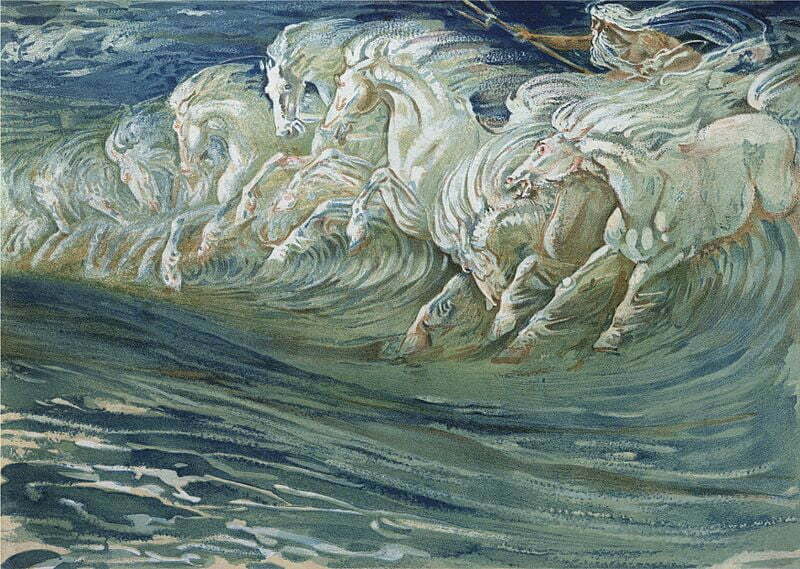
Neptune at a Glance
Tradition
Roman and Italic
Divine standing
Greater Deity
Campaign alignment
Chaotic Neutral
Portfolio
Waters, drought relief, flood, sea, storms, horses and dangerous natural force
Principal festival
Neptunalia, probably 23 July
Sacred places
Coasts, harbours, springs, river mouths, wells and places threatened by drought or flood
Emblems
Trident, horse, dolphin and wave
Favoured weapon
Trident
Hellenic relationship
Closely identified with Poseidon, while older Roman water identity and festival practice remain distinct.
Related Roman powers
Roman Pantheon · Waters · Drought · Flood · Sea · Horses
Neptune is the Roman god of waters whose later identification with Poseidon greatly expands his maritime identity. The Roman Neptune should not be reduced to “Poseidon with a Latin name”: the Neptunalia and older Roman water concerns remain important even after sea, horses and earthquake imagery become strongly associated with him.
Same Deity, Different Cultural Aspect
Neptune is the Roman aspect of Poseidon after ancient syncretism: one god whose Roman cult retains older concerns with water alongside the sea, horses and storm. The Poseidon page presents the Hellenic aspect. Both pages remain separate and self-canonical because they describe different cults and cultural presentations, not different cosmic beings.
Divine Mechanics
Campaign Divine Tier 38 describes Neptune’s setting-scale power and is not an SRD challenge rating. The rules-facing 5.5e block stays within SRD 5.2.1 CR 30 and ability-score-30 ceilings.
Neptune — 5.5e Rules-Facing Form
Medium Celestial (Deity), Chaotic Neutral
CR 40 (custom epic) · PB +11 · Campaign Divine Tier 38
AC 29 · HP 860 · Speed 40 ft., swim 120 ft.
| STR | DEX | CON | INT | WIS | CHA |
|---|---|---|---|---|---|
| 34 (+12) | 26 (+8) | 34 (+12) | 26 (+8) | 32 (+11) | 32 (+11) |
Saving Throws Str +23, Con +23, Wis +22, Cha +22
Skills Athletics +19, Nature +15, Perception +18, Religion +15, Survival +18
Damage Resistances cold, fire, lightning, thunder; bludgeoning, piercing and slashing from nonmagical attacks
Condition Immunities Charmed, Frightened, Poisoned
Senses Truesight 120 ft. · Languages all; telepathy 120 ft.
Traits
Legendary Resistance (6/Day). If Neptune fails a saving throw, he can choose to succeed instead.
Magic Resistance. Neptune has Advantage on saving throws against spells and other magical effects.
Lord of Waters. Neptune can breathe air and water, ignores the effects of water pressure and cold, and can move through water without provoking Opportunity Attacks.
Horse-Father. Beasts and magical creatures with an equine form will not willingly attack Neptune unless magically compelled or directly harmed by him.
Divine Spellcasting
Neptune has access to every spell granted by the deity’s portfolio domains in the edition being used: Water · Sea · Ocean · Protection. These domain spells are always prepared or available to the deity and do not replace the deity’s normal actions.
Actions
Multiattack. Neptune makes three Trident attacks.
Trident. Attack: +23 to hit, reach 15 ft. or range 120 ft. Hit: 32 (4d10 + 10) piercing plus 22 (4d10) cold damage.
Break the Shore (Recharge 5–6). A 120-foot-long, 30-foot-wide surge erupts from Neptune. Creatures make a DC 30 Strength save, taking 88 (16d10) bludgeoning damage, falling Prone and being pushed 60 feet on a failure, or half damage with no push on success.
Bonus Actions
Ride the Wave. Neptune moves up to 80 feet through or across water without provoking Opportunity Attacks.
Reactions
Drown the Flame. When fire damage is dealt within 60 feet, Neptune reduces that damage by 36 (8d8) and fills a 10-foot-radius area around the source with steam until the start of his next turn.
Legendary Actions
- Move. Move up to half Speed without provoking Opportunity Attacks.
- Divine Strike. Make one Trident attack.
- Earth-Shudder (Costs 2). Creatures on the ground within 30 feet make a DC 30 Dexterity save or take 22 (4d10) bludgeoning damage and fall Prone.
Neptune — Pathfinder 1e
Campaign epic extension; true deities are not normally given standard PF1e stat blocks.
CR benchmark 30 · hp about 760 · AC about 48 · Primary attack +41 · Primary DC 35 · Good saves +31 · Poor save +26.
Divine expression. Use swim mobility, battlefield-scale water control, flood, weather and trident effects while keeping the CR 30 numbers explicitly a campaign benchmark rather than an official true-deity statistic.
Spell-Like Abilities. At will—control water, freedom of movement, water breathing, true seeing; 3/day—earthquake, tsunami, control weather; 1/day—miracle. Use caster level 30 for the combat benchmark.
Statistics
CR 40 (custom epic) · AC 58 · hp 1060 · Fort +38 · Ref +32 · Will +37
Str 34 · Dex 26 · Con 34 · Int 26 · Wis 32 · Cha 32
Base Atk +40 · CMB +52 · CMD 102
Domain Access
Neptune has full access to the deity’s linked portfolio domains in their Pathfinder-facing versions or clearly marked campaign adaptations.
Neptune — D&D 3.5e
Greater Deity; Divine Rank 17; Chaotic Neutral Medium Outsider (Extraplanar)
Divine Rank 17 · DR 30/epic · SR 49 · Domain SLA caster level 27.
Divine rules. Divine rank adds to attacks, saves and checks; natural armour is rank + 13; divine AC bonus equals rank; deflection uses Charisma modifier.
Salient Divine Abilities. Alter Reality, Divine Storm, Power of Nature, Shapechange and rank-appropriate water or weather abilities.
Statistics
Challenge benchmark 46 · Ability scores use the deity’s epic 5.5e profile as the conversion baseline rather than a score-30 ceiling. Divine Rank remains the primary measure of cosmic authority.
Domain Access
Neptune can use every spell-like ability granted by the deity’s portfolio domains at the caster level determined by Divine Rank.
Neptune in Roman Religion
The Neptunalia was celebrated in the dry heat of July, probably on 23 July. Very little is securely known about the ceremonies beyond the use of temporary shelters made from branches and foliage. That scarcity of evidence matters: the page does not pretend to know a complete ancient rite where the sources do not preserve one.
Neptune’s later identification with Poseidon makes sea, trident, horses and earthquake imagery dominant in Roman art and literature. The older Roman concern with water more broadly remains useful, especially in a world where drought, wells, aqueducts and flood can decide whether a city survives.
What Is Neptune Doing Right Now?
Mediterranean shipping, piracy, naval rivalry and fortified harbours make Neptune a major strategic power. He does not need to sink fleets to change history: one failed spring, flooded quay or week of impossible weather can decide a campaign.
His cults overlap with Juturna at living water and with Mercury where shipping becomes trade. Neptune is more dangerous than either. He is the moment when useful water becomes a force no wall can negotiate with.
Worship in the Campaign Present
Mariners, harbour communities, horse breeders and settlements threatened by drought all invoke Neptune, but they do not necessarily imagine him in the same way. Coastal cults favour the later sea-god image; inland traditions may speak more about water supply, heat and relief from drought.
Neptunalia is still marked by temporary shade, communal drinking and petitions for water during the hottest part of the year. The exact ancient ritual is not reconstructed beyond the evidence that survives.
Domains, Spells and Divine Gifts
Neptune’s clergy favour Tempest, Nature, War and Travel themes. Suitable spells include Create or Destroy Water, Fog Cloud, Water Walk, Control Water, Freedom of Movement, Maelstrom, Control Weather and Tsunami.
Gift: Read the Water
The devotee can tell whether nearby water is fresh, salt, poisoned, magically altered or connected to a larger body.
Gift: Neptune’s Footing
Once per long rest, the devotee can move across water as solid ground for 10 minutes.
Relics
The Bridle of the First Horse
Any horse willingly bridled with it gains impossible endurance and can cross shallow water without slowing.
The Harbour Trident
Planted upright at a harbour mouth, it can calm one storm or unleash one controlled surge before becoming inert for a month.
Relationships
Juturna governs living springs and useful urban water where Neptune rules water on a much broader and more dangerous scale. Mercury depends on safe sea-lanes for trade; Jupiter competes with Neptune wherever storm and sky meet.
Use Neptune Tonight
The Sea Leaves the Harbour
At low tide the water retreats miles farther than it should, revealing a road of Roman stones.
The Horses Refuse the Bridge
Every horse stops before the same river crossing while Neptune’s priests insist the danger lies beneath the foundations.
The Dry Festival
During Neptunalia every well in a besieged city fills with seawater.
Divine Estate and Regional Effects
Where Neptune’s presence is strong, a major sanctuary can project the following effects across roughly six miles. A small shrine normally manifests only one effect within a much smaller area. Unless another divine power contests them, the effects fade over 1d10 days after the sanctuary is abandoned, desecrated or deliberately renounces the deity’s protection.
Water Finds Its Level
Wells, cisterns and canals within the region resist unnatural drying. Mundane blockages reveal themselves through ripples or damp stone.
Shoals Speak
Sailors and pilots receive unmistakable signs of reefs, submerged wreckage and sudden dangerous shallows before contact, granting Advantage on checks to avoid them.
Drought Has a Limit
Ordinary drought cannot reduce a protected settlement’s drinking water below survival needs while stores are shared rather than hoarded.
Deep Dive
Continue through the Roman Pantheon, Poseidon 2, Juturna, Jupiter, Mercury, Mars. Follow the cult into Rome and wider Italy, or use the Cleric and Cleric Domains pages for player-facing worship.
Historical Sources and Rules Compatibility
- Neptunalia — the July festival, games and temporary foliage shelters; the surviving description also stresses how little is known of the ceremonies.
Historical cult material is separated from campaign invention. The 5.5e block respects SRD 5.2.1 numeric ceilings; the higher Campaign Divine Tier is setting-only. Pathfinder 1e deity mechanics are explicitly a campaign epic extension. D&D 3.5e uses divine-rank structure.
Rules licensing. D&D 5.5e terminology derived from the System Reference Document 5.2.1 is used under CC BY 4.0 where applicable. Pathfinder 1e and D&D 3.5e deity statistics on this page are original campaign conversions rather than official published deity stat blocks.