
Light Wagon — Four-Wheeled Freight Transport
At a Glance
- Kind
- Four-wheeled road freight vehicle
- Purpose
- Merchant goods, farm supplies and caravan freight
- Propulsion
- Draft animals, commonly a large horse or team
- Working Route
- Roads, firm tracks, bridges and accessible market towns
- Advantages
- Stable load bed and more freight space than a small cart
- Limitations
- Road width, mud, hills, tolls and the cost of feeding the team
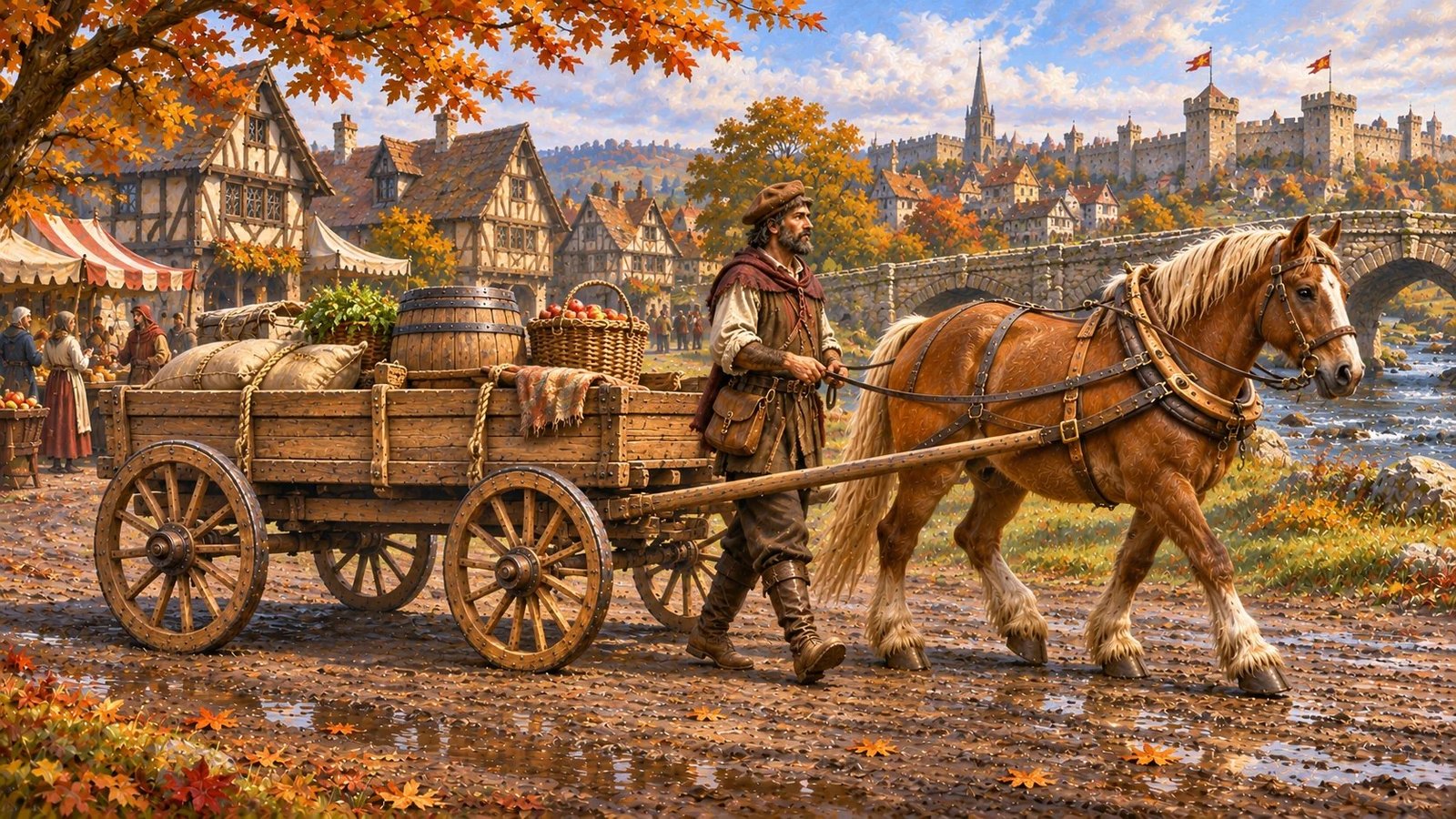
Before dawn a light waggon rattles through the market gate, carrying sacks of grain, barrels of oil and the tools needed to mend a village mill. A driver knows the road by its potholes and the watchmen by their demands. The load is valuable, but the journey may be lost to a broken spoke or a single washed-out bridge.
Across the trading roads of 1454, a four-wheeled freight waggon is a useful compromise between the smaller cart and the cumbersome heavy caravan vehicle. Its usefulness depends on good harness, sound wheels, an honest driver and ground that can bear the weight. It does not cross marshes or steep mountain tracks as easily as pack animals.
Construction, Freight and Maintenance
A wooden load bed rests on two axles and four wheels, with draft harness in front and ropes or a covering to restrain the cargo. Cargo should sit low and be distributed evenly: an overloaded rear axle may fail without warning, while shifting barrels make a sharp turn dangerous.
Drivers and escorts. A waggon needs a competent handler for its animals. Merchant caravans often employ scouts, guards and wheelwrights, especially where road patrols are unreliable. A guard riding with the load may spot danger, but too many passengers reduce cargo room.
Routine repairs. Spare pegs, ropes, grease and a jack can keep a minor mishap from ending the journey. Broken axles and wheels require skilled work. At a dangerous ford, unloading and ferrying cargo across separately can be safer than risking the whole waggon.
Routes, Tolls and Encounters
Merchants plan around legal crossings, reliable wells, safe inns and roads wide enough for turning. A waggon that reaches the wrong gate after dark might spend the night outside the walls, tempting thieves and attracting attention from patrols. Weather, supply and local authority are often as dangerous as monsters.
Adventure hook — The Buried Wheel. A merchant offers generous payment to rescue his waggon from a river ford. The front wheels are jammed beneath the water, yet the cargo has already been carried away in sealed wooden chests. Someone has made the route fail deliberately, and the supposed rescuer is not the only interested party.
Light Wagon — Vehicle Rules
Wagon — D&D 2024
Official drawn-vehicle equipment. The published wagon costs 35 GP, weighs 400 lb., and is propelled by a suitable draft team. These are equipment values, not a Pathfinder combat vehicle.
| Item | Wagon |
|---|---|
| Official price | 35 GP |
| Official weight | 400 lb. |
| Propulsion | Draft animal team |
Pulling capacity. Each animal can pull five times its carrying capacity, with the wagon’s own 400 lb. counted in the load. Add the pulling capacities of a team. Use the team’s movement and the travel rules, adjusted for hills, road surface, supplies and stops.
Manoeuvres. No check is required for routine driving. A hurried turn at a bridge, a panicked animal or a wheel striking a stone may call for an appropriate ability check using relevant proficiency. The DM determines the resulting delay, lost cargo or collision from the danger at hand.
Damage. No standard wagon AC, HP or ramming attack is printed in the basic equipment table. Resolve damage to wheels, bed and harness using object and hazard rules or an explicitly chosen encounter vehicle profile.
Rules reference: D&D 2024 Basic Rules — Equipment.
Wagon — D&D 2014
Official drawn-vehicle equipment. The published wagon costs 35 gp, weighs 400 lb., and is propelled by a suitable draft team. These are equipment values, not a Pathfinder combat vehicle.
| Item | Wagon |
|---|---|
| Official price | 35 gp |
| Official weight | 400 lb. |
| Propulsion | Draft animal team |
Hauling. A pulling creature can draw up to five times its carrying capacity, vehicle weight included. Team capacity, animal speed, travel pace and terrain determine overland travel; the wagon has no independent speed.
Hazards. The DM calls for ability checks when the vehicle must overcome a difficult ford, broken bridge or sharp turn under threat. Ordinary progress on a sound road needs no special roll. An overturned wagon may pin cargo and passengers and require unloading before it can be righted.
Damage. Apply object rules to axles, wheels and the load. Pathfinder’s CMB, CMD, hardness and ramming values do not transfer automatically to this edition.
Rules reference: D&D 2014 Basic Rules — Equipment.
Wagon, Light — Pathfinder 1e
Wagon, Light — Large land vehicle; Squares 4 (10 by 10 ft.; 5 ft. high); Cost 50 gp. These are the published Pathfinder Ultimate Combat vehicle statistics.
Defense
AC 9; Hardness 5; hp 60 (broken 29); Base Save +1.
Offense
Maximum Speed twice the pullers’ speed; Acceleration half the pullers’ speed; CMB +1; CMD 11; Ramming Damage 1d8.
Description
Propulsion muscle (pulled; four Medium or one Large creature); Driving Check Handle Animal or Profession (driver) with animal-intelligence creatures, Diplomacy or Intimidate with intelligent pullers; Forward Facing toward pullers; Driving Device reins; Driving Space two most forward squares; Deck 1; Capacity 1,000 lb. cargo; Weapons none listed.
Official source: Pathfinder Ultimate Combat — Land Vehicles.
Wagon — D&D 3.5e
Official standard Wagon equipment. The core SRD does not divide its wagon into distinct light and medium combat profiles.
| Cost | 35 gp |
|---|---|
| Weight | 400 lb. |
| Propulsion | Suitable draft team |
| Travel | Normally 2 miles per hour or 16 miles per day on usable routes |
| Cargo | Limited by the load the team can haul |
Movement. The 3.5e SRD’s cart-or-wagon travel category gives 2 miles per hour or 16 miles per day on usable routes, before terrain and load complications. The animals must have adequate hauling capacity, and the driver may need to choose a slower route on bad ground.
Handling and damage. The DM uses the applicable Handle Animal, skill and object rules when frightened animals, broken wheels or obstacles complicate movement. The equipment table does not assign this wagon Pathfinder vehicle combat statistics.
Rules references: D&D 3.5e SRD — Goods and Services and D&D 3.5e SRD — Travel.
Continue the Journey
Compare the two-wheeled cart, medium waggon and heavy waggon through the Vehicles catalogue. Routes and border crossings belong in the Geography atlas.
Sources and Licensing
Pathfinder 1e vehicle statistics refer to the light-wagon profile in Ultimate Combat. Other edition panels cite their transport and equipment rules directly.
Section 15: Copyright Notice — Pathfinder Roleplaying Game Ultimate Combat. Pathfinder Roleplaying Game Ultimate Combat © 2011, Paizo Publishing, LLC; authors Jason Bulmahn, Tim Hitchcock, Colin McComb, Rob McCreary, Jason Nelson, Stephen Radney-MacFarland, Sean K Reynolds, Owen K.C. Stephens, and Russ Taylor.
Keep this reference growing
If this page helped with your reading or game, you can support its upkeep or explore the curated books.
Explore the Bookshop — epics, classics and stories behind imagined worlds.