
Conjuration • Natural Allies • Creature Summoning
Summon Nature’s Ally IV
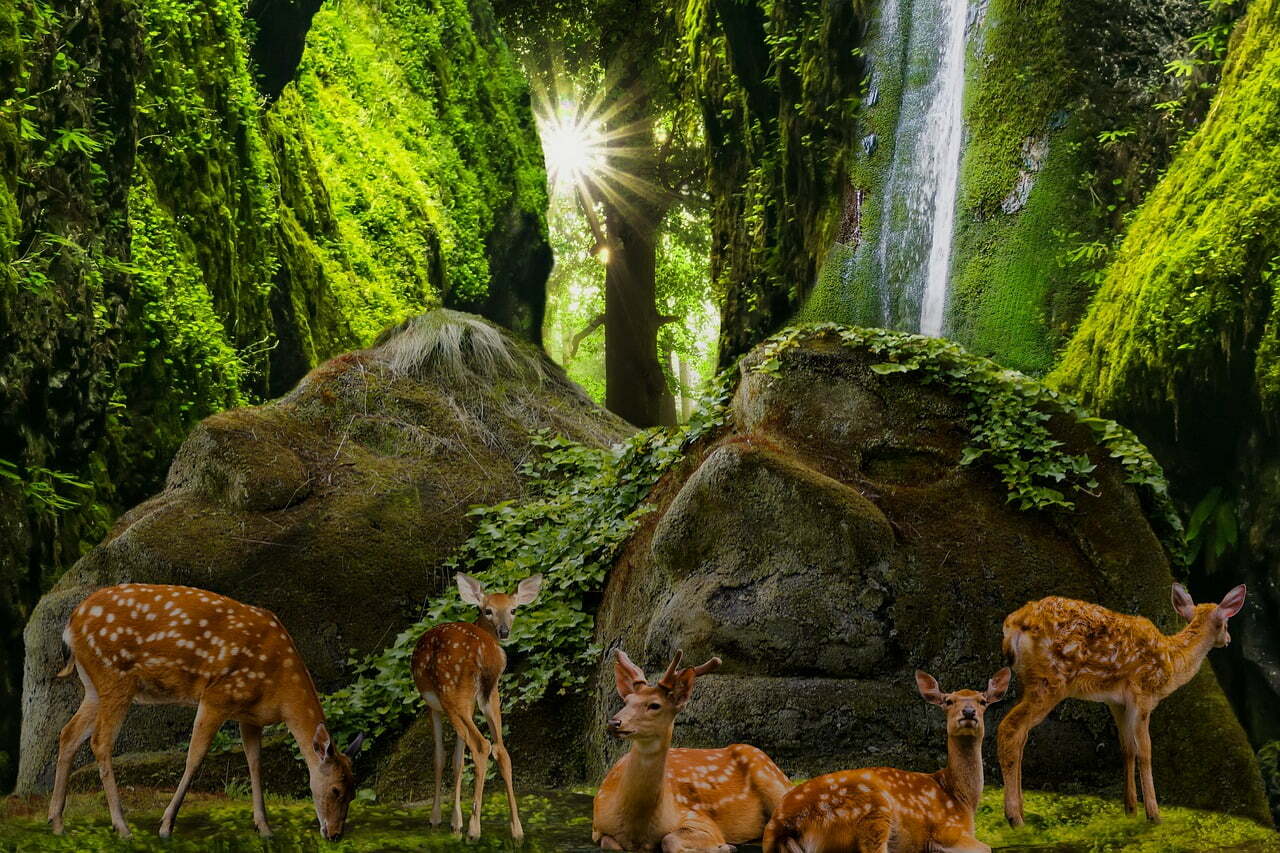
Summon Nature’s Ally IV calls powerful creatures from the wild to fight beside their summoner. Pathfinder 1e and D&D 3.5e use different published creature lists. For 2024 and 2014, the tabs explain the separate Conjure Animals spell cast using a fourth-level slot.
Summon Nature’s Ally IV at a Glance
| 5.5e / 2024 | Conjure Animals (4th-level slot): one spectral pack, 4d10 Slashing, up to 10 minutes. |
|---|---|
| 5e / 2014 | Conjure Animals (4th-level slot): 1–8 Fey spirits in beast form, up to 1 hour. |
| Pathfinder 1e | Druid 4 / Ranger 4: one strong ally or several weaker creatures. |
| D&D 3.5e | Animal domain 4 / Druid 4 / Ranger 4: its own creature list; legacy Witch 4 is third-party. |
Choose your edition below. The fourth-level summoning lists and the 2024/2014 spell mechanics are not interchangeable.
Spell Rules by Edition
Select your edition to see its casting rules, summoned creatures, duration and counterplay.
5.5e / 2024 — Conjure Animals at Fourth Level
Official equivalent, not a renamed official spell. The 2024 rules contain Conjure Animals as a 3rd-level Druid and Ranger spell. Casting it with a 4th-level spell slot increases its damage. It summons a Large pack of intangible nature spirits rather than independent beasts. 2024 rules reference.
| Rules status | Official 2024 Conjure Animals, cast using a 4th-level slot; not a published spell titled Summon Nature’s Ally IV |
|---|---|
| School and level | Level 3 Conjuration (Druid, Ranger); use a 4th-level slot |
| Casting Time | Action |
| Range | 60 feet |
| Components | V, S |
| Duration | Concentration, up to 10 minutes |
| Effect | One Large pack of spectral, intangible nature spirits |
| Damage at a 4th-level slot | 4d10 Slashing on failed Dexterity save |
| Movement | Move the pack up to 30 feet when you move on your turn |
| Saving Throw | Dexterity; once per turn per creature |
| Witch access | Only if an approved 2024 Witch spell list includes this spell |
Manifestation. Summon one Large pack of spectral animals—wolves, boars, birds or other natural forms—in an unoccupied space within 60 feet. Its appearance is cosmetic and does not give it creature attacks, a creature stat block, Hit Points, or separate Initiative. The pack is intangible and lasts while you Concentrate, up to 10 minutes.
Movement and protection. You have Advantage on Strength saving throws while within 5 feet of the pack. When you move on your turn, you can move the pack up to 30 feet to an unoccupied space you see. This does not require a Bonus Action.
Hazard and damage. Whenever the pack moves within 10 feet of a creature you can see, or a creature you can see enters or ends its turn within 10 feet of the pack, you may require a Dexterity saving throw. On a failure it takes 4d10 Slashing damage because a fourth-level spell slot adds 1d10 to the normal 3d10. On success it takes no damage. A creature makes this save only once per turn, regardless of the number of qualifying triggers.
Counterplay. Interrupt the caster’s Concentration, move beyond the spirits’ reach, break line of sight, use adequate protection against Slashing damage, or dispel the ongoing spell where permitted. These spectral animals cannot carry supplies, scout independently or flank an enemy as separate creatures.
5e / 2014 — Conjure Animals at Fourth Level
Official equivalent, not a renamed official spell. The 2014 Conjure Animals is 3rd-level Conjuration. A fourth-level slot is a legal casting but grants no extra creatures; the spell’s creature-number increases begin at a fifth-level slot. 2014 rules reference.
| Rules status | Official 2014 Conjure Animals, cast using a 4th-level slot; not a published spell titled Summon Nature’s Ally IV |
|---|---|
| School and level | 3rd-level conjuration (Druid, Ranger); use a 4th-level slot |
| Casting Time | 1 action |
| Range | 60 feet |
| Components | V, S |
| Duration | Concentration, up to 1 hour |
| Effect | One CR 2 or lower beast; two CR 1 or lower; four CR 1/2 or lower; or eight CR 1/4 or lower |
| Type | Summoned fey spirits in beast form; also count as Fey |
| Initiative | Summoned creatures roll initiative as a group |
| Commands | Obey verbal instructions without an action |
| Scaling | No additional creatures from a 4th-level slot; doubles at 5th |
| Witch access | Only by campaign Witch list or GM approval |
Choose a group. Select one of the four Challenge Rating and number options from the table. The Games Master determines exactly which eligible beasts appear; this is the published design intent explained in the Sage Advice Compendium. Do not treat the Pathfinder 1e or 3.5e monster lists as alternatives for this spell.
Appearing and acting. Fey spirits assume the forms of beasts in unoccupied spaces you can see. The summoned creatures are friendly to you and your companions, are also Fey, roll Initiative as a group, and obey verbal instructions without requiring the caster’s Action. If you do not direct them, they defend themselves but otherwise take no actions. They vanish when reduced to zero Hit Points or when the spell ends.
Counterplay. Concentration can be broken, individual creatures can be defeated, and a dispelling effect can end the ongoing spell. Use the exact 2014 beast stat blocks chosen by the GM, and respect the creature’s movement types and environment.
Pathfinder 1e — Summon Nature’s Ally IV
Official Pathfinder Core Rulebook spell. Druid 4 and Ranger 4 are the published class levels. Witch 4 is not a default Pathfinder spell-list entry; the site’s Witch 4 record belongs to its older d20 archive. Pathfinder Core Rulebook.
| School | Conjuration (Summoning) [see text] |
|---|---|
| Official Levels | Druid 4, Ranger 4 |
| Legacy Witch listing | Witch 4 appears only in the site’s older d20 Witch archive; not default Pathfinder class access |
| Casting Time | 1 round |
| Range | Close, 25 feet + 5 feet per 2 caster levels |
| Components | V, S, DF |
| Effect | One or more creatures, appearing no farther than 30 feet apart |
| Duration | 1 round per caster level (dismissible) |
| Saving Throw | None |
| Spell Resistance | No |
| Creature allocation | One from level 4; 1d3 of one kind from level 3; or 1d4+1 of one kind from level 2 or lower |
Choose the strength of the summoning. Call one creature from the Pathfinder 4th-level list; 1d3 creatures of the same kind from the Pathfinder 3rd-level list; or 1d4+1 creatures of the same kind from the Pathfinder 2nd-level list or lower. All appear within the spell’s permitted range, and the summoned creatures must begin no more than 30 feet apart.
Summoned actions. A creature appears and acts immediately on the caster’s turn, attacking opponents to the best of its ability. If it can understand the caster’s instructions, it may be commanded to guard, pursue or perform another suitable act. A summoning cannot itself summon additional creatures or use teleportation/planar travel; do not call creatures into a habitat that cannot sustain them.
Alignment and subtypes. Elemental or alignment subtypes can add corresponding descriptors to the summoning. Follow Pathfinder’s treatment of a summoned creature’s alignment, and the creature’s Pathfinder stat block. This is distinct from 3.5e descriptor and class-list handling.
D&D 3.5e — Summon Nature’s Ally IV
Official D&D 3.5e SRD spell. Published on the Animal domain 4, Druid 4 and Ranger 4 lists. The Witch 4 archive listing is a third-party class adaptation, not an official 3.5e Witch class level. D&D 3.5e SRD entry.
| School | Conjuration (Summoning) [see text] |
|---|---|
| Official Levels | Animal domain 4, Druid 4, Ranger 4 |
| Legacy Witch listing | Witch 4 is a separate third-party Witch archive addition, not official 3.5e SRD access |
| Casting Time | 1 round |
| Range | Close, 25 feet + 5 feet per 2 caster levels |
| Components | V, S, DF |
| Effect | One or more creatures, no two more than 30 feet apart |
| Duration | 1 round per caster level (dismissible) |
| Saving Throw | None |
| Spell Resistance | No |
| Creature allocation | One from level 4; 1d3 of one kind from level 3; or 1d4+1 of one kind from level 2 or lower |
Choose the level and number. Call one creature from the D&D 3.5e 4th-level list, 1d3 identical creatures from the 3rd-level list, or 1d4+1 identical creatures from a lower-level list. Multiple summoned creatures must start no farther than 30 feet from one another.
Actions and limits. They appear where you designate, immediately act on your turn, and ordinarily attack enemies. You can direct a creature that can understand you. The creatures cannot summon more monsters or use teleportation or planar travel. A shark or other water-dependent creature requires a suitable environment. Where summoning involves an alignment or elemental descriptor, the spell gains the relevant descriptor.
Do not substitute Pathfinder monsters. A 3.5e unicorn is on this level-4 list, but the Pathfinder list at level 4 instead includes an owlbear and griffon; the numerical spell level does not make the two tables interchangeable.
Fourth-Level Summoning Lists by Edition
Choose the matching edition, then open its creature list. The linked bestiary pages provide encounter context; use that edition’s stat blocks for play.
Pathfinder 1e — Show 19 level-4 creature choices
- Giant ant (drone)
- Bison
- Deinonychus
- Dire ape
- Dire boar
- Dire wolf
- Medium elemental (any)
- Giant scorpion
- Giant stag beetle
- Giant wasp
- Griffon
- Grizzly bear
- Lion
- Mephit (any)
- Owlbear
- Pteranodon
- Rhinoceros
- Satyr
- Tiger
Source: Pathfinder Core Rulebook, Table 10–2. Level-3 alternatives include ape, boar, crocodile, constrictor snake, cheetah and wolverine; the lower-level choices are found in the same table.
D&D 3.5e — Show 16 level-4 creature choices
- Juvenile arrowhawk
- Brown bear
- Giant crocodile
- Deinonychus
- Dire ape
- Dire boar
- Dire wolverine
- Medium elemental (any)
- Flamebrother salamander (NE)
- Sea cat (aquatic only)
- Huge shark (aquatic only)
- Huge viper
- Tiger
- Juvenile tojanida (aquatic only)
- Unicorn (CG)
- Minor xorn
Source: D&D 3.5e SRD spell list. Sea cat, Huge shark and juvenile tojanida require an aquatic or watery environment; summons with specified alignments may affect the spell descriptor.
What Changed Between Editions?
- 2024: Conjure Animals summons one intangible spectral pack. It is a 3rd-level spell; a 4th-level slot increases its Dexterity-save Slashing damage to 4d10, without independent creature turns.
- 2014: Conjure Animals brings actual beast-shaped Fey summons in one of four group sizes. A 4th-level slot does not increase the number; the first multiplier appears at 5th level.
- Pathfinder 1e: Uses its own 4th-, 3rd- and lower-level creature lists, one-round casting, Druid/Ranger 4 access, immediate actions and one-round-per-level duration.
- 3.5e: Also uses one-round casting and 1 round/level but its 4th-level roster is different and Animal domain 4 access appears alongside Druid/Ranger 4.
- Legacy Witch 4: The site’s historical Witch archive gives it at fourth level. That entry cannot grant the spell to a modern Witch automatically.
Worked Examples — The Forest Gate
An overgrown stone gateway is defended by raiders. A spellcaster must decide whether to hold the path, create a distraction or overwhelm a stronger opponent. The right spell effect depends on the campaign’s actual rules edition.
5.5e / 2024 — Spectral Wolves
A seventh-level Druid has a spell save DC of 15 and casts Conjure Animals using a 4th-level slot. The spirits form a Large pack of translucent wolves within 60 feet. When the Druid moves, the pack shifts up to 30 feet into sight of the raiders. An enemy within the pack’s 10-foot reach fails its Dexterity save and takes 4d10 Slashing damage. Even if two triggering movements occur on the same turn, that creature saves only once in that turn.
5e / 2014 — Two Guardians
A seventh-level Druid casts the official 2014 Conjure Animals with a fourth-level slot and chooses the option for two beasts of CR 1 or lower. The Games Master selects eligible creatures. The pair shares a group initiative and attacks when commanded; the Druid Concentrates for up to one hour. The fourth-level slot does not produce extra creatures. The spell remains distinct from 2024’s intangible pack.
Pathfinder 1e — A Dire Wolf at the Gate
An eighth-level Druid can summon a dire wolf from the Pathfinder 4th-level table, 1d3 of the same third-level species, or 1d4+1 of the same second-level or lower species. Close range is 45 feet (25 + 5 for every two of eight caster levels), and the summon lasts up to eight rounds. The creature acts immediately using its Pathfinder stat block.
D&D 3.5e — The Brown Bear
An eighth-level Druid calls one brown bear from the D&D 3.5e level-4 list. The range is 45 feet, the animal appears and acts on the caster’s turn, and the duration is eight rounds. The caster could instead summon multiple identical lower-tier allies after rolling 1d3 or 1d4+1. An aquatic summon is not available on this dry road.
Games Master’s Rulings and Counterplay
Visible clue. Roots, leaves or rain may swirl as an ally materialises in the older summoning systems. The 2024 pack has a visible spectral animal form but is intangible and has no separate creature statistics.
Casting interruption. In Pathfinder 1e and D&D 3.5e the spell takes a full round to finish; an enemy who disrupts that casting can prevent a creature appearing. Both modern Conjure Animals spells instead use an Action but require Concentration afterward.
Placement and habitat. Pathfinder and 3.5e summoners choose valid arrival points and keep multiple summoned creatures within 30 feet of each other on arrival. Creatures must be supportable by their surroundings: do not place a great shark onto dry cobblestones as a working combat summon.
Commands and consent. Older creatures act immediately and follow directions they can understand. 2014 summoned animals obey the verbal commands specified in their spell. The 2024 pack is controlled as part of the spell’s movement rule, not by giving individual wolves orders.
Dispelling. Dispel Magic may end the magical effect under the chosen edition. Damage or breaking Concentration affects the 2014/2024 versions according to their Concentration rules; killing a 2014 summoned creature removes that creature, not automatically all others.
Creature identity. Only the edition’s listed summons are eligible. Use the appropriate on-site bestiary entry and its correct stat panel; a modern monster with the same name need not have a compatible Pathfinder or 3.5e stat block.
Environment and movement. Flyers may scout where the game’s chosen spell and creature behaviour allow, but swimming creatures do not gain flight, and the 2024 spectral pack is never a scouting animal with independent senses.
Mythical Context
In Greek tradition, Artemis was the mistress and guardian of wild creatures. Archaic art shows the goddess holding deer, lions or birds as an image of mastery over untamed life. Such scenes offer a mythic model for a druid whose allies answer from forest and mountain, but they are not descriptions of a tabletop summoning spell.
Metropolitan Museum of Art — Artemis as mistress of animals · Metropolitan Museum of Art — Artemis and the wild fawn
Historical Context
Human commanders have long relied on trained creatures as more than pack animals. In ancient warfare, horses provided mobility and war elephants could disrupt close formations. Carthaginian armies used elephants in their campaigns against Rome, including the crossing of the Alps in 218 BCE. Unlike a summoned elemental or bear, these living animals had to be fed, transported, cared for and controlled, often with uncertain results.
Related Magic and Creatures
Summon Nature’s Ally I · Summon Nature’s Ally III · Summon Nature’s Ally V · Owlbear · Griffon · Witch Spell Lists
Rules Sources and Licensing
2024: D&D Basic Rules 2024, Conjure Animals; the 3rd-level spell has been explicitly evaluated at a 4th-level slot. It is not officially titled Summon Nature’s Ally IV. The corresponding SRD 5.2.1 content is available under Creative Commons Attribution 4.0.
2014: 2014 Conjure Animals and the Sage Advice Compendium for creature selection. The 2014 SRD 5.1 is available under CC BY 4.0.
Pathfinder 1e: Pathfinder Roleplaying Game Core Rulebook, Summon Nature’s Ally I–IX and Table 10–2.
D&D 3.5e: System Reference Document, Summon Nature’s Ally IV and Summon Nature’s Ally I.
Witch legacy context: The Witch 4 level on the site derives from its Liber Mysterium-era Witch archive and does not change the official class access of the other editions. The corresponding Pathfinder and 3.5e rules are Open Game Content under OGL 1.0a; the article’s original hero, commentary and original play examples are not automatically designated as copied third-party OGC.
Open Game License v1.0a — full licence and Section 15
OPEN GAME LICENSE Version 1.0a
The following text is the property of Wizards of the Coast, Inc. and is Copyright 2000 Wizards of the Coast, Inc (“Wizards”). All Rights Reserved.
1. Definitions: (a) “Contributors” means the copyright and/or trademark owners who have contributed Open Game Content; (b) “Derivative Material” means copyrighted material including derivative works and translations (including into other computer languages), potation, modification, correction, addition, extension, upgrade, improvement, compilation, abridgment or other form in which an existing work may be recast, transformed or adapted; (c) “Distribute” means to reproduce, license, rent, lease, sell, broadcast, publicly display, transmit or otherwise distribute; (d) “Open Game Content” means the game mechanic and includes the methods, procedures, processes and routines to the extent such content does not embody the Product Identity and is an enhancement over the prior art and any additional content clearly identified as Open Game Content by the Contributor, and means any work covered by this License, including translations and derivative works under copyright law, but specifically excludes Product Identity; (e) “Product Identity” means product and product line names, logos and identifying marks including trade dress; artifacts; creatures; characters; stories, storylines, plots, thematic elements, dialogue, incidents, language, artwork, symbols, designs, depictions, likenesses, formats, poses, concepts, themes and graphic, photographic and other visual or audio representations; names and descriptions of characters, spells, enchantments, personalities, teams, personas, likenesses and special abilities; places, locations, environments, creatures, equipment, magical or supernatural abilities or effects, logos, symbols, or graphic designs; and any other trademark or registered trademark clearly identified as Product Identity by the owner of the Product Identity, and which specifically excludes the Open Game Content; (f) “Trademark” means the logos, names, mark, sign, motto, designs that are used by a Contributor to identify itself or its products or the associated products contributed to the Open Game License; (g) “Use”, “Used” or “Using” means to use, Distribute, copy, edit, format, modify, translate and otherwise create Derivative Material of Open Game Content; (h) “You” or “Your” means the licensee in terms of this agreement.
2. The License: This License applies to any Open Game Content that contains a notice indicating that the Open Game Content may only be Used under and in terms of this License. You must affix such a notice to any Open Game Content that You Use. No terms may be added to or subtracted from this License except as described by the License itself. No other terms or conditions may be applied to any Open Game Content distributed using this License.
3. Offer and Acceptance: By Using the Open Game Content You indicate Your acceptance of the terms of this License.
4. Grant and Consideration: In consideration for agreeing to use this License, the Contributors grant You a perpetual, worldwide, royalty-free, non-exclusive license with the exact terms of this License to Use the Open Game Content.
5. Representation of Authority to Contribute: If You are contributing original material as Open Game Content, You represent that Your Contributions are Your original creation and/or You have sufficient rights to grant the rights conveyed by this License.
6. Notice of License Copyright: You must update the COPYRIGHT NOTICE portion of this License to include the exact text of the COPYRIGHT NOTICE of any Open Game Content You are copying, modifying or distributing, and You must add the title, the copyright date, and the copyright holder’s name to the COPYRIGHT NOTICE of any original Open Game Content You Distribute.
7. Use of Product Identity: You agree not to Use any Product Identity, including as an indication as to compatibility, except as expressly licensed in another, independent Agreement with the owner of each element of that Product Identity. You agree not to indicate compatibility or co-adaptability with any Trademark or Registered Trademark in conjunction with a work containing Open Game Content except as expressly licensed in another, independent Agreement with the owner of such Trademark or Registered Trademark. The use of any Product Identity in Open Game Content does not constitute a challenge to the ownership of that Product Identity. The owner of any Product Identity used in Open Game Content shall retain all rights, title and interest in and to that Product Identity.
8. Identification: If you distribute Open Game Content You must clearly indicate which portions of the work that you are distributing are Open Game Content.
9. Updating the License: Wizards or its designated Agents may publish updated versions of this License. You may use any authorized version of this License to copy, modify and distribute any Open Game Content originally distributed under any version of this License.
10. Copy of this License: You MUST include a copy of this License with every copy of the Open Game Content You Distribute.
11. Use of Contributor Credits: You may not market or advertise the Open Game Content using the name of any Contributor unless You have written permission from the Contributor to do so.
12. Inability to Comply: If it is impossible for You to comply with any of the terms of this License with respect to some or all of the Open Game Content due to statute, judicial order, or governmental regulation then You may not Use any Open Game Material so affected.
13. Termination: This License will terminate automatically if You fail to comply with all terms herein and fail to cure such breach within 30 days of becoming aware of the breach. All sublicenses shall survive the termination of this License.
14. Reformation: If any provision of this License is held to be unenforceable, such provision shall be reformed only to the extent necessary to make it enforceable.
15. COPYRIGHT NOTICE
Open Game License v 1.0a Copyright 2000, Wizards of the Coast, Inc.
System Reference Document Copyright 2003, Wizards of the Coast, Inc.; Authors Jonathan Tweet, Monte Cook, Skip Williams, Bruce R. Cordell, based on original material by E. Gary Gygax and Dave Arneson.
Pathfinder Roleplaying Game Core Rulebook. Copyright 2009, Paizo Publishing, LLC; Author: Jason Bulmahn, based on material by Jonathan Tweet, Monte Cook, and Skip Williams.
Liber Mysterium: The Netbook of Witches and Warlocks Copyright 2003, Timothy S. Brannan and the Netbook of Witches Team.
Keep this reference growing
If this page helped with your reading or game, you can support its upkeep or explore the curated books.
Explore the Bookshop — epics, classics and stories behind imagined worlds.