
Fly Spell — Wingstep
Fly Spell Guide: Rules, Best Uses, Tactics, and DM Advice
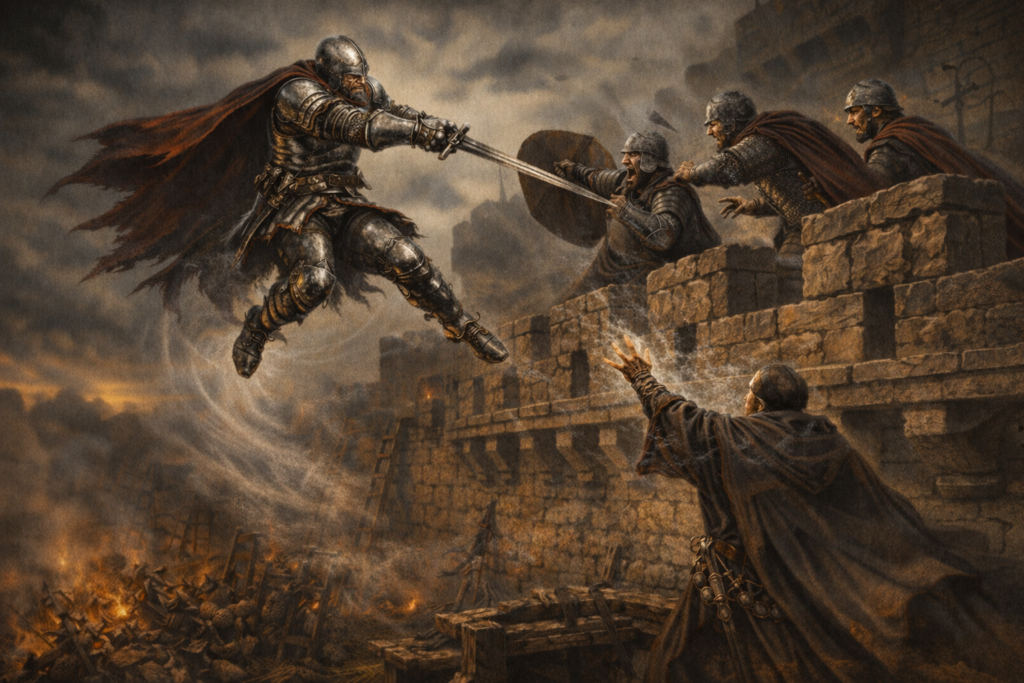
Some spells help a traveler overcome the world. Fly defies it. Walls lose authority. Ravines lose meaning. Height stops protecting the powerful. Towers, battlements, rooftops, cliffs, burning upper chambers, and broken bridges all become vulnerable the moment magic turns the sky into a road.
Seize the open air and turn height, distance, and impossible ground into advantages only spellcraft can command.
Rules
Fly by Edition
Fly — 5.5e / 2024

| Level | 3rd-level Transmutation |
|---|---|
| Classes | Sorcerer, Warlock, Wizard |
| Casting Time | 1 Action |
| Range | Touch |
| Components | V, S, M (a feather) |
| Duration | Concentration, up to 10 minutes |
| Target | One willing creature |
For the duration, the target gains a Fly Speed of 60 feet and can hover. When the spell ends, the target falls if it is still aloft unless it can stop the fall.
Using a Higher-Level Spell Slot: target one additional creature for each spell slot level above 3rd.
Fly — 5e / 2014
| Level | 3rd-level Transmutation |
|---|---|
| Classes | Sorcerer, Warlock, Wizard |
| Casting Time | 1 action |
| Range | Touch |
| Components | V, S, M (a wing feather from any bird) |
| Duration | Concentration, up to 10 minutes |
| Target | One willing creature |
The target gains a flying speed of 60 feet for the duration. When the spell ends, the target falls if it is still aloft unless it can stop the fall.
At Higher Levels: target one additional creature for each slot level above 3rd.
Edition note: the 2014 spell does not contain the 2024 sentence granting Hover.
Fly — Pathfinder 1e
| School | Transmutation |
|---|---|
| Level | Sorcerer/Wizard 3 |
| Casting Time | 1 standard action |
| Components | V, S, F (a wing feather) |
| Range | Touch |
| Target | Creature touched |
| Duration | 1 minute/level |
| Saving Throw | Will negates (harmless) |
| Spell Resistance | Yes (harmless) |
The subject flies at 60 feet, or 40 feet while wearing medium/heavy armour or carrying a medium/heavy load. It ascends at half speed, descends at double speed, and has good manoeuvrability.
The subject can attack and cast spells normally, can charge but not run, and cannot carry more than its maximum load plus worn armour. It gains a bonus on Fly skill checks equal to half your caster level.
When the spell ends: the subject descends 60 feet per round for 1d6 rounds. If it reaches the ground in time, it lands safely; otherwise it falls the remaining distance. Dispel Magic triggers this safe descent, while antimagic suppression does not.
Fly — D&D 3.5e
| School | Transmutation |
|---|---|
| Level | Sorcerer/Wizard 3, Travel 3 |
| Casting Time | 1 standard action |
| Components | V, S, F/DF |
| Range | Touch |
| Target | Creature touched |
| Duration | 1 minute/level |
| Saving Throw | Will negates (harmless) |
| Spell Resistance | Yes (harmless) |
The subject flies at 60 feet, or 40 feet in medium/heavy armour or with a medium/heavy load. It has good manoeuvrability, ascends at half speed and descends at double speed.
Flying requires no more concentration than walking. The subject can attack and cast normally, can charge but not run, and cannot carry more than its maximum load plus worn armour.
When the spell ends: the subject floats downward 60 feet per round for 1d6 rounds before falling normally if it has not reached the ground. A dispelled Fly receives that gradual descent; antimagic negation does not.
Arcane focus: a wing feather from any bird.
What Changed?
- 2024 adds Hover explicitly. The target can remain aloft without relying on ordinary flying-movement assumptions.
- 2024 simplifies the material component from a wing feather from any bird to simply a feather.
- 2014 otherwise keeps the modern 60-foot speed, Concentration and one-extra-target-per-higher-slot scaling.
- Pathfinder 1e and D&D 3.5e last 1 minute per caster level instead of requiring Concentration.
- Legacy flight is more simulation-heavy: armour/load can reduce speed, ascent/descent rates are explicit, and the spell includes a controlled descent when it expires or is dispelled.
- Pathfinder adds the Fly skill: the spell grants a Fly-check bonus equal to half caster level, a rule that does not exist in D&D 3.5e.
Overview
Fly is one of the great threshold spells of fantasy adventure. Before it, vertical space is a limit. Cliffs divide regions. Walls delay armies. Balconies protect archers. Towers separate rulers from danger. Ravines, rooftops, parapets, upper windows, and shattered stairways decide who can reach whom and how quickly.
After Fly, that logic changes. Open air becomes usable ground.
That is what makes the spell so important. It is not merely movement, but the magical abolition of ordinary access. A creature under Fly can bypass fortifications, pursue prey across broken terrain, descend on enemies from above, reach the stranded, escape a collapsing structure, or scout from angles no road could ever provide. Unlike Levitate, which suspends and repositions, Fly grants true freedom of direction. It does not merely lift. It releases.
For that reason, Fly is one of the defining utility spells in the game. It is also a battlefield spell, an infiltration spell, a rescue spell, and in the wrong hands, a spell of sudden panic. Its power lies not in direct destruction, but in changing what the world can no longer use to deny you.
Best Uses
Crossing What Should Stop You
This is the clearest use of Fly, and often the most dramatic. Chasms, cliffs, collapsed stairs, broken bridges, sinkholes, battlements, city walls, rooftops, and inaccessible ledges all lose much of their threat once one creature can simply move through the air.
Reaching the Untouchable
Watchmen on towers, spellcasters on balconies, archers on parapets, and monsters clinging to upper reaches often rely on height as protection. Fly denies them that assumption. It lets the party reach enemies who believed they had already controlled the field.
Turning Combat Vertical
In battle, Fly opens angles that ground-bound creatures cannot easily answer. A wizard can gain line of sight over cover. An archer can escape melee pressure. A warrior can pass over a defensive line and land where shock matters most. Even a small amount of controlled altitude can change a fight’s shape.
Rescue and Extraction
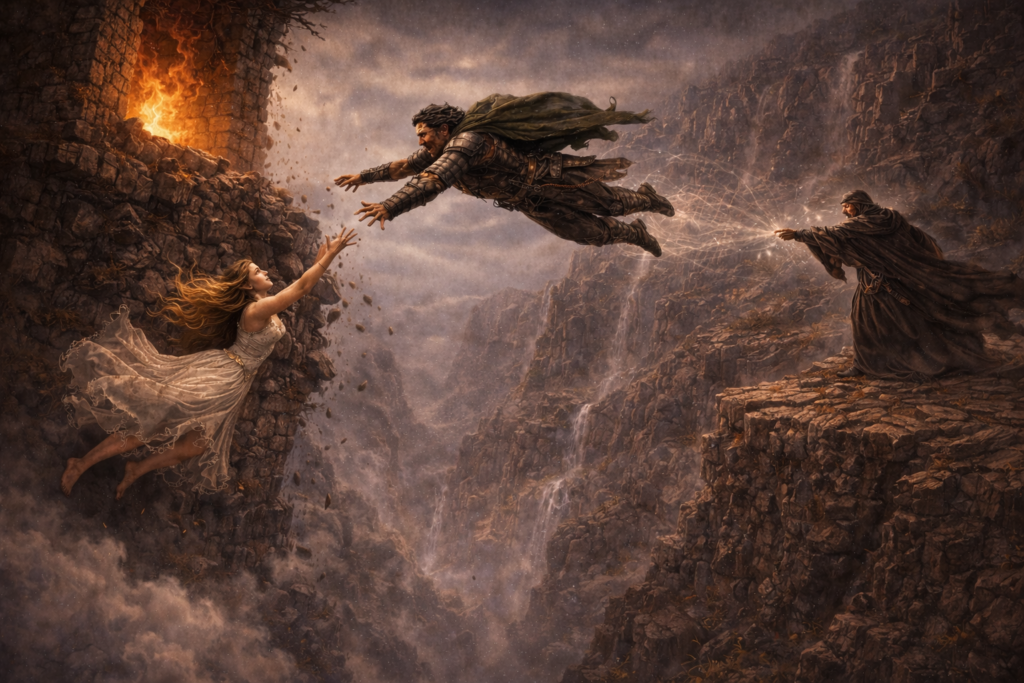
Many of the best uses of Fly are not aggressive at all. It can reach the stranded ally on a ledge, the prisoner in a high cell, the wounded figure trapped above a fire, or the scout cut off beyond a broken crossing. Spells that save lives often outlast spells that win battles.
Infiltration and Entry
Walls, courtyards, gates, and patrol roads matter less when the sky is an option. Fly can create access through a tower window, a rooftop hatch, a ruined upper arch, or a fortress face never meant to be approached from above.
Escape
When a position collapses or the fight turns bad, Fly can turn disaster into survival. It can remove a vital ally from encirclement, clear deadly terrain in seconds, and create vertical separation many enemies cannot immediately answer.
Good Combinations
Invisibility: A flying invisible infiltrator is dramatically harder to detect, especially when approaching from above rather than through the expected routes of gate, corridor, or road.
Levitate: These spells work well as a contrast in the same spell toolkit; Levitate controls elevation, but Fly conquers space.
Misty Step: A creature already in the air can use short-range repositioning to reach windows, ledges, parapets, and escape points with unnerving precision.
Fog Cloud: Conceals takeoff, landing, or aerial repositioning, forcing enemies to guess where the flying creature has gone.
Darkness: In the right hands, flight combined with magical darkness creates oppressive asymmetry, especially against enemies who cannot answer threats above them or within obscured space.
Pass without Trace: This supports stealthy approach before or after aerial repositioning, especially in wilderness routes, fortress edges, and broken terrain.
Dispel Magic: A flying spellcaster can reach elevated wards, magical emplacements, and defended effects that would otherwise remain inconveniently secure.
Tactics
Cast Fly before initiative if you already know vertical terrain, pursuit, escape, or difficult access will matter. Ten minutes is a generous duration, and the spell rewards foresight.
Do not cast it on yourself automatically. The best target is often the ally who gains the most from impossible access: the scout who must reach the tower, the ranged attacker who needs a clear angle, the rescuer who must reach the ledge, or the warrior who can break a defended line from above.
Use altitude with discipline. Height is power, but it is also exposure. A creature hanging in open air may be safer from blades, but often easier to see and shoot. The best aerial positioning is usually purposeful rather than theatrical.
Think in terms of new entry points. Once Fly is active, windows, tower mouths, hanging bridges, cliff shrines, ruined upper floors, tree platforms, and rooftop routes all become part of the map.
Respect concentration pressure. Archers, hostile spellcasters, bad weather, forced saving throws, and battlefield chaos can all turn a fine aerial position into a dangerous fall.
Never forget how the spell ends. The real cost of overconfidence is not being hit in the sky. It is what happens after.
DM Notes
Fly is one of the classic spells that reveals whether an adventure site has only been designed in two dimensions. If walls, towers, ravines, and cliffs exist merely as absolute barriers, Fly may seem to trivialize them. In truth, it rewards players for recognizing that vertical space is part of real adventure design.
The answer is not to punish the spell for functioning. Let it be excellent. Let it solve some problems cleanly. But make the sky matter. Give fortresses roof guards, signal horns, exposed approaches, arrow slits angled upward, warded windows, unstable ledges, smoke, weather, aerial predators, hanging obstacles, and too little room to land safely where comfort would be convenient.
This spell also has strong worldbuilding consequences. In a setting where Fly exists, rulers fear attack from above, prison design changes, fortifications gain upper defenses, messenger routes become stranger, and elite spellcasters can bypass prestige protections once thought secure simply because stone was high and the stair was narrow.
Why This Spell Is Dangerous in the World
Fly is dangerous because it breaks the old agreement between power and place.
A lord on a high balcony is no longer safely elevated above petitioners and assassins. A prison on a cliff is no longer secure because falling is no longer the final answer. A shrine atop a needle of rock is no longer protected by pilgrimage and exhaustion. A wall no longer means the same thing it once did. Rooftops stop being private. Height ceases to belong only to birds, towers, and those who control the stairs.
That does not make the world easier. It makes it more anxious.
Watchmen look upward. Architects reinforce roofs and upper windows. Temples ward their spires. Fortresses think in three dimensions. Smugglers, spies, raiders, and monster-hunters all gain new methods. The sky stops being empty background and becomes contested ground.
For common folk, that is frightening. For rulers, it is destabilizing. For adventurers, it is freedom sharpened into risk.