
Fog Cloud
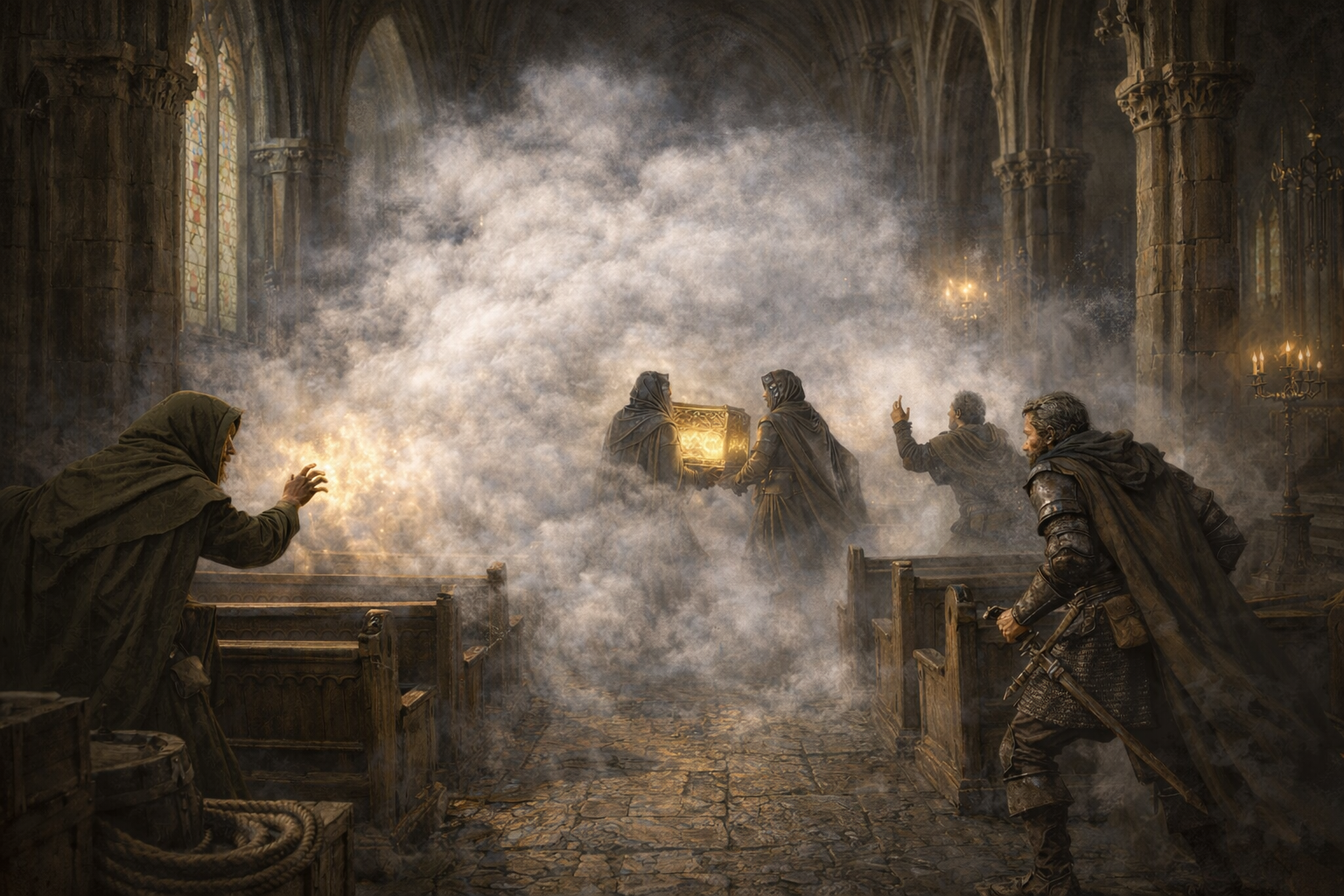
Fog Cloud fills an area with dense fog, hiding creatures and cutting off clear sightlines. A gateway disappears into white; the far end of a bridge becomes impossible to judge. The fog can cover a crossing, screen a rescue or conceal a withdrawal, but it hides allies and enemies alike.
It deals no damage and allows no saving throw. In D&D 2024 and 2014 it is a 1st-level spell requiring Concentration; in Pathfinder 1e and D&D 3.5e it is normally 2nd level and lasts without Concentration. Wind disperses it differently in each ruleset.
Fog Cloud at a Glance
- Main effect
- Obscures sight across a 20-foot-radius area. No damage or saving throw.
- D&D 2024 / 2014
- 1st-level Conjuration; Action; range 120 feet; V, S; Concentration, up to 1 hour.
- Pathfinder / 3.5e
- Usually 2nd level; standard action; medium range; V, S; 10 minutes per caster level. Uses concealment and miss chances.
- Key limitation
- Fog blocks sight, not movement or sound. It provides no physical cover and does not automatically hide a creature’s location.
Spell Rules by Edition
Fog Cloud — D&D 2024
Level and school: 1st-level Conjuration
Spell lists: Druid, Ranger, Sorcerer, Wizard
Casting time: 1 Action
Range: 120 feet
Components: V, S
Duration: Concentration, up to 1 hour
Area: 20-foot-radius Sphere
Attack / save: None
Create a Sphere of fog around a point within range. Its area is Heavily Obscured. The cloud persists for the duration unless a strong wind, including one produced by Gust of Wind, disperses it.
Higher-level slots: Add 20 feet to the radius for every slot level above 1st; a 2nd-level slot produces a 40-foot radius.
D&D 2024 spell reference. Additional class access depends on the character’s features.
Fog Cloud — D&D 2014
Level and school: 1st-level Conjuration
Spell lists: Druid, Ranger, Sorcerer, Wizard
Casting time: 1 Action
Range: 120 feet
Components: V, S
Duration: Concentration, up to 1 hour
Area: 20-foot-radius sphere
Attack / save: None
Create fog around a point within range. It spreads around corners and makes its area heavily obscured. It remains for the duration unless wind of at least 10 mph disperses it: moderate wind is sufficient in this edition.
Higher-level slots: Each slot level above 1st adds 20 feet to the fog’s radius.
D&D 2014 spell reference. Subclass features can grant additional access.
Fog Cloud — Pathfinder 1e
School: Conjuration (creation)
Level: Arcanist 2, Druid 2, Hunter 2, Magus 2, Shaman 2, Sorcerer 2, Summoner (unchained) 2, Witch 2, Wizard 2
Casting time: 1 standard action
Components: V, S
Range: Medium (100 feet + 10 feet per caster level)
Effect: Fog spreads in a 20-foot radius
Duration: 10 minutes per caster level
Saving throw: None
Spell resistance: No
Fog blocks sight, including darkvision, beyond 5 feet. Targets within 5 feet have concealment (20% miss chance). More distant targets have total concealment (50% miss chance); sight alone cannot establish their location.
Wind: Moderate wind (11 mph or faster) clears the fog in 4 rounds; strong wind (21 mph or faster) clears it in 1 round. The spell does not function underwater. Maintaining Concentration is not required, and it has no spell-slot upcasting rule.
Pathfinder rules and class access; Core Rulebook reference. Open Game Content under the Open Game License v1.0a.
Fog Cloud — D&D 3.5e
School: Conjuration (Creation)
Level: Druid 2, Sorcerer/Wizard 2, Water domain 2
Components: V, S
Casting time: 1 standard action
Range: Medium (100 feet + 10 feet per caster level)
Effect: Fog spreads in a 20-foot radius, 20 feet high
Duration: 10 minutes per caster level
Saving throw: None
Spell resistance: No
A bank of fog billows out from the point you designate. The fog obscures all sight, including darkvision, beyond 5 feet. A creature within 5 feet has concealment (attacks have a 20% miss chance). Creatures farther away have total concealment (50% miss chance, and the attacker can’t use sight to locate the target).
A moderate wind (11+ mph) disperses the fog in 4 rounds; a strong wind (21+ mph) disperses the fog in 1 round. The spell does not function underwater.
Revised 3.5 SRD. This material is Open Game Content, licensed for public use under the Open Game License v1.0a. The spell requires no ongoing Concentration and has no spell-slot upcasting rule.
What Changed Between Editions?
- 2024 versus 2014: Both use Heavily Obscured, Concentration and the same slot scaling. The 2024 spell specifies strong wind; 2014 explicitly allows moderate wind at 10 mph. The 2014 text also expressly says the fog spreads around corners.
- Pathfinder and 3.5e: The basic spell is 2nd level, its range increases with caster level, and its duration is 10 minutes per level without ongoing Concentration. Concealment uses 20% or 50% miss chances. Moderate and strong wind clear it over 4 rounds or 1 round respectively.
- Geometry: The fifth-edition cloud is a sphere. The 3.5e effect explicitly includes a 20-foot height; Pathfinder’s standard effect line gives a 20-foot radius without that height.
Using Fog Cloud
Cross exposed ground
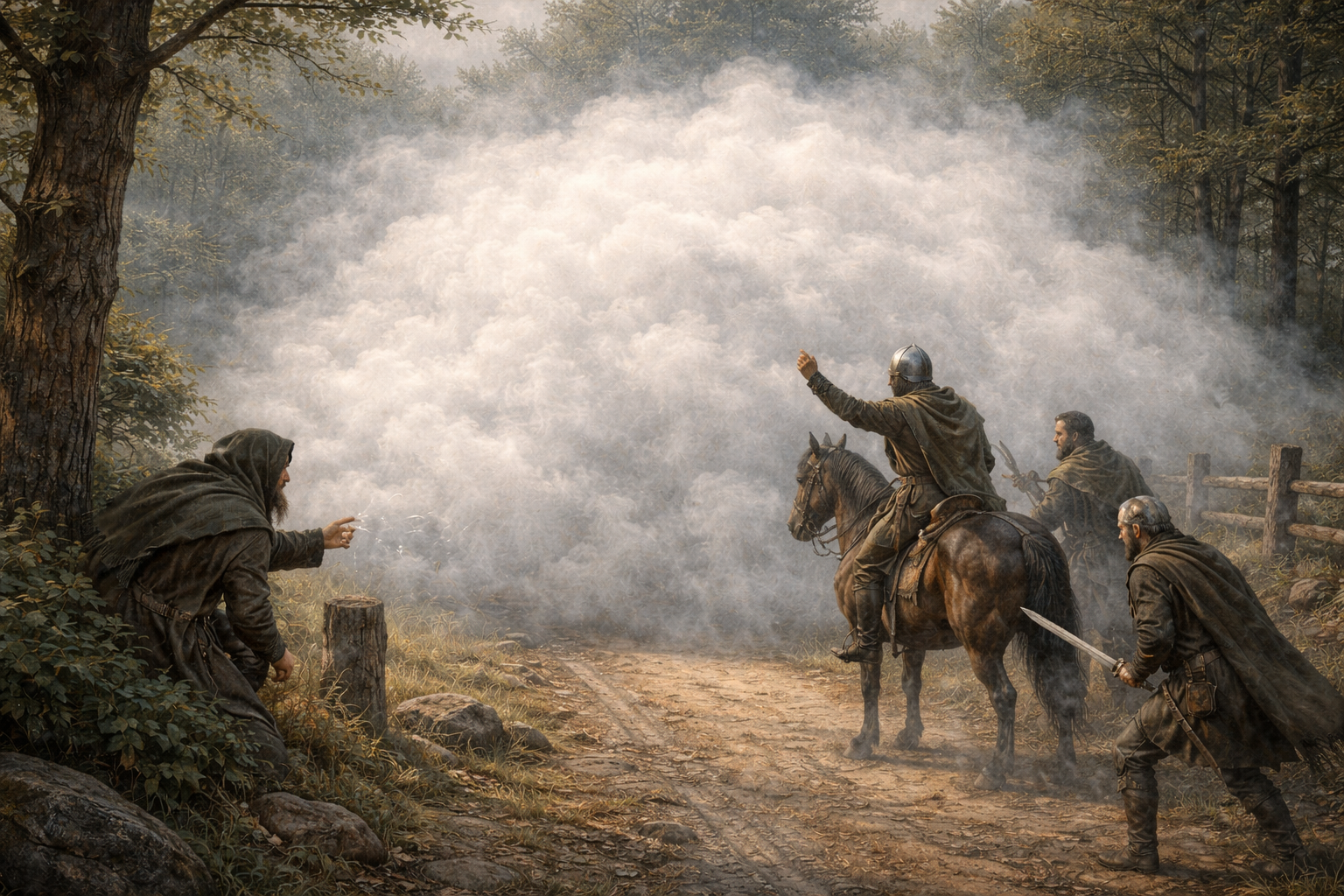
Place the cloud between an archer’s position and the crossing, or over the ground the party must traverse. Agree where everyone is going before visibility disappears. Fog conceals the route but does not stop arrows, close a gate or make a hidden stair safe.
Cover a withdrawal or rescue
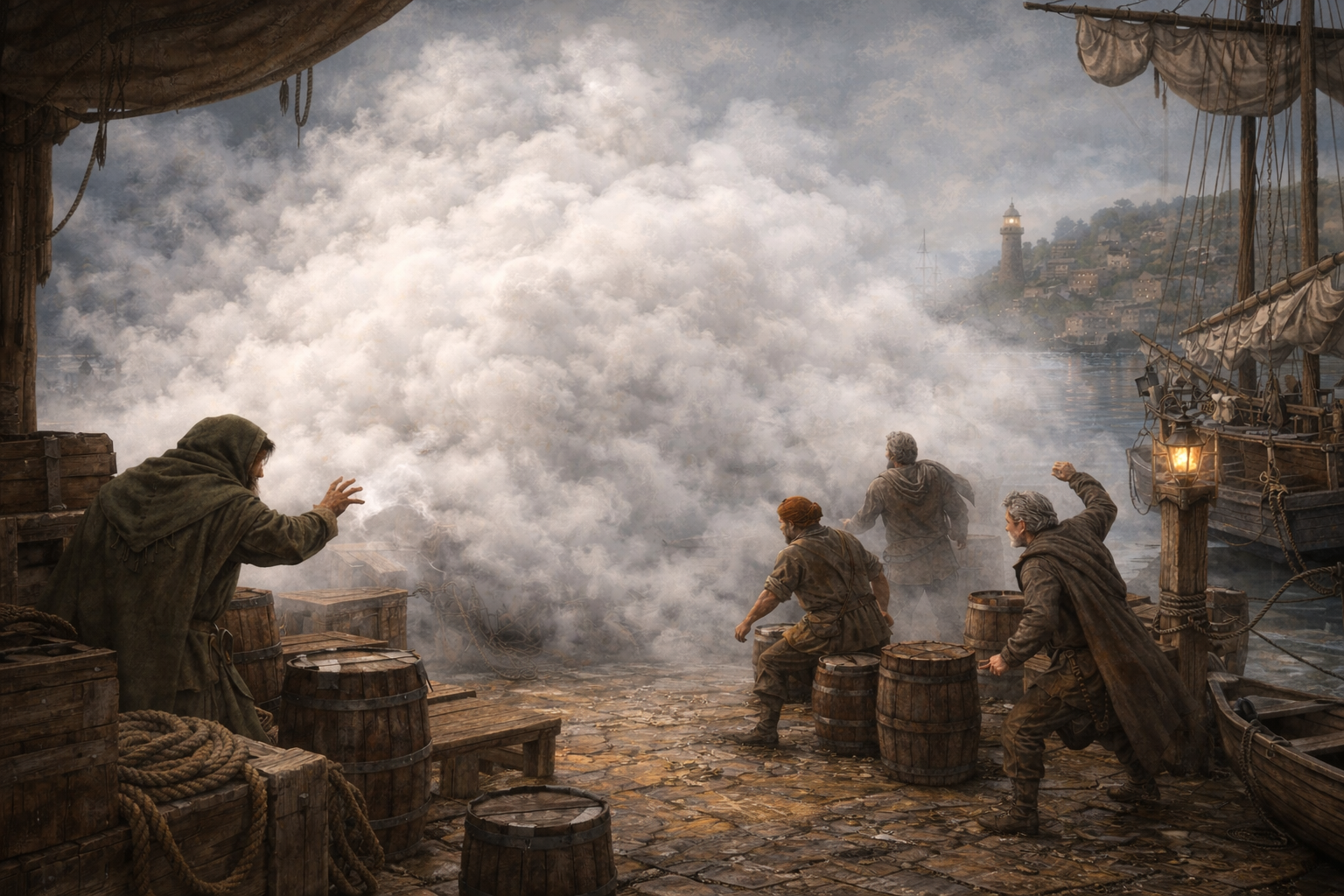
A cloud across a bridge approach, narrow street or dock can break visual contact while companions move wounded allies. Enemies may still follow voices and footsteps, attack a suspected position or move straight through. The spell imposes no movement penalty by itself.
Deny a clear target
Fog is particularly useful against an ability that requires a target the user can see. It also affects friendly spellcasters: put the screen where it helps the party’s next action. Area effects and attacks that do not require sight can still threaten creatures inside.
Watch your footing near hazards
A ravine edge, a quay or a winding stair remains hazardous when hidden. Describe the last visible landmark and let creatures choose how to proceed. Fog itself does not force hesitation, scatter a formation or automatically make anyone fall.
Rules That Matter at the Table
- Hidden is a separate question. A creature disappearing into fog may still be heard or tracked. Use the edition’s hiding, perception and unseen-target rules; Fog Cloud does not grant automatic stealth success.
- Obscurity is not cover. The cloud supplies no armour bonus or physical barrier. Walls and other solid obstacles still determine cover.
- Both sides lose sight. In fifth edition, an attacker unable to see its target usually has disadvantage, while an unseen attacker usually gains advantage. If both apply, they cancel; fog does not guarantee disadvantage on every incoming attack. A wrong guess about the target’s location still misses.
- Darkvision does not clear fog. Seeing in darkness is different from seeing through opaque mist. Apply any special sense according to its own range and rules.
- Wind is a practical answer. Check the threshold and dispersal time in the selected edition. Gust of Wind is a useful countermeasure.
- No added poison or suffocation. This spell obscures sight; it does not create toxic smoke, deal damage or prevent breathing.
Useful Combinations
Concentration matters in D&D 2024 and 2014: a single caster cannot maintain Fog Cloud alongside another Concentration spell. The combinations below may need a second caster; check the selected edition’s spell requirements.
- Silence: Hides sounds within its area as fog hides sight. Coordinate beforehand: Silence also prevents verbal spell components within its area.
- Invisibility: Can conceal a companion before they enter the fog or after they emerge. It adds little to ordinary sight concealment while they are already obscured, and does not erase noise or tracks.
- Pass without Trace: Supports a stealthy withdrawal; fog supplies visual concealment, while the other spell helps with stealth according to its edition. Neither makes every escape automatic. Read the D&D 3.5e version.
- Illusions: A false sound can draw attention away from an exit. Visual effects from Minor Illusion, Silent Image or Major Image must be somewhere the observer can actually see them; an image buried in opaque fog cannot mislead by sight.
- Spike Growth: Can punish pursuers entering dangerous ground concealed by fog. Resolve detection and damage using that spell’s own rules, and keep allies clear of the affected area.
Fog Cloud in the World
A smuggler may shroud a dockside exchange; a scout may screen a wagon crossing; a ship’s mage may hide the moment a boarding party leaves the rail. These uses make the spell valuable wherever a short break in observation matters. They also give defenders concrete responses: bells, shouted positions, a cleared route and access to wind magic.
Related cleric domains: Air · Weather. Spell access follows the domain and edition concerned.
Sources and Licensing
- D&D 2024: Fog Cloud; System Reference Document 5.2.1, Wizards of the Coast LLC.
- D&D 2014: Fog Cloud; System Reference Document 5.1, Wizards of the Coast LLC.
- Pathfinder 1e: Pathfinder RPG Core Rulebook, Fog Cloud; Archives of Nethys class list.
- D&D 3.5e: Revised 3.5 SRD, Fog Cloud.
The fifth-edition rules summaries include material from the System Reference Documents 5.2.1 and 5.1 by Wizards of the Coast LLC, available from the official SRD resource, licensed under Creative Commons Attribution 4.0 International. The summaries are reformatted and paraphrased. Pathfinder and 3.5e spell mechanics are Open Game Content under the Open Game License v1.0a. Artwork and original setting prose are not designated Open Game Content.
Open Game License v1.0a and copyright notices
OPEN GAME LICENSE Version 1.0a
The following text is the property of Wizards of the Coast, Inc. and is Copyright 2000 Wizards of the Coast, Inc (“Wizards”). All Rights Reserved.
1. Definitions: (a) “Contributors” means the copyright and/or trademark owners who have contributed Open Game Content; (b) “Derivative Material” means copyrighted material including derivative works and translations (including into other computer languages), potation, modification, correction, addition, extension, upgrade, improvement, compilation, abridgment or other form in which an existing work may be recast, transformed or adapted; (c) “Distribute” means to reproduce, license, rent, lease, sell, broadcast, publicly display, transmit or otherwise distribute; (d) “Open Game Content” means the game mechanic and includes the methods, procedures, processes and routines to the extent such content does not embody the Product Identity and is an enhancement over the prior art and any additional content clearly identified as Open Game Content by the Contributor, and means any work covered by this License, including translations and derivative works under copyright law, but specifically excludes Product Identity. (e) “Product Identity” means product and product line names, logos and identifying marks including trade dress; artifacts; creatures characters; stories, storylines, plots, thematic elements, dialogue, incidents, language, artwork, symbols, designs, depictions, likenesses, formats, poses, concepts, themes and graphic, photographic and other visual or audio representations; names and descriptions of characters, spells, enchantments, personalities, teams, personas, likenesses and special abilities; places, locations, environments, creatures, equipment, magical or supernatural abilities or effects, logos, symbols, or graphic designs; and any other trademark or registered trademark clearly identified as Product identity by the owner of the Product Identity, and which specifically excludes the Open Game Content; (f) “Trademark” means the logos, names, mark, sign, motto, designs that are used by a Contributor to identify itself or its products or the associated products contributed to the Open Game License by the Contributor (g) “Use”, “Used” or “Using” means to use, Distribute, copy, edit, format, modify, translate and otherwise create Derivative Material of Open Game Content. (h) “You” or “Your” means the licensee in terms of this agreement.
2. The License: This License applies to any Open Game Content that contains a notice indicating that the Open Game Content may only be Used under and in terms of this License. You must affix such a notice to any Open Game Content that you Use. No terms may be added to or subtracted from this License except as described by the License itself. No other terms or conditions may be applied to any Open Game Content distributed using this License.
3. Offer and Acceptance: By Using the Open Game Content You indicate Your acceptance of the terms of this License.
4. Grant and Consideration: In consideration for agreeing to use this License, the Contributors grant You a perpetual, worldwide, royalty-free, non-exclusive license with the exact terms of this License to Use, the Open Game Content.
5. Representation of Authority to Contribute: If You are contributing original material as Open Game Content, You represent that Your Contributions are Your original creation and/or You have sufficient rights to grant the rights conveyed by this License.
6. Notice of License Copyright: You must update the COPYRIGHT NOTICE portion of this License to include the exact text of the COPYRIGHT NOTICE of any Open Game Content You are copying, modifying or distributing, and You must add the title, the copyright date, and the copyright holder’s name to the COPYRIGHT NOTICE of any original Open Game Content you Distribute.
7. Use of Product Identity: You agree not to Use any Product Identity, including as an indication as to compatibility, except as expressly licensed in another, independent Agreement with the owner of each element of that Product Identity. You agree not to indicate compatibility or co-adaptability with any Trademark or Registered Trademark in conjunction with a work containing Open Game Content except as expressly licensed in another, independent Agreement with the owner of such Trademark or Registered Trademark. The use of any Product Identity in Open Game Content does not constitute a challenge to the ownership of that Product Identity. The owner of any Product Identity used in Open Game Content shall retain all rights, title and interest in and to that Product Identity.
8. Identification: If you distribute Open Game Content You must clearly indicate which portions of the work that you are distributing are Open Game Content.
9. Updating the License: Wizards or its designated Agents may publish updated versions of this License. You may use any authorized version of this License to copy, modify and distribute any Open Game Content originally distributed under any version of this License.
10. Copy of this License: You MUST include a copy of this License with every copy of the Open Game Content You Distribute.
11. Use of Contributor Credits: You may not market or advertise the Open Game Content using the name of any Contributor unless You have written permission from the Contributor to do so.
12. Inability to Comply: If it is impossible for You to comply with some or all of the terms of this License with respect to some or all of the Open Game Content due to statute, judicial order, or governmental regulation then You may not Use any Open Game Material so affected.
13. Termination: This License will terminate automatically if You fail to comply with all terms herein and fail to cure such breach within 30 days of becoming aware of the breach. All sublicenses shall survive the termination of this License.
14. Reformation: If any provision of this License is held to be unenforceable, such provision shall be reformed only to the extent necessary to make it enforceable.
15. COPYRIGHT NOTICE
Open Game License v 1.0a Copyright 2000, Wizards of the Coast, Inc.
System Reference Document Copyright 2000-2003, Wizards of the Coast, Inc.; Authors Jonathan Tweet, Monte Cook, Skip Williams, Rich Baker, Andy Collins, David Noonan, Rich Redman, Bruce R. Cordell, John D. Rateliff, Thomas Reid, James Wyatt, based on original material by E. Gary Gygax and Dave Arneson.
Pathfinder Roleplaying Game Core Rulebook. Copyright 2009, Paizo Publishing, LLC; Author: Jason Bulmahn, based on material by Jonathan Tweet, Monte Cook, and Skip Williams.
The Hypertext d20 SRD Copyright 2004, Jans W Carton; transferred to BoLS Interactive, 2016.
Keep this reference growing
If this page helped with your reading or game, you can support its upkeep or explore the curated books.
Explore the Bookshop — epics, classics and stories behind imagined worlds.