
Sir Hector de Maris — Lancelot’s Half-Brother
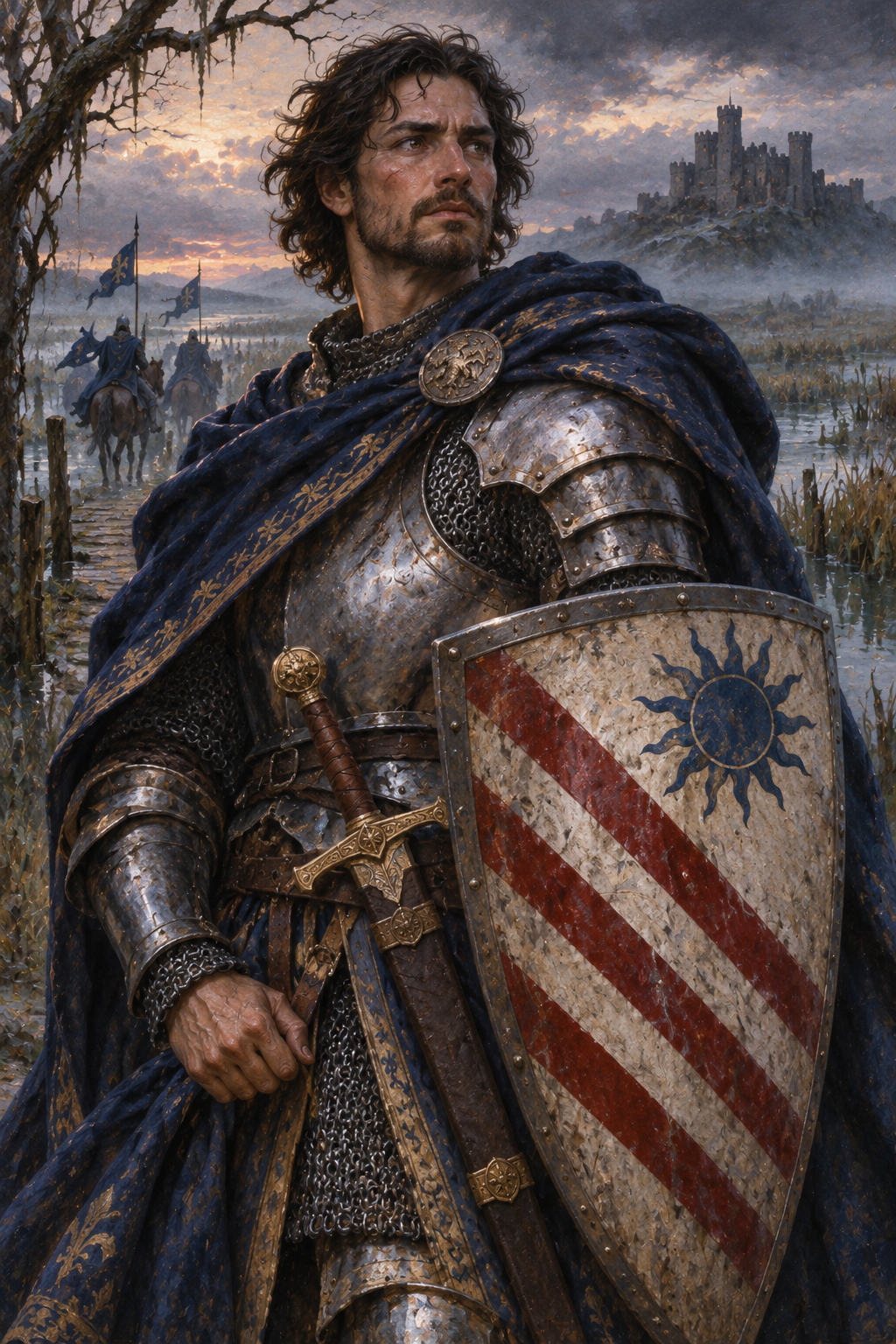
An old causeway crosses the marsh beneath a sky of grey fire. Sir Hector de Maris has come seeking Lancelot, his missing half-brother, and finds instead a bloodied horse bearing a bridle marked with the badge of Turquine. Hector orders his knights to hold the ford and asks the travellers who brought the horse whether its rider was taken alive. A road through the Fey World has opened onto this earlier hour of Camelot; those arriving from 1454 have only until sunset before the mist swallows the crossing.
At a Glance
- Identity
- Sir Hector de Maris (Ector des Mares), knight of the Round Table
- Family
- Son of King Ban and the Lady de Maris; half-brother of Lancelot; cousin of Bors the Younger and Lionel
- Raised by
- Agravadain the Black, his maternal grandfather, lord of the Castle of the Fens
- Allegiance
- Arthur and the Round Table, but loyalty to Lancelot can outweigh allegiance to the court
- Home
- The fens of Benoic; Arthur’s roads and the halls of the Round Table
- Outlook
- Lawful Neutral — disciplined and loyal to his family, capable of destructive jealousy and grave wrongdoing
- Rivals
- Turquine, captor of knights; hostile captains; enemies created by his own rash actions
- Languages
- Courtly French, Brythonic and the speech of the border marches
- Immediate danger
- A horse has returned from Turquine’s country without its rider; Hector believes the missing knight is Lancelot

What Is Happening Right Now?
Hector’s scout has found a broken lance, a saddle strap soaked through with river water and the imprint of two sets of hoofs leading toward a deserted causeway. His captain wants to ride straight into the marsh; Hector suspects a trap designed to draw him away from the king’s road. At dusk a prisoner escapes Turquine’s men and says a knight matching Lancelot’s description is chained beneath the fortress gate. The account is plausible, but the prisoner has been coached.
First Meeting
The knight stands beside a grey warhorse and tightens a frayed strap with his own hands. He is strong, travel-worn and alert to every movement in the reeds. Hector speaks plainly. He asks what the adventurers have seen, which direction the horse came from, and whether its rider spoke. When the name Lancelot is mentioned, his control nearly fails; he turns towards the ford before his captain can finish a warning.
Three Scenes Tonight
- Who carries the bridle? A frightened stable lad offers to identify Turquine’s servant, but fears being returned to his master.
- The wrong prisoner: Hector’s scouts seize a wounded knight who fought on the opposite shore. The man’s armour is Lancelot’s colour, not his device.
- Two roads: the party can track the stolen mount into the fens or lead Hector’s guards around the lake, but not do both before nightfall.
Appearance and Manner
Hector’s armour is serviceable and often mud-stained beneath its blue mantle. He rides with an eye for ambush and speaks in a measured tone when his men are watching. His first instinct is to defend a companion, and his second is to punish an insult. When discussing Lancelot he becomes more impatient than he wishes his knights to see. At court he gives due honour to Arthur; on the road he thinks of family and those who have trusted him with their lives.
Motives, Pressure and Private Truth
- Goal: find Lancelot and bring him home; secure the roads between Arthur’s court and the old lands of Benoic.
- Pressure: the missing knight has become a test of the loyalty between the Ban family and Arthur’s court.
- Secret: Hector has done terrible things for love and pride, including killing a rival in accounts of Lady Perse. He can be brave and protective without being beyond reproach.
- Weakness: an enemy who invokes Lancelot’s name can lure Hector away from a defensible position.
- Reward: a guarded escort, a reliable account of the marsh roads, help from his kin or an introduction to the Round Table.
Relationships and Allegiances
Hector is the son of King Ban by the Lady de Maris, making him Lancelot’s younger half-brother, not his foster father. He was brought up by his mother’s father, Agravadain the Black. Sir Bors and Sir Lionel are his cousins through the house of Gaunnes. Arthur receives Hector’s service as a Round Table knight, though the conflict between Arthur and Lancelot may eventually force his choice. Sir Ector, father of Sir Kay and foster father of King Arthur, is another person entirely.
Hector’s loyalty to Lancelot is tested in both directions: Lancelot rescues him from Turquine’s imprisonment, and Hector later helps bring his lost brother back to court. The romances also give Hector a troubled relationship with Lady Perse. His killing of her earlier betrothed should not be rewritten as faultless chivalry.
Game Statistics
Hector is a formidable mounted warrior and stubborn guardian of his companions. The sword, shield and mount in each rules profile are part of the same fighting style.
Sir Hector de Maris — D&D 2024
Medium Humanoid (Human), Lawful Neutral
Armor Class 20 (plate, shield); Initiative +1 (11); Hit Points 170 (20d8 + 80); Speed 30 ft.; Challenge 9 (5,000 XP; proficiency bonus +4).
| STR | DEX | CON | INT | WIS | CHA |
|---|---|---|---|---|---|
| 20 (+5) | 12 (+1) | 18 (+4) | 12 (+1) | 14 (+2) | 14 (+2) |
Saving Throws Str +9, Con +8, Wis +6; Skills Athletics +9, Insight +6, Intimidation +6, Perception +6, Persuasion +6; Senses passive Perception 16; Languages courtly French, Brythonic.
Traits
Marshland Rider. Hector ignores nonmagical difficult terrain caused by mud and shallow water while mounted, provided his mount can traverse the terrain.
Protect the Companion. Once on each of his turns, when Hector hits a creature that has damaged one of his allies since the end of Hector’s last turn, the hit deals an extra 7 (2d6) slashing damage.
Actions
Multiattack. Hector makes three longsword attacks. A mounted lance charge replaces Multiattack rather than joining it.
Longsword +1. Melee Attack Roll: +10 to hit, reach 5 ft., one target. Hit: 10 (1d8 + 6) slashing damage.
Lance. Melee Attack Roll: +9 to hit, reach 10 ft., one target. Hit: 11 (1d12 + 5) piercing damage. Breaking Charge. If Hector moves at least 20 feet straight towards a target while mounted immediately before this attack, it deals an extra 9 (2d8) piercing damage. He makes only one lance attack as this charge action.
Bonus Action
Hold the Line (2/Day). Hector chooses up to three allies within 30 feet who can hear him. Each gains 8 temporary Hit Points.
Reaction
Interpose Shield. When a creature within 5 feet of Hector that he can see takes damage from an attack, Hector reduces that damage by 14 (2d8 + 5), provided he is holding a shield. He must choose to use this reaction after the hit but before damage is applied.
Tactics
Hector guards the narrowest crossing and lets others withdraw. Once he identifies a captor or traitor, he presses the attack with little caution. He has no paladin spellcasting, Divine Intervention or Channel Divinity.
Sir Hector de Maris — D&D 2014
Medium humanoid (human), lawful neutral
Armor Class 20 (plate, shield); Hit Points 170 (20d8 + 80); Speed 30 ft.; Challenge 9 (5,000 XP; proficiency bonus +4).
| STR | DEX | CON | INT | WIS | CHA |
|---|---|---|---|---|---|
| 20 (+5) | 12 (+1) | 18 (+4) | 12 (+1) | 14 (+2) | 14 (+2) |
Saving Throws Str +9, Con +8, Wis +6; Skills Athletics +9, Insight +6, Intimidation +6, Perception +6, Persuasion +6; Senses passive Perception 16; Languages courtly French, Brythonic.
Traits
Marshland Rider. Hector ignores nonmagical difficult terrain caused by mud and shallow water while mounted, provided his mount can traverse the terrain.
Protect the Companion. Once on each of his turns, when Hector hits a creature that has damaged one of his allies since the end of Hector’s last turn, the hit deals an extra 7 (2d6) slashing damage.
Actions
Multiattack. Hector makes three longsword attacks. A mounted lance charge replaces Multiattack rather than joining it.
Longsword +1. Melee Weapon Attack: +10 to hit, reach 5 ft., one target. Hit: 10 (1d8 + 6) slashing damage.
Lance. Melee Weapon Attack: +9 to hit, reach 10 ft., one target. Hit: 11 (1d12 + 5) piercing damage. Breaking Charge. If Hector moves at least 20 feet straight towards a target while mounted immediately before this attack, it deals an extra 9 (2d8) piercing damage. He makes only one lance attack as this charge action.
Bonus Action
Hold the Line (2/Day). Hector chooses up to three allies within 30 feet who can hear him. Each gains 8 temporary Hit Points.
Reaction
Interpose Shield. When a creature within 5 feet of Hector that he can see takes damage from an attack, Hector reduces that damage by 14 (2d8 + 5), provided he is holding a shield. He must choose to use this reaction after the hit but before damage is applied.
Tactics
Hector guards the narrowest crossing and lets others withdraw. Once he identifies a captor or traitor, he presses the attack with little caution. He has no paladin spellcasting, Divine Intervention or Channel Divinity.
Sir Hector de Maris — Pathfinder 1e
CR 11; XP 12,800; male human fighter 12; LN Medium humanoid (human); Init +5; Senses Perception +6.
Defense
AC 25, touch 12, flat-footed 24 (+10 armour, +3 shield, +1 Dex, +1 deflection); hp 102 (12d10 + 36); Fort +11, Ref +5, Will +6; Defensive Abilities bravery +3 versus fear.
Offense
Speed 30 ft. in heavy armour (armour training 3); Melee +2 longsword +23/+18/+13 (1d8+13, 17–20/×2); Mounted Charge +1 lance +20 (1d8+6 ×3, single mounted attack using Spirited Charge, +2 charge attack bonus included); Ranged javelin +13/+8/+3 (1d6+5, 30-ft. increment); Space/Reach 5 ft./5 ft. (lance 10 ft.).
Tactics
Before Combat checks for trackers along the road and calls for the best mounted scout; During Combat holds a causeway or breaks a mounted line; Morale retreats rather than sacrifice wounded companions, unless the enemy has taken Lancelot.
Statistics
Str 20, Dex 12, Con 16, Int 12, Wis 14, Cha 14; Base Atk +12; CMB +17; CMD 29; Feats Weapon Focus (longsword), Greater Weapon Focus (longsword), Weapon Specialization (longsword), Greater Weapon Specialization (longsword), Improved Critical (longsword), Power Attack, Cleave, Combat Reflexes, Improved Initiative, Mounted Combat, Ride-By Attack, Spirited Charge, Step Up, Following Step (14 feats); Skills Ride +16, Intimidate +17, Diplomacy +12, Knowledge (nobility) +11, Perception +6; Languages courtly French and Brythonic.
Special Abilities
Armour Training 3, Weapon Training (heavy blades) +2, Bravery +3. The heavy-blade weapon training bonus is included in the longsword totals. The lance gains no heavy-blade weapon training bonus. Hector may make a single mounted charge attack with the lance, not iterative full attacks during a charge. His class abilities use Pathfinder fighter progression.
Gear +1 full plate, +1 heavy steel shield, +2 longsword, +1 lance, ring of protection +1, warhorse and a sealed letter for Lancelot.
Sir Hector de Maris — D&D 3.5e
CR 12; male human fighter 12; LN Medium humanoid (human); Init +5; Senses Listen +2, Spot +9.
Defense
AC 24, touch 12, flat-footed 23 (+9 armour, +3 shield, +1 Dex, +1 deflection); hp 102 (12d10 + 36); Fort +11, Ref +5, Will +6.
Offense
Speed 20 ft. in heavy armour; Melee +2 longsword +21/+16/+11 (1d8+11, 17–20/×2); Mounted Charge +1 lance +20 (1d8+6 ×3, one attack with Spirited Charge, +2 charge bonus included); Ranged javelin +13/+8/+3 (1d6+5, 30-ft. increment); Space/Reach 5 ft./5 ft. (lance 10 ft.).
Tactics
Before Combat sends riders to cover the causeway; During Combat shields the column or charges a single captor; Morale withdraws with his men when the road cannot be defended.
Statistics
Str 20, Dex 12, Con 16, Int 12, Wis 14, Cha 14; Base Atk +12; Grapple +17; Feats Weapon Focus (longsword), Greater Weapon Focus (longsword), Weapon Specialization (longsword), Greater Weapon Specialization (longsword), Improved Critical (longsword), Power Attack, Cleave, Combat Reflexes, Improved Initiative, Mounted Combat, Ride-By Attack, Spirited Charge, Blind-Fight (13 feats); Skills Ride +16, Intimidate +9, Knowledge (nobility and royalty) +8, Spot +9; Languages courtly French and Brythonic.
Special Abilities
Fighter Training. Hector follows the D&D 3.5 fighter full base attack and bonus feat progression. His +2 longsword includes Weapon Focus, Greater Weapon Focus, Weapon Specialization and Greater Weapon Specialization in its listed attack and damage. A mounted lance charge allows only one attack. He has no spells or supernatural paladin powers.
Possessions +1 full plate, +1 heavy steel shield, +2 longsword, +1 lance, ring of protection +1, warhorse and the badge of his mother’s family.
Run the Encounter
Hector gives a precise description of Lancelot’s saddle and asks the party to prove the message before he rides. Three successes from tracking, witness interviews or reading the hoof marks locate the correct road. Each failed attempt lets Turquine’s men move a prisoner farther from the causeway. Hector lends horses but refuses to abandon his own scouts. If the party exposes the deception he offers an armed escort; if they conceal the truth his anger is immediate and public.
Five Encounters
- The empty saddle: find the missing rider before the swamp water destroys every track.
- A knight in chains: Turquine’s gaoler offers to trade a captive for Hector’s shield.
- The false Lancelot: an injured man claims to be Hector’s brother, but his sword knot belongs to a dead traveller.
- Lady Perse’s messenger: a woman from Perse’s household demands Hector answer for a knight slain in her service.
- The divided banner: knights loyal to Arthur bar a ford used by Lancelot’s followers. Hector must decide whose orders to obey.
Six Adventure Hooks
- A 1454 traveller finds Hector’s blue-sun seal pressed into wax that opens an ancient Fey causeway.
- A surviving stablehand names Turquine as a captor, but the witness is held by mercenaries seeking a reward.
- Hector offers the party a safe route to Camelot in exchange for testimony about Lancelot’s whereabouts.
- A claimant to the Fens demands the shield of Agravadain the Black.
- Perse’s old retainers demand an accounting for her former betrothed’s death.
- A letter from Arthur orders Hector home while his half-brother is still missing.
Arms, Equipment and Travel
Hector carries sword, shield, lance, travel cloak and the saddlebags of a knight who expects to be on the road for weeks. His heraldic device is a silver shield with three red bends and a blue sun, ascribed to Hector des Mares in the heraldic tradition. The causeways of the fens are watched, and even trained mounts cannot pass deep water or broken bridges without help. A court order gives an escort authority on friendly roads but none over Turquine’s gaol or a rival knight’s manor.
Deeper History
The Old French prose cycles make Hector the son of King Ban and the Lady de Maris. He is raised in the house of Agravadain the Black, comes to Arthur’s court, and wins fame as a fighting knight. Turquine takes him prisoner; Lancelot brings his release. When Lancelot is lost and wounded in mind, Hector searches for him in turn. Later he remains loyal to Lancelot when the Round Table divides. His story also contains cruelty and rash violence; victory in battle does not absolve his treatment of Perse’s former betrothed. The ancient court, including its fall after Camlann, lies beyond the calendar of ordinary Britain in 1454; travellers meet Hector on a Fey road that opens upon its earlier history.
Related People and Places
Arthurian characters · Sir Lancelot · King Ban · Queen Elaine of Benoic · Sir Bors the Younger · Sir Lionel · King Arthur · Queen Guinevere

Sources and Artwork
- Old French Vulgate Merlin and Prose Lancelot, the family and adventures of Hector des Mares.
- Sir Hector de Marais (1859), Robbins Library Camelot Project — Hector searching for his brother.
- Hector and Perceval in BnF français 116, manuscript illustration and art-historical catalogue.
- Hector’s attributed heraldic arms depict three red bends on silver with a blue sun.
Keep this reference growing
If this page helped with your reading or game, you can support its upkeep or explore the curated books.
Explore the Bookshop — epics, classics and stories behind imagined worlds.