
King Mark of Cornwall — The King of Tintagel
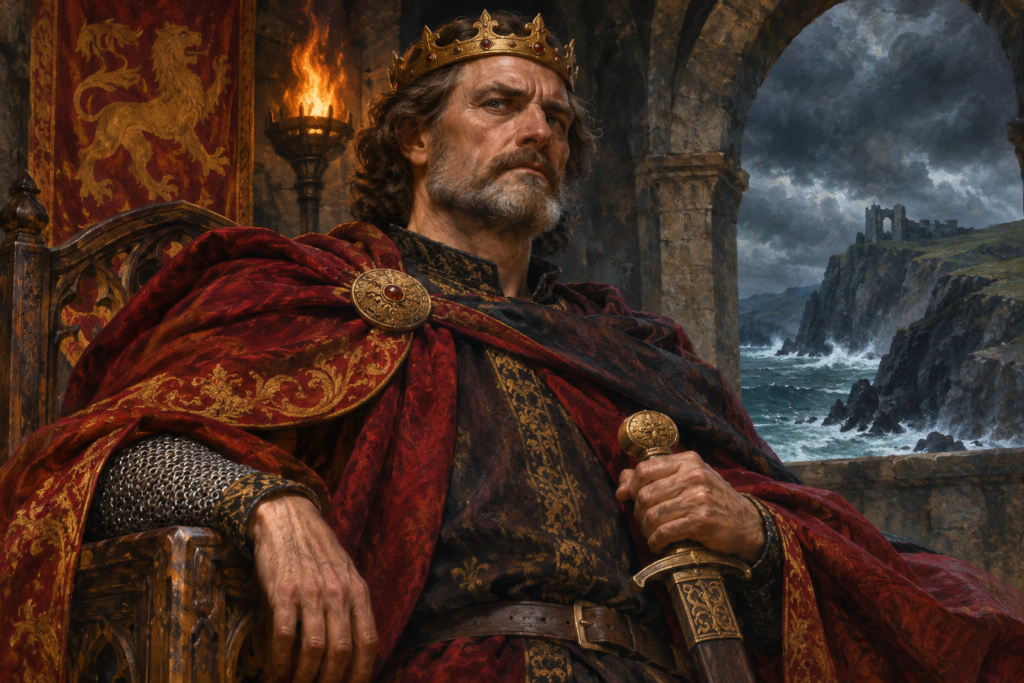
In the earlier reign before Camlann in 537 CE, King Mark of Cornwall rules from the halls of Tintagel, guarding a precarious peace while his nephew Tristan and his wife Iseult meet in secret. His councillors press him to denounce them openly; Mark fears a public trial would divide Cornwall more dangerously than silence. Tonight an informant reports that Tristan will enter the royal garden at moonrise, and a forged message instructs Mark’s guards to kill the intruder rather than arrest him. The characters arrive with proof that someone inside the palace wants all three dead.
At a Glance
- Identity
- King Mark (Marc, March) of Cornwall, uncle of Tristan
- Nature
- Human; mortal king, experienced intriguer and capable but cautious warrior
- Seat
- Tintagel and the royal courts of Cornwall
- Allegiance
- Cornwall’s throne, its great households and the safety of his kingdom
- Family
- Queen Iseult, his wife; Tristan of Lyonesse, his nephew
- Relationships
- Brangaine, Iseult’s confidante; Palamedes, Tristan’s rival; Arthur, fellow sovereign
- Alignment
- Lawful Evil — Mark prizes order and legitimate sovereignty, but uses threats, imprisonment and deceit to protect his pride and position
- Languages
- Cornish, Brythonic and the formal speech used in royal councils
- Immediate danger
- A forged execution order is about to turn a private investigation into murder
What Is Happening Right Now?
The king has summoned his household officers to question them about a letter found beneath the queen’s door. It is addressed in Tristan’s hand, but its wax bears the stamp of a different noble family. A guard commander argues that a corpse will be easier to explain than an escaped suspect. Mark has not authorised a killing, yet he could soon do so if his pride is challenged before witnesses. The characters can save the supposed intruder, reveal the forged seal or persuade Iseult to demand a public inquiry.
First Meeting
Mark receives strangers in a dark hall above the sea, seated beneath old tapestries and dressed in a crimson mantle. A sword rests within reach, though his greatest weapon is the authority of the man who asks the questions. He gives precise answers about Cornwall’s boundaries and obligations, then evades questions about his household. When someone speaks Tristan’s name his expression closes; when someone speaks on behalf of a terrified servant he begins to listen.
Three Scenes Tonight
- The false letter: the supposed lovers’ message contains a courtly expression Tristan has never used.
- The garden wall: a guard has been told to loose an arrow into a dark figure without offering arrest or warning.
- The queen’s witness: Brangaine knows the messenger’s face and fears that revealing him will expose someone else.
Appearance and Manner
Mark is an older ruler with greying hair and a strong, weathered face. His dress conveys authority without unnecessary ornament. A practiced politician, he can be gracious when an envoy gives him room to save face, but sharp and vindictive when mocked. His anger is real: he has been betrayed by two people close to him. That injury never makes his orders to intimidate servants or kill prisoners just.
Ambition, Pressure and Private Knowledge
- Ambition: leave Cornwall independent, solvent and loyal to the throne.
- Pressure: a court that expects a king to punish private dishonour as a public crime.
- Private knowledge: Mark suspects the love potion taken on the voyage has affected Tristan and Iseult, but he cannot prove how much of their conduct it explains.
- Fear: if Tristan becomes a martyr, Cornish knights may rally against their king.
- Flaw: Mark listens to informants who promise certainty because he cannot bear doubt.
- Turning point: an unassailable witness could persuade him to arrest a conspirator and permit the queen to speak rather than order the summary punishment of a rival.
Relationships and Allegiances
- Iseult of Ireland: his wife and queen, trained in medicine and far more than the object of a dispute between men.
- Tristan: nephew, celebrated knight and man whose love for Iseult threatens Mark’s marriage and standing.
- Palamedes: accomplished opponent of Tristan; Mark’s officers hope to use their rivalry to create an apparently legitimate duel.
- Brangaine: confidante of Iseult; Mark suspects she knows how the lovers’ first voyage went wrong.
- King Arthur: fellow king whose court might investigate Mark’s treatment of a Round Table knight.
- Dinadan: satirical knight whose stories can make a tyrant ridiculous without drawing a sword.
- Sir Bleoberis de Ganis: a formidable visiting knight whose confrontation with Tristan can draw an already divided court into another quarrel over honour.
- The people of Cornwall: many require protection from raids and taxes more urgently than they care about a royal marriage.
Game Statistics
Mark is a mortal king whose influence is strongest when he commands witnesses, guards and the procedure of his court. He is an able duellist but not the equal of Tristan in open combat. His judgement and his willingness to abuse lawful authority determine the threat he presents.
King Mark — D&D 2024
Medium Humanoid (Human), Lawful Evil
Armor Class 17 (breastplate, shield); Initiative +1 (11); Hit Points 135 (18d8 + 54); Speed 30 ft.; Challenge 7 (2,900 XP; PB +3)
| STR | DEX | CON | INT | WIS | CHA |
|---|---|---|---|---|---|
| 14 (+2) | 12 (+1) | 16 (+3) | 16 (+3) | 12 (+1) | 18 (+4) |
Saving Throws Int +6, Wis +4, Cha +7; Skills Deception +10, Insight +7, Intimidation +7, Investigation +6, Persuasion +10; Senses Passive Perception 11; Languages Cornish, Brythonic, royal court speech.
Traits
Court Authority. Mark has Advantage on Charisma checks to command his sworn guards in his own household; this does not magically compel a creature to obey an unlawful order. Keeper of Secrets. Mark has Advantage on Intelligence (Investigation) checks made to compare seals, ledgers and correspondence.
Actions
Multiattack. Mark makes two Longsword attacks.
Longsword. Melee Attack Roll: +5, reach 5 ft. Hit: 11 (2d8 + 2) Slashing damage.
Command the Watch (Recharge 5–6). Up to two allied guards who can hear Mark within 30 feet may each use their Reaction to make one weapon attack or move half their Speed without provoking Opportunity Attacks.
Bonus Action
Seize the Evidence. One ally within 30 feet who can hear Mark gains 8 Temporary Hit Points and can move up to 10 feet, provided the ally does not enter an enemy’s space.
Reaction
Parry. Mark adds 3 to his AC against one melee attack that would hit him if he sees the attacker and is holding his sword.
Tactics
Mark begins behind guards, calls for surrender and attempts to take a witness alive. If threatened, he protects the royal documents and retreats to a guarded hall rather than seeking glorious single combat.
King Mark — D&D 2014
Medium humanoid (human), lawful evil
Armor Class 17 (breastplate, shield); Hit Points 135 (18d8 + 54); Speed 30 ft.
| STR | DEX | CON | INT | WIS | CHA |
|---|---|---|---|---|---|
| 14 (+2) | 12 (+1) | 16 (+3) | 16 (+3) | 12 (+1) | 18 (+4) |
Saving Throws Int +6, Wis +4, Cha +7; Skills Deception +10, Insight +7, Intimidation +7, Investigation +6, Persuasion +10; Senses passive Perception 11; Languages Cornish, Brythonic, royal court speech; Challenge 7 (2,900 XP).
Traits
Court Authority. Mark has advantage on Charisma checks to direct his sworn household guards, but cannot compel a creature to commit a crime simply by speaking. Keeper of Secrets. He has advantage on Intelligence (Investigation) checks made to compare seals, ledgers and correspondence.
Actions
Multiattack. Mark makes two longsword attacks.
Longsword. Melee Weapon Attack: +5 to hit, reach 5 ft., one target. Hit: 11 (2d8 + 2) slashing damage.
Command the Watch (Recharge 5–6). Up to two allied guards within 30 feet that can hear Mark may each use their reaction to attack once or move half their speed without provoking opportunity attacks.
Bonus Actions
Seize the Evidence. One ally within 30 feet who can hear Mark gains 8 temporary hit points and can move 10 feet, without entering another creature’s space.
Reactions
Parry. Mark adds 3 to his AC against one melee attack that would hit him, provided he can see the attacker and is holding his sword.
Tactics
Mark has guards secure the exits, pressures the party to surrender evidence and offers a hearing that may be rigged. He is quick to order capture but seldom places himself in front of Tristan’s sword.
King Mark — Pathfinder 1e
CR 9; XP 6,400; Male human rogue 10; LE Medium humanoid (human); Init +5; Senses Perception +13.
Defense
AC 21, touch 12, flat-footed 21 (+7 armour, +1 Dex, +2 shield, +1 deflection); hp 85 (10d8 + 30 plus 10 Toughness); Fort +6, Ref +8, Will +4; Defensive Abilities evasion, uncanny dodge, improved uncanny dodge.
Offense
Speed 30 ft.; Melee +1 longsword +11/+6 (1d8 + 3/19–20); Special Attacks sneak attack +5d6 against qualifying foes; Space/Reach 5 ft./5 ft.
Statistics
Str 14, Dex 12, Con 16, Int 16, Wis 12, Cha 18; Base Atk +7; CMB +9; CMD 21.
Feats Weapon Focus (longsword), Improved Initiative, Toughness, Persuasive, Iron Will, Combat Expertise; Skills Bluff +20, Diplomacy +20, Sense Motive +14, Perception +14, Knowledge (nobility) +16, Linguistics +12; Languages Cornish and Brythonic.
Gear +1 breastplate, heavy steel shield, +1 longsword, ring of protection +1, royal signet, household keys, sealed warrants.
Special Abilities and Tactics
Mark controls information and retains skilled guards. Sneak attack is a rogue class feature, not a curse or a magic power. His role is to use deception, terrain and the royal watch to force a prisoner to surrender; he is not a superior mounted champion of Cornwall.
King Mark — D&D 3.5e
Male human rogue 10; Lawful Evil Medium humanoid (human); CR 10; Init +5; Senses Listen +11, Spot +11.
Defense
AC 20, touch 12, flat-footed 20 (+6 armour, +1 Dex, +2 shield, +1 deflection); hp 68 (10d6 + 30 plus 3 Toughness); Fort +6, Ref +8, Will +4; Special Qualities evasion, uncanny dodge, improved uncanny dodge.
Offense
Speed 30 ft.; Melee +1 longsword +11/+6 (1d8 + 3/19–20); Special Attacks sneak attack +5d6 when eligible; Base Atk +7; Grp +9.
Statistics
Str 14, Dex 12, Con 16, Int 16, Wis 12, Cha 18; Skills Bluff +17, Diplomacy +17, Sense Motive +14, Search +16, Knowledge (nobility) +16, Listen +11, Spot +11; Languages Cornish, Brythonic and court speech.
Feats Weapon Focus (longsword), Improved Initiative, Toughness, Persuasive, Iron Will; Special Abilities rogue special abilities as applicable at 10th level; ability to command the watch derives from his authority as king, not a class-granted supernatural feature.
Possessions +1 breastplate, heavy steel shield, +1 longsword, ring of protection +1, royal signet, sealed letters and a court escort.
Tactics
Mark orders allies to hold corridors, then uses feints and flanking to claim rogue sneak attack where possible. He refuses fair duels against Tristan and retreats when the court turns against him.
Run the Encounter
The king’s own hurt is not in doubt. His response to it is where the characters matter. Their best path is to secure the garden witness, uncover the origin of the forged letter and prevent a rigged hearing from becoming an execution. A persuasive appeal to Cornish law may succeed where a personal insult would condemn the messenger. Iseult and Tristan retain their own decisions and must not be treated as objects of a negotiation.
Five Encounters
- The garden trap: guards have orders to kill a cloaked figure entering the palace garden; the figure may be an innocent messenger.
- The lovers’ letter: two copies of an incriminating letter differ in seal and handwriting.
- A Cornish hearing: Mark offers the party one night to produce a witness before he condemns Tristan.
- The false knight: Palamedes receives a forged summons challenging him to a duel in Tristan’s name.
- The king’s bargain: Mark offers safe conduct for Iseult in exchange for evidence against a powerful Cornish lord.
Six Adventure Hooks
- A fisherman delivers a sealed message from Tintagel, but its wax bears the wrong household device.
- King Mark seeks a discreet guard escort for the queen and refuses to say why her regular attendants are under arrest.
- A servant claims Tristan’s sword has been hidden beneath the royal bed as evidence of treason.
- Mark offers a reward to anyone who finds the maker of a love potion blamed for breaking his marriage.
- A courtier is selling Mark’s plans to a rival harbour lord, endangering every Cornish vessel leaving the coast.
- An accused spy begs the characters to bring her case before Arthur rather than endure a private hearing at Tintagel.
Equipment, Court and Resources
A royal longsword, breastplate, shield, crown, sealed warrants, household guards, mounted couriers, spies and the revenues of Cornish ports. Mark commands lawful officers and can mobilise men quickly, but a sealed order is only as trustworthy as the hand that issued it. His private ambition never grants him supernatural control over Tristan, Iseult or the court.
Historical Artwork

Lore, History and Timeline
The medieval King Mark changes sharply across the Tristan traditions. In early versions he can be a wronged ruler and husband; later retellings and Malory’s Le Morte d’Arthur emphasise his treachery, mistrust and the danger he poses to an admired nephew. These different portraits offer a powerful king to play, not an excuse to reduce him to jealousy alone. The love potion that Tristan and Iseult drank on their voyage complicates responsibility, but it does not remove the suffering of a betrayed spouse or justify murder by royal command.
Mark ruled Cornwall in the older age of Tristan and Arthur, not as a contemporary of England’s kings in 1454. The accusations, garden trap and peril of his queen belong to that troubled court before Camelot’s fall. In 1454 Tintagel retains its memory of the king, but the mortal throne is no longer his: a sealed warrant written in Mark’s hand or a ship passing into an older Cornwall would reveal a dangerous crossing between ages. His jealous schemes can be encountered there without rewriting the politics of present-day Cornwall.
Related People and Places
Arthurian characters · Tristan · Iseult · Palamedes · Brangaine · Arthur · Dinadan
Sources and Artwork
- Tamsyn Rebekah Elise Knight, Zwîvalaere: King Mark as a Site of Conflict in the Tristan Legend (Massey University, 2001) — comparison of the king’s character across six medieval versions.
- Joseph Bédier, The Romance of Tristan and Iseult — court and love-potion tradition.
- Edward Burne-Jones, King Mark and La Belle Iseult (1862) — existing historic painting, public-domain reproduction.
- New original King Mark painted hero replaces the former shared-subject feature image. The historical painting is retained separately, and the mechanics, current conspiracy and adventure hooks are original unofficial campaign adaptations.
Keep this reference growing
If this page helped with your reading or game, you can support its upkeep or explore the curated books.
Explore the Bookshop — epics, classics and stories behind imagined worlds.