
Princess NPC | Royal Heir, Duelist, and Court Intrigue
A royal heir, diplomatic hostage, court-trained duelist, hidden reformer, or runaway noble whose title can change the fate of a kingdom.
Overview
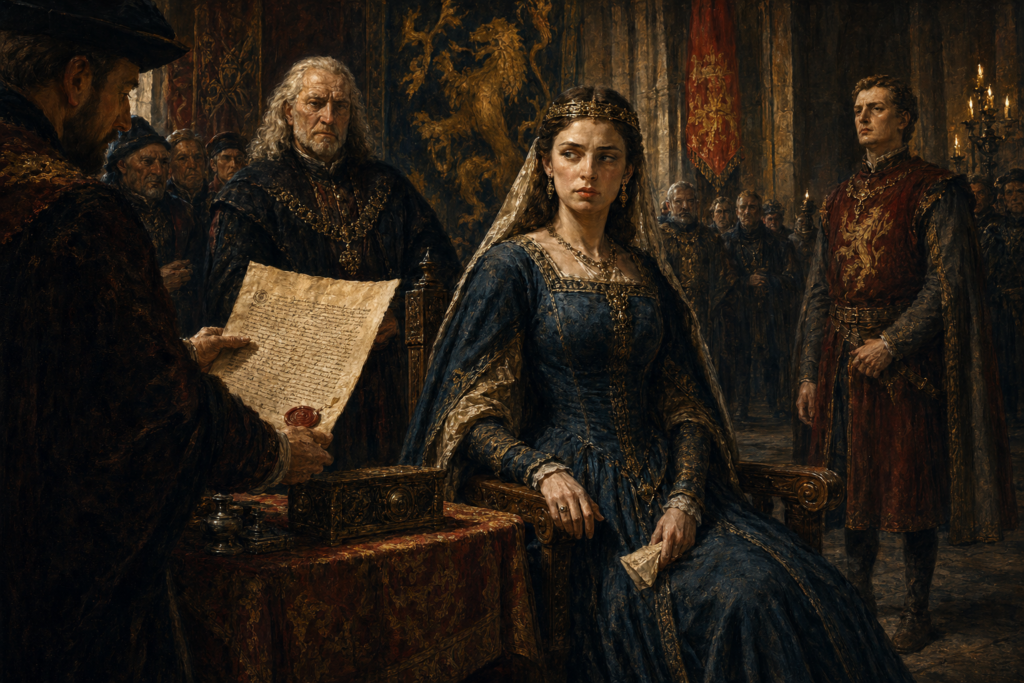
A Princess NPC is not just a noble in fine clothing. She is a political force with a human face. Her birth can settle treaties, provoke succession disputes, legitimize rebellions, shame corrupt courtiers, or draw assassins from every rival house in the realm.
Some princesses are rulers in their own right. Others are heirs displaced by brothers, widowed claimants, treaty brides, royal hostages, cherished daughters, or inconvenient women whose lives are negotiated by councils and crowned relatives. A princess may be protected by law and ceremony, but those same protections can become a gilded cage.
The best Princess NPCs are not passive prizes. They have motives, training, loyalties, secrets, and limits. A princess may sneak from court to taste freedom, fund a rebellion under her father’s nose, seek a forbidden tutor, expose a murderer, avoid a forced marriage, or test whether the tales of honour sung in her hall survive contact with mud, blood, and hunger.
Used well, she changes the shape of an adventure. The question is not simply whether the characters can protect her. It is whether they can survive what her name means.
Description
A princess is trained to be seen. Even when disguised, she often carries small signs of education and rank: controlled speech, good posture, careful handwriting, familiarity with horses, polished etiquette, or the instinctive expectation that people will make way.
Her appearance varies by kingdom, culture, and circumstance. At court, she may wear embroidered gowns, fine veils, jewellery, symbolic colours, or a circlet marking dynastic status. On the road, she may trade these for a hooded cloak, riding boots, a plain wool dress, borrowed armour, or the outfit of a lady-in-waiting, musician, scholar, pilgrim, or minor noble companion.
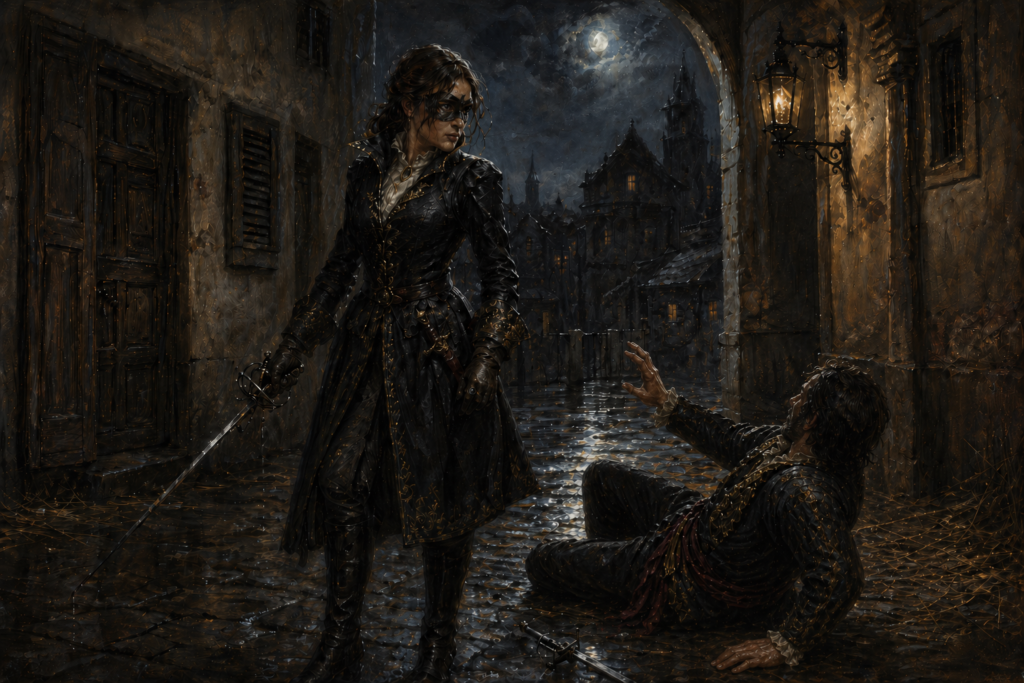
Many princesses are not battlefield warriors, but they are not helpless. Court life teaches caution. A dagger may be hidden beneath a sleeve. A rapier may be carried as part of noble fashion. A smile may conceal a threat. A dance step may become a duelist’s retreat. A princess raised among ambitious lords learns early that danger often begins with a courteous bow.
Role in the World
A princess exists at the crossing point of bloodline, law, wealth, reputation, and power.
She may be loved by the common people but ignored by the council. She may have a stronger claim than the prince favoured by the army. She may know which noble houses are bankrupt, which generals are loyal, which priests accept bribes, and which foreign envoys are lying. Her value is not only personal. It is symbolic.
This makes her useful to rulers, rebels, merchants, foreign courts, ambitious spouses, and enemies of the crown. Some seek to marry her. Some seek to silence her. Some seek to place her on the throne. Some seek to keep her smiling in public while decisions are made elsewhere.
A Princess NPC should therefore create social and political consequences. Her safety matters, but so do her choices.
Common Princess NPC Roles
The Dynastic Heir
She is next in line, or ought to be. Her claim may be accepted, disputed, hidden, forged, or inconvenient. Every faction has an opinion about whether she should inherit.
The Political Hostage
She has been sent to another court under the language of friendship, education, marriage, or diplomacy. In truth, she is living collateral.
The Treaty Bride
Her marriage is meant to end a war, seal an alliance, settle a border, or bind two dynasties. She may accept the duty, resent it, or secretly work to overturn it.
The Hidden Reformer
She uses courtly access to protect commoners, expose corrupt officials, fund scholars, shield persecuted cults, support rebels, or restrain a cruel parent.
The Runaway Noble
She has fled the palace for adventure, love, justice, pilgrimage, revenge, or simple breath. Her disappearance may be called kidnapping whether she consented or not.
The Aristocratic Duelist
She is trained in fencing, dance, disguise, and social warfare. She may belong to a circle of masked nobles who punish corruption, settle grudges, or play dangerous games in the city at night.
The Royal Patron
She cannot act openly, but she can hire adventurers, offer introductions, provide money, protect witnesses, or place a sealed letter where it will matter.
Using a Princess NPC in Your Game
The strongest Princess NPCs have agency.
She may need rescue, but she should not exist only to be rescued. She may be frightened, sheltered, proud, lonely, brilliant, naïve, manipulative, honourable, reckless, or exhausted. What matters is that she wants something and understands at least part of the danger around her.
A princess can complicate simple choices. Returning her to court may prevent war but condemn her to a forced marriage. Helping her escape may be morally right but politically catastrophic. Protecting her from assassins may reveal that she herself ordered a secret death for the good of the realm. Placing her on the throne may save the kingdom from a tyrant while starting a succession war.
Use her title as pressure, not decoration.
Princess NPC 5.5e / 2024
Princess (Human Aristocrat 8), Pathfinder
Princess NPC 5.5e / 2024

Medium Humanoid, Typically Neutral
Armor Class 16
Hit Points 44
Speed 30 ft.
| STR | DEX | CON | INT | WIS | CHA |
|---|---|---|---|---|---|
| 9 (-1) | 16 (+3) | 10 (+0) | 12 (+1) | 8 (-1) | 14 (+2) |
Saving Throws Dex +5, Cha +4
Skills Deception +6, History +3, Performance +4, Persuasion +6, Sleight of Hand +5, Stealth +5
Senses Passive Perception 9
Languages Common plus one other language
Challenge 3
Proficiency Bonus +2
Traits
Courtly Training
The princess has advantage on ability checks made to recall noble lineages, court customs, heraldry, etiquette, royal scandals, or succession disputes.
Noble Bearing
In a society that recognizes her rank, the princess has advantage on Charisma checks made to secure an audience, demand lawful treatment, delay violence, or invoke noble protocol.
Noble Fencer
The princess uses Dexterity for attack and damage rolls with her rapier and dagger.
Actions
Multiattack
The princess makes two attacks, using Rapier or Dagger in any combination.
Rapier
Melee Weapon Attack: +5 to hit, reach 5 ft., one target.
Hit: 7 piercing damage.
Dagger
Melee or Ranged Weapon Attack: +5 to hit, reach 5 ft. or range 20/60 ft., one target.
Hit: 5 piercing damage.
Cutting Remark
One creature the princess can see within 30 feet that can hear and understand her must succeed on a DC 12 Wisdom saving throw or have disadvantage on the next attack roll it makes before the end of its next turn.
This is not magical.
Reactions
Parry
The princess adds 2 to her AC against one melee attack that would hit her. To use this reaction, she must see the attacker and be wielding a melee weapon.
Boon
A princess can give the characters a gift worth up to 300 gp, help them escape minor legal trouble, or arrange a meeting with a royal parent, noble, knight, minstrel, celebrity bard, or merchant prince. When her favour matters, the characters gain a +5 bonus on one Charisma check made with that contact.
Princess (Human Aristocrat 8)
A princess is occasionally a ruler in her own right but is most often the daughter of a king and/or queen. In many societies, princesses come behind any princely brothers in the line of succession, and may even be treated like a commodity to be brokered between noble houses through marriage alliances. Small wonder, then, that princesses often find ways of sneaking away from their gilded homes and out into the world to find a taste of adventure.
This content was created for the Pathfinder rules by Paizo Publishing LLC and is part of the Pathfinder RPG product line.]
DESCRIPTION
Naturally, a princess’s stats can also be used to model any high-level noble, male or female. Princesses also make good aristocratic duelists, perhaps joining together in a noble ‘gangs’ of four members (CR 10).
A princess may be accompanied by four female noble scions as her ladies-in waiting or noble-born friends (CR 8), or by her mother and father, the king and queen (CR 15). Alone, a princess may keep a guard officer bodyguard (CR 7) or battle monk for protection (CR 8), possibly adding a minstrel as well for the company (CR 8 or 9).
| Princess CR 6 |
| XP 2,400 Human aristocrat 8 N Medium humanoid Init +3; Senses Perception +8 |
| DEFENSE |
| AC 20, touch 14, flat-footed 16 (+5 armor, +3 Dexterity, +1 Dodge, +1 shield) hp 40 (8d8+4) Fort +3, Ref +6, Will +6 |
| OFFENSE |
| Speed 30 ft. Melee mwk rapier +10/+5 (1d6-1/18-20) or mwk rapier +8/+3 (1d6-1/18-20), mwk dagger +8 (1d4-1/19-20) Ranged mwk dagger +10 (1d4-1/19-20) |
| STATISTICS |
| Strength 9, Dexterity 16, Constitution 10, Intelligence 12, Wisdom 8, Charisma 12 Base Atk +6; CMB +5; CMD 19 Feats Dodge, Mobility, Two-Weapon Defense, Two-Weapon Fighting, Weapon Finesse Skills Bluff +13, Diplomacy +13, Disguise +13, Escape Artist +4, Handle Animal +8, Intimidate +13, Knowledge (nobility) +10, Perception +8, Perform (dance) +10, Perform (string) +10, Ride +8, Sense Motive +5, Sleight of Hand +4, Stealth +4 Languages Common, Elven Gear +1 chain shirt, masterwork rapier, masterwork dagger, circlet of persuasion, cloak of resistance +1, Disguise kit Boon A princess can make a gift to PCs of up to a 300 gp value or get PCs out of minor legal trouble. A princess can also arrange a meeting with her royal parent, a knight, a noble, a minstrel or celebrity bard, or a merchant prince whose favor she has, with a +5 circumstance bonus on Diplomacy checks with them. |
Section 15: Copyright Notice – Pathfinder RPG GameMastery Guide
Pathfinder RPG GameMastery Guide, © 2010, Paizo Publishing, LLC; Authors: Cam Banks, Wolfgang Baur, Jason Bulmahn, Jim Butler, Eric Cagle, Graeme Davis, Adam Daigle, Joshua J. Frost, James Jacobs, Kenneth Hite, Steven Kenson, Robin Laws, Tito Leati, Rob McCreary, Hal Maclean, Colin McComb, Jason Nelson, David Noonan, Richard Pett, Rich Redman, Sean K Reynolds, F. Wesley Schneider, Amber Scott, Doug Seacat, Mike Selinker, Lisa Stevens, James L. Sutter, Russ Taylor, Penny Williams, Skip Williams, Teeuwynn Woodruff.
Adventure Hooks
The Runaway Alliance
The princess vanishes on the eve of a marriage treaty. Her father claims she has been abducted. Her own hidden letter says she fled willingly. Returning her may prevent war, but it may also deliver her into a brutal political bargain.
The Wrong Heir
Noble factions rally behind the princess as the rightful successor. In private, she believes another claimant has the stronger legal right. Revealing the truth could destroy the only faction preventing a military coup.
The Noble Gang
A princess and three high-born companions ride masked through the capital by night, humiliating corrupt magistrates and duelling predatory nobles. The crown wants the scandal ended before the common people begin cheering them.
The Gilded Prison
The princess asks the characters to smuggle one message beyond the palace walls. It is not a love letter. It is a list of names: tutors, guards, officials, and courtiers involved in treason.
The Diplomatic Hunt
During a royal hunt, the princess follows an omen into ancient woodland and disappears. The court blames enemy agents, but the trail leads to old powers that remember an oath her dynasty broke.
The Queen’s Shadow
The princess appears controlled by her mother in every public matter. The characters are hired to protect her from assassination, only to discover the queen’s control may be the only thing keeping the princess alive.
The Princess in Disguise
A charming musician, scholar, or travelling noble joins the party on the road. Only later do the characters learn she is the missing princess whose disappearance has mobilized half the kingdom.
The Marriage Knife
A foreign prince arrives to claim the princess’s hand. He is polite, handsome, and politically ideal. He is also bound to a secret power that will gain influence over the realm the moment the marriage vows are spoken.
Encounter Groups
A Princess NPC rarely exists outside a social web. Even when alone, her rank brings unseen consequences.
Princess Alone
A disguised noble travelling under an assumed identity, testing the world without servants, heralds, or guards.
Princess with Guard Officer Bodyguard
A formal escort, tense court journey, secret diplomatic mission, or desperate flight from a compromised palace.
Princess with Battle Monk Protector
A royal ward protected by temple oath, family debt, monastic prophecy, or an old vow made before her birth.
Princess with Minstrel
A courtly escape, secret romance, coded diplomatic errand, or travelling performance used to conceal her identity.
Princess with Ladies-in-Waiting
Four noble-born companions serve as friends, rivals, informants, decoys, or co-conspirators. This group may seem harmless until their family names matter.
Princess with King and Queen
A full royal encounter involving succession, treaty negotiation, trial, marriage, abdication, inheritance, or public ceremony.
Princess with Noble Gang
Four aristocratic duelists or reckless high-born conspirators act as masked reformers, scandalous thrill-seekers, or dangerous romantics.
Campaign Use
A Princess NPC can anchor an entire adventure arc because she brings personal stakes and political stakes together.
She may be the person the characters must escort, but she may also be the person hiring them, deceiving them, testing them, or forcing them to choose between law and justice. Her bodyguards, relatives, rivals, and enemies give the DM an easy way to widen a local scene into a kingdom-level crisis.
The key is to let her title matter without letting it erase her personhood. She should have fears, loyalties, memories, preferences, blind spots, and private convictions. A throne may claim her, but it does not fully define her.
Why This NPC Works
The Princess NPC works because she creates pressure without needing monstrous power.
She can make violence costly. She can turn a roadside ambush into an international incident. She can transform a marriage negotiation into a succession crisis. She can force the characters to decide whether duty, law, love, bloodline, oath, or conscience matters most.
She is useful in courtly intrigue, wilderness escort adventures, rebellion stories, succession disputes, rescue missions, masked-duelist plots, political marriages, hostage exchanges, and royal scandals. She can be ally, patron, fugitive, claimant, rival, witness, bargaining piece, or future sovereign.
The old version of the story asks, “Can the heroes rescue the princess?”
The better version asks, “What does the princess want, and what will the realm become if she gets it?”
Keep this reference growing
If this page helped with your reading or game, you can support its upkeep or explore the curated books.
Explore the Bookshop — epics, classics and stories behind imagined worlds.