
Jacob Marley — The Chained Ghost of London
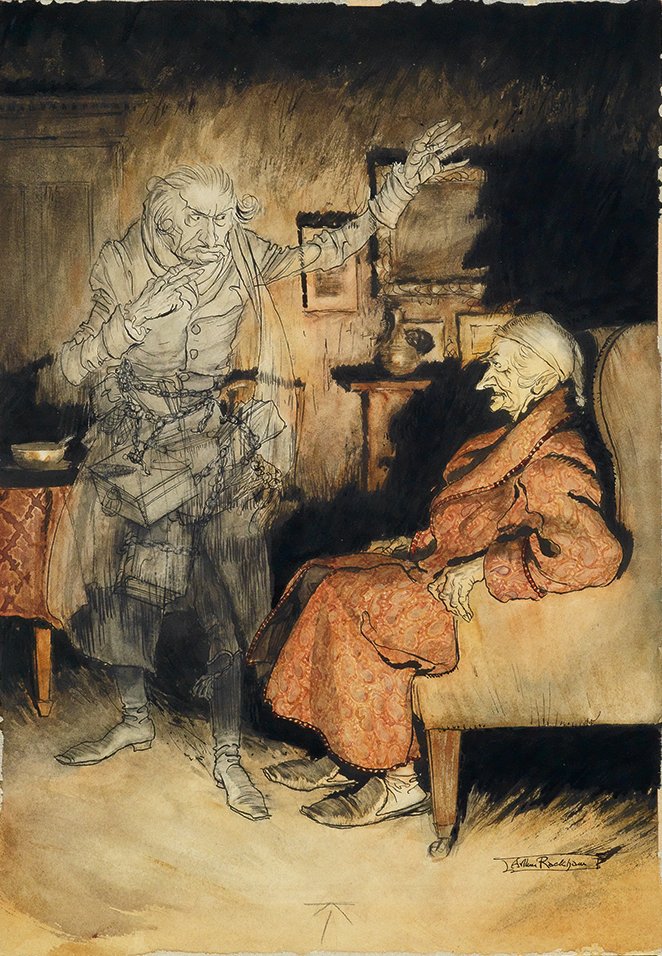
Jacob Marley is dead, but his accounts are not closed. In life he treated obligation as weakness and profit as proof of merit. In death those choices hang from him as a chain of locks, keys, purses, ledgers and strongboxes that no living hand can lift.
Marley now appears where greed has become more important than human obligation. He cannot simply solve the wrongs he witnesses. His punishment is to understand what he refused to understand while alive—and to warn others before they forge chains of their own.
At a Glance
- Name: Jacob Marley
- Species: Undead spirit
- Base: London; appears around counting houses, store rooms and homes tied to unresolved debts
- Role: Penitent ghost, warning spirit and reluctant supernatural guide
- Alignment: Lawful Neutral
- Campaign status: Dead, but active as a ghost
- Campaign use: Supernatural warning, haunting witness, moral complication or guide to hidden financial wrongdoing
Game Statistics
5.5e / 2024
Jacob Marley
Medium Undead, Lawful Neutral
Armor Class 14
Hit Points 85 (10d8 + 40)
Speed 0 ft., fly 40 ft. (hover)
| STR | DEX | CON | INT | WIS | CHA |
|---|---|---|---|---|---|
| 7 (-2) | 16 (+3) | 18 (+4) | 15 (+2) | 17 (+3) | 18 (+4) |
Saving Throws Wis +6, Cha +7
Skills History +5, Insight +6, Investigation +5
Damage Resistances acid, fire, lightning, thunder; bludgeoning, piercing and slashing from nonmagical attacks
Damage Immunities cold, necrotic, poison
Condition Immunities Charmed, Exhaustion, Frightened, Grappled, Paralyzed, Petrified, Poisoned, Prone, Restrained
Challenge 6 (2,300 XP; PB +3)
Traits
Incorporeal Movement. Marley can move through creatures and objects as if they were difficult terrain.
Chain of Consequence. A creature that begins its turn within 10 feet of Marley and knowingly profits from a serious unpaid debt, broken obligation or exploitative bargain must succeed on a DC 15 Wisdom saving throw or have Disadvantage on its next attack roll or ability check before the end of the turn.
Bound to Warning. Marley cannot willingly use his abilities to enrich himself or directly settle a financial dispute in favour of one living party. He can reveal, warn and frighten, but not become a supernatural debt collector.
Actions
Dragging Chain. Melee Spell Attack: +7, reach 10 ft. Hit: 13 (2d8 + 4) necrotic damage, and the target’s Speed is reduced by 10 feet until the end of its next turn.
Show the Weight (Recharge 5–6). One creature Marley can see within 30 feet must make a DC 15 Wisdom saving throw. On a failure it is Frightened for 1 minute as it sees a vision of the burden created by its own choices. It repeats the save at the end of each turn.
Pathfinder 1e
Jacob Marley CR 6 unique ghost; LN Medium undead (incorporeal). AC 19, touch 19; hp 70; Fort +4, Ref +8, Will +10.
Special Attacks corrupting touch 1d6+4, frightening moan (DC 18), chain of consequence aura (DC 18 Will). Skills Knowledge (local) +13, Profession (merchant) +15, Sense Motive +15.
D&D 3.5e
Jacob Marley CR 6 unique ghost; LN Medium undead (incorporeal). AC 19; hp 68. Special Attacks corrupting touch, frightful moan, manifestation and unique burden-chain effect. Skills Knowledge (local) +12, Profession (merchant) +14, Sense Motive +13.
What Is Jacob Marley Doing Right Now?
Marley is haunting a sequence of London counting rooms connected by the same set of unpaid military supply contracts. Each business insists the next debtor is responsible. Marley knows the chain ends with someone who profited from shortages while claiming the Crown had already paid.
He cannot simply name the culprit. His punishment allows him to show the consequences and point toward the next link, forcing living people to follow the evidence themselves.
Encounters
Marley arrives with sound before shape: dragging metal, keys knocking against locks, the scrape of a strongbox that is not physically there. He speaks urgently and with the exhausted anger of someone who has finally understood a lesson too late.
Appearance and Manner
His ghost resembles a prosperous merchant stripped of comfort. Heavy spectral chains coil around him, threaded with keys, ledgers, purse clasps and miniature coffers. His face is recognisably human but stretched by sleepless regret.
Personality
Marley is remorseful without becoming gentle. He is impatient with excuses because he recognises every one of them. He does not preach abstract virtue; he points to specific people who went hungry, lost homes or died while profitable accounts remained balanced.
Relationships
London merchants: many dismiss his appearances as guilt, fraud or drunkenness until several witnesses describe the same chain.
Sherlock Holmes: Holmes is interested in the pattern of hauntings even before deciding how much of Marley’s testimony counts as evidence.
The indebted: Marley appears most strongly around obligations everyone involved is trying not to see.
Equipment and Possessions
Marley carries no usable treasure. His keys, purses and ledgers are part of the haunting itself and become intangible if removed from his chain.
Running Marley at the Table
Use Marley as a supernatural clue source with limits. He can identify the shape of wrongdoing, reveal emotional or moral consequence and point toward the next person in the chain, but the players should still gather admissible evidence, confront the responsible people and decide what justice requires.
Adventure Hooks
- The Unpaid Soldiers: Marley appears wherever false supply accounts are stored.
- The Locked Ledger: a merchant burns his books, but Marley’s chain begins displaying the missing account numbers.
- The Wrong Debtor: everyone blames a ruined trader; Marley refuses to haunt him.
- The Weight of Keys: a stolen key appears on Marley’s chain before anyone reports it missing.
- One Last Warning: Marley asks the party to reach a living merchant before that person makes the choice that will bind a new chain.
Connected Places and People
Literary Inspiration
Jacob Marley originates in Charles Dickens’s A Christmas Carol. This version places his chain-haunting directly into fifteenth-century London and connects it to medieval merchant debts and supply contracts.
Rules Notes
The game statistics, haunting limits and campaign relationships are original adaptations for the stated rules editions.