
Necromancy • Dispersal of the Restless Dead
Undead Destruction
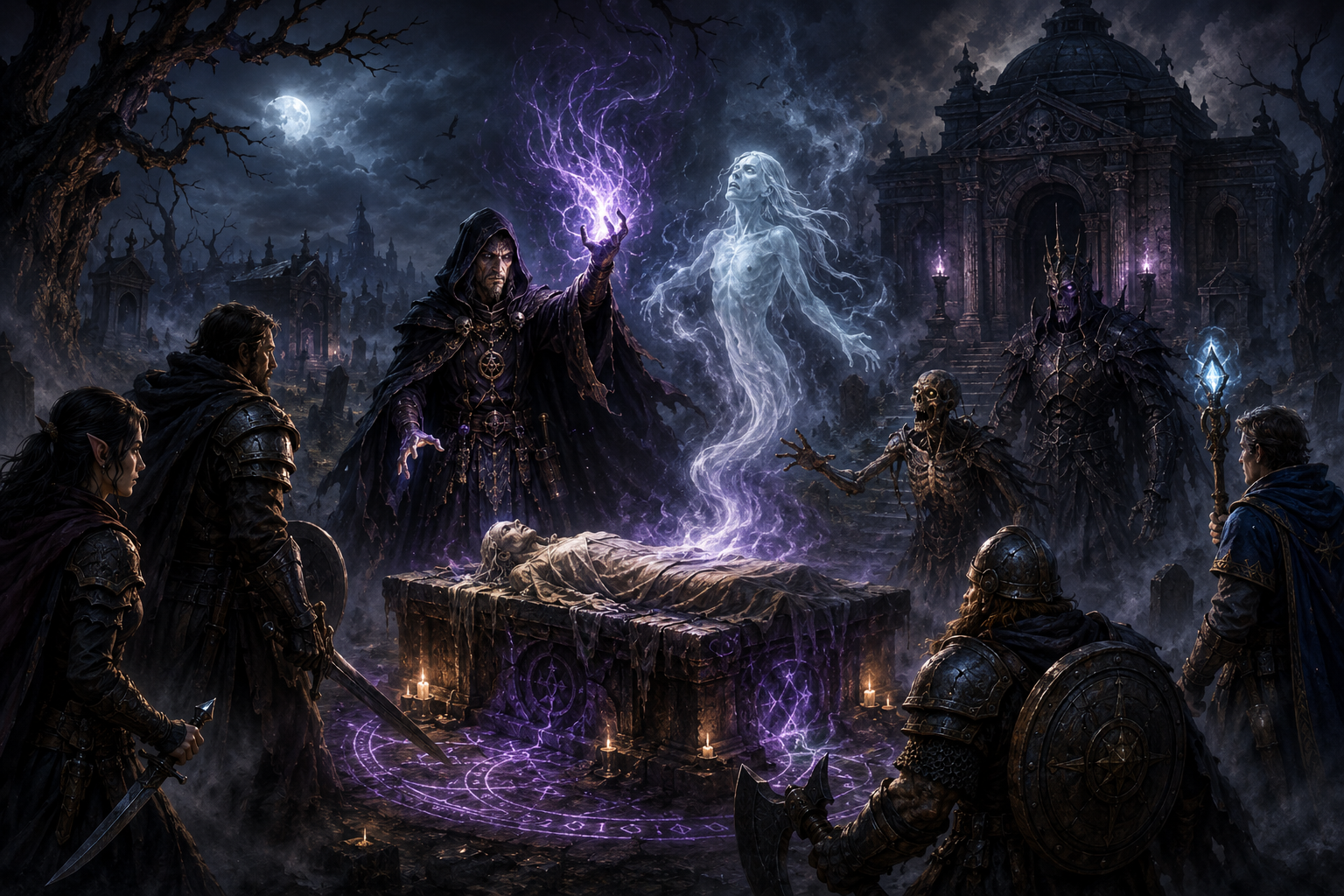
Undead Destruction breaks the power that keeps lesser corpses moving. In its original Liber Mysterium form, a Witch makes one Cleric-style turning check to destroy weak undead, with a Hit Dice limit and no ability to command survivors. The later edition panels are playable, clearly optional conversions rather than spells falsely attributed to official rulebooks.
Undead Destruction at a Glance
| 5.5e / 2024 | Optional 4th-level Necromancy: 5d8 Radiant damage, Wisdom save; no CR-based destruction |
|---|---|
| 5e / 2014 | Optional 4th-level Necromancy: 4d8 radiant, Wisdom save; low-CR destruction condition |
| Pathfinder 1e | Optional Witch 4 / Sorcerer-Wizard 6: positive energy, Will saves and Hit Dice limits |
| D&D 3.x Legacy | Original third-party Witch 4 / Sorcerer-Wizard 6: turning check and 1 destroyed HD per caster level |
Do not mix edition mechanics. Turn Undead, Destroy Undead (2014), Sear Undead (2024) and Pathfinder channel energy belong to different published class rules. The original spell is third-party d20 material.
Spell Rules by Edition
Worked examples inside the mechanics. Restless sentries rise in an ancient burial chamber. The caster may have only one opportunity to prevent the guardians surrounding the party. Each example is presented within its corresponding edition below.
Choose the edition in which your characters are playing. The original 2003 spell is preserved in the final tab.
Undead Destruction — 5.5e / 2024
Optional 2024 fourth-level spell. No published SRD spell bears these mechanics. The design uses a damaging pulse rather than the obsolete 2014 automatic-CR threshold.
| Level and School | 4th-level Necromancy (optional) |
|---|---|
| Suggested Classes | Cleric, Wizard; a campaign Witch with GM permission |
| Casting Time | Action |
| Range | Self (30-foot Emanation) |
| Components | V, S, M (chip from a grave marker honouring a benevolent dead person; consumed) |
| Duration | Instantaneous |
| Targets | Undead of your choice that you can see in the Emanation |
| Saving Throw | Wisdom against spell save DC |
| Effect | 5d8 Radiant damage on a failed save; half on success |
| Higher-Level Slots | +1d8 Radiant damage per spell slot level above 4 |
Spell effect. Grave-pale light expands from your palm. Each selected Undead creature in the 30-foot Emanation makes a Wisdom saving throw. On a failed save it takes 5d8 Radiant damage; on success half as much. An Undead reduced to 0 Hit Points is destroyed as normal. There is no automatic CR threshold in this optional conversion.
Counterplay. Moving beyond the Emanation, breaking the caster’s view of a target, Total Cover, protection against Radiant damage, or a successful save can reduce the spell’s usefulness. It does not turn, banish, immobilise or command undead that survive.
Official boundary. The 2024 Cleric’s Sear Undead feature adds Radiant damage when an undead fails its Turn Undead saving throw; unlike the 2014 class feature, it has no automatic low-CR destruction table. That feature is not this optional fourth-level spell.
In Play — Radiant Dispersion
With spell save DC 15, a seventh-level Witch using the optional fourth-level spell affects three visible zombies within 30 feet. Each makes a Wisdom save, taking 5d8 Radiant damage on failure or half on success. A survivor continues fighting: the conversion has no automatic CR destruction.
Undead Destruction — 5e / 2014
Optional 2014 fourth-level spell. This conversion keeps the source’s emphasis on the weakest undead while using CR and saving throws instead of a 3.x turning check.
| Level and School | 4th-level necromancy (optional) |
|---|---|
| Suggested Classes | Cleric, Wizard; a campaign Witch with GM permission |
| Casting Time | 1 action |
| Range | Self (30-foot radius) |
| Components | V, S, M (chip from a grave marker honouring a benevolent dead person; consumed) |
| Duration | Instantaneous |
| Targets | Undead of your choice you can see within 30 feet |
| Saving Throw | Wisdom against spell save DC |
| Effect | 4d8 radiant damage on a failed save; half on success |
| Destruction Rule | An Undead of CR 1/2 or lower and Intelligence 5 or lower that fails its save is destroyed instead of taking damage |
| Higher-Level Slots | +1d8 radiant damage per slot level above 4; CR threshold unchanged |
Spell effect. Choose any number of Undead you can see within 30 feet. Each makes a Wisdom saving throw. An Undead of CR 1/2 or lower with Intelligence 5 or lower that fails is destroyed outright. All other Undead that fail take 4d8 radiant damage; any that succeed take half the damage and are not automatically destroyed.
The threshold. Both conditions must be met: CR 1/2 or lower and Intelligence 5 or lower. A vampire, wight or other powerful intelligent foe is not destroyed just because it has already lost Hit Points. The original 2003 spell uses Hit Dice and turning checks, not Challenge Ratings.
Official boundary. In 2014, a Cleric’s Destroy Undead is an improvement to the Turn Undead class feature and has its own Cleric-level thresholds. This optional spell is not a published Cleric class feature or a default Witch spell.
In Play — Breaking the Muster
A seventh-level caster faces six ordinary skeletons (CR 1/4) and a wight (CR 3). A skeleton failing its Wisdom save is destroyed if its Intelligence is 5 or lower. A skeleton succeeding instead takes half of 4d8 radiant damage. The wight is not automatically destroyed and takes normal damage according to its save.
Undead Destruction — Pathfinder 1e
Optional Pathfinder 1e conversion. Witch 4 and Sorcerer/Wizard 6 are campaign-list additions, not default official spell access.
| School | Necromancy (optional) |
|---|---|
| Level | Witch 4, Sorcerer/Wizard 6 (optional) |
| Casting Time | 1 round |
| Range | 30 feet |
| Targets | Undead selected within 30 feet of the caster |
| Components | V, S, M (chip from the gravestone of a benevolent dead person; consumed) |
| Duration | Instantaneous |
| Saving Throw | Will half; see destruction rule |
| Spell Resistance | Yes |
| Damage | Positive energy: 1d6 per two caster levels (maximum 10d6) |
| Destruction | An undead with Intelligence 5 or lower and HD no greater than half caster level that fails its Will save is destroyed, subject to a total HD cap equal to caster level |
Spell effect. You release a pulse of positive energy against the chosen undead. Resolve any Spell Resistance first. Each target attempts a Will save. An Undead whose Intelligence is at most 5 and whose HD are no greater than half your caster level is destroyed on failure, provided the total destroyed HD have not exceeded caster level. Otherwise an affected undead takes 1d6 positive-energy damage per two caster levels (maximum 10d6) on a failed save or half as much on success.
Target selection. If too many undead qualify, the caster chooses the order in which eligible undead are destroyed, stopping when the HD allowance is exhausted. A creature that cannot fit within the remaining allowance instead takes the normal damage; it is not partially destroyed.
Channel resistance. A GM using this optional turning-inspired spell should specify whether a target’s channel resistance applies to its Will save. This is not the Pathfinder channel energy ability and does not consume daily channel uses.
Example. At caster level 8, an undead must have 4 HD or fewer, Intelligence 5 or lower, and fail its Will save for instant destruction. The total destroyed Hit Dice cannot exceed 8. A 6-HD undead failing its save instead takes 4d6 positive-energy damage.
In Play — Counting the Fallen
At caster level 8, three 2-HD skeletons and one 1-HD zombie total 7 HD. If each fails its Will save, all can be destroyed inside the caster-level cap of 8. A 5-HD target cannot qualify for automatic destruction at this level and instead takes 4d6 positive-energy damage on a failed save.
Undead Destruction — D&D 3.x / Legacy d20
Original third-party spell. The rules below preserve the 2003 Liber Mysterium entry rather than substituting later turning mechanics.
| Source | Liber Mysterium: The Netbook of Witches and Warlocks (2003), p. 152 |
|---|---|
| School | Necromancy |
| Level | Witch 4, Sorcerer/Wizard 6 |
| Components | V, S, M |
| Casting Time | 1 round |
| Range | 30 feet |
| Target, Effect, Area | 1 HD of Undead per caster level |
| Duration | Instantaneous |
| Saving Throw | See text |
| Spell Resistance | Yes |
| Turning Check | One turning check as a good Cleric of caster level, substituting the casting-ability modifier for Charisma |
| Intelligence Limit | An Undead with Intelligence above 5 can never be destroyed |
Original effect. The caster attempts to destroy, and only destroy, undead as a good Cleric would. This spell does not turn, rebuke or command a target. Make one turning check using the relevant casting-ability modifier in place of Charisma and the caster level as the effective Cleric level. The 3.x turning rules decide which creatures are eligible for destruction.
Hit Dice. No more than one total Hit Die of undead can be destroyed per caster level. At caster level 10, the original gives an example of destroying ten separate one-Hit-Die skeletons and zombies, but never a vampire. An undead with Intelligence greater than 5 cannot be destroyed even if its Hit Dice fall within the limit.
Turning capacity ambiguity. The source refers both to the normal turning check and to its fixed one-HD-per-level cap, without specifying whether the ordinary turning-damage roll imposes another limit. Use the 3.x turning eligibility test, and agree before the session whether the turning-damage result supplies a stricter total cap. Do not quietly replace the original one-HD-per-level maximum.
Material component. The source specifies a chip from a good-aligned person’s tombstone. A campaign can depict the grave of an honoured ancestor or defender; that setting choice does not alter the alignment requirement of the source rule.
Magic resistance. Apply the original Spell Resistance: Yes where the rules of the campaign require it. This third-party spell does not grant the Cleric Turn Undead class feature for feat or prestige-class prerequisites.
In Play — Ten Guardians
At caster level 10, a successful turning check capable of destroying 1-HD skeletons may destroy up to ten total Hit Dice of such undead, subject to the campaign’s resolution of turning capacity. An intelligent vampire is ineligible if its Intelligence is greater than 5, even if it stands within the 30-foot range.
What Changed Between Editions?
- Legacy d20: one turning check, original Hit Dice cap, instant destruction of qualifying undead and an Intelligence 5 ceiling.
- Pathfinder 1e: optional positive-energy and Will-save mechanics; no official default Witch access.
- 2014 D&D: the class feature Destroy Undead uses a Challenge Rating threshold; the adapted spell uses a fixed CR 1/2 threshold.
- 2024 D&D: the class feature Sear Undead instead inflicts Radiant damage; the optional spell follows that model rather than importing 2014 CR destruction.
Games Master’s Rulings and Counterplay
Visible clue. Ancient graves bear protective carvings; when the caster invokes the spell, loose dust and pale light spill from the joints of walking corpses.
Trigger. A single completed casting releases an instantaneous effect. None of the four versions relies on Concentration or repeats attacks on later rounds.
Detection. The spell can be recognised through the relevant edition’s Arcana, Religion or Spellcraft methods where available. Its material component may be visible before casting.
Effect. The 2003 version checks eligibility for cleric-style destruction with a total Hit Dice cap. Pathfinder resolves Will saves and positive energy. 2014 uses both Radiant damage and a low-CR condition. The 2024 adaptation uses Radiant damage without a CR threshold.
Disarm. Taking a material component before casting can prevent the spell if the caster cannot replace it. Breaking the spent component afterward has no effect.
Counterplay. Counterspell may interrupt casting where an edition allows it. The older versions allow Spell Resistance. In modern versions, saves, cover and range matter. Dispel Magic does not ordinarily reverse instantaneous destruction after the effect is resolved.
Grave-marker ruling. The original material component is from a good-aligned person’s tombstone. An honoured ancestor’s memorial works as an in-world depiction without requiring symbols from any particular historical religion.
Mythical Context
In Hellenic traditions, Hecate is associated with the night, ghosts, crossroads and necromancy. Those legends did not describe this role-playing spell; they suggest a place for it in stories about the boundaries between the living and dead. Her associations with witchcraft and spirits are described in classical accounts of Hecate.
Historical Context
Ancient Egyptian burials included funerary shabti figures intended to serve the dead in the afterlife. The Metropolitan Museum of Art records hundreds found with the burial of Nauny, dated around 1051–1002 BCE. These were objects of funerary custom, not historical methods of destroying reanimated corpses. For the spell, they suggest the importance of grave goods, naming and the proper treatment of the dead. The Met: Worker Shabti of Nauny.
Rules Sources and Licensing
Original source. Liber Mysterium: The Netbook of Witches and Warlocks (2003), p. 152, Timothy S. Brannan and the Netbook of Witches Team. Undead Destruction is third-party Open Game Content and not an official D&D 3.5e spell.
Edition rules for comparison. 2024 Cleric: Sear Undead; 2014 Cleric: Destroy Undead; Pathfinder Turn Undead feat. The optional conversions are clearly distinct from these published features.
Licence boundary. Legacy OGL material retains the full original licence and Section 15 notices below. SRD 5.1 and 5.2.1 use their separate Creative Commons Attribution 4.0 conditions. The modern adaptations and illustrative examples are not claimed to be official mechanics.
Open Game License v1.0a and Section 15 copyright notices
OPEN GAME LICENSE Version 1.0a
The following text is the property of Wizards of the Coast, Inc. and is Copyright 2000 Wizards of the Coast, Inc. (“Wizards”). All Rights Reserved.
1. Definitions: (a) “Contributors” means the copyright and/or trademark owners who have contributed Open Game Content; (b) “Derivative Material” means copyrighted material including derivative works and translations (including into other computer languages), potation, modification, correction, addition, extension, upgrade, improvement, compilation, abridgment or other form in which an existing work may be recast, transformed or adapted; (c) “Distribute” means to reproduce, license, rent, lease, sell, broadcast, publicly display, transmit or otherwise distribute; (d) “Open Game Content” means the game mechanic and includes the methods, procedures, processes and routines to the extent such content does not embody the Product Identity and is an enhancement over the prior art and any additional content clearly identified as Open Game Content by the Contributor, and means any work covered by this License, including translations and derivative works under copyright law, but specifically excludes Product Identity; (e) “Product Identity” means product and product line names, logos and identifying marks including trade dress; artifacts; creatures; characters; stories, storylines, plots, thematic elements, dialogue, incidents, language, artwork, symbols, designs, depictions, likenesses, formats, poses, concepts, themes and graphic, photographic and other visual or audio representations; names and descriptions of characters, spells, enchantments, personalities, teams, personas, likenesses and special abilities; places, locations, environments, creatures, equipment, magical or supernatural abilities or effects, logos, symbols, or graphic designs; and any other trademark or registered trademark clearly identified as Product Identity by the owner of the Product Identity, and which specifically excludes the Open Game Content; (f) “Trademark” means the logos, names, mark, sign, motto, designs that are used by a Contributor to identify itself or its products or the associated products contributed to the Open Game License by the Contributor; (g) “Use”, “Used” or “Using” means to use, Distribute, copy, edit, format, modify, translate and otherwise create Derivative Material of Open Game Content; (h) “You” or “Your” means the licensee in terms of this agreement.
2. The License: This License applies to any Open Game Content that contains a notice indicating that the Open Game Content may only be Used under and in terms of this License. You must affix such a notice to any Open Game Content that You Use. No terms may be added to or subtracted from this License except as described by the License itself. No other terms or conditions may be applied to any Open Game Content distributed using this License.
3. Offer and Acceptance: By Using the Open Game Content You indicate Your acceptance of the terms of this License.
4. Grant and Consideration: In consideration for agreeing to use this License, the Contributors grant You a perpetual, worldwide, royalty-free, non-exclusive license with the exact terms of this License to Use the Open Game Content.
5. Representation of Authority to Contribute: If You are contributing original material as Open Game Content, You represent that Your Contributions are Your original creation and/or You have sufficient rights to grant the rights conveyed by this License.
6. Notice of License Copyright: You must update the COPYRIGHT NOTICE portion of this License to include the exact text of the COPYRIGHT NOTICE of any Open Game Content You are copying, modifying or distributing, and You must add the title, the copyright date, and the copyright holder’s name to the COPYRIGHT NOTICE of any original Open Game Content You Distribute.
7. Use of Product Identity: You agree not to Use any Product Identity, including as an indication as to compatibility, except as expressly licensed in another, independent Agreement with the owner of each element of that Product Identity. You agree not to indicate compatibility or co-adaptability with any Trademark or Registered Trademark in conjunction with a work containing Open Game Content except as expressly licensed in another, independent Agreement with the owner of such Trademark or Registered Trademark. The use of any Product Identity in Open Game Content does not constitute a challenge to the ownership of that Product Identity. The owner of any Product Identity used in Open Game Content shall retain all rights, title and interest in and to that Product Identity.
8. Identification: If you distribute Open Game Content You must clearly indicate which portions of the work that you are distributing are Open Game Content.
9. Updating the License: Wizards or its designated Agents may publish updated versions of this License. You may use any authorized version of this License to copy, modify and distribute any Open Game Content originally distributed under any version of this License.
10. Copy of this License: You MUST include a copy of this License with every copy of the Open Game Content You Distribute.
11. Use of Contributor Credits: You may not market or advertise the Open Game Content using the name of any Contributor unless You have written permission from the Contributor to do so.
12. Inability to Comply: If it is impossible for You to comply with any of the terms of this License with respect to some or all of the Open Game Content due to statute, judicial order, or governmental regulation then You may not Use any Open Game Material so affected.
13. Termination: This License will terminate automatically if You fail to comply with all terms herein and fail to cure such breach within 30 days of becoming aware of the breach. All sublicenses shall survive the termination of this License.
14. Reformation: If any provision of this License is held to be unenforceable, such provision shall be reformed only to the extent necessary to make it enforceable.
15. COPYRIGHT NOTICE
Open Game License v 1.0a Copyright 2000, Wizards of the Coast, Inc.
System Reference Document Copyright 2003, Wizards of the Coast, Inc.; Authors Jonathan Tweet, Monte Cook, Skip Williams, Bruce R. Cordell, based on original material by E. Gary Gygax and Dave Arneson.
“Witch-finder” Copyright 2003, Dominique Crouzet.
“Witch Knight”, Copyright 2001, Ravenscyre Grey Daegmorgan.
Ritual Magic rules from Relics & Rituals Copyright 2001, Clark Peterson, Sword and Sorcery Studios.
“Divine Dominion” and “Greater Divine Dominion”, Copyright 2001 Bradely H. Bemis.
“Extra Familiar”, Copyright 2001 Paul King.
“Leprechaun” from the Tome of Horrors, Copyright 2002, Necromancer Games, Inc.; Author Scott Greene, based on original material by Gary Gygax.
“Poppet” and “Create Poppet” from Liber Bestarius, Copyright 2002, Eden Studios. Additional non-OGC permission granted by Eden Studios May 27th, 2003.
Liber Mysterium: The Netbook of Witches and Warlocks is Copyright © 2003, Timothy S. Brannan and the Netbook of Witches Team.
All content is considered open for the Open Gaming License, unless otherwise noted. But it is not public domain. Permission is granted to make and redistribute copies of this document as long as this copyright page remains intact.
Keep this reference growing
If this page helped with your reading or game, you can support its upkeep or explore the curated books.
Explore the Bookshop — epics, classics and stories behind imagined worlds.