
Divination Spell
True Strike Spell
A flash of supernatural certainty reveals the opening in which one attack can decide the fight.
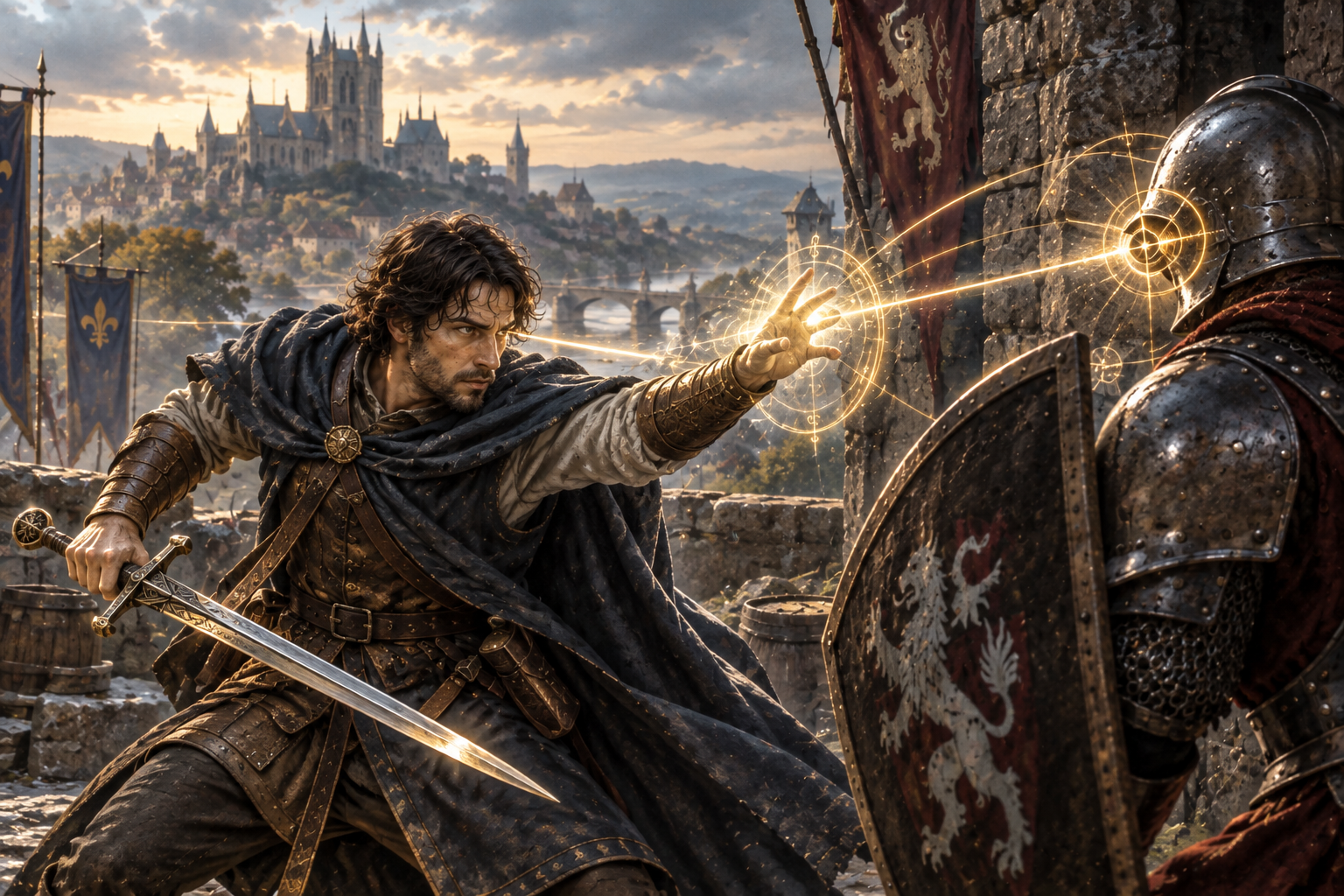
What Does True Strike Do?
True Strike uses magical foresight to make one attack unusually precise. The exact benefit depends on the ruleset: the spell may guide a weapon attack as it is made, grant advantage on a later attack, or provide an overwhelming insight bonus to the next strike.
The spell is about timing and certainty. It does not make the caster invulnerable, automatically produce a critical hit, or guarantee that an attack succeeds.
True Strike Game Statistics
Choose the edition being played. Each rules panel is self-contained.
D&D 5.5e / 2024
True Strike
Divination Cantrip — Bard, Sorcerer, Warlock, Wizard
Casting Time: Action
Range: Self
Components: S, M (a weapon with which you have proficiency and that is worth at least 1 CP)
Duration: Instantaneous
Guided by a flash of magical insight, you make one attack with the weapon used as the spell’s material component.
For that attack, use your spellcasting ability modifier for the attack roll and the weapon’s damage roll instead of using Strength or Dexterity.
If the attack deals damage, you can choose for the weapon to deal Radiant damage instead of its normal damage type.
Cantrip Upgrade
The attack deals additional Radiant damage when you reach higher character levels:
- Level 5: +1d6 Radiant damage.
- Level 11: +2d6 Radiant damage.
- Level 17: +3d6 Radiant damage.
Rules Clarifications
The weapon attack happens as part of the spell’s Action. True Strike does not create a benefit that waits until a later turn.
The spell does not itself grant Advantage. Apply Advantage, Disadvantage and other attack modifiers normally when another rule supplies them.
A ranged weapon can be used if it satisfies the spell’s material-component requirement. Resolve the weapon attack using that weapon’s normal rules.
D&D 5e / 2014
True Strike
Divination Cantrip — Bard, Sorcerer, Warlock, Wizard
Casting Time: 1 action
Range: 30 feet
Components: S
Duration: Concentration, up to 1 round
Choose a creature within range and point toward it. Your magic gives you a brief insight into that creature’s defences.
Provided the spell is still active, on your next turn you gain advantage on your first attack roll against the chosen creature.
Rules Clarifications
The benefit applies only to the first attack roll you make against the chosen target on your next turn.
If your Concentration ends before that attack, the benefit ends with the spell.
True Strike affects the attack roll. It does not increase the damage of the attack.
Pathfinder First Edition
True Strike
School: Divination; Level: Sorcerer/Wizard 1
Casting
Casting Time: 1 standard action
Components: V, F (a small wooden replica of an archery target)
Effect
Range: Personal
Target: You
Duration: See text
Description
You gain a moment of intuitive knowledge concerning the immediate future of your next attack.
Your next single attack roll gains a +20 insight bonus, provided the attack is made before the end of the next round.
That attack also ignores the miss chance normally imposed by concealment.
Rules Clarifications
The +20 bonus is an insight bonus and follows the normal rules for bonuses of the same type.
Only one attack receives the bonus. Once that attack is made, the benefit is discharged.
Ignoring the concealment miss chance for the attack does not reveal the concealed creature or remove concealment for anyone else.
D&D 3.5e
True Strike
School: Divination
Level: Sorcerer/Wizard 1
Components: V, F
Casting Time: 1 standard action
Range: Personal
Target: You
Duration: See text
You gain temporary intuitive insight into the immediate future of your next attack.
Your next single attack roll gains a +20 insight bonus if that attack is made before the end of the next round.
The attack also ignores the miss chance normally imposed by concealment.
Focus
A small wooden replica of an archery target.
Rules Clarifications
The benefit applies to one attack roll and is discharged when that attack is made.
A natural 1 remains subject to the normal rules for attack rolls. The spell provides extraordinary accuracy rather than an automatic hit.
Ignoring concealment’s miss chance does not otherwise reveal the target or remove its concealment.
What Changed Between Editions?
True Strike keeps the same basic theme—magical certainty applied to one important attack—but its actual combat function changes substantially between rulesets.
| Change | 5.5e / 2024 | 5e / 2014 | Pathfinder 1e | D&D 3.5e |
|---|---|---|---|---|
| Spell level | Cantrip | Cantrip | 1st-level Sorcerer/Wizard spell | |
| Timing | The weapon attack is made while casting the spell. | The spell prepares advantage for the first qualifying attack on your next turn. | The spell prepares a bonus for the next single attack made before the end of the next round. | |
| Range | Self | 30 feet; choose a creature. | Personal; target yourself. | |
| Accuracy | Use your spellcasting ability for the weapon’s attack and damage rolls. | Advantage on the first attack roll against the chosen target on your next turn. | +20 insight bonus on the next single attack roll. | |
| Damage | The weapon can deal Radiant damage and gains additional Radiant damage as character level increases. | No additional damage from the spell. | No additional damage from the spell. | |
| Concealment | No special concealment rule. | No special concealment rule. | The affected attack ignores the normal concealment miss chance. | |
| Components | Somatic plus the weapon used for the attack as the material component. | Somatic only. | Verbal plus a small wooden replica of an archery target as focus. | |
| Scaling | Additional Radiant damage at character levels 5, 11 and 17. | No built-in scaling. | No built-in scaling. | |
Video: True Strike in 5e / 2014
The original SpiralWorlds True Strike page included this video discussion of the spell. It is preserved here because it remains useful commentary on the 5e / 2014 version of True Strike.
The video predates the substantially revised 5.5e / 2024 version, so its discussion should not be treated as an explanation of the modern weapon-attack cantrip.
This video discusses the earlier 5e / 2014 concentration-and-advantage form of True Strike. Use the 5.5e / 2024 rules tab above for the current modern version.
Using True Strike in Play
True Strike rewards a character who can identify the attack that matters most. Its identity is not a flurry of blows but a moment of concentration in which one opening becomes more important than everything around it.
Strong Uses
- Opening a formal duel with a carefully chosen attack.
- Committing to a strike against a dangerous or high-value opponent.
- Using a weapon when magical precision matters more than ordinary physical ability.
- Making an attack whose secondary effect becomes especially valuable if the attack connects.
- Exploiting a narrow tactical opening before an enemy can change position.
Choose the Attack That Matters
A routine blow against an unimportant enemy wastes the central idea of True Strike.
Its most memorable use is against the champion holding the doorway, the rider about to escape, the creature protecting a vulnerable ally, the guard controlling a gate, or the enemy whose defeat will change the direction of the encounter.
Common Rulings
Does True Strike Guarantee a Hit?
No. Resolve the attack roll normally using the benefit supplied by the edition being played.
Does True Strike Automatically Cause a Critical Hit?
No. Nothing in the spell automatically turns the affected attack into a critical hit.
Can It Be Used with a Ranged Weapon?
Yes when the weapon and attack satisfy the rules of the relevant edition. True Strike is not inherently restricted to melee combat.
Does It Reveal an Invisible or Concealed Creature?
No. True Strike is a spell of combat foresight rather than a detection spell. Pathfinder 1e and D&D 3.5e allow the affected attack to ignore the normal concealment miss chance, but that does not itself reveal the creature.
True Strike in the Campaign World
True Strike is taught where divination and martial training overlap. A scholar may understand its principles from books, but dependable battlefield use requires practice with movement, weapons, distance and fear.
Courtly fencing masters may teach the spell beside guards, counters and footwork. Military magicians practise against moving targets in castle yards. University-trained natural philosophers may approach the magic through theories of motion, probability and perception, while private circles preserve their own methods of recognising the instant in which an opponent becomes vulnerable.
The caster need not perceive an entire future. The spell may reveal only a fraction of a second: the place a sword will be, the gap a shield will leave, the instant a horse will turn, or the line along which an arrow can pass.
Duels and Judicial Combat
True Strike is particularly feared in formal single combat. A champion known to use divination may provoke demands for magical inspection, negotiated restrictions, counter-diviners or witnesses capable of recognising spellcasting.
Mercenaries and Battlefield Magicians
A mercenary captain cares less about the philosophy of foresight than whether the spell can help bring down an enemy officer, gate guard, mounted messenger or other target at the critical moment.
A spellcaster who can use divination while fighting with steel therefore occupies a different military role from a magician who remains behind the battle line.
Learning the Spell
Training commonly uses wooden weapons, moving targets, suspended rings, changing distances and deliberately deceptive footwork. The difficult part is not merely receiving the magical insight. The caster must act before the opening disappears.
Historical & Mythic Context
Late medieval fighting culture provides an unusually close historical parallel for the idea behind True Strike: martial expertise appearing beside practices intended to predict the outcome of combat.
The Metropolitan Museum of Art’s study of Hans Talhoffer’s fight-book tradition describes Talhoffer as a renowned fifteenth-century master at arms whose material includes judicial combat, weapon techniques and a rare treatise on onomancy—the art of foreseeing the outcome of a duel.
The associated onomantic tradition analysed the names of fighters and the dates of their duels in an attempt to determine which combatant would prevail. Martial training, calculation and divination could therefore appear together within the intellectual world surrounding late medieval combat.
The Wellcome Collection preserves another medieval example of onomantic calculation used to predict binary outcomes including whether a person would live or die and the outcome of a duel or battle.
In the campaign world, True Strike turns that desire for certainty into immediate magic. Where an onomancer might work through names, numbers, planetary weekdays and diagrams, the spellcaster receives the answer in the instant before steel meets steel.
True Strike FAQ
Is True Strike a cantrip?
It is a cantrip in D&D 5.5e/2024 and D&D 5e/2014. Pathfinder 1e and D&D 3.5e present it as a 1st-level Sorcerer/Wizard spell.
Does True Strike give +20 to an attack?
Pathfinder 1e and D&D 3.5e grant a +20 insight bonus to the next qualifying attack roll. The D&D 5e versions use different mechanics.
Does 2024 True Strike grant Advantage?
No. The 2024 spell makes a weapon attack as part of its casting and lets the caster use their spellcasting ability for that attack and its damage roll.
Can True Strike be used with a ranged weapon?
Yes when the chosen weapon and attack satisfy the requirements of the relevant ruleset.
Does True Strike reveal an invisible creature?
No. The spell is not a detection effect. Any interaction with concealment is limited to the specific rules printed for that edition.
What might True Strike look like when cast?
The caster might glimpse an opponent’s next movement, see a momentary line showing the correct attack, feel a weapon pull toward an opening, or perceive several possible motions before one suddenly becomes certain.
Sources, Attribution & Licensing
- D&D 5.5e / 2024: System Reference Document 5.2.1 and the D&D 2024 spell description for True Strike.
- D&D 5e / 2014: System Reference Document 5.1 / 2014 True Strike spell.
- Pathfinder Roleplaying Game Core Rulebook PRD — True Strike .
- Revised D&D 3.5 System Reference Document — True Strike .
- The Metropolitan Museum of Art — Hans Talhoffer’s Fight Book .
- Wellcome Collection — Ars computistica with astrological and divinatory material .
Creative Commons Material
This work includes material from the System Reference Document 5.2.1 and System Reference Document 5.1 by Wizards of the Coast LLC. Applicable SRD material is used under the Creative Commons Attribution 4.0 International Licence .
Open Game Content
Mechanical rules material inside the Pathfinder 1e and D&D 3.5e mechanics panels is designated Open Game Content only to the extent that it derives from material already released as Open Game Content under the Open Game License version 1.0a.
No other portion of this page is designated Open Game Content. SpiralWorlds setting material, historical synthesis, campaign material, tactical guidance, explanatory prose, artwork, CSS, page design and editorial presentation are excluded from that designation.
Open Game License v1.0a + applicable Section 15 notices
OPEN GAME LICENSE Version 1.0a
The following text is the property of Wizards of the Coast, Inc. and is Copyright 2000 Wizards of the Coast, Inc (“Wizards”). All Rights Reserved.
1. Definitions: (a) “Contributors” means the copyright and/or trademark owners who have contributed Open Game Content; (b) “Derivative Material” means copyrighted material including derivative works and translations (including into other computer languages), potation, modification, correction, addition, extension, upgrade, improvement, compilation, abridgment or other form in which an existing work may be recast, transformed or adapted; (c) “Distribute” means to reproduce, license, rent, lease, sell, broadcast, publicly display, transmit or otherwise distribute; (d) “Open Game Content” means the game mechanic and includes the methods, procedures, processes and routines to the extent such content does not embody the Product Identity and is an enhancement over the prior art and any additional content clearly identified as Open Game Content by the Contributor, and means any work covered by this License, including translations and derivative works under copyright law, but specifically excludes Product Identity; (e) “Product Identity” means product and product line names, logos and identifying marks including trade dress; artifacts; creatures characters; stories, storylines, plots, thematic elements, dialogue, incidents, language, artwork, symbols, designs, depictions, likenesses, formats, poses, concepts, themes and graphic, photographic and other visual or audio representations; names and descriptions of characters, spells, enchantments, personalities, teams, personas, likenesses and special abilities; places, locations, environments, creatures, equipment, magical or supernatural abilities or effects, logos, symbols, or graphic designs; and any other trademark or registered trademark clearly identified as Product identity by the owner of the Product Identity, and which specifically excludes the Open Game Content; (f) “Trademark” means the logos, names, mark, sign, motto, designs that are used by a Contributor to identify itself or its products or the associated products contributed to the Open Game License by the Contributor; (g) “Use”, “Used” or “Using” means to use, Distribute, copy, edit, format, modify, translate and otherwise create Derivative Material of Open Game Content; (h) “You” or “Your” means the licensee in terms of this agreement.
2. The License: This License applies to any Open Game Content that contains a notice indicating that the Open Game Content may only be Used under and in terms of this License. You must affix such a notice to any Open Game Content that you Use. No terms may be added to or subtracted from this License except as described by the License itself. No other terms or conditions may be applied to any Open Game Content distributed using this License.
3. Offer and Acceptance: By Using the Open Game Content You indicate Your acceptance of the terms of this License.
4. Grant and Consideration: In consideration for agreeing to use this License, the Contributors grant You a perpetual, worldwide, royalty-free, non-exclusive license with the exact terms of this License to Use, the Open Game Content.
5. Representation of Authority to Contribute: If You are contributing original material as Open Game Content, You represent that Your Contributions are Your original creation and/or You have sufficient rights to grant the rights conveyed by this License.
6. Notice of License Copyright: You must update the COPYRIGHT NOTICE portion of this License to include the exact text of the COPYRIGHT NOTICE of any Open Game Content You are copying, modifying or distributing, and You must add the title, the copyright date, and the copyright holder’s name to the COPYRIGHT NOTICE of any original Open Game Content you Distribute.
7. Use of Product Identity: You agree not to Use any Product Identity, including as an indication as to compatibility, except as expressly licensed in another, independent Agreement with the owner of each element of that Product Identity.
You agree not to indicate compatibility or co-adaptability with any Trademark or Registered Trademark in conjunction with a work containing Open Game Content except as expressly licensed in another, independent Agreement with the owner of such Trademark or Registered Trademark. The use of any Product Identity in Open Game Content does not constitute a challenge to the ownership of that Product Identity.
The owner of any Product Identity used in Open Game Content shall retain all rights, title and interest in and to that Product Identity.
8. Identification: If you distribute Open Game Content You must clearly indicate which portions of the work that you are distributing are Open Game Content.
9. Updating the License: Wizards or its designated Agents may publish updated versions of this License. You may use any authorized version of this License to copy, modify and distribute any Open Game Content originally distributed under any version of this License.
10. Copy of this License: You MUST include a copy of this License with every copy of the Open Game Content You Distribute.
11. Use of Contributor Credits: You may not market or advertise the Open Game Content using the name of any Contributor unless You have written permission from the Contributor to do so.
12. Inability to Comply: If it is impossible for You to comply with the terms of this License with respect to some or all of the Open Game Content due to statute, judicial order, or governmental regulation then You may not Use any Open Game Material so affected.
13. Termination: This License will terminate automatically if You fail to comply with all terms herein and fail to cure such breach within 30 days of becoming aware of the breach. All sublicenses shall survive the termination of this License.
14. Reformation: If any provision of this License is held to be unenforceable, such provision shall be reformed only to the extent necessary to make it enforceable.
15. COPYRIGHT NOTICE
Open Game License v 1.0a Copyright 2000, Wizards of the Coast, Inc.
System Reference Document. Copyright 2000, Wizards of the Coast, Inc.; Authors Jonathan Tweet, Monte Cook, Skip Williams, based on material by E. Gary Gygax and Dave Arneson.
Pathfinder Roleplaying Game Core Rulebook. Copyright 2009, Paizo Publishing, LLC; Author: Jason Bulmahn, based on material by Jonathan Tweet, Monte Cook, and Skip Williams.
END OF LICENSE
Keep this reference growing
If this page helped with your reading or game, you can support its upkeep or explore the curated books.
Explore the Bookshop — epics, classics and stories behind imagined worlds.