
Conjuration • Calling and Negotiating with Outsiders
Planar Ally, Lesser

An envoy arrives from beyond the world, but it is not a servant bound to obey. The caller petitions an otherworldly power to send a lesser ally, then bargains for a precise service. Offerings open the way; the visitor chooses whether the terms are acceptable. Pathfinder and D&D 3.5e use their published fourth-level calling mechanics, while the two fifth-edition tabs provide optional lesser adaptations distinct from official sixth-level Planar Ally.
Lesser Planar Ally at a Glance
| 5.5e / 2024 | Optional conversion: 4th-level Conjuration, Cleric or campaign Witch; a willing CR 2-or-lower Celestial, Elemental or Fiend, 10 minutes, negotiated service |
|---|---|
| 5e / 2014 | Optional conversion: 4th-level conjuration, Cleric or campaign Witch; CR 2-or-lower ally, 10-minute casting time, payment and consent required |
| Pathfinder 1e | Official Cleric 4: one called Outsider of up to 6 HD; 500 gp offerings plus separately negotiated payment; 10-minute casting time |
| D&D 3.5e | Official Cleric 4: one called Elemental or Outsider of up to 6 HD; 100 XP casting cost plus payment; 10-minute casting time |
| Browse | Cleric spells • Witch spell archive |
Important: the official 2024 and 2014 Planar Ally spells are 6th-level Conjuration, not lesser 4th-level spells. The modern tabs below contain clearly labelled, complete optional 4th-level adaptations; their creature limits and payment suggestions must never be presented as published 5e rules. The two older panels retain their official 6-Hit-Die calling mechanics.
Spell Rules
Lesser Planar Ally — 5.5e / 2024
Optional 2024 rules conversion — not an official spell. This original fourth-level version is available only if the Games Master authorises it. The actual 2024 Planar Ally is a separate 6th-level spell for Clerics.
| Level / School | 4th-level Conjuration |
|---|---|
| Suggested Classes | Cleric; optional Witch by campaign permission |
| Casting Time | 10 minutes (not a Ritual) |
| Range | 60 feet |
| Components | V, S, M (an offering worth 100 gp, consumed) |
| Duration | Instantaneous; the agreed service lasts up to one hour |
| Effect | One willing Celestial, Elemental or Fiend chosen by the Games Master, Challenge Rating 2 or lower |
| Saving Throw | None |
| Damage | None |
| Agreement | Bargained service only; the creature is not compelled |
Calling, not commanding. Name a known otherworldly patron or power that might send a servant. The Games Master chooses one willing Celestial, Elemental or Fiend of Challenge Rating 2 or lower from that power’s allies; you may request a particular creature by name, but the patron is not obliged to send it. The creature appears in an unoccupied space within 60 feet and is genuinely present on the world. It is not under your control or automatically Friendly.
One negotiated task. You must be able to communicate with the visitor. Bargaining takes at least one round; it can act on an agreed service no earlier than the next round. It can refuse a demand, set conditions or request a nonmonetary payment. The service may last for no more than one hour, even if completed earlier. When the service ends or a bargain cannot be reached, the visitor returns to its home plane. This spell does not confer mind control, a permanent companion or a new monster stat block.
Payments — this optional conversion only. The 100 gp offering is consumed during casting whether or not a bargain succeeds. For one nonhazardous task lasting up to 10 minutes, suggested additional payment is 50 gp; for up to one hour, 250 gp. The service payment can take the form of treasure, a donation or a clearly defined quest. The Games Master may halve the service fee for an especially suitable request, double it for a dangerous task, or have the ally reject a suicidal demand. These costs are not the official 2024/2014 Planar Ally prices and do not derive from Pathfinder’s gp-per-Hit-Die schedule.
Failure and protections. A patron may decline to answer or send an unhelpful envoy, at the Games Master’s discretion; the casting offering is still spent. The called creature is not a disposable summoned spirit: it can be attacked and injured, and death has whatever consequences its stat block and the campaign’s plane rules specify. Magic that prevents planar arrival or travel may block the effect. This instantaneous casting does not require Concentration after the creature appears.
Example. A seventh-level Cleric calls a CR 2-or-lower messenger and bargains for ten minutes of scouting. The spell consumes 100 gp in offerings. A standard nonhazardous ten-minute task suggests 50 gp more in service payment, for 150 gp total; the visitor must still agree. No edition’s official sixth-level Planar Ally mechanics have been substituted for this homebrew variant.
Lesser Planar Ally — 5e / 2014
Optional 2014 rules conversion — not an official spell. This original fourth-level version is available only if the Games Master authorises it. The actual 2014 Planar Ally is a separate 6th-level spell for Clerics.
| Level / School | 4th-level conjuration |
|---|---|
| Suggested Classes | Cleric; optional Witch by campaign permission |
| Casting Time | 10 minutes (not a Ritual) |
| Range | 60 feet |
| Components | V, S, M (an offering worth 100 gp, consumed) |
| Duration | Instantaneous; the agreed service lasts up to one hour |
| Effect | One willing Celestial, Elemental or Fiend chosen by the Games Master, Challenge Rating 2 or lower |
| Saving Throw | None |
| Damage | None |
| Agreement | Bargained service only; the creature is not compelled |
Calling, not commanding. Name a known otherworldly patron or power that might send a servant. The Games Master chooses one willing Celestial, Elemental or Fiend of Challenge Rating 2 or lower from that power’s allies; you may request a particular creature by name, but the patron is not obliged to send it. The creature appears in an unoccupied space within 60 feet and is genuinely present on the world. It is not under your control or automatically Friendly.
One negotiated task. You must be able to communicate with the visitor. Bargaining takes at least one round; it can act on an agreed service no earlier than the next round. It can refuse a demand, set conditions or request a nonmonetary payment. The service may last for no more than one hour, even if completed earlier. When the service ends or a bargain cannot be reached, the visitor returns to its home plane. This spell does not confer mind control, a permanent companion or a new monster stat block.
Payments — this optional conversion only. The 100 gp offering is consumed during casting whether or not a bargain succeeds. For one nonhazardous task lasting up to 10 minutes, suggested additional payment is 50 gp; for up to one hour, 250 gp. The service payment can take the form of treasure, a donation or a clearly defined quest. The Games Master may halve the service fee for an especially suitable request, double it for a dangerous task, or have the ally reject a suicidal demand. These costs are not the official 2024/2014 Planar Ally prices and do not derive from Pathfinder’s gp-per-Hit-Die schedule.
Failure and protections. A patron may decline to answer or send an unhelpful envoy, at the Games Master’s discretion; the casting offering is still spent. The called creature is not a disposable summoned spirit: it can be attacked and injured, and death has whatever consequences its stat block and the campaign’s plane rules specify. Magic that prevents planar arrival or travel may block the effect. This instantaneous casting does not require Concentration after the creature appears.
Example. A seventh-level Cleric calls a CR 2-or-lower messenger and bargains for ten minutes of scouting. The spell consumes 100 gp in offerings. A standard nonhazardous ten-minute task suggests 50 gp more in service payment, for 150 gp total; the visitor must still agree. No edition’s official sixth-level Planar Ally mechanics have been substituted for this homebrew variant.
Planar Ally, Lesser — Pathfinder 1e
Cleric spell level 4. Edition source.
| School | conjuration (calling) [see text] |
|---|---|
| Level | cleric 4 |
| Casting Time | 10 minutes |
| Components | V, S, M (offerings worth 500 gp plus payment, see text), DF |
| Range | close (25 ft. + 5 ft./2 levels) |
| Effect | one called outsider of 6 HD or less |
| Duration | instantaneous |
| Saving Throw | none |
| Spell Resistance | no |
By casting this spell, you request your deity to send you an outsider (of 6 HD or less) of the deity’s choice. If you serve no particular deity, the spell is a general plea answered by a creature sharing your philosophical alignment. If you know an individual creature’s name, you may request that individual by speaking the name during the spell (though you might get a different creature anyway).
You may ask the creature to perform one task in exchange for a payment from you. Tasks might range from the simple to the complex. You must be able to communicate with the creature called in order to bargain for its services.
The creature called requires a payment for its services. This payment can take a variety of forms, from donating gold or magic items to an allied temple, to a gift given directly to the creature, to some other action on your part that matches the creature’s alignment and goals. Regardless, this payment must be made before the creature agrees to perform any services. The bargaining takes at least 1 round, so any actions by the creature begin in the round after it arrives.
A task taking up to 1 minute per caster level requires a payment of 100 gp per HD of the creature called. For a task taking up to 1 hour per caster level, the creature requires a payment of 500 gp per HD. A long-term task, one requiring up to 1 day per caster level, requires a payment of 1,000 gp per HD.
A nonhazardous task requires only half the indicated payment, while an especially hazardous task might require a greater gift. Few if any creatures will accept a task that seems suicidal (remember, a called creature actually dies when it is killed, unlike a summoned creature). However, if the task is strongly aligned with the creature’s ethos, it may halve or even waive the payment.
At the end of its task, or when the duration bargained for expires, the creature returns to its home plane (after reporting back to you, if appropriate and possible).
Note: When you use a calling spell that calls an air, chaotic, earth, evil, fire, good, lawful, or water creature, it is a spell of that type.
Planar Ally, Lesser — D&D 3.5e
Cleric spell level 4. Edition source.
| School | Conjuration (Calling) [see text] |
|---|---|
| Level | Clr 4 |
| Components | V, S, DF, XP |
| Casting Time | 10 minutes |
| Range | Close (25 ft. + 5 ft./2 levels) |
| Effect | One called elemental or outsider of 6 HD or less |
| Duration | Instantaneous |
| Saving Throw | None |
| Spell Resistance | No |
By casting this spell, you request your deity to send you an elemental or outsider (of 6 HD or less) of the deity’s choice. If you serve no particular deity, the spell is a general plea answered by a creature sharing your philosophical alignment. If you know an individual creature’s name, you may request that individual by speaking the name during the spell (though you might get a different creature anyway).
You may ask the creature to perform one task in exchange for a payment from you. Tasks might range from the simple to the complex. You must be able to communicate with the creature called in order to bargain for its services.
The creature called requires a payment for its services. This payment can take a variety of forms, from donating gold or magic items to an allied temple, to a gift given directly to the creature, to some other action on your part that matches the creature’s alignment and goals. Regardless, this payment must be made before the creature agrees to perform any services. The bargaining takes at least 1 round, so any actions by the creature begin in the round after it arrives.
A task taking up to 1 minute per caster level requires a payment of 100 gp per HD of the creature called. For a task taking up to 1 hour per caster level, the creature requires a payment of 500 gp per HD. A long-term task, one requiring up to one day per caster level, requires a payment of 1,000 gp per HD.
A nonhazardous task requires only half the indicated payment, while an especially hazardous task might require a greater gift. Few if any creatures will accept a task that seems suicidal (remember, a called creature actually dies when it is killed, unlike a summoned creature). However, if the task is strongly aligned with the creature’s ethos, it may halve or even waive the payment.
At the end of its task, or when the duration bargained for expires, the creature returns to its home plane (after reporting back to you, if appropriate and possible).
Note: When you use a calling spell that calls an air, chaotic, earth, evil, fire, good, lawful, or water creature, it is a spell of that type.
XP Cost: 100 XP.
Edition Status
| 5.5e / 2024 | Optional 4th-level conversion: complete calling and payment mechanics appear in the 2024 tab; the published Planar Ally remains a separate 6th-level Cleric spell. |
|---|---|
| 5e / 2014 | Optional 4th-level conversion: complete 2014-formatted mechanics appear in that tab; there is no official spell by this exact lesser name. |
| Pathfinder 1e | Official Cleric 4 spell with its 6-Hit-Die Outsider limit, 500 gp offerings and a service-payment schedule. |
| D&D 3.5e | Official Cleric 4 spell allowing an Elemental or Outsider of up to 6 Hit Dice, with a 100 XP casting cost and negotiated service payment. |
What Changed?
- 5.5e / 2024: the optional 4th-level spell calls a willing Celestial, Elemental or Fiend of Challenge Rating 2 or lower. Casting consumes a 100 gp offering; an agreed task lasts at most one hour. The published Planar Ally is a separate 6th-level spell with different payment and service rules.
- 5e / 2014: the optional version uses 2014 action and spell terminology, still without domination or automatic service. It is not the published 2014 6th-level Planar Ally.
- Pathfinder 1e: the deity or allied patron sends one Outsider of up to 6 Hit Dice. Casting costs 500 gp in offerings, plus a payment negotiated by task duration and the creature’s Hit Dice.
- D&D 3.5e: the spell can call either an Elemental or an Outsider of up to 6 Hit Dice, expends 100 XP in casting and then negotiates payment; there is no 500 gp Pathfinder material offering.
- All editions: this is calling, not mind control. The ally retains its will, and payment or a mutually accepted task is required before service.
Using Lesser Planar Ally in Play
The spell is most useful when the service matters more than the called creature’s combat strength: finding a planar guide, securing the testimony of an outsider, arranging passage through a dangerous region, or bargaining for one specialised task. A called being is a negotiator and potential ally, not a puppet.
What Do You Ask the Ally to Do?
Decide what the characters need before calling. A messenger can carry a warning across hostile territory; a creature familiar with planar roads can identify a route; a guard may protect a ritual circle for a short time. State the task’s objective, deadline, dangers and proposed payment before bargaining.
The Games Master determines which being answers the call and whether it can provide the requested service. An offer that conflicts with the creature’s nature, obligations or survival may be refused even when the caster has wealth enough to pay.

The Price of a Promise
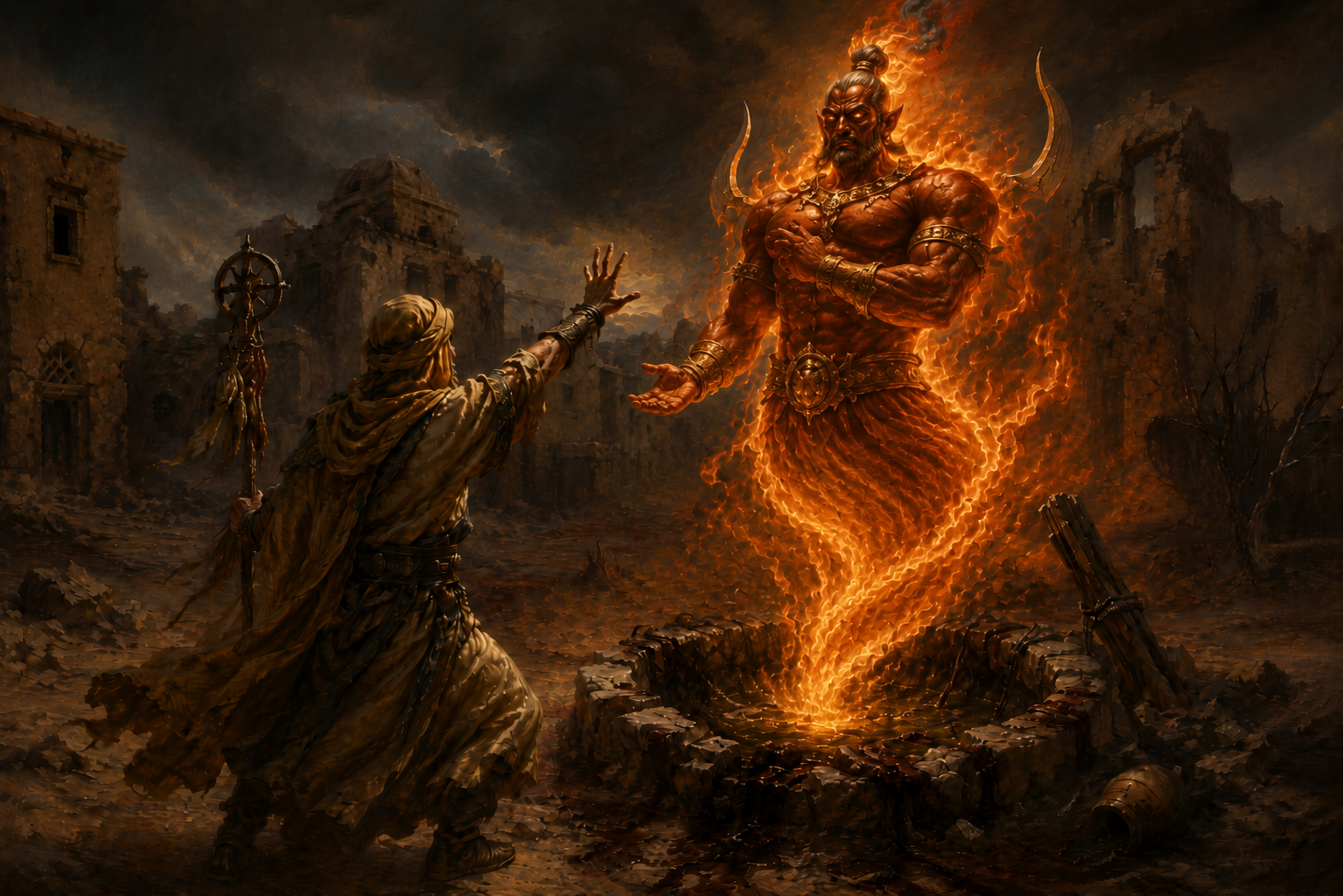
Offerings and service payments are different expenses. Pathfinder uses a 500 gp offering as a spell component and separate payment tied to the outsider’s Hit Dice and task duration. D&D 3.5e instead charges 100 XP for the casting and then negotiates service payment. The optional 2024 and 2014 variants have their own clearly designated lower-level costs in the appropriate tabs.
Make the agreement clear: who serves, what they will do, how long they will remain, what payment they receive, and what conditions let either side end the bargain. If an agreement fails, the caller still expends the cost of casting. Do not turn an instantaneous calling effect into a Concentration summon that follows every command.
Counterplay and Rulings
Visible clue. A newly called being appears near a ritual petitioner, without behaving like an automatically obedient combat summon. Payment, introductions and bargaining should occur before work begins.
Detection. Knowledge of planar creatures, their languages and their loyalties can help identify what was sent and whether it could actually accomplish the offered task. In the legacy rules the visitor is chosen by the petitioned deity or by a power sharing the caller’s alignment, not dictated by a shopping list of stat blocks.
Interruption. Prevent the ten-minute casting from finishing, or use appropriate Counterspell rules where available. Wards that bar planar travel may obstruct the arrival. After an instantaneous calling has resolved, Dispel Magic does not automatically dismiss a fully independent creature.
Contract. The ally is not dominated and can reject suicidal, hazardous or ill-defined demands. Resolve its speech, requests and compensation before beginning its service. A creature with no common means of communication cannot successfully negotiate the bargain without translation.
Payment. Pathfinder: 500 gp offerings plus the HD-based agreed fee. D&D 3.5e: 100 XP casting cost plus negotiated fee. Optional modern conversions: the specifically labelled 100 gp offering and separate service proposal. Do not import any one edition’s numbers into another.
When service ends. The called creature returns to its home plane after the task or agreed period, if possible; it is not a permanent party member. A completed calling is not equivalent to concentrating on an ordinary summoning spell.
Worked Examples: The Price of Aid
Pathfinder 1e — an 8th-level Cleric
An 8th-level Cleric calls a 6-Hit-Die Outsider for a task that lasts no longer than 8 minutes (one minute per caster level). The spell requires 500 gp in offerings as its material component. The normal service payment is 100 gp × 6 HD = 600 gp, making the combined cost 1,100 gp. A nonhazardous task ordinarily reduces the negotiated service payment to 300 gp, but not the 500 gp component, making a combined 800 gp. A task that can take up to 8 hours instead has the base service payment of 500 gp × 6 HD = 3,000 gp in addition to offerings.
D&D 3.5e — an 8th-level Cleric
The caster requests a 6-Hit-Die Elemental or Outsider and pays the spell’s 100 XP casting cost. For a task of at most 8 minutes, the regular service payment is 600 gp (100 gp × 6 HD). A longer 8-hour service costs 3,000 gp before hazard or ethos adjustments. Unlike Pathfinder, the 3.5e spell does not require the Pathfinder 500 gp offering; the 100 XP cost is separate from any service fee.
2024 and 2014 — optional lesser conversion
A 7th-level Cleric requests a small planar messenger, which the Games Master chooses from suitable CR 2-or-lower Celestials, Elementals or Fiends. The caller expends 100 gp of offerings while casting. The messenger agrees to a ten-minute nonhazardous errand for the suggested extra 50 gp, making 150 gp total. If it refuses, the offering is still spent and no work is done. This formula is a homebrew design for the lesser spell; it is not the official sixth-level Planar Ally price table.
Mythical Context
In Book One of Homer’s Iliad, Achilles calls upon his mother Thetis, who then petitions Zeus on his behalf. The appeal depends on a relationship and the granting of a favour, not on the son commanding a greater power. Lesser Planar Ally draws upon a similar pattern: an intermediary is asked for help, and the nature of the requested service matters.
Hermes, too, travels between the divine and mortal worlds as messenger and guide. Stories of divine envoys make a natural mythic parallel for a visiting otherworldly ally without suggesting that a game spell’s numerical limits appear in ancient texts.
Thetis and the appeal to Zeus — ancient Greek sources · Hermes, messenger and guide
Historical Context
In the ancient Greek world, petitioners travelled to sanctuaries to seek advice and favour from the gods. Delphi became especially renowned for the oracle of Apollo, where ritual offerings and consultation formed part of an enduring civic and religious institution. Such records give historical context for reciprocal petitions and costly gifts; they are not evidence that a real planar creature was summoned or compelled to serve.
Related Magic
Rules Sources and Licensing
2024 reference: Planar Ally (2024), a published 6th-level Conjuration spell for Clerics; its rules derive from SRD 5.2.1, available under Creative Commons Attribution 4.0. 2014 reference: Planar Ally (2014), likewise 6th level, with separately established rules in SRD 5.1. The fourth-level lesser mechanics above are original optional adaptations; their CR cap, spell offerings and negotiated fee suggestions are not official 5e rules.
Pathfinder 1e: Planar Ally, Lesser — Core Rulebook, including a 500 gp offering, a called Outsider of up to 6 HD and the payment-by-task schedule. D&D 3.5e: Planar Ally, Lesser — SRD, including a 100 XP cost and an Elemental or Outsider of up to 6 HD. These legacy spell mechanics are Open Game Content under the Open Game License v1.0a. The complete licence and inherited Section 15 notices are retained below. Artwork, optional modern conversions, original campaign prose, and added play examples are not claimed as third-party Open Game Content.
Open Game License v1.0a and copyright notices
Permission to copy, modify and distribute the files collectively known as the System Reference Document (“SRD”) is granted solely through the use of the Open Gaming License, Version 1.0a.
This material is being released using the Open Gaming License Version 1.0a and you should read and understand the terms of that license before using this material.
The text of the Open Gaming License itself is not Open Game Content. Instructions on using the License are provided within the License itself.
The following items are designated Product Identity, as defined in Section 1(e) of the Open Game License Version 1.0a, and are subject to the conditions set forth in Section 7 of the OGL, and are not Open Content: Dungeons & Dragons, D&D, Player’s Handbook, Dungeon Master, Monster Manual, d20 System, Wizards of the Coast, d20 (when used as a trademark), Forgotten Realms, Faerûn, proper names (including those used in the names of spells or items), places, Red Wizard of Thay, the City of Union, Heroic Domains of Ysgard, Ever-Changing Chaos of Limbo, Windswept Depths of Pandemonium, Infinite Layers of the Abyss, Tarterian Depths of Carceri, Gray Waste of Hades, Bleak Eternity of Gehenna, Nine Hells of Baator, Infernal Battlefield of Acheron, Clockwork Nirvana of Mechanus, Peaceable Kingdoms of Arcadia, Seven Mounting Heavens of Celestia, Twin Paradises of Bytopia, Blessed Fields of Elysium, Wilderness of the Beastlands, Olympian Glades of Arborea, Concordant Domain of the Outlands, Sigil, Lady of Pain, Book of Exalted Deeds, Book of Vile Darkness, beholder, gauth, carrion crawler, tanar’ri, baatezu, displacer beast, githyanki, githzerai, mind flayer, illithid, umber hulk, yuan-ti.
All of the rest of the SRD is Open Game Content as described in Section 1(d) of the License.
More information on the Open Game License can be found at www.wizards.com/d20.
The terms of the Open Gaming License Version 1.0a are as follows:
OPEN GAME LICENSE Version 1.0a
The following text is the property of Wizards of the Coast, Inc. and is Copyright 2000 Wizards of the Coast, Inc (“Wizards”). All Rights Reserved.
1. Definitions: (a)”Contributors” means the copyright and/or trademark owners who have contributed Open Game Content; (b)”Derivative Material” means copyrighted material including derivative works and translations (including into other computer languages), potation, modification, correction, addition, extension, upgrade, improvement, compilation, abridgment or other form in which an existing work may be recast, transformed or adapted; (c) “Distribute” means to reproduce, license, rent, lease, sell, broadcast, publicly display, transmit or otherwise distribute; (d)”Open Game Content” means the game mechanic and includes the methods, procedures, processes and routines to the extent such content does not embody the Product Identity and is an enhancement over the prior art and any additional content clearly identified as Open Game Content by the Contributor, and means any work covered by this License, including translations and derivative works under copyright law, but specifically excludes Product Identity. (e) “Product Identity” means product and product line names, logos and identifying marks including trade dress; artifacts; creatures characters; stories, storylines, plots, thematic elements, dialogue, incidents, language, artwork, symbols, designs, depictions, likenesses, formats, poses, concepts, themes and graphic, photographic and other visual or audio representations; names and descriptions of characters, spells, enchantments, personalities, teams, personas, likenesses and special abilities; places, locations, environments, creatures, equipment, magical or supernatural abilities or effects, logos, symbols, or graphic designs; and any other trademark or registered trademark clearly identified as Product identity by the owner of the Product Identity, and which specifically excludes the Open Game Content; (f) “Trademark” means the logos, names, mark, sign, motto, designs that are used by a Contributor to identify itself or its products or the associated products contributed to the Open Game License by the Contributor (g) “Use”, “Used” or “Using” means to use, Distribute, copy, edit, format, modify, translate and otherwise create Derivative Material of Open Game Content. (h) “You” or “Your” means the licensee in terms of this agreement.
2. The License: This License applies to any Open Game Content that contains a notice indicating that the Open Game Content may only be Used under and in terms of this License. You must affix such a notice to any Open Game Content that you Use. No terms may be added to or subtracted from this License except as described by the License itself. No other terms or conditions may be applied to any Open Game Content distributed using this License.
3.Offer and Acceptance: By Using the Open Game Content You indicate Your acceptance of the terms of this License.
4. Grant and Consideration: In consideration for agreeing to use this License, the Contributors grant You a perpetual, worldwide, royalty-free, non-exclusive license with the exact terms of this License to Use, the Open Game Content.
5.Representation of Authority to Contribute: If You are contributing original material as Open Game Content, You represent that Your Contributions are Your original creation and/or You have sufficient rights to grant the rights conveyed by this License.
6.Notice of License Copyright: You must update the COPYRIGHT NOTICE portion of this License to include the exact text of the COPYRIGHT NOTICE of any Open Game Content You are copying, modifying or distributing, and You must add the title, the copyright date, and the copyright holder’s name to the COPYRIGHT NOTICE of any original Open Game Content you Distribute.
7. Use of Product Identity: You agree not to Use any Product Identity, including as an indication as to compatibility, except as expressly licensed in another, independent Agreement with the owner of each element of that Product Identity. You agree not to indicate compatibility or co-adaptability with any Trademark or Registered Trademark in conjunction with a work containing Open Game Content except as expressly licensed in another, independent Agreement with the owner of such Trademark or Registered Trademark. The use of any Product Identity in Open Game Content does not constitute a challenge to the ownership of that Product Identity. The owner of any Product Identity used in Open Game Content shall retain all rights, title and interest in and to that Product Identity.
8. Identification: If you distribute Open Game Content You must clearly indicate which portions of the work that you are distributing are Open Game Content.
9. Updating the License: Wizards or its designated Agents may publish updated versions of this License. You may use any authorized version of this License to copy, modify and distribute any Open Game Content originally distributed under any version of this License.
10. Copy of this License: You MUST include a copy of this License with every copy of the Open Game Content You Distribute.
11. Use of Contributor Credits: You may not market or advertise the Open Game Content using the name of any Contributor unless You have written permission from the Contributor to do so.
12. Inability to Comply: If it is impossible for You to comply with any of the terms of this License with respect to some or all of the Open Game Content due to statute, judicial order, or governmental regulation then You may not Use any Open Game Material so affected.
13. Termination: This License will terminate automatically if You fail to comply with all terms herein and fail to cure such breach within 30 days of becoming aware of the breach. All sublicenses shall survive the termination of this License.
14. Reformation: If any provision of this License is held to be unenforceable, such provision shall be reformed only to the extent necessary to make it enforceable.
15. COPYRIGHT NOTICE
Open Game License v 1.0a Copyright 2000, Wizards of the Coast, Inc.
System Reference Document Copyright 2000-2003, Wizards of the Coast, Inc.; Authors Jonathan Tweet, Monte Cook, Skip Williams, Rich Baker, Andy Collins, David Noonan, Rich Redman, Bruce R. Cordell, John D. Rateliff, Thomas Reid, James Wyatt, based on original material by E. Gary Gygax and Dave Arneson.
Pathfinder Roleplaying Game Core Rulebook. © 2009, Paizo Publishing, LLC; Author: Jason Bulmahn, based on material by Jonathan Tweet, Monte Cook, and Skip Williams. END OF LICENSE
Keep this reference growing
If this page helped with your reading or game, you can support its upkeep or explore the curated books.
Explore the Bookshop — epics, classics and stories behind imagined worlds.