
Mark of Apollo Spell: Sacred Sign of Divine Favour
A hidden sign of sun, song, healing, and prophecy waits beneath the skin, waking only when the bearer proves worthy of Apollo’s favour.
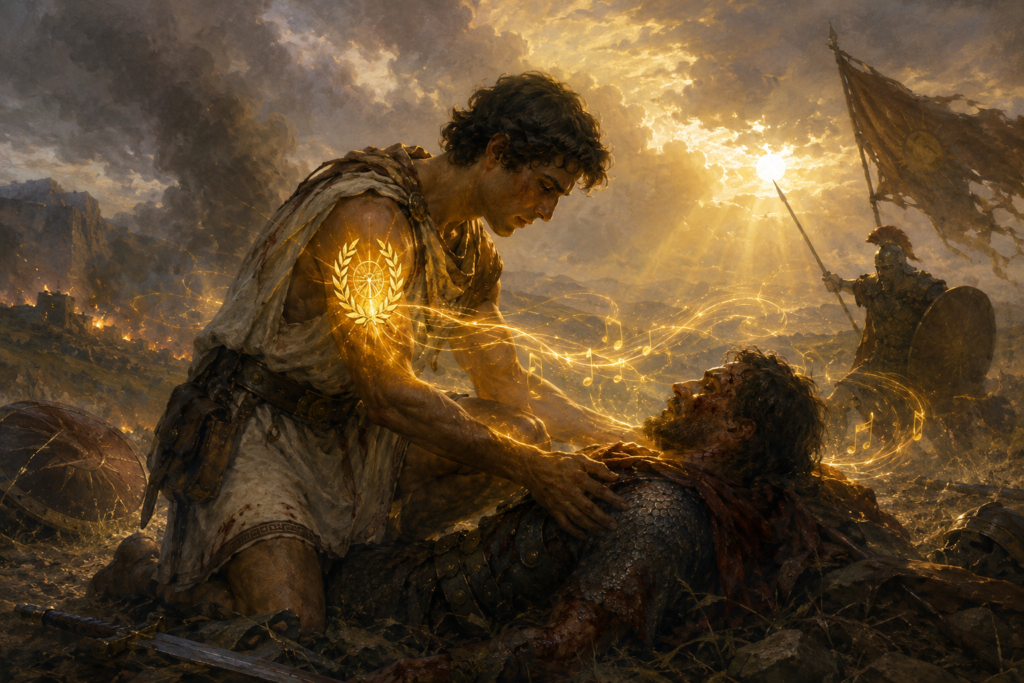
Mark of Apollo is a sacred enchantment placed upon a willing creature by a bard or priest dedicated to Apollo. The spell does not grant immediate power. Instead, it creates a permanent dormant mark tied to one specific worthy behaviour chosen when the spell is cast.
When the bearer performs that behaviour in a meaningful situation, the mark awakens and releases Apollo’s Grace. Golden light rises through the sign, filling the bearer with vitality, endurance, and divine battle-favour.
This is not a casual stored blessing. The mark rewards conduct that belongs to Apollo’s sphere: healing under threat, inspired music, truth spoken before danger, defence of the sick, resistance against darkness, disciplined excellence, prophetic obedience, or the protection of beauty, life, and sacred order.
Quick Rules Reference
- Places a permanent dormant divine mark on a willing touched creature.
- The caster chooses one specific worthy behaviour that can awaken the mark.
- The trigger must be meaningful, voluntary, and tied to Apollo’s ideals.
- The bearer cannot cheaply stage, fake, or trivialise the trigger.
- When triggered, the mark releases Apollo’s Grace on the bearer.
- Use the caster level or spellcasting statistics of the original Mark of Apollo caster when resolving Apollo’s Grace.
- The mark is not removed by ordinary dispelling.
- It can be removed by powerful curse-breaking, enchantment-breaking, miracle, wish, or equivalent magic.
- A creature can normally benefit from only one Mark of Apollo at a time.
- The mark activates once, then remains as an inert divine sign unless removed.
Effect
When you cast Mark of Apollo, you touch a willing creature and draw an indelible sacred mark upon them. The mark may appear as a golden laurel, sunburst, lyre-string sigil, shining arrow, physician’s sign, or another symbol appropriate to Apollo.
As part of the casting, you name one clear behaviour that can activate the mark. Examples include:
- healing an ally while personally endangered,
- singing or performing to strengthen companions during battle,
- standing against a creature of darkness, plague, corruption, or falsehood,
- telling a dangerous truth before a ruler, judge, oracle, or hostile crowd,
- protecting a wounded innocent,
- sparing a defeated enemy in Apollo’s name,
- completing a sacred performance, vow, purification, or prophetic duty under threat.
The trigger cannot be trivial. “Take a step,” “speak a word,” “draw a weapon,” “begin combat,” or “heal a harmless scratch” is not enough. The action must carry cost, risk, courage, skill, mercy, beauty, or sacred purpose.
Once the mark activates, the bearer immediately gains the effect of Apollo’s Grace. The mark then becomes spent, though the visible or hidden sign may remain as an inert divine mark until removed.
Mechanics Tabs
The rules below are mechanics compatible for different game editions.
Mark of Apollo 5.5e / 2024
Mark of Apollo, Pathfinder 1e / 3.5e
Mark of Apollo 3.0e
Mark of Apollo 5.5e / 2024
5th-Level Enchantment
Casting Time: 10 minutes
Range: Touch
Components: V, S
Duration: Permanent until activated; see text
School: Enchantment
Spell Lists: Bard, Cleric
Alternative Spell Name: Mark of Apollo, “The Laurel That Wakes”
You touch one willing creature and place an indelible divine mark upon it. When you cast the spell, choose one specific worthy behaviour that can activate the mark. The behaviour must be voluntary, meaningful, and connected to Apollo’s domains of healing, music, prophecy, sunlight, truth, discipline, beauty, archery, purification, or sacred protection.
The mark remains dormant until the creature performs the chosen behaviour in a significant situation. The DM decides whether the behaviour is sufficient. A staged, trivial, accidental, coerced, or purely technical fulfilment does not activate the mark.
When the mark activates, the bearer immediately gains the effect of Apollo’s Grace, using the spellcasting ability of the original Mark of Apollo caster. If the campaign uses the D&D 5.5e / 2024-compatible version of Apollo’s Grace, use that version.
Once Apollo’s Grace ends, the mark no longer grants power. The visible or hidden sign remains as an inert divine mark until removed.
This mark cannot be ended by Dispel Magic. It can be removed by Remove Curse, Greater Restoration, Wish, divine intervention, or comparable magic at the DM’s discretion.
A creature can bear only one active Mark of Apollo at a time. If another Mark of Apollo is placed on the creature before the first mark activates, the new casting fails unless the existing mark is removed first.
Apollo-Dedicated Casters Only: This spell can normally be cast only by a bard or cleric dedicated to Apollo, or to a closely equivalent solar, healing, prophetic, or artistic divine power if the campaign allows such substitution.
Mark of Apollo, Pathfinder 1e / 3.5e
Enchantment (Compulsion) [Mind-Affecting]
Level: Bard 4, Cleric 5
Components: V, S
Casting Time: 10 minutes
Range: Touch
Target: Creature touched
Duration: Permanent until activated; see text
Saving Throw: Will negates (harmless)
Spell Resistance: Yes (harmless)
You draw an indelible sacred mark upon a willing creature, naming a specific worthy behaviour that will awaken the blessing. The behaviour must be meaningful and associated with Apollo’s divine concerns: healing, music, prophecy, sunlight, truth, purification, protection, archery, beauty, or disciplined excellence.
Examples include healing allies during battle, singing to inspire companions in danger, defending the sick from harm, speaking a dangerous truth, resisting a creature of darkness, or completing a sacred act under threat.
The trigger cannot be trivial, staged, accidental, or coerced. The subject must perform the chosen behaviour in a significant situation. A creature cannot activate the mark by arranging harmless danger, healing an insignificant wound, giving a meaningless performance, or technically obeying the trigger without real cost or purpose.
When the subject performs the chosen behaviour, the mark activates and immediately grants the effect of Apollo’s Grace, as if cast by the original caster of Mark of Apollo.
For convenience, the legacy Apollo’s Grace effect grants the subject temporary hit points equal to 2d8 + caster level, to a maximum of 2d8 + 10 temporary hit points at caster level 10. The subject is immune to fatigue effects for the spell’s duration and gains a +1 luck bonus on attack rolls while the spell is in effect. The effect lasts 1 minute per caster level.
After Apollo’s Grace ends, the mark’s blessing is spent. The sign may remain visible or hidden as an inert divine mark.
A Mark of Apollo cannot be removed by dispel magic. It can be removed by break enchantment, limited wish, miracle, remove curse, wish, or equivalent campaign magic. These restrictions apply whether or not the mark has already activated.
A creature can bear only one active Mark of Apollo at a time. If another Mark of Apollo is cast on the same creature before the first mark activates, the new spell fails unless the existing mark is removed.
This spell may be cast only by a bard or cleric dedicated to Apollo, or by a caster serving an equivalent solar, prophetic, healing, or artistic deity if the campaign permits such substitution.
Mark of Apollo 3.0e
Relics & Rituals: Olympus
© 2004 White Wolf Publishing, Inc. Distributed for Sword and Sorcery Studios by White Wolf Publishing, Inc.
By W. Jason Peck, Aaron Rosenberg, Christina Stiles and Relics & Rituals: Olympus team
Enchantment (Compulsion)[Mind-Affecting]
Level: Cleric 5, Bard 4
Components: V, S
Casting Time: 10 minutes
Range: Touch
Target: Creature touched
Duration: Permanent until activated
Saving Throw: Will negates (harmless)
Spell Resistance: Yes (harmless)
You draw an indelible mark on the subject worthy of Apollo’s blessings. You designate some behavior on the part of the subject that will activate the mark, such as acting selflessly to heal others during battle or singing to inspire others during battle. When activated, the mark blesses the subject with Apollo’s grace, as if cast by a cleric of your level.
A mark of Apollo cannot be dispelled, but it can be removed with a break enchantment, limited wish, miracle, remove curse ,or wish spell. These restrictions apply regardless of whether the mark has activated.
This spell may be cast only by a bard or cleric dedicated to Apollo.
Why This Spell Is Dangerous in the World
Mark of Apollo is dangerous because it turns a private deed into visible divine judgement. When the mark wakes, witnesses may read the event as proof that Apollo favours the bearer’s action.
That can change more than a battle. A healer becomes a sacred witness. A singer becomes politically dangerous. A condemned speaker becomes harder to silence if the mark burns gold while they tell the truth before a throne.
Temples, rulers, patrons, and rival cults may all care deeply about who receives such a mark. A false claimant can be exposed. A hidden servant can be revealed. A marked criminal may become protected by divine politics. The spell creates power not by force, but by public legitimacy.
Rules Clarifications and Edge Cases
- The trigger must matter. The mark awakens when the bearer fulfils the chosen behaviour under meaningful pressure.
- The bearer cannot fake virtue cheaply. False danger, staged mercy, harmless wounds, or hollow performances should not activate the mark.
- The caster chooses the trigger. The subject may agree to receive the mark, but the caster defines the condition at casting.
- The mark is not mind control. It does not force the bearer to act.
- The mark normally activates once. After Apollo’s Grace ends, the remaining sign is symbolic unless the DM builds a divine story around it.
- Apollo’s dedication matters. The spell should not be available as generic divine magic.
- Removal is deliberately difficult. Ordinary dispelling is not enough because the mark is a sacred enchantment, not a temporary magical effect.
- The DM decides borderline cases. A good test is whether witnesses, allies, enemies, or Apollo’s temple would recognise the deed as meaningful.
- The linked spell supplies the active benefit. Mark of Apollo is the delayed mark; Apollo’s Grace is the blessing released when the mark awakens.
Good Combinations
- Apollo’s Grace: The spell’s direct released effect and the core reason the mark matters.
- Bless: Reinforces Apollo’s favour when the bearer must make decisive attacks, saves, or ability checks.
- Heroism: Works well for a marked singer, healer, archer, sacred envoy, or truth-speaker expected to face fear.
- Lesser Restoration / Restoration: Fits Apollo’s healing and purification aspect, especially when the mark awakens during plague, poison, exhaustion, or corruption.
- Augury / Divination: Helps Apollo’s servants identify the kind of deed, danger, or moment for which the bearer has been marked.
Adventure Hooks
The Song That Woke the Mark
A forgotten temple singer performs during a siege, expecting only to steady frightened townsfolk. The mark on her throat ignites, and every wounded soldier nearby sees Apollo’s favour. By dawn, three factions want to control her.
The Unwanted Blessing
A mercenary bears a hidden Mark of Apollo placed on him years ago. It activates when he spares an enemy commander instead of killing him. His employer calls it betrayal. Apollo’s priests call it proof.
The Stolen Laurel
A noble house claims its heir bears Apollo’s mark, but the temple suspects the sign was transferred, forged, or awakened by a manipulated act of staged mercy. The characters must determine whether the blessing is real before a succession ceremony turns into civil violence.
Historical and Mythic Context
Mark of Apollo draws on the ancient idea that divine favour can be made visible through signs, vows, sacred tokens, and acts of recognition. Apollo’s blessing is not only a private feeling in the soul. In mythic religion, the god’s approval may appear through prophecy, purification, music, healing, sudden clarity, or the public vindication of a chosen act.
Apollo is one of the great gods of ordered divine power. Classical tradition links him with prophecy, music, poetry, archery, healing, plague, purification, and the protection of the young. These powers make the spell’s delayed awakening especially fitting. A mark that stirs only when the bearer performs a worthy deed reflects Apollo’s concern with disciplined excellence, right action, public truth, and sacred timing. Useful overviews of Apollo’s roles can be found at Theoi’s Apollo entry and Encyclopaedia Britannica’s article on Apollo.
The spell also echoes the importance of sacred signs in ancient religion. A seal, wreath, scar, ritual sign, or consecrated inscription can identify a person as belonging to a god, a temple, a vow, or a rite of passage. In a fantasy campaign, Mark of Apollo turns that idea into active magic. The bearer carries a dormant sign that possession alone cannot prove. It wakes only when conduct matches the god’s nature.
This makes the spell different from an ordinary blessing. It does not simply reward the subject for being favoured. It waits for a deed. Healing an ally under threat, singing to strengthen companions in battle, telling a dangerous truth, protecting the sick, or standing against corruption all become possible moments of revelation. When the mark awakens, the bearer’s body becomes evidence that Apollo has recognised the act.
In a campaign world where the gods are real, such a mark can become politically and religiously dangerous. A glowing sign of Apollo’s favour may legitimise a witness, protect a healer, expose a fraud, strengthen a sacred performer, or turn a condemned person into someone the authorities cannot easily silence. The spell is strongest when it appears before witnesses, because its true power lies not only in the blessing it releases, but in the public meaning of being seen to act under Apollo’s gaze.
Keep this reference growing
If this page helped with your reading or game, you can support its upkeep or explore the curated books.
Explore the Bookshop — epics, classics and stories behind imagined worlds.