
Divination spell · Written languages · Three-edition rules
Comprehend Writing Spell
Touch an unfamiliar letter, tablet, charter or inscription and understand the literal meaning of the words written there.
Comprehend Writing is a narrow language divination for ordinary written text. It translates visible words without teaching the language, proving that a document is authentic or supplying the history and specialist knowledge needed to interpret everything its writer intended.
The spell matters when the document changes what the characters do next: a warning names the sealed door, an intercepted order exposes a traitor, a boundary stone contradicts a modern claim, or a damaged record preserves the one name that someone attempted to erase.
Quick Rules Reference
These points apply to all three versions below. Casting time, duration, class access and other edition-specific rules remain inside their own mechanics panels.
Comprehend Writing Mechanics
Comprehend Writing — D&D 5.5e / 2024
SpiralWorlds homebrew conversion- Level
- Divination cantrip
- Casting Time
- 1 minute
- Range
- Self
- Components
- V, S
- Duration
- Concentration, up to 10 minutes
- SpiralWorlds Spell Lists
- Bard, Cleric, Sorcerer, Warlock, Wizard
Effect
For the duration, you understand the literal meaning of nonmagical writing in any language while you can see the writing and are touching the surface on which it appears.
It takes about 1 minute to read one page of text. A tablet, wall, monument or other continuous inscription counts as one page for every section containing roughly 250 words.
The spell gives you comprehension only. It does not grant the ability to speak, sign or write the language, and it does not automatically identify the language by name.
Limits
- The spell translates only marks that form part of a written language.
- It does not decode ciphers, code words, acrostics, steganography or secret messages concealed inside otherwise ordinary text.
- It does not explain specialist knowledge, historical references, legal conventions, poetic allusions or technical vocabulary beyond their literal wording.
- It does not reveal whether the writer lied, whether a document is authentic or whether a copied text is complete.
- It translates only writing you can actually perceive. Erased, missing, obscured, weathered or illegible marks remain absent or unclear.
- It does not decipher magical writing, glyphs, sigils, spell notation or symbols that are not part of a written language.
Dangerous Documents
The spell provides no protection from an effect triggered by touching, seeing, reading, understanding, copying or speaking a written message. Resolve the trigger exactly as described by the effect.
Cantrip Balance
The 1-minute casting time, concentration requirement and writing-only effect preserve a useful role for Comprehend Languages . Comprehend Writing is suited to documents and inscriptions rather than immediate conversation or rapid use during an encounter.
At Higher Levels
This cantrip gains no additional effect at higher character levels.
Comprehend Writing — Pathfinder 1e
SpiralWorlds Pathfinder conversion- School
- Divination
- Level
- Bard 0, Cleric 0, Sorcerer/Wizard 0
- Components
- V, S
- Casting Time
- 1 standard action
- Range
- Personal
- Target
- You
- Duration
- 10 minutes/level
- Saving Throw
- None
- Spell Resistance
- No
Effect
You can read otherwise incomprehensible nonmagical writing while touching the surface on which it appears. The spell supplies the literal meaning of the written language without granting the ability to speak or write that language.
You can read one page, or about 250 words, per minute. Magical writing cannot be read, although the spell reveals that the writing is magical.
The spell does not decipher codes or reveal messages concealed inside otherwise ordinary text. It does not restore missing text, verify a document or explain cultural and specialist knowledge beyond the literal words.
Linguistics
Linguistics remains relevant when the text is coded, deliberately obscure, damaged, forged, written in an unusual form or dependent upon contextual interpretation. The spell removes the unknown-language barrier; it does not replace every use of the skill.
Named-Spell Interactions
This distinction matters for Illusory Script and similar effects. A GM may deliberately allow the substitution, but that is a campaign ruling rather than an automatic benefit.
Secret Page prevents the spell from revealing its concealed original contents. Comprehend Writing can translate only the writing actually presented to the caster.
Permanency
Comprehend Writing is not automatically eligible for Permanency . Comprehend Languages appears separately on the Permanency list. Adding this cantrip requires explicit GM approval or suitable spell research.
Comprehend Writing — D&D 3.5e
Clarified legacy rules- School
- Divination
- Level
- Bard 0, Cleric 0, Sorcerer/Wizard 0
- Components
- V, S
- Casting Time
- 1 standard action
- Range
- Personal
- Target
- You
- Duration
- 10 minutes/level
- Saving Throw
- None
- Spell Resistance
- No
Effect
You can read otherwise incomprehensible nonmagical writing while touching the surface that bears it. The spell conveys the literal meaning of the written language without teaching you to speak or write that language.
Written material can be read at the rate of one page, or about 250 words, per minute. Magical writing cannot be read, although the spell reveals that the writing is magical.
The spell does not decipher codes or reveal messages concealed inside otherwise normal text. Damaged, erased, obscured and missing passages remain incomplete.
Decipher Script
Decipher Script remains relevant for codes, difficult documents, unusual conventions, damaged passages and contextual interpretation. Comprehend Writing translates a language; it does not solve every problem presented by a document.
Named-Spell Interactions
It therefore does not automatically provide the Comprehend Languages component required in the combination used to penetrate Illusory Script . A DM may allow that substitution as a deliberate campaign ruling.
Secret Page prevents access to its concealed original text. The spell translates only the apparent writing.
Permanency
The spell is not automatically eligible for Permanency . The listed spell is Comprehend Languages, not Comprehend Writing.
What the Spell Actually Does
Comprehend Writing removes one obstacle: the caster does not know the language in which a visible mundane text is written.
It does not turn every document into a solved mystery. A translated charter can still be forged. A warning can refer to a forgotten calendar. A medical account can use terminology the caster does not understand. A poem can remain ambiguous, and a deliberately coded sentence can remain coded.
Translation
The spell supplies the ordinary literal meaning of the surviving words, including normal grammar and sentence structure.
Interpretation
Context, allusion, professional knowledge, disputed terminology and the writer’s intentions may still require research or an appropriate ability or skill check.
What Remains Beyond the Spell
Codes and Ciphers
A translated word can still be a code word. Substitution ciphers, private abbreviations, acrostics and concealed messages remain intact.
Missing Evidence
Torn pages, scraped names, faded ink and broken tablets remain incomplete. The spell does not invent lost words.
Authenticity
A forged order, false confession or dishonest contract remains false after translation.
Specialist Knowledge
Legal, medical, astronomical, military and technical texts may remain difficult even when every word is understood.
Cultural Context
Idiom, humour, poetry, metaphor, ritual convention and historical reference can require further interpretation.
Magical Script
Glyphs, spell notation, magical formulae and active arcane writing require Read Magic or another specialised effect.
Rules Clarifications and Edge Cases
| Question | Ruling | Remaining uncertainty |
|---|---|---|
| Does the caster learn which language it is? | The caster understands the words. | The language’s name, period, origin and script family require prior knowledge or investigation. |
| Does it solve poor handwriting? | It translates marks that are legible enough to be perceived as writing. | Smudged, cramped or genuinely illegible handwriting can remain unreadable. |
| Does it restore erased or missing text? | It translates the writing that survives. | Torn pages, scraped names, lost fragments and weathered lines remain absent. |
| Does it explain metaphor and idiom? | It supplies the nearest literal meaning. | Wordplay, symbolism, humour, poetry and cultural references may remain uncertain. |
| Can it read through glass? | The caster must touch the surface carrying the words. | A display case, pane, force barrier or sealed container blocks the required contact. |
| Can the caster copy the translation? | Yes. The caster may write the understood meaning in a language they already know. | The copy reflects the caster’s phrasing and may lose layout, ambiguity or wordplay. |
| Does the caster remember the text later? | The caster retains the ordinary memories formed while reading. | The spell grants neither perfect recall nor lasting knowledge of the original language. |
| Does it prove the document genuine? | No. It translates what the document says. | Age, authorship, authority, alteration and forgery require other evidence. |
| Can it read maps or numbers? | Written labels and sentences can be translated when they form language. | Geography, mathematics, heraldry and specialist notation are not automatically explained. |
| Can darkness or blindness prevent it? | The caster must perceive the written marks clearly enough to read them. | Another sense works only when it genuinely reveals the shape and arrangement of the writing. |
Writing Mixed with Symbols
A sentence may contain ordinary words, numbers, heraldic signs, diagrams and magical marks. Resolve each part separately. Comprehend Writing can translate the words without explaining the diagram or deciphering an arcane sigil embedded beside them.
Writing in More Than One Language
The spell can translate several languages appearing in the same document, provided each passage is visible, nonmagical and written in a genuine language. Differences in terminology or wording may reveal that the versions were composed by different people or at different times.
Touching a Book
Touching a closed cover does not translate every page inside. The caster must expose, perceive and touch the page or written surface currently being read.
Reading, Memory and Copies
Reading Aloud
The spell does not teach pronunciation. The caster can explain the translated meaning in a language they know but cannot reliably speak the original words.
Writing a Translation
The caster may create a working translation in a known language. That translation records meaning rather than reproducing every feature of the original wording.
Remembering the Text
The caster remembers the document normally. The spell provides no flawless memory and leaves no permanent knowledge of the source language.
Exact Copies
Amanuensis can preserve an exact copy of ordinary text but does not translate it.
Best Uses in Play
Ruins and Tombs
Read builders’ marks, burial notices, boundary stones, dedication tablets and surviving warnings before disturbing a site.
Letters and Orders
Translate captured correspondence, intercepted instructions, military orders and personal letters without finding a fluent speaker.
Law and Ownership
Examine wills, charters, contracts, toll records and land grants whose precise wording can change a dispute.
Trade and Travel
Read manifests, road notices, harbour rules, warehouse marks, inventories and local warnings.
Libraries and Archives
Identify which unfamiliar texts deserve deeper research before committing days to scholars, translators or magical investigation.
Treasure and Provenance
Recover names, makers, dedications and former owners engraved or written on objects without identifying every property of the item.
Practical Table Procedure
- Establish how the characters reach, illuminate, uncover and touch the writing.
- Decide whether the marks are ordinary language, magical writing, a code or a mixture of several forms.
- Apply the correct edition’s casting time, duration and concentration rules.
- Give the literal translation at the spell’s normal reading rate.
- Identify any missing, damaged, overwritten or deliberately obscured sections.
- Call for further checks only when context, forgery, specialist knowledge, code or physical damage creates a separate problem.
- Let the information create a decision, reveal evidence or change the direction of the investigation.
Useful Translation
“The lower gate is to remain sealed until the third night after the red moon. The warden’s name has been chiselled away.”
Weak Translation
“It is an old warning written in a language you do not know.”
GM Guidance
Provide the Actual Words
When the spell applies, give the players a usable translation. Names, instructions, claims, warnings and contradictions make the document part of the adventure.
Preserve Physical Evidence
Water stains, changed ink, scraped names, missing pages, later additions and broken seals can remain important after the words are understood.
Preserve Human Uncertainty
Writers can lie, misunderstand events, exaggerate titles, repeat rumours or use terms whose meaning is disputed.
Avoid Empty Skill Taxes
Do not require a second roll merely to obtain the literal translation the spell already promises. Use checks only for a genuinely separate question.
Separate Translation from Expertise
A translated surgical text is still surgical. A translated legal clause can still depend upon local law. The characters have gained access, not instant professional training.
Let Fragments Matter
Partial text should usually reveal partial evidence rather than become worthless. One surviving name or date can be enough to move the investigation forward.
Counters and Defences
Physical Separation
Glass cases, sealed containers, force barriers and unreachable walls prevent the required touch.
Damage and Erasure
Fire, water, rot, scraping, missing pages and Erase can remove the words before they are translated.
Encoding
Ciphers, codebooks, private abbreviations and concealed messages remain secret after literal translation.
Fragmentation
Dividing instructions among several documents prevents any one intercepted text from revealing the whole plan.
Deceptive Writing
False documents, substituted pages and misleading wording exploit the fact that the spell translates rather than verifies.
Ending the Spell
Breaking concentration ends the 2024 version. Dispel Magic can end an active spell when the caster is a valid target under the edition being used.
Spellcasting Culture and Worldbuilding
Courts and Chanceries
Trusted casters examine foreign treaties, inherited charters and disputed records. Seals, witnesses and provenance remain essential because translation does not prove authenticity.
Merchants and Harbours
Traders use the spell for manifests, toll notices and contracts. Cautious guilds respond with codebooks, numbered ledgers and divided records.
Libraries and Schools
The spell helps scholars sort unfamiliar collections. Serious study still requires language history, subject expertise and comparison with other manuscripts.
Spies and Investigators
Intercepted documents are easier to exploit, encouraging secret names, false routes, partial instructions and codes kept separately from the message.
Archives and Record Offices
Governments employ magical readers to recover older records, but the authority of those records still depends upon dates, seals, witnesses and recognised custody.
Explorers and Archaeologists
The spell allows lost peoples to speak through their own records. Responsible users preserve the original writing, record its location and distinguish translation from later interpretation.
Adventure Hooks
The Charter with Two Dates
A translated land grant appears genuine, but its calendar date belongs to a system abolished before the named ruler took power.
The Prisoner’s Marginalia
Notes in an unknown language reveal that the official prison register was altered after every execution.
The Builder’s Warning
A monument praises a conqueror, while a small inscription beneath its base warns that the monument is also a seal.
The Perfect Copy
A contract matches the original word for word, yet its legal force depends upon a missing seal and a witness who vanished.
The Removed Name
Every royal name on a tablet survives except one carefully scraped line that still preserves the first letter.
The Bilingual Boundary
Two versions of the same border decree describe different rivers, placing an inhabited valley inside both rival claims.
Historical and Occult Development
Writing allows a statement to act after its speaker has left or died. Laws, debts, contracts, names, instructions and claims can cross distance and survive political change because they have been placed upon a durable surface.
Historical decipherment depends upon comparison and context. The British Museum’s Rosetta Stone resource explains how related versions of one decree helped scholars unlock Egyptian hieroglyphic writing. A bilingual decree, repeated royal title or familiar place name can play the same role in an adventure.
Manuscripts also preserve evidence of the people who made them. Corrections, marginal notes, worn pages, scraped passages and changes in ink may reveal how a document was copied or altered. The British Library’s discussion of scribes at work in medieval manuscripts provides a useful introduction to the labour, tools and skill involved.
Occult traditions often treat writing as an action rather than a passive record. Names, signs, diagrams and carefully formed characters may carry authority through their material, order or ritual use. Comprehend Writing stops at the boundary between ordinary language and active magical inscription; crossing that boundary belongs to Read Magic and other specialised divinations.
Historical Details for Play
- A reused page may preserve faint earlier writing beneath the visible text.
- A translation may reveal that a supposed title is actually a personal name.
- Different scribes may use different spellings for the same place.
- A copied document may preserve an error introduced generations earlier.
- A later ruler may remove names without replacing the surrounding sentence.
- A bilingual inscription may contain deliberate differences between its versions.
Mythological Parallels
Seshat and Recorded Order
Egyptian tradition associates Seshat with writing and record keeping . Her pattern suits spells used on censuses, royal names, building records and the exact language of law.
Thoth and the Divine Scribe
Thoth is associated with writing, accounting and intellectual work . In fantasy, translation magic may be taught as an imitation of divine record keeping.
Nisaba and the Tablet
The Sumerian goddess Nisaba is associated with writing, accounts and the keeping of divine and mortal records.
Hermes and Language
Greek traditions connect Hermes with language, writing, messages and eloquence . The parallel suits a spell that carries meaning across a linguistic boundary without revealing every intention behind the message.
The Exact Name
Mythic and magical stories frequently treat exact names as sources of authority. Literal translation may reveal a name’s meaning while leaving its proper pronunciation and magical use unresolved.
The Lost People’s Voice
Inscriptions allow vanished peoples to remain witnesses through their own words. Translation can restore testimony without pretending that one surviving document explains an entire culture.
Sources, Attribution and Licensing
Original Attribution
The surviving SpiralWorlds entry attributes the original Comprehend Writing concept to Shadowfoot of the former Wizards Community forums. The original Gleemax thread is no longer reliably available. This rebuild preserves that attribution while replacing the former page’s prose, structure and rules presentation.
D&D 5.5e / 2024 Rules
The D&D 5.5e / 2024 version on this page is an original SpiralWorlds conversion and is not an official spell.
This work includes material from the System Reference Document 5.2.1 (“SRD 5.2.1”) by Wizards of the Coast LLC, available at D&D Beyond . The SRD 5.2.1 is licensed under the Creative Commons Attribution 4.0 International License .
Legacy Open Game Content
The mechanical rules text inside the Pathfinder 1e and D&D 3.5e mechanics panels is designated as Open Game Content and may be Used only under and in terms of the Open Game License version 1.0a reproduced below.
No other portion of this page is designated as Open Game Content. The artwork, design, CSS, presentation, examples, historical discussion, mythological discussion, adventure hooks and SpiralWorlds editorial prose remain excluded from that designation.
Open Game License version 1.0a — complete text
OPEN GAME LICENSE Version 1.0a
The following text is the property of Wizards of the Coast, Inc. and is Copyright 2000 Wizards of the Coast, Inc (“Wizards”). All Rights Reserved.
1. Definitions: (a)”Contributors” means the copyright and/or trademark owners who have contributed Open Game Content; (b)”Derivative Material” means copyrighted material including derivative works and translations (including into other computer languages), potation, modification, correction, addition, extension, upgrade, improvement, compilation, abridgment or other form in which an existing work may be recast, transformed or adapted; (c) “Distribute” means to reproduce, license, rent, lease, sell, broadcast, publicly display, transmit or otherwise distribute; (d)”Open Game Content” means the game mechanic and includes the methods, procedures, processes and routines to the extent such content does not embody the Product Identity and is an enhancement over the prior art and any additional content clearly identified as Open Game Content by the Contributor, and means any work covered by this License, including translations and derivative works under copyright law, but specifically excludes Product Identity.
(e) “Product Identity” means product and product line names, logos and identifying marks including trade dress; artifacts; creatures characters; stories, storylines, plots, thematic elements, dialogue, incidents, language, artwork, symbols, designs, depictions, likenesses, formats, poses, concepts, themes and graphic, photographic and other visual or audio representations; names and descriptions of characters, spells, enchantments, personalities, teams, personas, likenesses and special abilities; places, locations, environments, creatures, equipment, magical or supernatural abilities or effects, logos, symbols, or graphic designs; and any other trademark or registered trademark clearly identified as Product identity by the owner of the Product Identity, and which specifically excludes the Open Game Content; (f) “Trademark” means the logos, names, mark, sign, motto, designs that are used by a Contributor to identify itself or its products or the associated products contributed to the Open Game License by the Contributor (g) “Use”, “Used” or “Using” means to use, Distribute, copy, edit, format, modify, translate and otherwise create Derivative Material of Open Game Content.
(h) “You” or “Your” means the licensee in terms of this agreement.
2. The License: This License applies to any Open Game Content that contains a notice indicating that the Open Game Content may only be Used under and in terms of this License. You must affix such a notice to any Open Game Content that you Use. No terms may be added to or subtracted from this License except as described by the License itself. No other terms or conditions may be applied to any Open Game Content distributed using this License.
3. Offer and Acceptance: By Using the Open Game Content You indicate Your acceptance of the terms of this License.
4. Grant and Consideration: In consideration for agreeing to use this License, the Contributors grant You a perpetual, worldwide, royalty-free, non-exclusive license with the exact terms of this License to Use, the Open Game Content.
5. Representation of Authority to Contribute: If You are contributing original material as Open Game Content, You represent that Your Contributions are Your original creation and/or You have sufficient rights to grant the rights conveyed by this License.
6. Notice of License Copyright: You must update the COPYRIGHT NOTICE portion of this License to include the exact text of the COPYRIGHT NOTICE of any Open Game Content You are copying, modifying or distributing, and You must add the title, the copyright date, and the copyright holder’s name to the COPYRIGHT NOTICE of any original Open Game Content you Distribute.
7. Use of Product Identity: You agree not to Use any Product Identity, including as an indication as to compatibility, except as expressly licensed in another, independent Agreement with the owner of each element of that Product Identity. You agree not to indicate compatibility or co-adaptability with any Trademark or Registered Trademark in conjunction with a work containing Open Game Content except as expressly licensed in another, independent Agreement with the owner of such Trademark or Registered Trademark. The use of any Product Identity in Open Game Content does not constitute a challenge to the ownership of that Product Identity. The owner of any Product Identity used in Open Game Content shall retain all rights, title and interest in and to that Product Identity.
8. Identification: If you distribute Open Game Content You must clearly indicate which portions of the work that you are distributing are Open Game Content.
9. Updating the License: Wizards or its designated Agents may publish updated versions of this License. You may use any authorized version of this License to copy, modify and distribute any Open Game Content originally distributed under any version of this License.
10. Copy of this License: You MUST include a copy of this License with every copy of the Open Game Content You Distribute.
11. Use of Contributor Credits: You may not market or advertise the Open Game Content using the name of any Contributor unless You have written permission from the Contributor to do so.
12. Inability to Comply: If it is impossible for You to comply with any of the terms of this License with respect to some or all of the Open Game Content due to statute, judicial order, or governmental regulation then You may not Use any Open Game Material so affected.
13. Termination: This License will terminate automatically if You fail to comply with all terms herein and fail to cure such breach within 30 days of becoming aware of the breach. All sublicenses shall survive the termination of this License.
14. Reformation: If any provision of this License is held to be unenforceable, such provision shall be reformed only to the extent necessary to make it enforceable.
15. COPYRIGHT NOTICE
Open Game License v 1.0a Copyright 2000, Wizards of the Coast, Inc.
System Reference Document Copyright 2000-2003, Wizards of the Coast, Inc.; Authors Jonathan Tweet, Monte Cook, Skip Williams, Rich Baker, Andy Collins, David Noonan, Rich Redman, Bruce R. Cordell, John D. Rateliff, Thomas Reid, James Wyatt, based on original material by E. Gary Gygax and Dave Arneson.
Pathfinder Roleplaying Game Reference Document. Copyright 2011, Paizo Publishing, LLC; Author: Paizo Publishing, LLC.
Pathfinder Roleplaying Game Core Rulebook. Copyright 2009, Paizo Publishing, LLC; Author: Jason Bulmahn, based on material by Jonathan Tweet, Monte Cook, and Skip Williams.
Comprehend Writing. Copyright 2026, SpiralWorlds.
END OF LICENSE
Rules References
- System Reference Document 5.2.1
- Pathfinder Reference Document: Comprehend Languages
- Pathfinder Reference Document: Illusory Script
- Pathfinder Reference Document Open Game License notices
Artwork
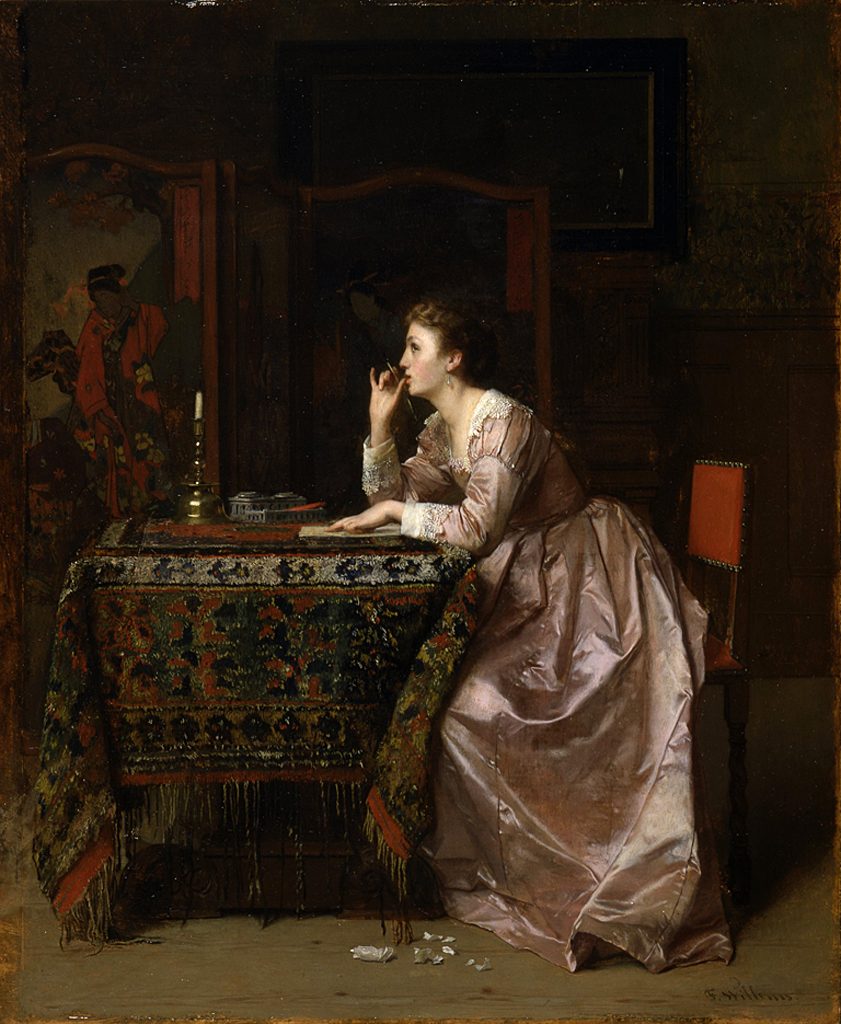
The Important Response by Florent Willems, 19th century, Walters Art Museum, accession number 37.140. The museum makes the collection image available under Creative Commons Zero.
Comprehend Writing is a custom spell. Dungeons & Dragons, Pathfinder and their associated marks remain the property of their respective rights holders.