
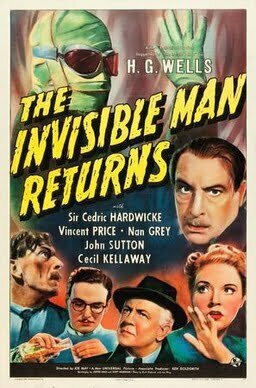
The Invisible Man Returns (1940)
A condemned man becomes invisible to escape the gallows—but the serum that could prove his innocence may destroy his reason before he can find the truth.
Joe May’s The Invisible Man Returns (1940) takes Universal’s invisible-man premise in a different direction. Vincent Price plays Geoffrey Radcliffe, a man convicted of killing his own brother, who accepts an extraordinary scientific intervention to escape and investigate. His new freedom is precarious: the same drug that concealed the earlier invisible man threatens to unmake his mind. The sequel mixes a murder mystery, a race against time and dazzling effects without simply resurrecting Jack Griffin.
At a Glance
| Film | The Invisible Man Returns (1940) |
|---|---|
| Director | Joe May |
| Story and screenplay | Story by Joe May and Curt Siodmak; screenplay by Lester Cole and Curt Siodmak |
| Cast | Vincent Price (Geoffrey Radcliffe), Sir Cedric Hardwicke (Richard Cobb), Nan Grey (Helen Manson), John Sutton (Doctor Frank Griffin), Cecil Kellaway (Inspector Sampson), Alan Napier (Willie Spears) |
| Studio | Universal Pictures; black-and-white mystery and science-fiction horror |
| Special effects | John P. Fulton and team; Academy Award nomination for special effects |
| Related film | The Invisible Man (1933), the earlier Universal picture |
| Adventure themes | Wrongful conviction, hidden evidence, invisibility with a cost and pursuit through industrial ruins |
Why This Film Matters
The first Invisible Man story asked what a scientist might do after acquiring an extraordinary power. This sequel starts with someone who needs that power for an immediate and apparently justifiable purpose: to escape an execution and clear his name. Invisibility becomes both a means of finding evidence and a temptation to abandon restraint. Vincent Price brings unusual vulnerability to the central role before the serum begins to erode his judgement.
John P. Fulton’s special-effects work expanded the original film’s visual ingenuity, allowing an unseen body to leave signs of movement, inhabit clothing and disturb objects around other performers. Its effects team received an Academy Award nomination, recognising the technical complexity behind the apparently empty space.
The Story — Without Major Spoilers
Geoffrey Radcliffe has been convicted of his brother’s murder. Shortly before his sentence is carried out, Doctor Frank Griffin secretly gives him a serum that renders him invisible. Geoffrey slips away and sets out to find the real killer. The powerful effects of the drug have a dangerous precedent: Frank’s own brother Jack was the invisible man of the earlier film.
Inspector Sampson pursues the fugitive, while Geoffrey’s fiancée Helen fears what the serum is doing to him. Clues lead from laboratories and private houses toward the Radcliffe family’s mining business, where recent promotions and old loyalties may expose the truth. Geoffrey’s opportunities to investigate grow even as his ability to control himself weakens.
Characters and Performances
Vincent Price as Geoffrey Radcliffe plays a wrongly condemned man whose fear of injustice is gradually joined by dangerous exhilaration. He is not the original Jack Griffin; his link to that earlier story is the formula, its consequences and the scientist who administers it. Price’s measured voice gives the invisible character a distinct emotional register from Claude Rains’s merciless 1933 protagonist.
John Sutton as Doctor Frank Griffin is the brother of the original film’s Jack Griffin, not Jack himself. He knows the risk of the serum and struggles to reverse its effects. Nan Grey’s Helen Manson supports Geoffrey but fears losing him to the drug. Cecil Kellaway’s Inspector Sampson is an observant pursuer whose investigations give the story a detective-film dimension.
Sir Cedric Hardwicke’s Richard Cobb represents the interests of the mining business after the murder, while Alan Napier’s Willie Spears is an important figure in its shifting internal loyalties. Their conduct, testimony and ambitions turn the case into more than a contest between an invisible man and the police.
The World on Screen
Industrial works, a prison, country houses and narrow offices make invisibility a tactical power with limitations. Clothing can betray the wearer’s location; objects still move; footsteps, sounds and disturbed materials can supply clues. Mines and factory spaces offer unusual routes for a fugitive, but also dangerous machinery, enclosed passages and people caught in the consequences of the search.
This is the film’s own twentieth-century setting. The campaign can borrow its investigative structure without importing its electrical laboratories and penal institutions unchanged. London and its wider English setting have independent histories.
Behind the Camera
Joe May directed Universal’s sequel, whose screenplay was developed by Lester Cole and Curt Siodmak. John P. Fulton extended the photographic effects techniques used in the original, with the sound and special-effects teams contributing to its Academy Award recognition. The film shares a fictional discovery with James Whale’s 1933 production while shifting the drama toward a condemned man’s investigation rather than a scientist’s initial experiment.
Adaptation, Themes and Critical Assessment
Though inspired by H. G. Wells, the movie’s murder trial, industrial dispute, new invisible protagonist and antidote race are screen inventions. The film is more sympathetic to its afflicted hero than the original but does not pretend that innocence of one accusation excuses subsequent wrongdoing. The serum’s mental consequences are a dramatic source of danger, not a general property of all invisibility effects.
What works: a clean mystery premise, Price’s performance, the competing clocks of execution and madness, and impressive physical effects. Limitations: the mystery can be more predictable than its striking imagery suggests, several secondary characters receive little development and the drug’s powers and disadvantages bend to the needs of the plot. Its greatest gameable contribution is the tension between evidence, rescue and keeping a fugitive safe.
Legacy and Related Viewing
Begin with The Invisible Man (1933), in which Jack Griffin first develops the disastrous serum. This sequel features a new invisible man and a family connection through Frank Griffin, so the two protagonists should not be conflated. For other scientific Gothic horror, compare Frankenstein (1931) and Bride of Frankenstein (1935).
Explore in SpiralWorlds
Concealment: Invisibility, Greater Invisibility and the Ring of Invisibility offer rules for concealment in different campaigns. None replicates the serum’s fictional mental effects, and each should use the rules appropriate to its edition.
Detection and investigation: See Invisibility and Invisibility Purge provide potential countermeasures. The absence of a required spell does not stop investigators following footprints, hearing doors open or comparing testimony. H. G. Wells provides the source tradition; the film’s Geoffrey and Frank are not automatically existing NPCs with their own campaign biographies.
Ideas for the Table
The condemned witness. A prisoner offers an impossible explanation for a murder and claims to possess evidence that could exonerate them. The characters must obtain the documents before the sentence is carried out without assuming that every accuser is corrupt.
The invisible fugitive. An ally can hide from guards but must use an uncertain magic item that alters judgement under stress. The party can seek another way out, place safeguards on the plan or decide when continued concealment puts other people in danger.
What the mine remembers. A death at a quarry seems solved until new leadership changes the crew assignments. A ledger, a missing worker and tracks at a lift may establish a very different chronology. A supernatural pursuer is not necessary for a playable mystery.
Sources and Credits
- American Film Institute — The Invisible Man Returns (1940), cast, story and special effects.
- Universal Pictures — The Invisible Man Returns, official synopsis and credited actors.
- H. G. Wells, literary source context.
The historical theatrical poster is retained for identification. The review and tabletop adventure hooks are independent writing; movie-specific scientific methods are not campaign rules.
Keep this reference growing
If this page helped with your reading or game, you can support its upkeep or explore the curated books.
Explore the Bookshop — epics, classics and stories behind imagined worlds.