
Edirne — The Sultan’s Imperial Capital
Edirne governs the western Ottoman lands from the crossings of the Tunca and Meriç. The sultan’s couriers ride out towards the Balkans and Anatolia; guards and caravan merchants crowd the bridges, while craftsmen labour on a new palace north of the city. Mehmed II holds his capital here. Constantinople has fallen, but not to him: the hobgoblin Ninefold Dominion took it, leaving the Ottoman court to weigh a dangerous reconquest against the needs of its own realm.
- Realm: Ottoman Empire; a sovereign state separate from the Ninefold Dominion
- Ruler: Sultan Mehmed II, with his court and appointed provincial and military officers
- Seat: Edirne, the working imperial capital of the campaign
- Setting: city of Thrace beside the Tunca and Meriç, near the Arda confluence
- Roads: west and north into the Balkan provinces, south towards Gallipoli and east along the Thracian road
- People and speech: Turkish-speaking court and garrison among merchants and households using Greek, Bulgarian, Persian and other languages
- Livelihoods: military provisioning, river trade, court service, horse markets, workshops, caravan lodgings and bridge tolls
- Pressures: Constantinople under hobgoblin occupation; costly palace works; bridge security; competing demands on the treasury
What Is Happening Right Now?
Two dispatches reach the sultan’s council on the same morning. One reports a weakening of the Ninefold garrison in Constantinople; another insists that its commanders are receiving reinforcements. Officers argue over sending scouts, moving artillery and strengthening the roads into Thrace. Traders from the eastern approaches are questioned closely, and a false report can ruin a merchant as surely as a captured convoy.
The new riverside palace is demanding dressed stone, timber and skilled hands, but several wagonloads of material have been diverted for frontier works. The builders demand payment, army officials produce urgent warrants, and carters refuse to enter the next floodplain crossing until someone accepts responsibility for their losses.
The City and Its Crossings
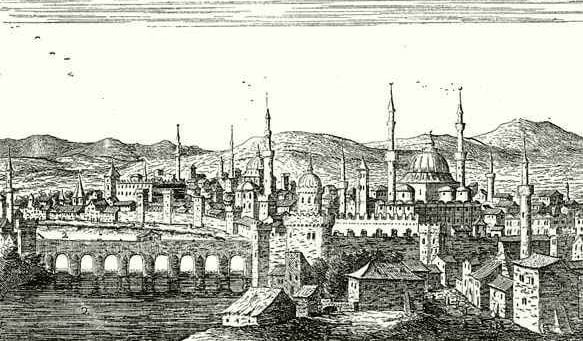
The old fortified town. Edirne inherits the strategic ground of Hadrianopolis, where older roads converge before crossing the rivers. Stonework from earlier centuries stands among the busy streets. The city is both a seat of command and a place of ordinary markets, ovens, workshops, baths and lodging houses; a traveller needs a guide to find the right officer as often as the right bridge.
The bridges. The repaired Gazi Mihal crossing takes traffic across the Tunca, while the Şahabettin Paşa and Fatih bridges belong to the newer routes serving the court and palace ground. A bridge may be passable for a rider yet closed to a laden wagon after heavy rain. Officials collect tolls, search suspicious cargo and issue safe-conducts; boatmen earn their living when the rivers make road travel uncertain.
The older court and the new palace. Established halls and treasuries continue to serve Mehmed while the ambitious new palace rises beside the Tunca. Begun under Murad II in 1450, it is a worksite as much as a residence. Masons, carpenters, guards, water-carriers, surveyors and cooks mingle with messengers waiting for the sultan’s seal. The great complex familiar to later generations has not yet been finished.
The markets. Horses and equipment pass through the capital with grain, timber, hides, cloth and provisions for the garrisons. Caravan lodging houses provide farriers and guards as well as gossip. City merchants are accustomed to several tongues and currencies; they are less forgiving when a newly appointed officer demands duties already paid at the last crossing.
Authority and Allegiance
Mehmed’s power runs through military commanders, palace officials, magistrates and provincial governors. A letter from a frontier captain may reach the council before the witnesses who can test it; a requisition issued for the army can empty a merchant’s warehouse while the owner petitions for compensation. The sultan must maintain his forces and court without letting the occupied city on the Bosphorus dictate every decision made in Edirne.
The Ninefold Dominion’s hobgoblin soldiers are enemies across the contested frontier, not a resident race to be scattered through Edirne’s streets. Refugees, scouts and merchants bring news from the occupied city. Each arrival is questioned according to what they know, whom they served and whether their evidence can be trusted.
Travelling Through Edirne
The capital is an important stop for anyone travelling between the Balkan lands and the Ottoman territories to the east. Merchants arriving along the northern roads can find repair shops, food, guards and an advocate for a disputed consignment. Soldiers on the move take priority on some routes, particularly when a bridge or ferry must pass a military column.
The Tunca and Meriç rise quickly in wet weather. Low meadows can flood while the old fortified streets remain secure, and an apparently short diversion may require a much longer circuit to a serviceable crossing. A traveller in haste should ask whether the bridge is open to wagons, not simply whether anyone has crossed it that morning.
Affairs Worth Entering
- The two dispatches. A courier offers the party an unsealed copy of the latest report from Constantinople. One adviser believes it is a trap; another needs independent witnesses before the council orders troops onto the road.
- Stone for the palace. The masons have stopped work because the army took the last stone convoy. The contractor can show a royal order, but the bridge captain has a more recent one. Each side holds goods that ordinary workers need to be paid.
- A flooded crossing. A merchant’s horses and cargo are stranded on the far bank of the Tunca. The ferry crew will help, but not while soldiers threaten to seize their boats for military transport.
History and Sources
The City of Edirne’s history describes the city’s former role as Ottoman capital; the Turkish Ministry of Culture dates work on the new riverside palace to 1450 under Murad II. Government material on Edirne’s historic bridges records the earlier Gazi Mihal crossing and bridges built in 1451–52. In recorded history Constantinople passed to Mehmed in 1453 and became the capital; the established campaign chronicle instead places Constantinople under the Ninefold Dominion and retains Edirne as Mehmed’s capital.
Related Lands
Keep this reference growing
If this page helped with your reading or game, you can support its upkeep or explore the curated books.
Explore the Bookshop — epics, classics and stories behind imagined worlds.