
Stettin — Griffin Court and the Oder Merchants

The Oder brings goods from the continent into Stettin’s harbours, and every cargo carries a question of privilege. Grain, fish, timber and cloth fill the warehouses below the town’s brick halls. Merchants want to decide which ships may trade upriver; the young Griffin duke Otto III has his own needs, while his Brandenburg guardians eye the city and its revenues. Stettin is a ducal seat but not the capital of a single, united Pomerania.
- Realm: Pomerania-Stettin, one of the divided Griffin duchies
- Duke: Otto III, still under Brandenburg guardianship
- Civic rule: burgomasters and town council governing under Magdeburg law granted in 1243
- River: Oder, linking inland markets to the Baltic
- Commerce: grain, salt, fish, cloth, ship timber and river transport
- Harbour interests: merchants’ shipping privileges and competition with Stargard
- Landmarks: old town hall and markets, waterfront, and the ducal stone house begun in 1346
- Current pressures: Oder trade dispute, civic autonomy and rival orders issued for the young duke
What Is Happening Right Now?
Stettin’s merchants have resumed a struggle with Stargard over the Oder trade. Goods are held at landings, and shipmasters fear the quarrel will cost them vessels as well as fees. One grain cargo must be sold before it spoils, but its owner cannot agree to the toll without surrendering the precedent his guild depends upon.
At court, Otto’s Brandenburg guardians and Stettin’s officers have issued competing requests for the same timber. One demands it for river defences; the other claims it for a ducal building. Shipwrights protest: they need the wood to mend hulls before the next voyage.
Markets and the Oder Waterfront
Stettin stands on rising ground above the Oder, with lanes descending towards wharves where river craft and coastal ships exchange their loads. The Gothic council hall faces busy markets. Packers, coopers, pilots and shipwrights serve merchants whose fortunes depend on a reliable passage to the Baltic. The fishing rights and surrounding meadows granted under city law supply the town with food, fuel and working land.
A warehouse keeper must know who owns each consignment, which customs it has cleared and whether the ship can sail that week. If a waterfront landing is blocked, a farm upstream loses the sale of its grain and a carpenter goes without payment. The quarrel over the river reaches far beyond the harbour.
A Young Duke and a Proud Council
Barnim I granted Stettin its charter in 1243. The town could conclude contracts and issue documents under its own seal, although it owed duties in the defence of Pomerania. Barnim III began a stone residence in the city in 1346 despite patrician objections; that building continues to embody the duke’s uneasy presence among independent-minded merchants.
The current duke, Otto III, is a boy. His uncle Frederick II of Brandenburg acts as guardian, and officers from different households claim to speak in his name. A merchant who receives a sealed order must determine who issued it before wagering an entire shipment on its authority. Otto’s inheritance belongs to the Stettin branch: Duke Wartislaw IX rules the separate Wolgast lands.
Stettin and the Hanseatic Ports
Stettin trades with the Hanseatic League but does not always share the interests of its leading cities. Its merchants watch the Oder and Warta river trade more closely than the distant Sound; a dispute with Stargard may matter more than a boycott declared from Lübeck. They need help against rivals but resist outside interference in their own staple rights.
Farther west, Stralsund and Greifswald belong to another Griffin branch. One duke’s safe-conduct does not automatically bind every Pomeranian port. A cargo master who sails without checking the next harbour’s rules takes a risk even in peacetime.
Work for Travellers
Shipowners hire escorts, interpreters and witnesses when a cargo is seized during the contest with Stargard. A council clerk needs the original text of a privilege brought from another city; a court official offers money for a duplicate. A river pilot refuses to sail into shallow water until his crew’s wages are paid. The character who can settle a dispute may save more lives than one who wins a skirmish.
Sources and Neighbouring Cities
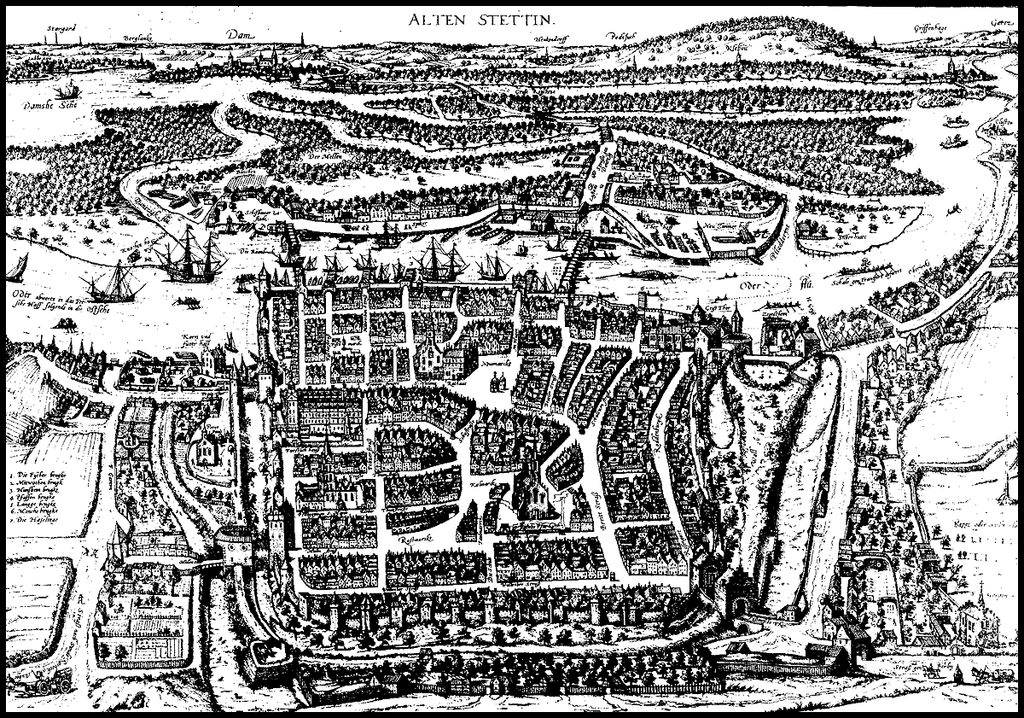
The National Museum in Szczecin documents the 1243 charter. Its medieval city history covers ducal fortifications and the trade war with Stargard beginning in 1454. Otto III’s biography provides the minority and guardianship chronology. The historical image below is a later view dated 1575, not a contemporary city plan.
Keep this reference growing
If this page helped with your reading or game, you can support its upkeep or explore the curated books.
Explore the Bookshop — epics, classics and stories behind imagined worlds.