
Krull (1983)

A wandering fortress, an impossible weapon and a kingdom’s unlikely fellowship against an invading power.
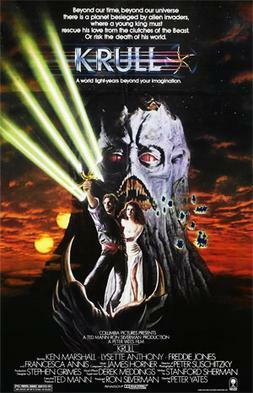
Peter Yates’s Krull (1983) stands at the strange meeting point of sword-and-sorcery and science fiction. On a distant world of castles, seers and enchanted beasts, a predatory power arrives from beyond the sky. The film’s greatest strength is not its love story or the logic of its central quest, but the extraordinary succession of places, creatures and allies that make the journey feel as though it crosses a much larger world.
At a Glance
| Film | Krull (1983) |
|---|---|
| Director | Peter Yates |
| Screenplay | Stanford Sherman |
| Producer | Ron Silverman |
| Principal cast | Ken Marshall, Lysette Anthony, Freddie Jones, Alun Armstrong, Bernard Bresslaw and Francesca Annis |
| Music | James Horner |
| Genre | Science fantasy; quest adventure |
| World | Krull, a fictional planet threatened by the Beast |
Why This Film Matters
Krull explores a useful fantasy idea: a world need not abandon its myths when threatened by something alien. The invaders possess frightening weapons and an apparently invincible fortress, yet the heroes must seek out seers, ancient knowledge and a magical weapon called the Glaive. The result combines the visual vocabulary of a medieval quest with the looming danger of an extraterrestrial occupation.
The Story — Without Major Spoilers
Prince Colwyn and Princess Lyssa hope to unite their kingdoms against the forces of the Beast. Their wedding is interrupted by an assault, and Lyssa is taken to the Black Fortress, a stronghold that shifts location rather than remaining on any ordinary map. Colwyn survives and sets out to find her, gathering allies while searching for a weapon that may overcome the invader’s power.
The expedition must learn not only where the fortress will appear but whom to trust along the way. A band of outlaws, a nervous magician, an ancient guide and a solitary Cyclops become part of the effort. Each companion can do something the prince cannot, and each brings risks or private hopes to the road.
Characters and Performances
Colwyn (Ken Marshall) has the determination expected of a heroic prince, but he is not equipped to cross the hostile country alone. Lyssa (Lysette Anthony) is the emotional centre of the rescue and a target of the Beast’s attempt to dominate the planet’s future. Ynyr (Freddie Jones) is an experienced adviser whose knowledge carries the melancholy of long responsibility.
Torquil (Alun Armstrong) leads the outlaws, lending the quest a rougher, less courtly sense of loyalty. Ergo (David Battley) provides comedy that occasionally becomes courage. Rell (Bernard Bresslaw), a Cyclops, is one of the film’s most affecting figures: his powers and fate give his decisions a weight the central romance sometimes lacks. The Widow of the Web (Francesca Annis) suggests an older history that the film only briefly reveals.
The World on Screen
Krull’s landscape ranges from mountain peaks and forests to swamps, caves and the interiors of an alien fortress. The film does not explain every culture or supernatural rule. That incompleteness can be frustrating as storytelling, but it gives the locations an enticing sense of independence. The Black Fortress is especially effective because it refuses the premise of an ordinary siege: the heroes cannot simply march to a castle whose position never changes.
The Glaive is memorable as an object, but the more interesting obstacles are often social or geographical. An oracle’s message can be intercepted, an apparent ally can betray the party, and a dangerous shortcut can cost more than the time it saves. The film’s Glaive is a five-bladed, star-shaped magical throwing weapon, not the long-bladed polearm called a glaive in the site’s weapons reference. A game adaptation should treat its powers as a unique artefact rather than copy ordinary polearm statistics.
Behind the Camera
Peter Yates directed from Stanford Sherman’s screenplay, with Ron Silverman producing. The production involved extensive physical sets, unusual creature designs and visual effects intended to make an alien world feel inhabited. James Horner’s expansive score supplies much of the heroic momentum and emotional scale. The production’s ambition sometimes exceeds the clarity of its storytelling, but the visual commitment is rarely in doubt.
Themes and Critical Assessment
The strongest theme is fellowship: a prince cannot overcome a planetary invader without people whom his court might normally dismiss. Outlaws, a solitary creature and a self-important amateur magician all become valuable because they act at the right moment. The film also treats destiny as both an opportunity and a burden. Foreknowledge does not necessarily make danger easier to face.
What works: a distinctive science-fantasy landscape, imaginative supporting characters, the changing fortress and Horner’s music. What works less well: a thin central romance, unexplained rules for some magical objects and a quest assembled from familiar fantasy episodes. Its unevenness is real, but the inventions give it an identity beyond more conventional sword-and-sorcery films.
Related Films
Compare Dragonslayer (1981) for a harsher treatment of a monster shaping a kingdom, or Willow (1988) for an adventure whose unlikely travelling companions are as important as the final objective. Browse the Fantasy Films archive for further film-worlds and quests.
Ideas for the Table
A fortress that moves every dawn is a fine engine for a sandbox campaign. Give the party several leads to its next location: an astronomer’s calculations, a prisoner who escaped its halls, and rumours from villages it passed near. The players should choose how to use these leads and what risks to take. Their rivals can interpret the same evidence differently.
Recruiting companions should mean earning their commitment, not simply collecting predetermined party members. A seer might demand a rescue, an outlaw might need proof of a pardon, and a dangerous creature might agree to guide the party only after a promise is made. Once the heroes reach the fortress, the relationships they have built should change what options remain possible. Related encounter material can be found in the Bestiary.
The fortress at dawn. A black citadel vanishes each night and reappears in a different kingdom. Scholars can predict three plausible arrival sites, but a rival faction is spreading false charts. The party must decide which witnesses and signs to trust before marching.
The one-eyed guide. A formidable stranger knows a shortcut through the enemy’s territory and demands an oath in return. His warnings concern a fate he believes unavoidable. Rather than forcing tragedy, let the players test whether knowledge and loyalty can change what happens.
The stolen star. A unique five-bladed talisman has been taken from an ancient shrine. Returning it may reopen a sanctuary, but the artefact seems to choose its bearer and refuses ordinary use. Resolving the theft should depend as much on understanding the shrine’s history as winning a fight.
Production Deep Dive — Journey to Krull
The original television promotional documentary, Journey to Krull, includes interviews with director Peter Yates, performers and the effects and stunt teams. An archival upload of the making-of film offers behind-the-scenes footage; its continued availability may vary. The Digital Bits review of the 4K edition documents the featurette and contemporary reporting from the set. The ACMI collection record places the production’s combination of medieval fantasy and science fiction in its historical context.
Sources and Credits
- Rotten Tomatoes — Krull cast and crew (credits).
- British Film Database — Krull (1983) (film overview).
The film’s characters and promotional artwork belong to their respective rights holders. This criticism and the campaign suggestions are independently written.
Keep this reference growing
If this page helped with your reading or game, you can support its upkeep or explore the curated books.
Explore the Bookshop — epics, classics and stories behind imagined worlds.