
Labyrinth (1986)
A goblin kingdom built from riddles, bad bargains and a teenager’s growing sense of responsibility.
Jim Henson’s Labyrinth (1986) combines puppetry, elaborate physical sets and musical performance in a fairy tale about the limits of fantasy and the demands of growing up. Its heroine, Sarah, must cross an ever-changing maze to rescue her baby brother from Jareth, the Goblin King. What looks at first like a straightforward rescue adventure becomes a struggle to recognise manipulation and take responsibility for a careless wish.
At a Glance
| Film | Labyrinth (1986) |
|---|---|
| Director | Jim Henson |
| Screenplay | Terry Jones, from a story by Jim Henson and Dennis Lee |
| Principal cast | Jennifer Connelly, David Bowie and an extensive puppet-performance ensemble |
| Executive producer | George Lucas |
| Visual design | Brian Froud |
| Music | Trevor Jones; songs performed by David Bowie |
| Running time | 101 minutes |
| Genre | Musical fantasy; fairy-tale adventure |
Why This Film Matters
Labyrinth makes the rules of a fairy tale seem simultaneously arbitrary and deeply meaningful. Doors give misleading advice, paths rearrange themselves, and courtiers play games with time. Yet there is a consistent emotional logic beneath the chaos: the Goblin King’s power relies on Sarah treating her own fears and desires as reasons to surrender her choices.
The film’s visual world is extravagant, but its most durable idea is simple. A story can help someone understand a difficult life, provided the story does not replace the responsibilities of living it.
The Story — Without Major Spoilers
Sarah resents being made to babysit her infant brother Toby and, in frustration, wishes him away to the goblins. When he vanishes, Jareth offers her a chance to reclaim him by reaching the centre of a labyrinth before the allotted time runs out. She enters a world of shifting passages, impossible staircases and creatures whose friendliness is not always proof of honesty.
Along the way Sarah meets Hoggle, a reluctant and compromised guide; Ludo, a powerful but gentle creature; and Sir Didymus, an excitable guardian with strict ideas about honour. The maze is more than a test of directions. It rewards cooperation, punishes assumptions and presents temptations that reflect Sarah’s own habits.
Characters and Performances
Sarah (Jennifer Connelly) begins with a theatrical idea of heroism and gradually learns that other people are not props in her story. Connelly gives the role enough sincerity to make its changes believable. Jareth (David Bowie) combines charm, threat and wounded vanity. His seeming generosity always threatens to become a claim of ownership over someone else’s future.
Hoggle is interesting because he wants both safety and friendship; his hesitation has consequences. Ludo uses great strength without cruelty, while Sir Didymus turns chivalric confidence into comedy. The puppeteers bring these characters to life through gait, timing, voice and physical response to a shared environment.
The World on Screen
Brian Froud’s creatures belong to a world of weathered stone, moss, old toys and twisted courtly fashion. The Goblin City feels messy and inhabited rather than carefully arranged for a single hero’s arrival. Creatures move through the frame with their own routines, and the different districts of the labyrinth each obey a distinctive visual logic.
The film’s greatest technical accomplishment is not one creature or maze effect, but the impression of a society continuing beyond the edge of the camera. The architecture, puppets and theatrical illusions invite exploration even when the story moves quickly through them.
Behind the Camera
Henson directed the film from Terry Jones’s screenplay, with George Lucas as executive producer. Designers, puppeteers, technicians and live-action performers combined practical sets and creatures with visual effects. Jennifer Connelly and David Bowie anchor the human performances, while Trevor Jones’s score and Bowie’s songs create a musical world that shifts between exuberance and melancholy.
The film followed Henson’s The Dark Crystal, but the two projects take different approaches. Where the earlier film removed humans from the screen entirely, Labyrinth places a recognisably human heroine amid extravagantly unfamiliar inhabitants.
Themes and Critical Assessment
The central themes are growing up, the temptation to control others and the difference between claiming independence and exercising it responsibly. Jareth’s glamour makes his coercion attractive, while the maze’s absurdities repeatedly demand practical judgement. Sarah succeeds at her best when she starts taking other beings seriously rather than imagining herself alone on a stage.
What works: extraordinary puppetry, memorable creature personalities, unsettling dream logic and a genuinely distinctive musical presence. What is less effective: an occasionally episodic structure and an uneven balance between fantasy humour and psychological tension. Its very peculiarities, however, prevent it from becoming an anonymous fantasy quest.
Legacy and Related Viewing
Labyrinth has remained a touchstone for practical-effects fantasy and for stories in which strange companions matter as much as the goal. For another Henson fantasy, explore The Dark Crystal (1982) and the wider Fantasy Films archive.
Ideas for the Table
A maze becomes interesting when its inhabitants have conflicting motives. Give players more than a sequence of navigation rolls: a bridge-keeper may demand a promise, a helpful guide may owe a debt to the maze’s ruler, and a apparently hostile creature may know the only safe route. Different choices should produce different shortcuts, obligations and alliances.
The maze itself can react to identity, memory or spoken promises. Let players map some routes, discover the logic behind others and occasionally take a risk that changes the environment. When the party reaches the centre, its relationships should matter at least as much as its equipment. Find suitable inhabitants in the Fey Bestiary.
Trailer and Further Viewing
The Jim Henson Company — official film background.
Production Deep Dive — Inside the Labyrinth
American Cinematographer’s August 1986 production article, republished for the film’s fortieth anniversary, includes Jim Henson’s explanation of the development of Brian Froud’s ideas and the technical challenges of the impossible staircase sequence. The contemporary documentary Inside the Labyrinth features Henson, David Bowie and Jennifer Connelly. The Rock & Roll Hall of Fame’s catalogue documents further interviews and Brian Froud’s commentary on the anniversary release. Documentary availability varies by edition and region.
Sources and Credits
- The Jim Henson Company — Labyrinth (film overview).
- Lucasfilm — Labyrinth (production context).
- Sony Pictures — Labyrinth (official synopsis).
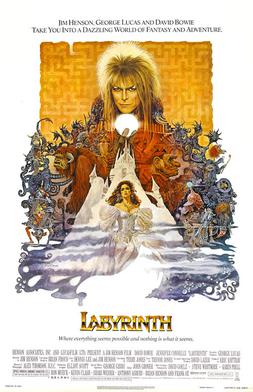
The characters and poster belong to their respective rights holders. This criticism and the original campaign examples are independent editorial content.
Keep this reference growing
If this page helped with your reading or game, you can support its upkeep or explore the curated books.
Explore the Bookshop — epics, classics and stories behind imagined worlds.