
The Golden Voyage of Sinbad (1973)
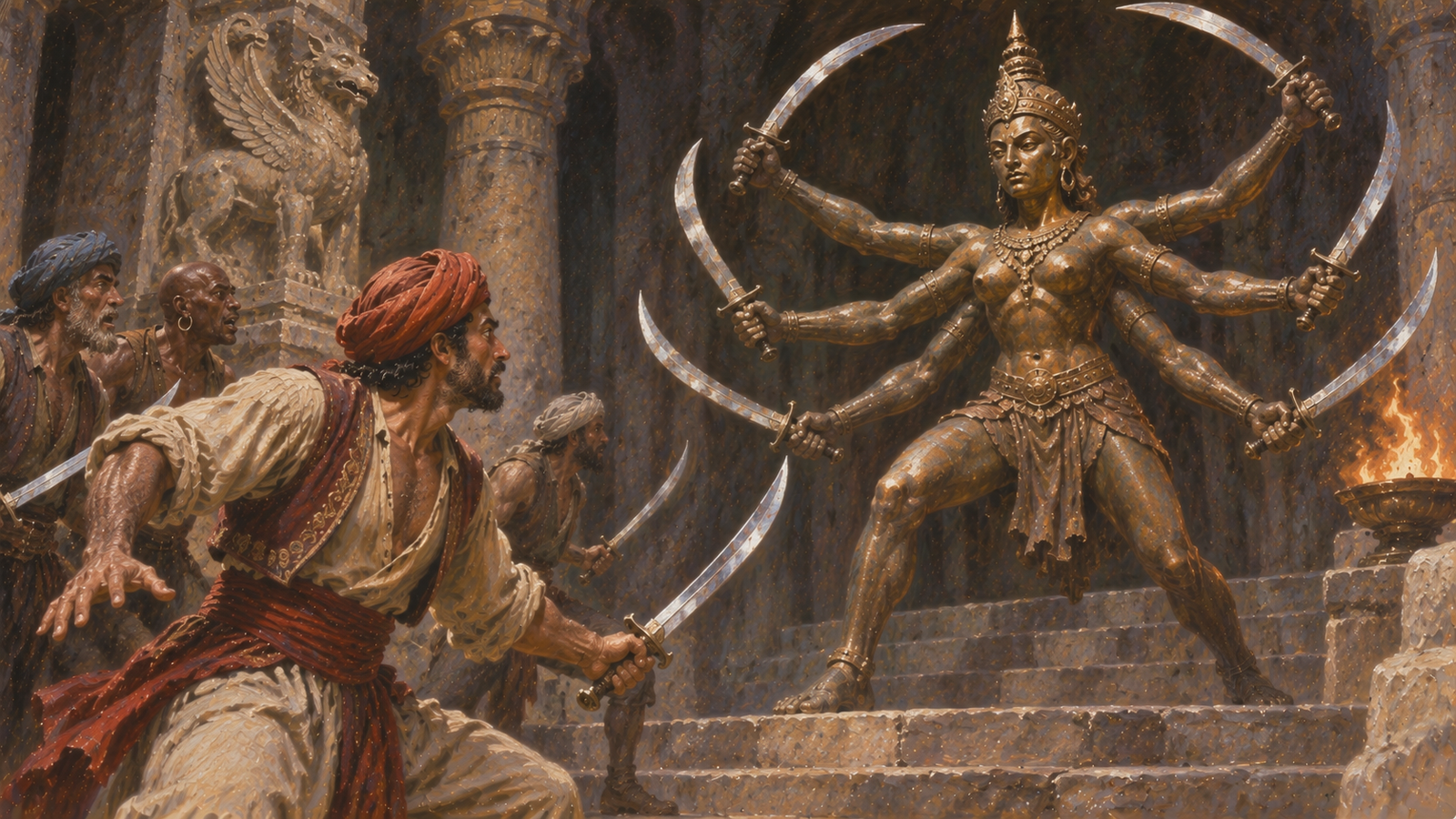
A fragment of a golden talisman sends Sinbad towards an island of animated idols, dangerous guardians and a sorcerer whose magic consumes his own life.
The Golden Voyage of Sinbad (1973), directed by Gordon Hessler, is the middle adventure in the trilogy of Sinbad fantasies associated with producer Charles H. Schneer and effects artist Ray Harryhausen. John Phillip Law plays Sinbad, Tom Baker is the sinister magician Koura, and Caroline Munro plays Margiana. The film combines sea adventure, stop-motion monsters and a memorable rivalry in which every spell brings Koura closer to his own destruction.
At a Glance
| Film | The Golden Voyage of Sinbad (1973) |
|---|---|
| Director | Gordon Hessler |
| Producers | Charles H. Schneer and Ray Harryhausen |
| Screenplay | Brian Clemens, from a story by Clemens and Ray Harryhausen |
| Cinematography | Ted Moore |
| Creature effects and story | Ray Harryhausen |
| Principal cast | John Phillip Law, Tom Baker, Caroline Munro, Douglas Wilmer, Martin Shaw and Kurt Christian |
| Music | Miklós Rózsa |
| Release | First shown in 1973; released in several markets during 1974 |
| Runtime | Approximately 105 minutes; editions vary |
| Genre | Fantasy voyage; sword-and-sorcery; creature adventure |

Why This Film Matters
The film illustrates the power of giving each magical obstacle a different personality. Rather than sending an endless procession of similar enemies against Sinbad, Harryhausen animates a wooden ship’s figurehead, a multi-armed temple statue and extraordinary animal-like beings whose shape affects how they move and fight. The resulting encounters offer variety even when the story that connects them is fairly simple.
Its antagonist is equally important. Koura knows a great deal about forbidden magic, but using it exacts a physical cost. Each exercise of power becomes a decision about what he is willing to sacrifice. That makes a straightforward rivalry more interesting than a contest between two characters with limitless resources.
The Story — Without Major Spoilers
While sailing, Sinbad’s crew intercepts a winged homunculus carrying part of a mysterious golden talisman. It seems to point towards a hidden treasure of immense supernatural value, but a magician named Koura is determined to seize it. Sinbad joins forces with the masked Grand Vizier of Marabia, who possesses another piece of the puzzle. Their shared objective carries them towards the legendary island of Lemuria.
Margiana, a woman marked by a strange symbol on her hand, becomes an essential part of the voyage, while the inexperienced Haroun joins the crew. Pursuit by Koura forces the travellers to seek information from an oracle and navigate hostile landscapes, enchanted objects and unfamiliar communities. Their destinations are not safe simply because a prophecy or map has brought them there.
Characters and Performances
Sinbad (John Phillip Law) is a physically capable but comparatively reserved hero. His strength is determination and the ability to maintain a crew rather than magical prowess. Koura (Tom Baker) dominates many scenes with an intense, deliberate performance: a practitioner of dangerous magic who can see his remaining life ebb away whenever he casts a spell.
Margiana (Caroline Munro) is more than a mysterious marking within the plot, although the film often treats her through the limited romantic conventions of the period. The Grand Vizier (Douglas Wilmer) has a private history with Koura and seeks to restore his own prospects through the voyage. Haroun (Kurt Christian) provides an inexperienced companion whose occasional successes give the party a welcome element of unpredictability.
The World on Screen
The film imagines Marabia, ocean routes and Lemuria as places of extravagant adventure rather than historical locations. Temples, caves, island settlements and ships become stages for the supernatural. Its giant creatures are best understood as the film’s creations, not accurate representations of any living culture’s religious beliefs or of a particular tabletop bestiary.
A six-armed statue animated by Koura is often referred to as Kali in descriptions of the film. This is cinematic appropriation of divine imagery, not a faithful portrayal of the Hindu goddess. Similarly, the centaur-like guardian and griffin are inventions shaped around a particular battle and need not be treated as authoritative versions of mythological beings.
Behind the Camera
Gordon Hessler directed, with Charles H. Schneer and Ray Harryhausen producing. Brian Clemens wrote the screenplay from a story developed with Harryhausen. Photography began in 1972, with Spanish locations including Majorca and Madrid; further work took place in Malta. The film reached different markets in 1973 and 1974. Harryhausen’s complex stop-motion work required painstaking coordination between model animation and live-action staging.
The temple sequence pits Sinbad and his crew against a bronze statue approximately eight feet tall, its six hands each armed with a curved sword. Harryhausen planned the model’s movements in relation to the actors’ rehearsed swordplay, giving the encounter its remarkable rhythm and physical presence. The figure is an animated idol within the film, not the goddess herself. Miklós Rózsa’s score supplies an expansive adventure identity to the voyage. The film sits between The 7th Voyage of Sinbad (1958) and Sinbad and the Eye of the Tiger (1977), but it tells a self-contained story with a different Sinbad actor in each of those earlier and later productions.
Themes and Critical Assessment
The central themes are temptation, power and the cost of using others to fulfil private ambitions. Koura treats people as tools and sacrifices part of himself for every new advantage; Sinbad has reasons to take risks, but his loyalty to fellow travellers is the stronger foundation for his success. The film’s creatures reinforce this contrast by presenting obstacles that need observation and judgement rather than only bravery.
What works: Tom Baker’s unnerving villain, Harryhausen’s inventive models, the extraordinary encounter with an animated statue, Rózsa’s music and varied fantasy locations. What works less well: a thinly developed central romance, a plot driven by convenient discoveries and some dated cultural and gender portrayals. Its pleasures are largely visual and atmospheric, but those are substantial achievements.
Explore the Other Voyages
For the trilogy, visit The 7th Voyage of Sinbad (1958) and Sinbad and the Eye of the Tiger (1977). Explore Ray Harryhausen for the animator’s other work and One Thousand and One Nights for the broader storytelling tradition. The films are freely imagined adventures rather than direct versions of particular Sinbad tales.
Related People and Creatures
For separate campaign-world treatments, discover Sinbad the Sailor, the Arabian NPCs collection and the Bestiary. The Kali page concerns the deity rather than the animated idol in the film.
- Homunculus — Koura’s small magical spies suggest an artificer’s familiars and agents.
- Centaur — the one-eyed guardian is a cinematic variation rather than a representative of ordinary centaur peoples.
- Griffon — the guardian of the fountain suggests a powerful beast whose purpose extends beyond hunting.
- Constructs — the animated figurehead and temple statue offer inspiration for magically awakened guardians rather than literal manifestations of a goddess.
Ideas for the Table
The divided map: several rival expeditions each possess a fragment of directions to an ancient place. Combining them requires trust, bargaining or theft, and no one can be certain the prize is worth the cost. Provide multiple routes rather than a predetermined path.
The magician’s diminishing years: a powerful enemy’s greatest spell ages them noticeably. The party can investigate this limitation and use it to negotiate, delay or compel the antagonist to make a costly decision. Combat is one possibility, not the only answer.
The temple’s waking guardian: an immense statue animates when visitors violate a sacred space. The guardians and worshippers have their own interests, distinct from the sorcerer who manipulated the event. Characters who respect the site’s inhabitants may gain allies rather than another compulsory fight.
Sources and Credits
- Sony Pictures — The Golden Voyage of Sinbad (official synopsis and cast).
- AFI Catalog — The Golden Voyage of Sinbad (production and release history).
- Turner Classic Movies — The Golden Voyage of Sinbad (production context and criticism).
- BFI Southbank programme notes (the bronze statue’s scale, six arms and animation technique).
- Ray Harryhausen archive — Kali lighting stand-in model (surviving production artefact).
The film, characters and promotional artwork remain the work of their respective rights holders. This article offers independent criticism and original campaign prompts.
Keep this reference growing
If this page helped with your reading or game, you can support its upkeep or explore the curated books.
Explore the Bookshop — epics, classics and stories behind imagined worlds.