
The 7th Voyage of Sinbad (1958)
A monster-haunted voyage where every bargain conceals another danger.
The 7th Voyage of Sinbad (1958) brings the Arabian Nights adventure tradition into full-colour creature fantasy. Its spectacle owes much to Ray Harryhausen, whose stop-motion beings are distinctive characters in their own right. The film is most enjoyable as a succession of discoveries, perils and magical reversals, but its craft is also a reminder that a great fantasy creature should have movement, presence and a place in its environment.
At a Glance
| Film | The 7th Voyage of Sinbad (1958) |
|---|---|
| Director | Nathan Juran |
| Producer | Charles H. Schneer |
| Principal cast | Kerwin Mathews, Kathryn Grant, Torin Thatcher and Richard Eyer |
| Creature effects | Ray Harryhausen, using Dynamation |
| Music | Bernard Herrmann |
| Genre | Fantasy adventure; sword-and-sorcery; creature feature |
| Year | 1958 |
Why This Film Matters
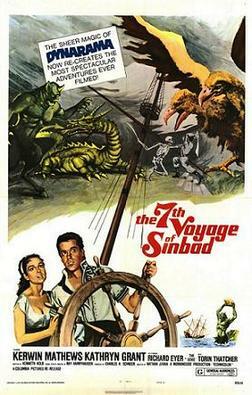
Harryhausen’s creatures made impossible encounters feel like events happening in a shared physical space. A Cyclops can stoop, search and attack with an animal’s ungainly force. A skeleton duelist can suggest combat skill despite being made of little more than bone and motion. Their individuality lifts the film beyond a catalogue of attractions.
The movie also helped establish the visual vocabulary of later fantasy adventure: exotic shores, a dangerous magician, monsters that must be outwitted as well as fought, and a hero compelled to revisit a place he would rather escape.
The Story — Without Major Spoilers
Sinbad and Princess Parisa are travelling toward their marriage when they encounter the dangerous Island of Colossa. There they meet Sokurah, a magician whose possessions and ambitions are entangled with the island’s monstrous inhabitants. An act of sorcery places Parisa in grave danger and compels Sinbad to undertake another perilous voyage.
The return expedition must negotiate monsters, an enchanted cave, dangerous terrain and a sorcerer whose offers cannot be trusted at face value. The film follows the broad outline of a fairy-tale quest: each obstacle exposes another complication, and apparent victories rarely end the danger.
Characters and Performances
Sinbad (Kerwin Mathews) is an energetic and resourceful adventurer, sometimes too ready to believe that determination can overcome every obstacle. Parisa (Kathryn Grant) gives the journey its immediate personal stakes and a reason to challenge Sokurah. Sokurah (Torin Thatcher) embodies the familiar but effective figure of a sorcerer who claims that his schemes serve a necessary purpose.
The greatest supporting performances are partly animated. The creatures establish their personalities through the force of their movements, whether an intimidating charge, a hesitant glance or the careful handling of an obstacle.
The World on Screen
The Island of Colossa is a miniature fantasy setting rather than just a location for action. A coastline, a cavern, strange beasts and a magician’s hidden objective all combine to suggest ecological and supernatural history. The film’s fantasy geography is compressed, but its locations remain memorable because each new region changes what the travellers must fear.
The use of scale is central to its wonder. A human figure standing beneath an animated giant tells us immediately how the party’s options have changed. The film often asks its heroes to think in terms of terrain, movement and timing rather than the simple exchange of sword blows.
Behind the Camera
Nathan Juran directed and Charles H. Schneer produced. Ray Harryhausen realised the creatures through elaborate stop-motion work combined with live action, an approach marketed as Dynamation. It allowed animated figures to appear within the same frames as the actors, helping give fantasy beings an apparently substantial presence. Bernard Herrmann’s score heightens the danger and grandeur of these encounters.
The production’s visual inventiveness had a strong influence on later makers of fantasy films and on generations of artists and gamers who imagined similar monsters at the table.
Themes and Critical Assessment
The film’s pleasures are adventure, spectacle and the uneasy relationship between resourcefulness and temptation. Its moral contrasts are simple: the cunning sorcerer makes the hero’s frank determination seem admirable. Some cultural imagery reflects mid-century adventure conventions and should be recognised as such rather than mistaken for a reliable portrait of historical societies.
What works: the great creature sequences, Herrmann’s music and the sense that each new location may contain a wholly different danger. What works less well: a thin emotional arc, abrupt narrative conveniences and some dialogue that exists only to get the expedition moving again. The creatures, not the plotting, are the film’s enduring achievement.
Legacy and Related Viewing
For another voyage into mythic creature fantasy, see Jason and the Argonauts (1963) and the site’s Ray Harryhausen filmmaker profile. The broader Fantasy Films archive includes later films in the Sinbad tradition.
Explore in SpiralWorlds
For adventures beyond the film, meet Sinbad the Sailor, explore the Arabian NPCs, and draw creatures from the Cyclops, Roc and wider Bestiary collections. These are campaign interpretations of legendary figures and creature types, not official film statistics.
What a Games Master Can Take from It
Use an island or remote valley as a sequence of discoveries rather than an empty map filled with combat encounters. Put the expedition’s goal somewhere obvious but difficult to reach. Let the players see evidence of an enormous creature before meeting it, hear different accounts from local inhabitants and decide whether to evade, bargain or fight.
Give a sorcerer plausible immediate reasons for needing assistance, but let the party investigate the true cost. If a magical transformation threatens someone important, offer more than one possible cure, each with different dangers. Monster behaviour should open creative choices: the giant may guard territory, a lesser beast may follow food, and a sentry may protect something more valuable than itself.
Explore the Bestiary for creatures that can support similarly varied encounters with their own identities and motives.
Trailer and Further Viewing
Sony Pictures — official film overview.
Sources and Credits
- Sony Pictures — The 7th Voyage of Sinbad (production and cast).
- Sony Pictures Museum — The 7th Voyage of Sinbad (Harryhausen and film history).
- AFI Catalog (credits and production).
The film’s characters and promotional artwork remain the property of their respective rights holders. This review and original adventure ideas are independent commentary.
Keep this reference growing
If this page helped with your reading or game, you can support its upkeep or explore the curated books.
Explore the Bookshop — epics, classics and stories behind imagined worlds.