
Faerie Hills
Hollow hills, hidden courts and impossible roads through the rolling uplands of the Otherworld.
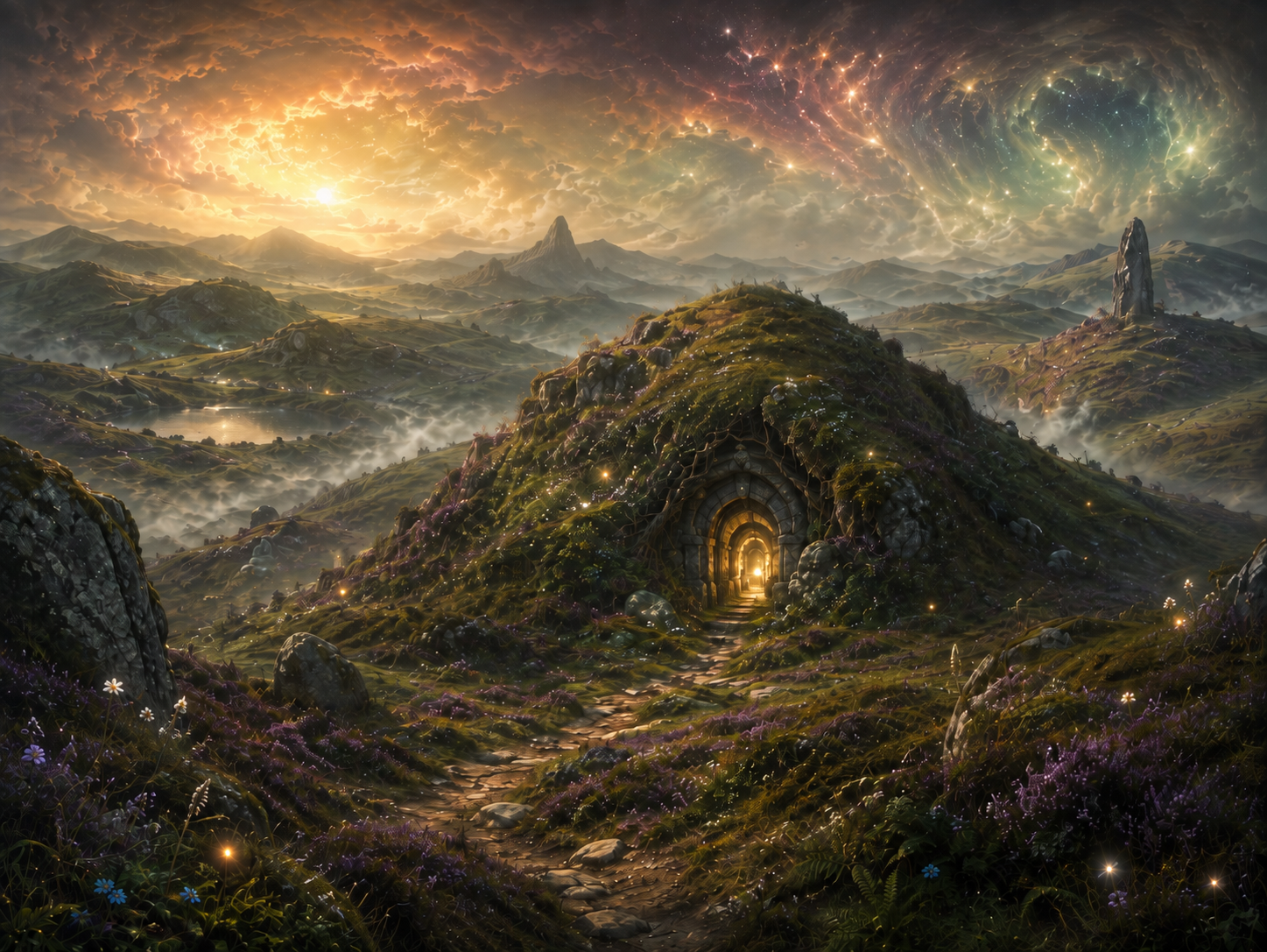
The Hills That Open
In Faerie, a green hill is rarely only a hill. Beneath the turf may lie a feast hall, a forgotten road, a sleeping court, a giant’s refuge, or a country larger than the landscape that contains it.
The Faerie Hills are not a single bounded province. They are a recurring landscape of the Fey World: rolling uplands, heather-covered ridges, secluded valleys, ancient earthworks, steep glens and green mounds whose apparent simplicity conceals a dense web of fey territories, secret roads and hidden dwellings.
Hill fey are particularly diverse because hills rarely exist in isolation. A single range can descend into forest, rise towards mountains, break into rocky crags, open onto grassland or channel streams through sheltered valleys. Fey associated with each neighbouring environment therefore mingle in the hills, while magical creatures, giant-kind and powerful draconic inhabitants maintain territories of their own.
Many fey favour precisely this kind of country. A forest announces itself as wilderness and a mountain displays its dangers from miles away. A grassy hill can stand beside a mortal road for centuries without revealing that music sounds beneath it every seventh night.
Game Statistics
Ordinary slopes, cliffs, vegetation and weather use the normal terrain rules of the chosen game system. The following rules represent the supernatural characteristics that make these hills distinctively Faerie.
Finding a Hidden Threshold
A character actively examining a suspicious mound, standing stone, spring, hollow, cave or hillside can identify signs of a concealed fey threshold with a DC 15 Wisdom (Perception) or Intelligence (Investigation) check.
Discovering how the threshold opens requires a DC 15 Intelligence (Arcana or Nature) or Wisdom (Survival) check.
Success identifies the relevant condition: direction of approach, time of day, spoken greeting, offering, musical phrase, particular path, seasonal event or another clue present in the surrounding landscape.
Thresholds are discoveries, not arbitrary locked doors. Once characters learn how a particular crossing works, that knowledge remains useful unless something deliberately changes it.
Following a Faerie Hill Road
For every four hours spent travelling beyond a clearly established route, one character guides the party and makes a DC 14 Wisdom (Survival) check.
- Success: the party reaches the intended district or landmark.
- Success by 5 or more: the guide identifies a useful shortcut or stable landmark.
- Failure: the party reaches a neighbouring feature, crossing or political boundary before correcting its course.
- Failure by 5 or more: the road folds back on itself or leads directly into a regional encounter.
Stable Landmarks
Ancient standing stones, boundary stones, particular springs and other deeply anchored places resist the shifting geography of Faerie.
A traveller navigating by a known stable landmark has advantage on Wisdom (Survival) checks made to navigate the surrounding hills.
The Hill Is Larger Within
A supernatural hollow hill can contain an extradimensional interior vastly larger than its exterior. Distance travelled inside does not determine the distance between its entrances, and excavating the visible mound does not automatically expose the chambers within.
Time Beneath an Unstable Hill
Most hollow hills keep ordinary local time. A hill specifically affected by temporal instability distorts the relationship between time within and time outside.
After creatures spend at least 1 hour within such a hill and then leave it, roll once for the entire visit.
| d6 | Time Passed Outside |
|---|---|
| 1 | Only a few minutes have passed. |
| 2–4 | Approximately the same amount of time has passed inside and outside. |
| 5 | One day outside has passed for every hour spent within. |
| 6 | 1d4 days outside have passed for every hour spent within. |
Finding a Hidden Threshold
Locating signs of a concealed fey entrance requires a DC 20 Perception check while examining an appropriate mound, standing stone, spring, hollow or hillside.
A DC 15 Knowledge (nature), Knowledge (planes) or Survival check identifies the condition required to open or safely cross the threshold.
Following a Faerie Hill Road
For every four hours spent travelling away from a stable road or known landmark, the party’s guide makes a DC 15 Survival check.
- Success: travel proceeds towards the intended destination.
- Success by 5 or more: the guide identifies a shortcut or stable landmark.
- Failure: the party strays into an adjacent district, crossing or court boundary.
- Failure by 5 or more: the road folds back or leads into a regional encounter.
Stable Landmarks
A traveller using a known standing stone, ancient spring, boundary marker or similarly anchored location gains a +4 circumstance bonus on Survival checks made to avoid becoming lost in the surrounding hills.
Hollow-Hill Interiors
A supernatural hollow hill functions as an extradimensional space. Its internal dimensions do not need to correspond with the visible mound.
Time Beneath an Unstable Hill
After a creature spends at least one hour inside a time-unstable hollow hill and then leaves, roll once for the entire visit.
| d6 | Time Passed Outside |
|---|---|
| 1 | Only several minutes pass outside. |
| 2–4 | Time passes at approximately the normal rate. |
| 5 | One day outside passes for every hour within. |
| 6 | 1d4 days outside pass for every hour within. |
Finding a Hidden Threshold
Discovering a concealed entrance in a mound, stone circle, hollow or hillside requires a DC 20 Search check when examining the correct location.
A DC 15 Knowledge (nature), Knowledge (the planes) or Survival check identifies the condition necessary to open or safely cross the threshold.
Following a Faerie Hill Road
For every four hours spent away from established routes, the group’s guide makes a DC 15 Survival check.
- Success: the travellers remain on course.
- Success by 5 or more: the guide finds a stable landmark or supernatural shortcut.
- Failure: the road carries the group into an adjacent district instead of the intended destination.
- Failure by 5 or more: the road doubles back or leads directly into an encounter.
Stable Landmarks
Travellers navigating from an identified stable landmark gain a +4 circumstance bonus on Survival checks made to avoid becoming lost nearby.
Hollow-Hill Interiors
A supernatural hill interior functions as an extradimensional space. Its chambers can occupy far more space than the exterior mound and need not maintain ordinary geographic relationships.
Time Beneath an Unstable Hill
| d6 | Time Passed Outside |
|---|---|
| 1 | Only several minutes pass outside. |
| 2–4 | Time passes at approximately the same rate. |
| 5 | One day outside passes for every hour within. |
| 6 | 1d4 days outside pass for every hour within. |
A Landscape Between Landscapes
The defining strength of the Faerie Hills is their variety. Forest fey climb wooded slopes; mountain creatures descend through high passes; grassland wanderers follow long ridges; streams bring water-dwelling beings into secluded valleys; and caves open beneath apparently gentle ground.
Borders between environments become meeting places, hunting grounds, roads, markets and battlefields.
In Annwn, hill country often resembles an intensified reflection of mortal terrain. Colours are richer, valleys deeper and distant ridges more dramatic, but roads and landmarks possess enough consistency to be learned.
Deeper in Ladinion, the idea of a hill becomes more important than its physical dimensions. A ridge can lengthen according to the traveller’s purpose. A summit can overlook a valley impossibly distant from it. Two neighbouring mounds can contain domains whose inhabitants regard each other as distant foreign powers.
Long Ridges
Ridges serve as natural roads. Some preserve an ancient destination more faithfully than direction, carrying travellers towards the place the road remembers rather than the point indicated by a map.
Mist Hollows
Low valleys rapidly fill with mist. Sounds travel farther than sight, distances become difficult to judge and travellers can emerge onto the wrong side of a hill—or a different hill entirely.
Hill Springs
Springs are among the most dependable natural gathering places. Courts mark them, beasts defend them and travellers use them to recover their bearings.
Crags and Escarpments
Rougher heights are more frequently contested by giant-kind, predatory beasts and draconic powers seeking defensible ground, nesting sites or control of important passes.
Standing Stones
Certain ancient stones resist the movement of the landscape. Local inhabitants use them as boundaries, meeting places, oath-sites and navigation anchors.
Hidden Valleys
A sheltered valley can contain farms, orchards, workshops, herds or entire settlements while remaining invisible from every surrounding summit until approached by the correct road.
The Hollow Hills
The greatest wonders of the Faerie Hills lie beneath their surface. Some are hollow hills: supernatural dwellings whose interiors obey the geometry of Faerie rather than the dimensions of the mound visible from outside.
An entrance may be obvious to those who belong there and almost impossible for everyone else to recognise. Turf peels aside like a curtain. A standing stone becomes a doorway when approached from the west. Music reveals an opening that vanishes when the song ends. A narrow animal track reaches a carved gate at twilight despite ending against bare stone by day.
A hollow hill should feel larger after entry, not merely underground. The greatest contain halls, orchards, fortified courts, workshops, caverns, feast chambers and roads leading still deeper into Faerie.
What Lies Beneath?
| d8 | Hollow-Hill Interior |
|---|---|
| 1 | A small household of secretive fey inhabiting chambers built between immense roots. |
| 2 | A feast hall belonging to a local court, bright with music and guarded hospitality. |
| 3 | An abandoned dwelling whose inhabitants vanished while leaving fires, food and possessions untouched. |
| 4 | A subterranean road junction linking hills that stand many miles apart in the outer landscape. |
| 5 | A workshop, armoury or storehouse maintained by fey craftspeople and their household. |
| 6 | A fortified refuge claimed by giant-kind or another non-fey power. |
| 7 | An extensive courtly domain containing fields, woods and an open sky beneath a modest green mound. |
| 8 | A sealed road descending towards a far older and more dangerous region of Ladinion. |
Hospitality Beneath the Hill
A hall beneath a hill is somebody’s home even when no inhabitant is immediately visible. Food, shelter, music and gifts can all be acts of hospitality rather than traps.
Respectful travellers ask before taking what has not been offered and listen carefully when a host states the terms of a bargain. Individual hosts may be generous, manipulative, honourable, dangerous or several of these things at once.
Courts, Borders and Hill-Lords
The hills are politically fragmented. Their inhabitants participate in the wider Faerie Courts, but no single monarch rules every hill merely because it is hill country.
The great Demesne Courts claim authority through terrain, climate and supernatural affinity. Hill country therefore becomes disputed wherever environments overlap.
Wooded hills attract forest interests. Cold uplands draw courts associated with frost and winter. High ridges become extensions of mountain influence. Rivers crossing a valley give water-oriented powers reason to assert ancient rights.
Local courts complicate the situation further. A valley can owe allegiance to one power while the ridge above answers to another, and an ancient hollow hill may remain independent despite standing inside territory claimed by a much greater court.
Territorial Conflict
Many conflicts concern not merely ownership of land but what the land will become.
A forest court wants trees to climb the slopes. A mountain power wants the ridges to harden into bare heights. A river power seeks to flood a valley. A local hill court resists them all because the existing mixture of pasture, scrub, spring, stone and woodland is the source of its strength.
Non-fey powers also make territorial claims. Giant-kind possess old halls, secluded valleys, grazing land and defensible heights. Linnorms and other powerful dragons can dominate entire upland districts, forcing neighbouring courts into tribute, alliance or war.
Local Courts
The powers adventurers most frequently encounter. Their authority can encompass a single household, one hollow hill, or an entire chain of valleys and ridges.
Demesne Interests
Greater environmental courts regard hill country as territory to protect, transform, annex or recover from competing landscapes.
Independent Powers
Ancient fey rulers, giant clans and powerful monsters may acknowledge no court. Their independence frequently survives because defeating them would cost more than tolerating them.
Shared Claims
Several powers can claim the same landscape for different reasons. Such overlap produces treaties, proxy struggles, old feuds and opportunities for skilled outsiders.
Inhabitants of the Faerie Hills
Fey remain the characteristic inhabitants, but the hills support a far more mixed population than many other Faerie environments. When building encounters, use creatures already established in the SpiralWorlds Bestiary wherever possible.
Daoine Sídhe
The Daoine Sídhe are among the inhabitants most closely associated with the courtly life of the hollow hills. Ancient mounds, barrows, standing stones and hidden halls make natural centres for their households, gatherings and political interests.
They need not rule every hollow hill. Individual Daoine Sídhe may serve greater courts, maintain their own lesser households, act as envoys between neighbouring powers or possess complex claims that overlap those of older local inhabitants.
Other Fey
Korreds are especially suited to rocky hill country, stone, secluded uplands and hidden gatherings. Atomies make excellent scouts, sentries and messengers around court roads and concealed approaches.
Redcaps turn ruined, abandoned or bloodstained hills into places avoided even by neighbouring fey. Satyrs range easily between woodland, pasture and hill country, paying little attention to boundaries recognised by more settled inhabitants.
Brownies are more commonly encountered around isolated cottages, hill farms, barns, mills and occupied valleys than on empty summits. Their preference for rural households makes them particularly suitable for the places where Faerie hill country approaches settled land.
Other fey appear wherever their established habits fit the surrounding environment.
Giants and Giant-Kin
Giants are not incidental visitors. Some lineages occupy remote uplands in their own right, maintaining herds, halls, cairns, roads and territorial claims that may be older than neighbouring fey courts.
Firbolgs are particularly appropriate inhabitants of secluded hills, wooded uplands and remote valleys.
Fomorians and other giant powers occur where their established territories, migrations or political struggles bring them into the hill country.
Dragons and Linnorms
True dragons matter precisely because they are not ordinary hill wildlife. A dragon claiming a ridge, cavern system, ruined stronghold or ancient mound becomes a regional power in its own right.
Linnorms are particularly dangerous territorial rivals. Their presence can close roads, displace settlements and force neighbouring courts into alliances they would otherwise never contemplate.
Animals and Magical Creatures
Herds, predatory animals, giant birds, drakes and other magical creatures are often more visible than the fey themselves.
Travellers can therefore spend days seeing abundant supernatural wildlife while remaining unaware that fey households, courts and hidden communities occupy the hills around them.
Use established creatures first. A hill does not need a newly named monster merely because it is magical. Terrain, behaviour, allegiance and encounter context can make a familiar Bestiary creature feel completely different.
Roads, Crossings and Getting Lost
Travel through the Faerie Hills is rarely random. The landscape has patterns, but those patterns answer to memory, allegiance and supernatural geography as readily as physical distance.
The Ridge Remembers
Old roads can preserve the destination for which they were made. A path once linking allied courts may continue to connect them after the intervening landscape changes.
Conversely, a road between former allies can become tortuously long after a feud, as though the countryside itself recognises their estrangement.
The Returning Path
Travellers who lose a Faerie road do not necessarily wander into empty countryside. They may repeatedly return to a familiar stone, re-enter the same valley from another direction or discover that every descending track leads back to the summit they have just left.
The repetition should leave evidence: the same broken branch, the same distant flock, the same standing stones, or the same fragment of music carried on the wind. Once travellers recognise the pattern, deliberate action can break it.
Crossings to Terra
Where the Fey World presses close to the mortal world, a hill may become a planar threshold.
Common signs include:
- a doorway or cave appearing only at twilight;
- a ring of mushrooms or flowers untouched by grazing animals;
- music heard beneath apparently solid earth;
- a path visible from only one direction;
- standing stones framing a landscape that cannot be seen from beside them;
- a spring reflecting a different sky;
- a mound opening on a particular night, season or lunar phase.
A crossing does not necessarily return travellers to the place from which they entered. The same hollow hill may open onto different mortal landscapes at different times, while a road entered in Annwn may descend much deeper into Ladinion before reaching its destination.
See the Fey World for the broader planar rules governing breaches, travel and the mutable geography of Faerie.
Faerie Hills Encounters
The strongest encounters do not begin automatically as combat. Travel, territory, hospitality, misunderstanding and supernatural geography are as important as hostile monsters.
| d12 | Encounter |
|---|---|
| 1 | A flight of atomies watches the travellers from a safe distance before deciding whether they are dangerous, useful or simply amusing. |
| 2 | A brownie discreetly requests help with a problem affecting an isolated hill household whose mortal occupants do not know the fey exists. |
| 3 | Korreds cross a stony ridge while travelling between two gatherings. They know several safe roads but have no particular reason to share them freely. |
| 4 | A band of satyrs is holding a revel beside a spring that also happens to be the only stable landmark for miles. |
| 5 | Redcaps have occupied an abandoned mound and are making the surrounding district increasingly dangerous. |
| 6 | A firbolg boundary patrol calmly informs the travellers that the road ahead crosses private grazing land. |
| 7 | A procession of Daoine Sídhe and their attendants is moving a courtly household from one hollow hill to another. The road itself bends around the procession. |
| 8 | An apparently ordinary hill opens at sunset. Light, music and the smell of food emerge from within, but no host waits at the entrance. |
| 9 | Two groups of fey argue over whether the appearance of a new spring has transferred this hillside into a neighbouring court’s territory. |
| 10 | Enormous tracks, shattered stones and abandoned boundary markers reveal that a linnorm has begun moving into the district. |
| 11 | Mortal travellers emerge from a mound asking for directions home. They believe they have been absent for only a single night. |
| 12 | A road repeatedly brings the travellers back to the same standing stones, where an unattended object or message has apparently been waiting for them. |
Running the Faerie Hills
Begin with Familiar Country
The hills are most effective when the first view looks almost ordinary. Grass, heather, sheep tracks, rain, distant stones and a lonely road create a recognisable landscape.
Introduce the impossible gradually: a hill that was not visible an hour ago, music beneath the turf, a road that reaches its destination much too quickly, or sunset lingering in one valley long after another lies beneath the stars.
Give the Strangeness Rules
Faerie can be unpredictable without becoming arbitrary. Let characters discover that particular stones are stable, that a certain road works when approached from the correct direction, or that a court consistently observes a particular custom.
Knowledge transforms the region from random danger into territory that can be explored, understood and eventually mastered.
Make Courtesy Matter
Fey social encounters become stronger when courtesy, insult, obligation and hospitality have understandable consequences.
A visitor can refuse an offer. A bargain has terms. A host can be dangerous without behaving nonsensically.
Keep the Hills Politically Crowded
Do not assume that every creature in the same valley belongs to the same faction. A Daoine Sídhe household, a firbolg clan, a lesser fey community and a neighbouring linnorm may all possess different claims to the same landscape.
Let Characters Learn the Roads
A group that discovers stable stones, court boundaries, threshold conditions and safe roads should become substantially more capable when it returns.
Familiarity with Faerie is an earned advantage.
Use Time Distortion for Consequences
Temporal displacement works best when it changes the adventure: a rival has advanced a plan, a season has turned, someone has been waiting or an old problem has become urgent.
The greatest distortions should belong to places already marked as unusual rather than occurring every time somebody stops for lunch in the hills.
Adventure Hooks
Historical & Mythic Context
The idea of supernatural communities dwelling within hills, mounds and ancient earthworks appears strongly in the folklore of Ireland and Gaelic Scotland. These traditions are much richer than the later popular image of tiny harmless winged fairies.
Irish Fairy Hills and Raths
Irish folklore repeatedly associates supernatural inhabitants with hills, raths, forts, caves and underground passages. Traditional accounts describe music and gatherings within apparently ordinary landscape features and preserve warnings against disturbing particular mounds or forts.
The National Folklore Collection preserves local traditions of fairy hills and supernatural occupation of ancient places.
For an example, see Dúchas.ie — The Fairy Hill, Rathcoffey .
Gaelic Scotland
Scottish Gaelic traditions similarly connect the fairy people with hills, mounds and particular features of the landscape. The daoine sìthe are not simply miniature winged beings; tradition can portray supernatural communities with households, social relationships, occupations and sometimes dangerous dealings with their mortal neighbours.
See Historic Environment Scotland — Scary Fairies! Scotland’s Gaelic Fairy Folklore .
The SpiralWorlds Interpretation
In SpiralWorlds, these traditions do not create the Faerie Hills, nor does any single mortal culture possess the complete explanation for them. The hills and the Fey World are vastly older than the later human traditions associated with particular landscapes.
Mortal folklore instead preserves different cultural memories of genuine contact with the Otherworld.
A fairy mound in Ireland, a supernatural hill in Gaelic Scotland and comparable traditions elsewhere can therefore represent different peoples encountering local manifestations of the same vast planar reality without reducing those traditions to a single interchangeable mythology.