
The Flowering World
Cretaceous · c. 143.1–66 million years ago
The dinosaurs leave the Jurassic still in command of the Earth. Ahead lies no long decline, but another immense age of monsters: continents separating, seas flooding deep into the land, forests changing beneath the feet of giants, and different regions breeding their own terrible rulers. Flowers spread. Birds multiply. Mammals endure. Mosasaurs rise in the seas. Giant pterosaurs still cross the sky.
The last dinosaur world does not look like a dying world. It looks unconquerable.
01 · When the old rulers become many
The Last Great Dinosaur World
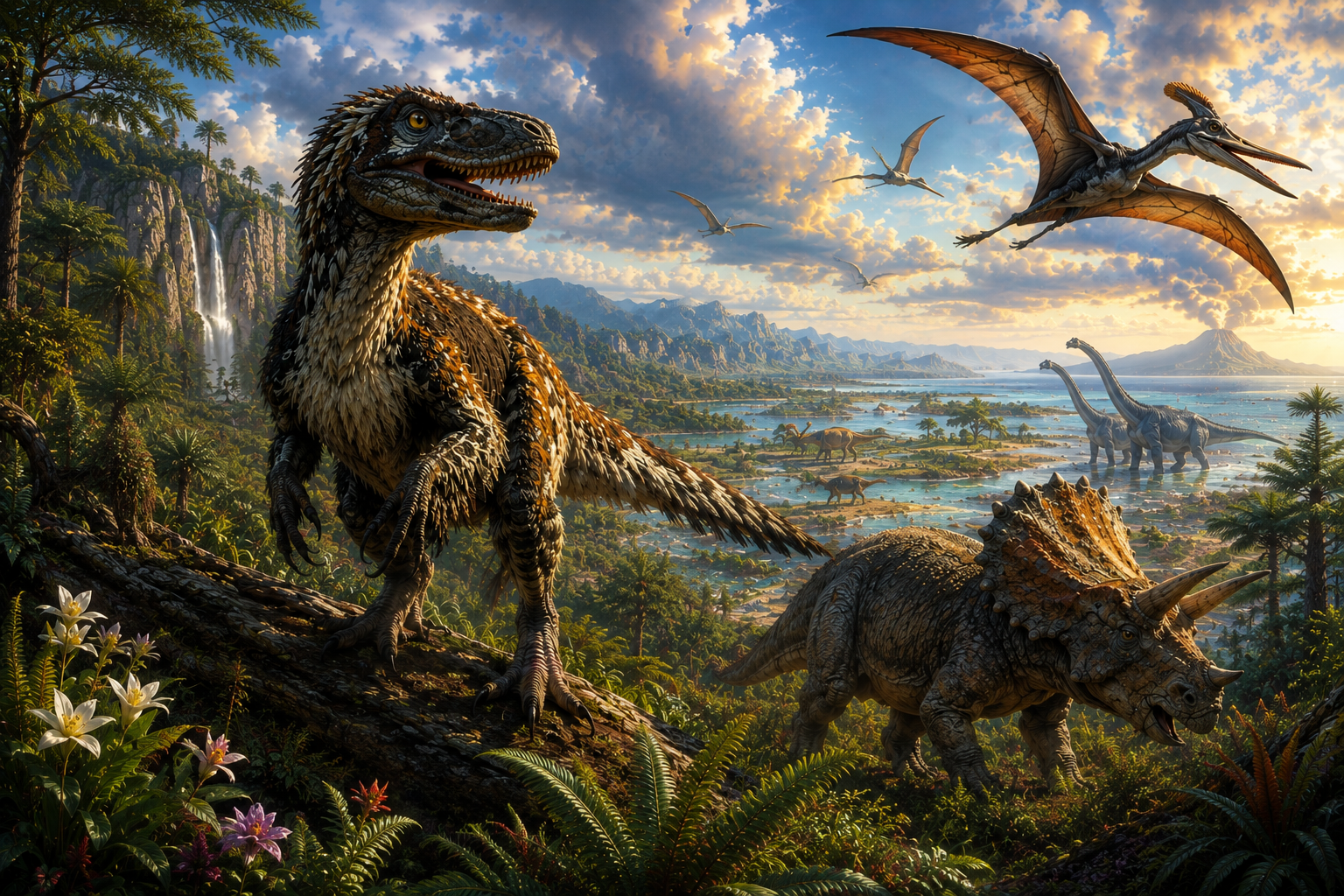
The Cretaceous begins with dinosaurs already ancient. Their ancestors have ruled the land through the whole Jurassic, survived previous extinctions and spread across enormous territories. Nothing now needs to invent the dinosaur world. The Cretaceous takes that inheritance and breaks it into many different monster realms.
As the continents draw farther apart, the beasts of one land become increasingly different from those beyond the sea. Vast herbivores still reshape forests and floodplains simply by feeding and moving through them. Great theropods still follow the herds. Armoured dinosaurs become living fortresses. Horned forms rise. Feathered hunters work the smaller killing grounds.
The forests change beneath them. Flowering plants become increasingly important through the age, not by instantly replacing the older vegetation, but by spreading among conifers, cycads, ferns and other plants inherited from deeper time. New fruits, seeds, insects and feeding opportunities enter an already crowded world.
Sea and sky are no safer. Plesiosaurs still cruise Cretaceous waters. Later, mosasaurs become some of the most formidable marine hunters ever to live. Pterosaurs remain great masters of the air even while birds become more numerous and varied.
Land
Titanosaurs, iguanodontians, hadrosaurs, ceratopsians, ankylosaurs, dromaeosaurs, carcharodontosaurids, tyrannosaurs and countless smaller dinosaurs divide the continents between them.
Sea
Sharks, ammonites, fish and plesiosaurs fill warm waters. Mosasaurs later enter those seas and rise into enormous, fast-moving predators.
Sky
Birds become increasingly varied, but pterosaurs do not simply surrender the air. Some of the greatest flying animals in Earth history appear near the end of the age.
The Hidden World
Elder peoples, ancient subterranean places and Fey wildernesses remain part of the Earth’s deeper history. They inhabit the Cretaceous rather than replacing its natural world.
XXXIVa · c. 143.1–100.5 million years ago
A World Breaking Apart
The first Cretaceous landscapes still carry much of the old Mesozoic character. Conifers rise above fern country. Cycads and other ancient plants remain common. Sauropods still move through many lands, pterosaurs still cross the coasts and great theropods still claim enormous hunting territories.
But the map beneath them is changing.
Oceans widen between lands that were once joined. New coastlines appear. Basins flood. Old migration routes disappear beneath water. Populations separated for millions of years begin following different paths, and each continent gradually develops its own cast of giants.
Baryonyx and related spinosaurids haunt rivers and wetlands in parts of the Early Cretaceous world. Acrocanthosaurus stands among the great predators of North America. Iguanodontians become important heavy herbivores, while ankylosaurs and other armoured dinosaurs turn defence into an increasingly formidable answer to enormous jaws.
Sauropods have not disappeared. Titanosaur lineages spread through much of the world and will eventually produce some of the greatest land animals ever to walk the Earth.
Flowers begin their great Cretaceous expansion within this older vegetation. The change is quiet when measured against a roaring theropod or a moving sauropod herd, but it will ultimately transform the feeding world beneath them.
Birds continue the feathered history begun before the Cretaceous. Mammals remain small beside the great reptiles, yet they are already more varied than the old image of a single frightened, mouse-like survivor suggests. They climb, burrow, hunt and scavenge wherever the giant rulers leave room.
- Baryonyx and other early spinosaurids along rivers and wetlands.
- Acrocanthosaurus and other great theropod hunters.
- Iguanodontians moving through changing plant communities.
- Armoured dinosaurs carrying increasingly formidable defences.
- Titanosaurs spreading the sauropod dynasty across new lands.
- Birds and mammals multiplying beneath the reign of giants.
XXXIVb · c. 100.5–83.6 million years ago
The Flowering Earth and the Monster Seas
The middle Cretaceous is a hot world of high water. Warm seas spread across broad regions and in places push deep into the continents. Shorelines become immense hunting grounds. Islands and separated lands multiply. A creature may travel hundreds of miles through a world shaped as much by water as land.
Flowering plants are now becoming harder to ignore. They spread among older forests and across river margins, disturbed ground and low country. Insects gather around new forms of blossom and seed. Fruits become more important. The ground beneath the dinosaurs is changing even while the largest animals remain unmistakably Mesozoic.
Great predators follow the abundance. Spinosaurus hunts the vast waterways of northern Africa. Titanosaurs continue to grow into extraordinary forms. Herding herbivores spread across broad feeding grounds while heavily defended dinosaurs make themselves increasingly difficult prey.
Above inland seas and coastlines, Pteranodon and other pterosaurs cross enormous distances. Birds share those skies, but the great flying reptiles remain successful and unmistakable.
Beneath the waves lies another monster world.
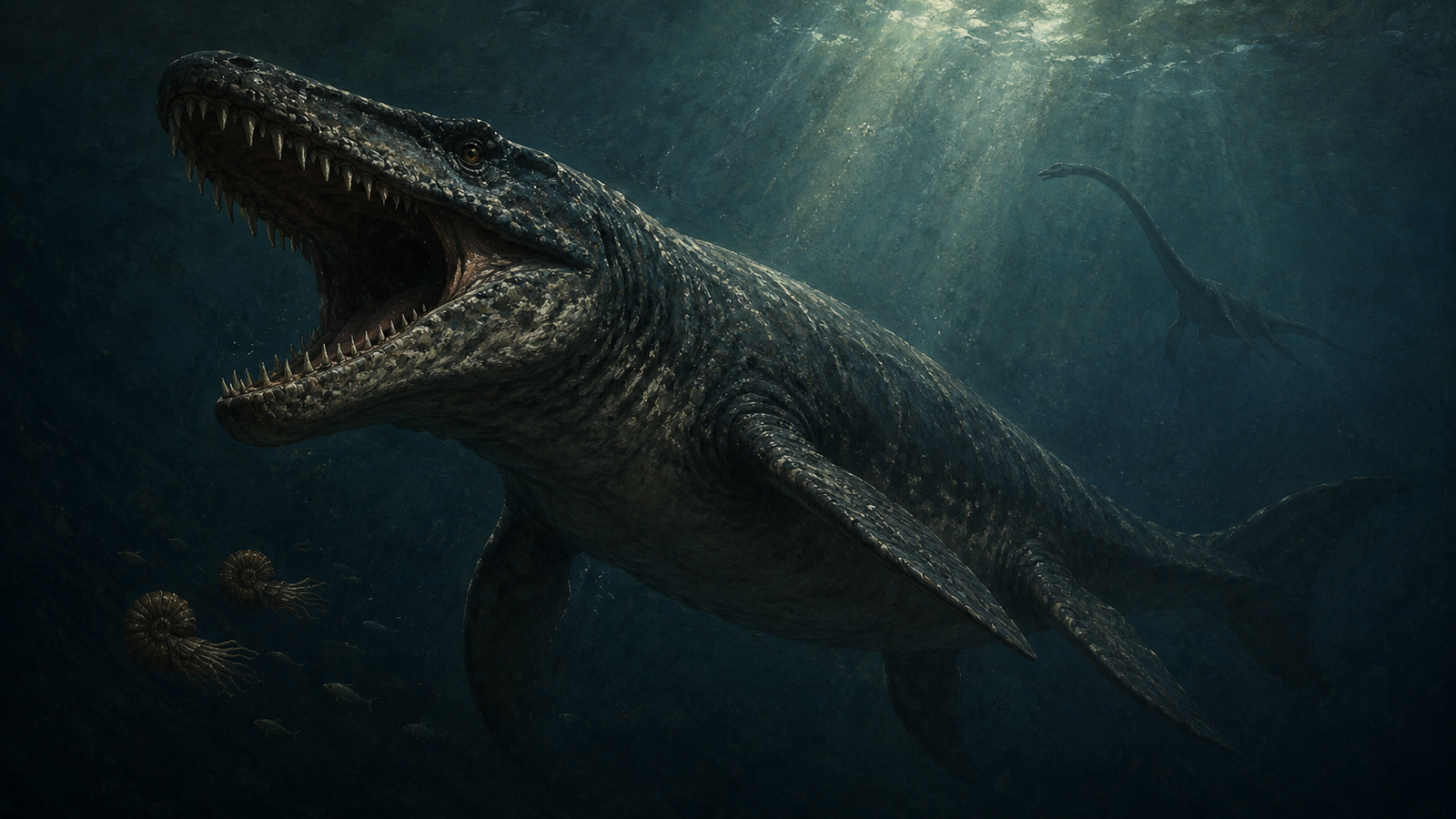
Plesiosaurs continue to hunt through Cretaceous waters. Sharks and large fish fill the open sea. Ammonites remain abundant. Then the mosasaurs rise: powerful marine lizards transformed for life in open water, with paddle limbs, long bodies and tails built to drive enormous predators through the deep.
By the later part of this span, Tylosaurus and related mosasaurs are becoming some of the great monsters of the Cretaceous seas.
Around a hundred million years ago, another history reaches one of its ancient heights.
Elder Thing civilisation stands at one of the last great peaks of its terrestrial power. Their cities and workings do not cover the visible Earth. Most dinosaurs never encounter one.
Their domains belong instead to ocean depths, isolated lands, buried complexes and places ordinary life simply grows around. Their presence is real, ancient and consequential without becoming an explanation for the dinosaurs, the plants or the changing seas.
Fey wildernesses also continue to deepen where forest, spring, wetland and secluded green country provide strong anchors. These are older powers inhabiting an increasingly rich Earth, not a supernatural replacement for the living world itself.
XXXIVc · c. 83.6–66 million years ago
The Last Dinosaur Kingdoms
The closing Cretaceous is not an emptying world. It is a world divided into powerful regional kingdoms of beasts.
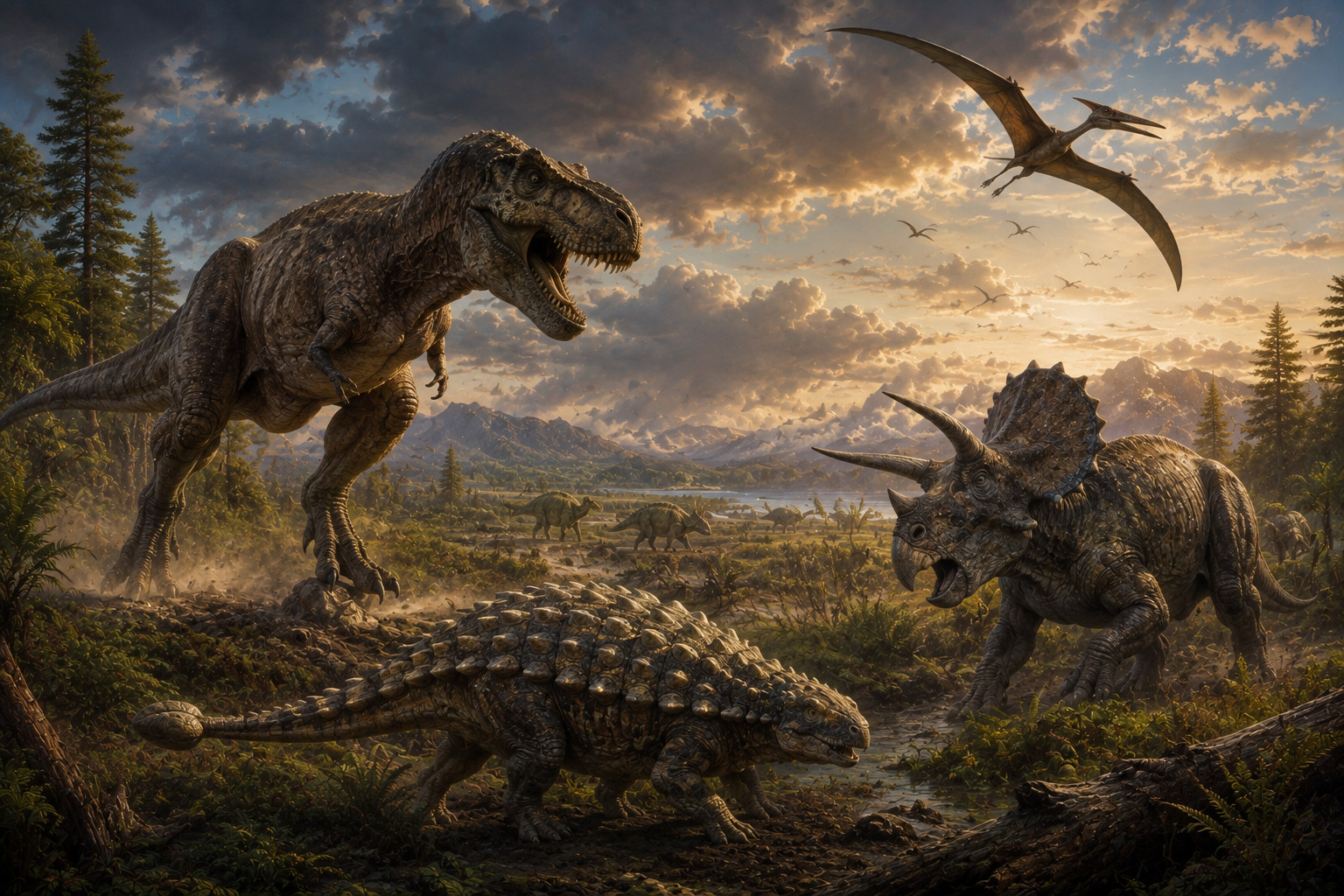
In parts of North America, hadrosaurs move through river plains and woodland in great numbers. Ceratopsians turn skull and horn into formidable weapons. Ankylosaurs answer predators with armour, spikes and crushing tail clubs. Smaller feathered hunters work beneath them.
The tyrannosaur dynasty grows into its final great forms. Daspletosaurus belongs to this long rise. In the last few million years of the age, Tyrannosaurus walks the same broad world as Triceratops and Ankylosaurus.
These famous animals belong near the end of the Cretaceous. They are not mascots for the entire period. Tens of millions of years of other dinosaur worlds had already risen and vanished before Tyrannosaurus ever opened its jaws.
The southern continents possess different rulers. Titanosaurs remain colossal. Abelisaurids and other predators hunt landscapes no Tyrannosaurus ever sees. Isolation has turned the Cretaceous into a patchwork of monster worlds rather than one universal dinosaur kingdom.
Above them, birds continue to diversify—but the pterosaurs still have one final spectacle to offer.
Quetzalcoatlus and other giant azhdarchids possess some of the most extraordinary silhouettes in the history of flight: immense heads and necks, long limbs and wings capable of carrying them across enormous territories. On the ground they can stalk open country like towering predatory birds from another world.
The seas remain equally dangerous. Mosasaurs are now established among the great marine predators. Plesiosaurs persist beside them. Sharks continue their own much older history. Ammonites still fill the water.
Mammals survive everywhere beneath this grandeur. Birds inhabit the same sky as pterosaurs. Snakes move through the undergrowth. Insects crowd the changing forests. The future is already present—but it does not yet rule.
- Tyrannosaurs dominating some of the great northern hunting grounds.
- Ceratopsians carrying horns and massive skulls into the predator world.
- Hadrosaurs forming some of the great herbivore populations of the age.
- Ankylosaurs turning armour into a complete survival strategy.
- Titanosaurs preserving gigantic sauropod life across southern lands.
- Dromaeosaurs and other feathered theropods hunting smaller prey.
- Giant azhdarchid pterosaurs stalking land and crossing immense skies.
- Mosasaurs patrolling seas still filled with plesiosaurs, sharks and ammonites.
XXXIVd · 66 million years ago
The Day the Old World Ended
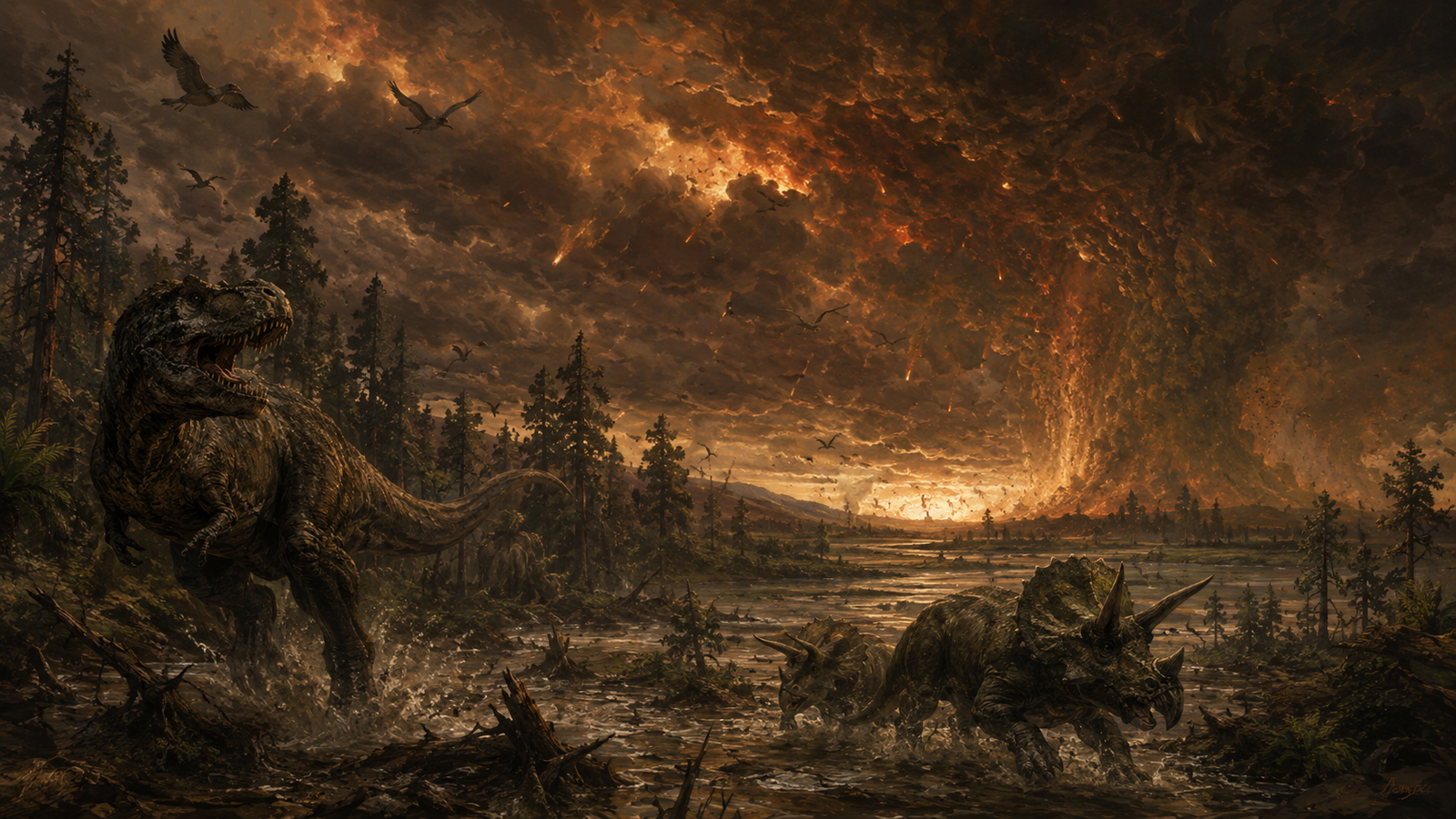
On the final day of the Cretaceous, dinosaurs still walk the land.
Mosasaurs still hunt. Pterosaurs still cross the sky. Ammonites still live in seas whose history reaches back through ages almost beyond comprehension.
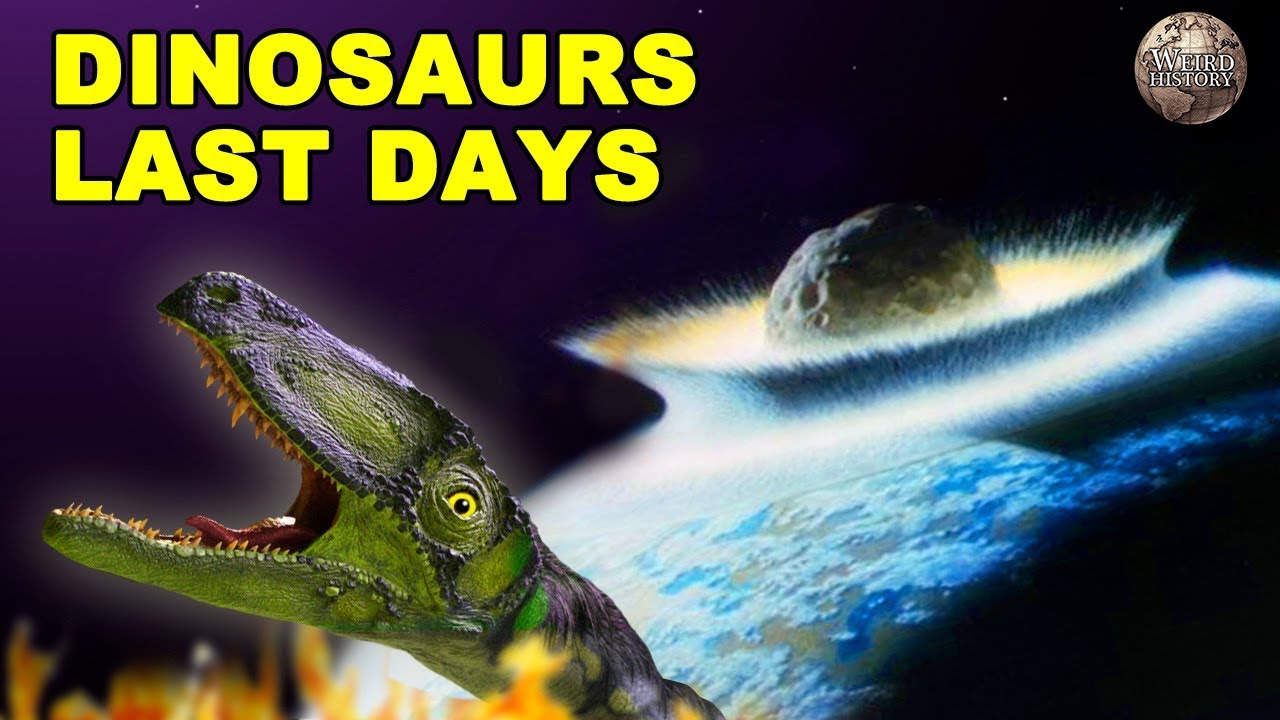
Then a great asteroid strikes what will one day be the Yucatán Peninsula.
Near Chicxulub, the destruction is immediate. Earth and sea are struck with unimaginable violence. Rock is shattered, melted and hurled skyward. Enormous waves race outward. Earthquakes tear through distant lands. Material thrown high above the planet returns through the atmosphere.
Then the longer death begins.
Dust, soot and debris darken the sky. Sunlight weakens. Plants fail. The great feeding chains that support the giants begin to collapse. Size, armour, horn and tooth—advantages that ruled the old world— cannot solve hunger on a planetary scale.
The non-avian dinosaurs vanish. Pterosaurs disappear. Mosasaurs and the remaining plesiosaur lineages are lost. Ammonites, survivors of catastrophes far older than the dinosaurs, finally come to their end.
Whole dynasties are erased.
05 · What crosses the boundary
Life Beneath the Darkness
The impact destroys the old rulers. It does not sterilise the Earth.
Birds survive—and with them one living branch of the dinosaurs. Small mammals endure. Crocodilians, turtles, amphibians, fish, insects and innumerable other creatures cross the boundary. Plants survive through seeds, roots, spores and refuges.
Smallness becomes an advantage. Burrows become fortresses. Fresh water, shelter, broad diets and the ability to endure hunger matter more than the power to dominate an open landscape.
SpiralWorlds’ hidden peoples do not stand outside this catastrophe. Ancient knowledge is not immunity from a broken food chain, burning landscape or poisoned sky. Elder sites are lost. Fey wildernesses burn or wither. Routes close. Settlements disappear.
Some survive because they are already hidden: under stone, beneath deep water, within sealed places or beyond territories struck by the worst immediate destruction.
The distinction matters. The impact does not magically erase every secret history on Earth—but neither does fantasy make planetary catastrophe harmless.
06 · The Cretaceous beneath the campaign world
Using the Flowering World in Play
The Cretaceous is more useful to a fantasy campaign when it remains a real lost age rather than becoming a theme park of famous dinosaurs. Its creatures, ruins and relics should carry the weight of a world separated from human history by tens of millions of years.
Surviving Beasts
A living Cretaceous animal needs no mystical origin. Where an ancient lineage survives into later ages, the creature can simply be what it has always been: a natural monster from an older Earth.
Ruins Below Ruins
Elder Thing structures and other deep-time sites can lie beneath geological layers far older than human settlement. The challenge is not merely entering them, but understanding a place never built for human bodies or human history.
Monster Seas
Ancient marine lineages make excellent threats because ordinary sailors need not understand what they have found. A surviving mosasaur is not a sea dragon. It is something older and just as deadly.
The Extinction Layer
Ash, shocked stone, impact glass and buried remains can mark a genuine dividing line in the world. Anything discovered directly beneath or above it belongs to a very different Earth.
07 · Real deep time beneath the chronicle
Reference Points
The monster chronicle rests on real deep time. These references support the geological boundary, changing Cretaceous continents and seas, the spread of flowering plants, the succession of dinosaur worlds and the catastrophe at 66 million years ago.
Deep-time dates are refined as stratigraphic calibration improves. Older references commonly round the Jurassic–Cretaceous boundary to about 145 million years ago; this page follows the current International Chronostratigraphic Chart and the adjoining SpiralWorlds Jurassic chronology.
08 · The last roar of the old Earth
The World Was Still Full of Giants
The Flowering World matters not because dinosaurs were about to disappear, but because they had not disappeared yet.
For tens of millions of years after the Jurassic, new dinosaur kingdoms continued to rise. Different continents bred different monsters. Horned giants and armoured herbivores filled northern worlds. Titanosaurs carried colossal life across southern lands. Mosasaurs seized the seas. Pterosaurs reached extraordinary size.
Beneath them, flowers spread through ancient vegetation. Insects multiplied around new food. Birds became more varied. Mammals occupied the margins. Elder peoples built, fought, declined and endured in places most animals would never see.
Yet no throne stood empty.
Tyrannosaurus did not walk through a world politely preparing itself for mammals. Triceratops did not graze on the edge of an inevitable human future. The old rulers were still alive, dangerous and magnificently successful on the final day of their age.
Then the sky changed.
The giants were gone.
The Earth remained.
And through the ash came a new dawn.
09 · Continue through deep time