
Eon XXXV – The Ashen Dawn
SpiralWorlds Timeline · Earth and Deep Time
Earth Age 06 · 66–23.03 million years ago
The dinosaurs are gone. The world is not empty.
The Ashen Dawn begins beneath smoke, cold and hunger. The impact that ends the Cretaceous destroys the old surface order, but it does not erase life, magic or the older peoples already hidden within the Earth. Birds survive. Small mammals survive. Crocodilians, turtles, amphibians, fish, insects and countless smaller lineages cross the boundary. Elder civilisations endure in refuges beneath ocean, ice, stone and warded wilderness.
What follows is not a supernatural replacement for the Paleogene. This Paleogene Earth timeline follows a magical Earth in which forests return, mammals diversify, whales enter the sea, climates swing from extraordinary warmth toward lasting Antarctic ice, and open country begins to widen. At the same time, an ancient war between the Great Race and the Flying Polyps convulses hidden Earth, Elder Thing cities fall, and the Lemurians raise Shamballah.
← Previous · The Flowering World · Master Timeline · Next · The Age of Open Lands →
01 · The world after fire
Ash, survivors and vacant kingdoms
The first years of the age belong to the survivors of the Cretaceous catastrophe. The great non-avian dinosaur dynasties are gone. Pterosaurs, ammonites, mosasaurs and many other ancient lineages have vanished with them. The catastrophe opens ecological space on a scale the surviving world has not known for tens of millions of years.
The creatures that inherit that space are not newly created. They are survivors. Birds carry the dinosaur line forward. Mammals emerge from burrows, forests, margins and night-worlds into landscapes suddenly stripped of their former giants. Reptiles, amphibians, fishes and invertebrates rebuild around them. Recovery is uneven: some regions remain devastated while others become refuges from which life spreads again.
The hidden world follows the same rule. No ancient people is declared extinct merely because the surface has changed. Elder Things, Shoggoths, Mi-Go outposts, fey domains, Yithian enclaves and other older powers survive where their own refuges, technologies or territories allow them to do so. Their political reach may contract. Their species do not simply cease to exist.
02 · World at a Glance
| Time frame | 66–23.03 million years ago |
|---|---|
| Geological period | Paleogene |
| Natural arc | Post-impact recovery → warm forest world → long cooling → Antarctic glaciation → increasingly open habitats |
| Visible rulers | Birds and rapidly diversifying mammals |
| Hidden powers | Elder Things, Shoggoths, Great Race of Yith, Flying Polyps, Mi-Go enclaves, Lemurians, fey domains and underworld peoples |
| Major mythic crisis | c. 50 Ma · Flying Polyps escape, devastate Yithian terrestrial power and trigger a wider elder-world catastrophe |
| Permanent consequence | The visible world becomes recognisably mammalian while elder civilisations retreat, rebuild or conceal themselves rather than vanish |
Chronology rule: geological dates and natural history follow Earth history. Dates assigned to elder civilisations, hidden wars and supernatural events are SpiralWorlds campaign chronology.
03 · Paleogene Earth timeline
66–56 million years ago · The Paleocene recovery
- 66 Ma: The Paleogene begins after the end-Cretaceous catastrophe. Impact darkness, fire, cold and food-chain collapse destroy the old surface dominion.
- Early Paleocene: Forests recover unevenly. Birds, mammals, reptiles, amphibians, fishes and insects spread into abandoned ecological space.
- Paleocene: Mammalian lineages diversify rapidly. Early members of elephant-kind and many hoofed or hoof-like forms appear within this changing world.
- Paleocene: Fey powers re-root themselves in recovering forests, rivers, wetlands and secluded green country. They inhabit the renewed world; they do not cause its natural recovery.
- Throughout the recovery: Elder civilisations preserve scattered strongholds beneath seas, polar regions, caverns and remote lands.
56–33.9 million years ago · The Eocene world
- c. 56 Ma: A great natural warming event drives temperatures sharply upward. Forest belts extend far poleward and warm-climate life reaches regions that will later be ice-bound.
- Early Eocene: True primates become clearly established. Early horses and many other mammalian lines spread through warm forests and woodland.
- Eocene: Some mammals return to the water. The long transformation of early whales begins along coasts and shallow seas before fully marine forms emerge.
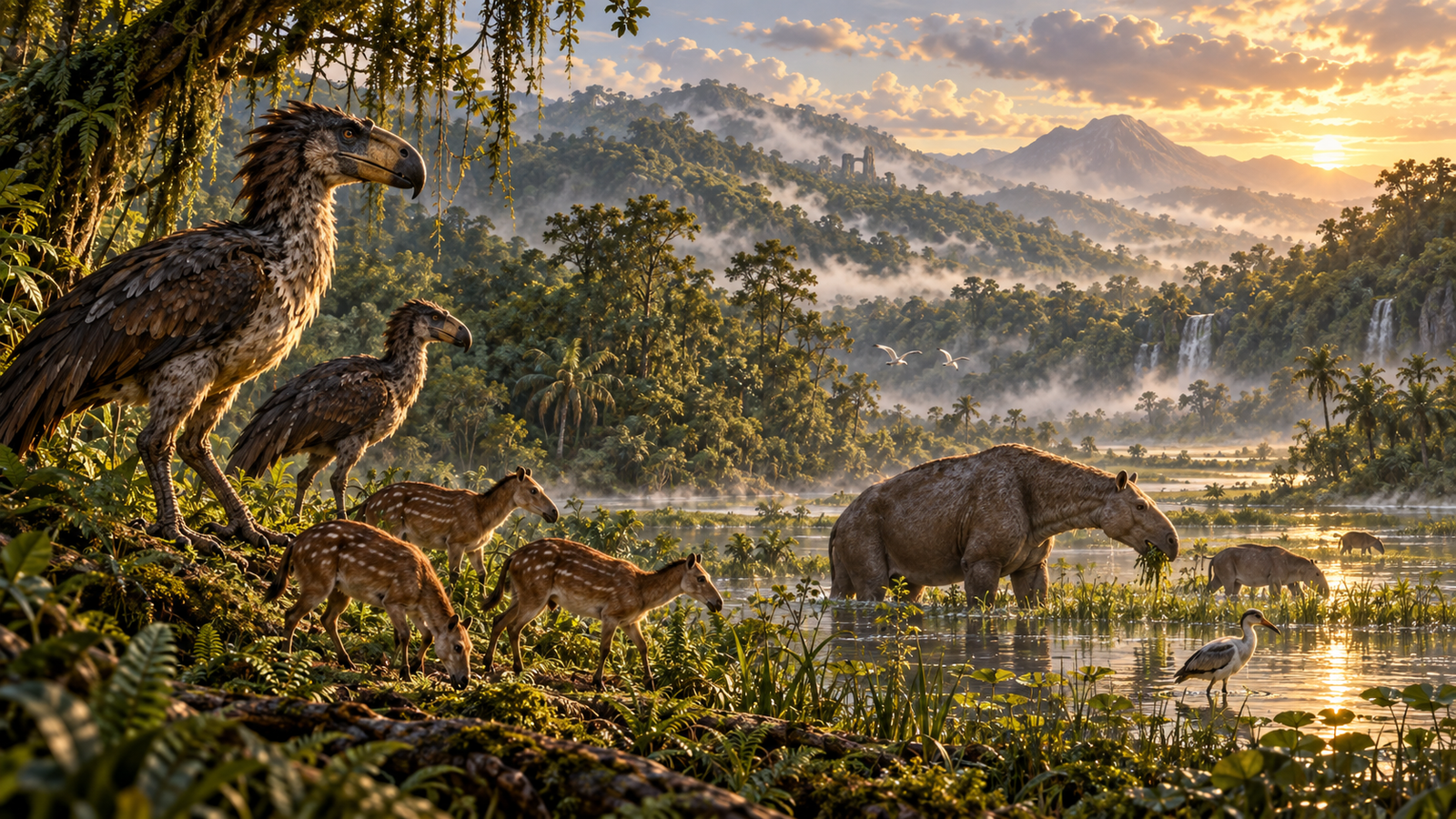
- Eocene: Large flightless birds occupy powerful roles in several regions. Mammals meanwhile continue expanding into forms and niches once occupied by the old reptilian world.
- c. 50 Ma: The Flying Polyps break free from ancient prisons and renew their war against the Great Race of Yith.
- c. 50 Ma: The Great Race loses its principal terrestrial centres. Its greatest minds abandon threatened bodies and centres of occupation, but the Great Race itself is neither created nor extinguished by this event.
- c. 50 Ma: The wider catastrophe destroys numerous Elder Thing cities, including their original Antarctic settlement. Surviving Elder Things later establish a new Antarctic city while retaining marine and subterranean refuges.
- c. 50 Ma: The ancient Lemurians build Shamballah in the Great Eastern Desert. This marks a civilisation threshold in their known Earth history, not the origin of the Lemurian people.
33.9–23.03 million years ago · The Oligocene turning
- c. 34 Ma: Long-term cooling culminates in the great Eocene–Oligocene transition. Large permanent Antarctic ice sheets form and sea level falls.
- Oligocene: Forests remain extensive, but drier and more seasonal regions increase. Woodland, scrub and open habitats become more important across many continents.
- Oligocene: Immense mammals such as Paraceratherium appear in Eurasia. Entelodonts and amphicyonids occupy powerful predatory and scavenging roles.
- Late Oligocene: Early true cats appear, adding a predatory line that will become increasingly important in later ages.
- 23.03 Ma: The Paleogene closes. Mammals and birds dominate the visible land world, while the hidden Earth remains divided among powers far older than either.
04 · c. 50 Ma — The war beneath the recovering world
The Great Race loses Earth without ceasing to exist
The greatest hidden crisis of the Ashen Dawn is not an origin story. The Great Race of Yith is already ancient, and the Flying Polyps were imprisoned long before the Paleogene. Around fifty million years ago, those prisons fail or are broken, and the old enemies meet again.
The Polyps do not merely raid Yithian cities. They hunt the minds that rule them. Their winds, invisibility and movement through solid ground make conventional defence almost meaningless. Yithian terrestrial centres collapse. Archives are abandoned, sealed or displaced. The greatest surviving minds escape by the same temporal and bodily exchanges through which the Great Race has crossed ages before.
This is the end of a major Earth occupation, not the extinction of the Great Race. Yithian minds continue to cross time, space and species. Later exchanges, archives and observers remain possible because the civilisation survives beyond the particular bodies and cities lost here.
The Flying Polyps are released, not born
The Polyps likewise do not originate in the Ashen Dawn. Their escape is an event in Earth history, not a species beginning. Some are later trapped again beneath the Earth; others retreat into sealed regions where unnatural winds, dead cities and ancient barriers mark their presence. Their hatred of the Great Race survives into the Age of Open Lands and beyond.
The catastrophe reaches the Elder Things
The war does not remain confined to Yithian ground. Shock, broken wards, unleashed weapons and collapsing subterranean systems spread destruction through older territories. Numerous Elder Thing cities are lost, including the original Antarctic settlement.
This does not end Elder Thing civilisation. Survivors retain deep-ocean, subterranean and polar refuges. In Antarctica they establish a new city, built for a colder future than the world in which their first settlement stood. That distinction matters: the Paleogene is another severe defeat in a long history of contraction, not the final extinction of the Elder Things.
05 · Shamballah rises in the Great Eastern Desert
A civilisation gate, not a species origin
In the same broad period, the ancient Lemurians build Shamballah. SpiralWorlds does not use this event to declare when the Lemurian people first evolved or appeared. Their deeper origin remains unresolved. What is fixed here is political and architectural: by about fifty million years ago they possess the organisation, knowledge and power required to establish a hidden city able to endure through immense changes in climate and geography.
Shamballah becomes a storehouse of memory in an age when elder cities are falling elsewhere. Its concealed roads, mountain sanctuaries, desert approaches and wards allow it to survive without ruling the visible world. Later Lemurian communities preserve outlying observatories and dependencies, but the heart of their continuity is concealment rather than conquest.
By the next age, Shamballah is not a new city. It is already ancient.
06 · The visible Earth becomes mammalian
The Paleocene — survival before splendour
The first phase of the Ashen Dawn is defined by recovery. The great surface animals of the preceding age are absent, but the world does not instantly fill with modern creatures. Small survivors multiply, diverge and occupy abandoned roles. Many forms are temporary experiments. Some become ancestors of later lineages; others prosper for millions of years and disappear without descendants.
The important change is opportunity. Forest floor, canopy, riverbank, coast and open ground all contain spaces once dominated by creatures now gone. Mammals and birds enter those spaces repeatedly, producing a world that grows stranger before it grows familiar.
The Eocene — a world of warmth
The early Eocene becomes one of the warmest intervals of the Cenozoic. Forests reach high latitudes. Crocodilian relatives and warmth-loving plants live far closer to the poles than they can in 1454. The distinction between tropical, temperate and polar worlds is unlike anything later humanity knows.
Among the mammals, early horses remain small forest animals. Primates become established in warm woodland. Bats take to the air. Whales begin as shore-going and amphibious hunters before fully marine forms enter open seas. Elephant-kind, carnivorous mammals and many other lines continue their long experimentation.
This abundance does not mean stability. The Eocene contains repeated climate shifts, changing seas and moving continents. The living world expands through change, not because the planet has reached a permanent balance.
The Oligocene — the long cooling becomes undeniable
By the end of the Eocene the old greenhouse world is breaking. Around thirty-four million years ago, permanent ice expands across Antarctica on a continental scale. Sea levels fall. Seasons sharpen. Forests retreat from some interiors while persisting strongly in wetter regions.
Open country is becoming increasingly important, but the great grassland worlds of the later Neogene do not yet cover the globe. The Oligocene is the threshold: more woodland breaks apart, scrub and open habitats widen, and animals increasingly adapt to longer movement between food, water and cover.
In Eurasia, Paraceratherium becomes one of the largest land mammals ever to walk the Earth. Entelodonts and amphicyonids occupy their own formidable niches. Early cats appear before the period ends. The next age will take these trends and open the land far more dramatically.
07 · Hidden powers of the Ashen Dawn
Elder Things and Shoggoths
The Elder Things enter the Paleogene already diminished from their earlier terrestrial height. Their defeat by the Mi-Go in the Jurassic forced them southward and into marine refuges; later disasters further narrowed their visible reach. The c. 50 Ma catastrophe destroys more cities, but surviving colonies remain technologically formidable.
Shoggoths remain both servants and threats. Some labour inside surviving Elder Thing colonies. Others occupy abandoned cities and deep caverns beyond effective control. The memory of the ancient Shoggoth rebellion shapes every Elder Thing decision about expansion, security and biological engineering.
Mi-Go enclaves
The Mi-Go do not need to rule the surface to remain on Earth. Their ancient war with the Elder Things left them northern possessions, extraction routes and hidden installations. Through the Paleogene, surviving enclaves continue mining, research and observation in remote mountains, polar regions and places where surface life offers little interference.
Fey domains
The Fey World remains bound to terrestrial wilderness without replacing natural ecology. As forests recover, fey courts and spirits return to rivers, wetlands, groves and secluded country. When climates later cool and forests shift, those domains must shift with them, retreat behind old crossings or contest the changing land.
These are ancient fey powers. They should not be mistaken for later terrestrial elven kingdoms, which belong to younger parts of the chronology.
Underworld peoples
The Paleogene surface is only half the world. Beneath it lie old roads, sealed laboratories, Polyp prisons, Shoggoth territories, Serpent People remnants and other communities whose histories do not depend upon the rise of mammals above them. Earth can change rulers on the surface while remaining densely occupied below.
08 · Canon boundaries
What the Ashen Dawn does — and does not — establish
- Natural history remains natural. The impact, recovery, warming, continental movement, cooling and Antarctic glaciation are not caused by gods, Elder Things or hidden wars.
- The Great Race does not become extinct c. 50 Ma. Its major terrestrial occupation collapses; Yithian minds, archives and later exchanges survive.
- The Flying Polyps do not originate c. 50 Ma. Their imprisonment, escape and revenge are stages in a much older history.
- The Elder Things do not vanish. Many cities are destroyed, but Antarctic, marine and subterranean populations endure.
- Shamballah does not mark the origin of the Lemurians. It is the first fixed Paleogene civilisation gate in their current chronology.
- No younger people is backdated merely to fill the age. Dwarves, orcs, hobgoblin imperial societies and later terrestrial elven kingdoms are not projected into the Paleogene without an established origin.
- Ancient survival is not the same as uninterrupted empire. A people can survive after its cities, colonies or political system have fallen.
09 · What the age leaves behind
- Antarctic Elder Thing ruins: the destroyed original settlement and the later replacement city become separate archaeological layers with different construction histories.
- Yithian archive vaults: abandoned repositories contain records written by minds that fled the c. 50 Ma collapse.
- Polyp prisons: sealed caverns and impossible shafts preserve barriers raised after the great escape.
- Shamballah: the Lemurian city endures behind concealed routes and wards, carrying Paleogene knowledge into younger ages.
- Independent Shoggoth territories: abandoned Elder Thing works become habitats, fortresses and hunting grounds for former servants.
- Mi-Go extraction sites: mines and research stations remain hidden in remote country long after surrounding ecosystems change.
- Fey boundaries: forgotten groves, river claims and crossings preserve treaties made when climate and coastlines were radically different.
- Fossil worlds: Paleocene, Eocene and Oligocene deposits preserve creatures whose bones can be mistaken for monsters, altered by magic or exposed beneath later settlements.
10 · Why the Ashen Dawn still matters in 1454
The age is tens of millions of years distant, but its consequences remain playable. A tunnel beneath an Alpine mine can intersect a Yithian vault. Antarctic ruins can contain two Elder Thing architectural layers separated by the c. 50 Ma catastrophe. A desert map copied by a medieval scholar may record one of the concealed roads to Shamballah. An apparently natural cavern can be a failed Polyp prison.
The point is not to make every ruin Paleogene. It is to make deep history consequential when it surfaces. The age supplies ancient claims, sealed threats, impossible records and rival interpretations of the Earth long before humanity existed.
11 · Handover to the Age of Open Lands
By 23.03 million years ago the Ashen Dawn has done its work. The world is no longer recovering from the Cretaceous impact. Mammals and birds have become the dominant visible land animals. Antarctica carries permanent ice. Open habitats are widening. Elder powers have survived, but many now operate through refuges, hidden roads, sealed cities and diminished territorial systems rather than broad surface dominion.
The next age does not begin with a clean slate. It inherits a new Antarctic Elder Thing city, surviving Shoggoths, Mi-Go enclaves, Yithian observers, Polyp prisons, Shamballah, fey domains and underworld peoples.
Then the land opens further.
Continue: Eon XXXVI – The Age of Open Lands.
12 · Watch the Paleogene
Both legacy videos remain available and serve different purposes, so both are retained: the PBS Eons film focuses on the extraordinary Eocene warming, while Lindsay Nikole’s longer survey follows the Paleogene as a whole.
13 · Scientific & mythic references
Natural chronology: The Paleogene begins after the end-Cretaceous extinction at about 66 Ma and ends at 23.03 Ma. The page follows established evidence for post-impact recovery, Eocene warming, the evolution of early whales and other mammal groups, and the major Eocene–Oligocene cooling and Antarctic glaciation around 34 Ma.
Scientific reading: Natural History Museum material on the Cretaceous–Paleogene extinction and vertebrate recovery; Pearson, Foster & Wade, Atmospheric carbon dioxide through the Eocene–Oligocene climate transition, Nature 461 (2009), on Antarctic ice-sheet formation at c. 33.5–34 Ma.
Mythic chronology: The Great Race, Flying Polyps and related elder-history material are adapted into the SpiralWorlds chronology. Their campaign dates describe events on Earth, not universal species origins or extinctions.
Publication & licensing note: This timeline page reproduces no tabletop rules text. Scientific references are cited to their original publishers; the two videos remain embedded from their original YouTube channels; the Ashen Dawn hero is original SpiralWorlds AI-assisted artwork.
Earlier continuity: The Dawn of Earth · The Age of Awakening · Bugs, Amphibians and the Rise of Giants · The Jurassic Age of Giants · The Flowering World.
Timeline Navigation
← Previous Age · Eon XXXIV – The Flowering World
Master Chronology · SpiralWorlds Timeline
Next Age · Eon XXXVI – The Age of Open Lands →
Keep this reference growing
If this page helped with your reading or game, you can support its upkeep or explore the curated books.
Explore the Bookshop — epics, classics and stories behind imagined worlds.